
Last updated on June 24, 2026
The AI-103 Microsoft Certified Azure AI App and Agent Developer Associate certification exam is designed for candidates who build, manage, and deploy AI applications and agents by using Microsoft Foundry. Candidates should have experience developing apps with Python and working with Azure services, generative AI, agentic AI, and general AI capabilities.
Candidates should be familiar with planning and managing Azure AI solutions, implementing generative AI and agentic workflows, building multimodal and computer vision solutions, applying text and speech capabilities, and extracting information from documents and other content. The exam also covers responsible AI practices, monitoring, security, retrieval, grounding, and tool integration for production-ready AI applications.
For more information about the AI-103 exam, you can check out this exam skills outline. This study guide will provide comprehensive review materials to help you pass the exam successfully.
AI-103 Exam Domains
Below are the exam domains, or “Skills Measured,” for the AI-103 Microsoft Certified: Azure AI App and Agent Developer Associate certification exam. These domains represent the Azure AI engineering skills that candidates are expected to demonstrate when building, managing, securing, and deploying AI applications and agents by using Microsoft Foundry.
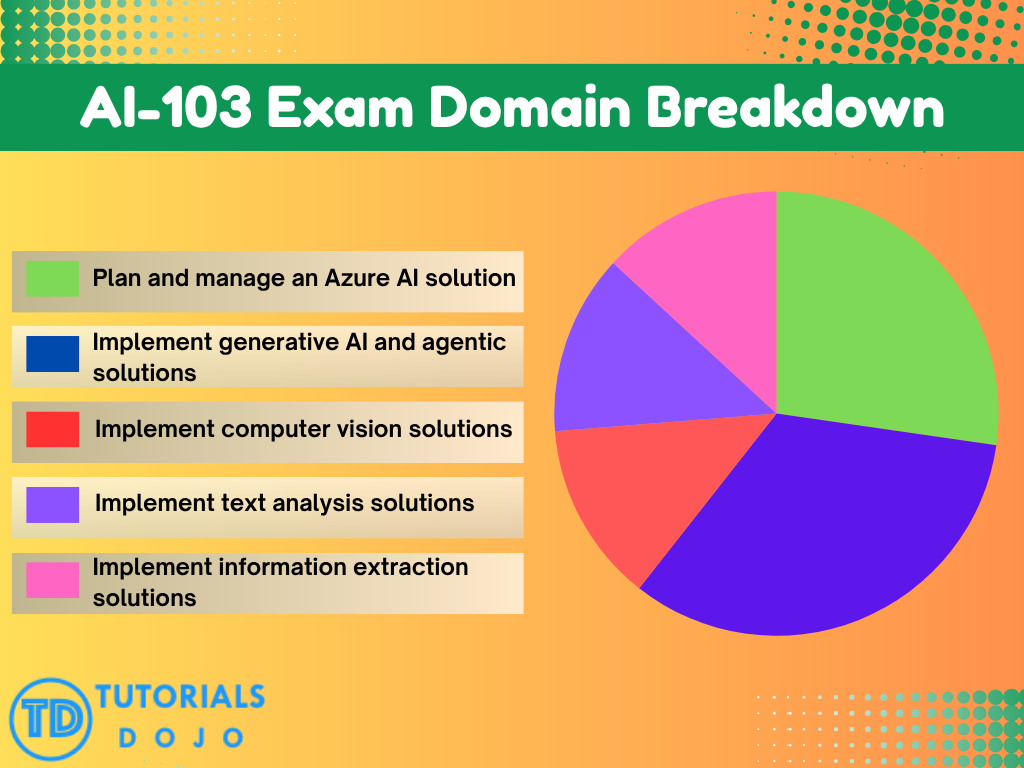
- Plan and manage an Azure AI solution (25–30%)
- Implement generative AI and agentic solutions (30–35%)
- Implement computer vision solutions (10–15%)
- Implement text analysis solutions (10–15%)
- Implement information extraction solutions (10–15%)
AI-103 Study Materials
Before attempting the AI-103 Microsoft Certified Azure AI App and Agent Developer Associate exam, it is highly recommended to review the following study materials. These resources are designed to help candidates understand the key concepts, tools, and services that are commonly evaluated in the certification. By studying these materials in advance, candidates can strengthen their knowledge of machine learning operations, automation, and deployment practices within the Microsoft ecosystem.
- Tutorials Dojo’s Azure Cheat Sheets — Quick reference guides that summarize key Azure services and concepts commonly covered in certification exams.
- Azure PlayCloud Hands-On Labs — Guided labs that allow you to practice deploying and managing Azure resources in a real environment.
- Azure Practice Exams — Our very own set of practice exams designed to help evaluate your readiness for the certification and identify topics that require further study.
- Microsoft Official Documentation and Learning Resources:
- Azure AI services
- Azure AI Vision
- Azure AI Video Indexer
- Azure AI Language
- Azure AI Speech
- Azure AI Search
- Azure OpenAI
- Azure AI Document Intelligence
- AI – Machine Learning – Microsoft Tech Community
- AI – Machine Learning Blog – Microsoft Tech Community
- Microsoft Learn – Microsoft Tech Community
- The AI Show
- Azure Blog
- Azure Free Account — Enables you to explore Azure services and gain hands-on experience while preparing for the exam.
Azure Services to Focus on for the AI-103 Exam
Here is the list of Azure services and platforms to focus on for the AI-103 Microsoft Certified: Azure AI App and Agent Developer Associate exam:
Microsoft Foundry
- Microsoft Foundry — build, deploy, evaluate, and manage AI applications and agents.
- Foundry Projects — organize AI applications, model deployments, agent configurations, tools, evaluations, and connected resources.
- Foundry Tools — connect agents and applications to retrieval, file search, code execution, content understanding, translation, speech, and custom functions.

Azure AI and Generative AI Services
- Azure OpenAI in Foundry Models — deploy and consume generative AI models for chat, reasoning, multimodal, and agentic workloads.
- Azure Language in Foundry Tools — implement natural language processing capabilities such as entity extraction, sentiment analysis, summarization, question answering, and intent routing.
- Azure Speech in Foundry Tools — implement speech-to-text, text-to-speech, speech translation, custom speech models, and voice-enabled agent interactions.
- Azure Translator in Foundry Tools — build multilingual text and speech translation workflows for applications and agents.
- Azure Vision in Foundry Tools — analyze images and videos, generate captions, detect objects, and support OCR and visual understanding workflows.
- Azure Content Understanding in Foundry Tools — extract structured information from documents, images, audio, and video for RAG, agents, and downstream reasoning.
- Azure Document Intelligence in Foundry Tools — extract text, layout, tables, and fields from forms and documents.
- Azure AI Search — implement indexing, semantic search, hybrid search, and vector search for retrieval-augmented generation and grounding.
- Azure AI Content Safety — detect harmful content, configure moderation, apply Prompt Shields, and support responsible AI guardrails.
AI-103 Key Exam Topics by Domain
Plan and manage an Azure AI solution
- Foundry service selection: Learn how to choose the right Microsoft Foundry services, models, tools, and retrieval options for generative AI apps, agents, multimodal processing, grounding, and knowledge integration.
- AI solution setup: Understand how to configure Foundry projects, deploy models and agents, select deployment options, and connect AI solutions to CI/CD workflows.
- Monitoring and security: Know how to manage quotas, scaling, costs, rate limits, model performance, grounding quality, search health, managed identities, private networking, and role-based access.
- Responsible AI implementation: Apply safety filters, guardrails, evaluators, trace logging, approval workflows, provenance tracking, and tool-access controls to manage risk in AI applications and agents.
Implement generative AI and agentic solutions
- Generative AI application development: Build applications that use deployed models, prompt engineering, retrieval-augmented generation, grounding, Foundry SDKs, and connected data sources.
- Agent design and development: Create agents with defined roles, goals, tools, memory, retrieval, function calling, custom APIs, knowledge stores, and conversation-tracking logic.
- Agent workflow orchestration: Implement single-agent and multi-agent workflows that support multistep reasoning, tool use, safeguards, approval flows, and semiautonomous operations.
- Generative AI optimization: Improve model and agent behavior by tuning prompts, adjusting model parameters, evaluating outputs, analyzing errors, and monitoring traces, latency, token usage, and safety signals.
Implement computer vision solutions
- Image and video generation: Build solutions that generate images or videos from text prompts and reference media, including editing workflows such as inpainting and prompt-based modifications.
- Multimodal understanding: Use multimodal models to analyze images, videos, and visual context, generate captions, answer questions based on visual evidence, and create accessibility-focused descriptions.
- Visual extraction with Content Understanding: Apply Azure Content Understanding in Foundry Tools to identify visual characteristics, objects, regions, components, and video segments.
- Responsible multimodal AI: Detect unsafe visual content, reduce risks from embedded text in images, enforce visual policies, apply watermarks, and flag inappropriate or prohibited content.
Implement text analysis solutions
- Language model text analysis: Build solutions that extract entities, topics, summaries, sentiment, tone, safety signals, and structured outputs by using generative prompting and Foundry Tools.
- Domain-specific text processing: Customize model outputs for specialized tasks such as compliance summaries, domain extraction, classification, translation, and structured JSON generation.
- Speech-enabled AI workflows: Implement speech-to-text, text-to-speech, speech translation, custom speech models, and voice-based agent interactions.
- Audio and multimodal reasoning: Enable AI applications and agents to process spoken input, reason over audio content, and translate speech by using language models and Foundry Tools.
Implement information extraction solutions
- Retrieval and grounding pipelines: Ingest, enrich, and index content from documents, images, audio, and video to support search, grounding, RAG workflows, and agent tools.
- Search and indexing: Configure semantic search, hybrid search, vector search, OCR, enrichment skills, layout processing, and relevance improvements for grounded AI responses.
- Document extraction: Extract text, tables, fields, layout details, and structured information from forms, documents, scanned files, and multimodal content.
- Content Understanding outputs: Use Azure Content Understanding in Foundry Tools to produce structured or markdown outputs that can support downstream reasoning, RAG, and agent workflows.
AI-103 Important Skills to Focus on
- Microsoft Foundry Solution Planning — choose appropriate Foundry services, models, tools, deployment options, retrieval methods, memory services, and knowledge integrations for AI applications and agents.
- Generative AI and RAG Development — build applications that use deployed models, prompt engineering, grounding, retrieval-augmented generation, Foundry SDKs, connectors, and evaluation workflows.
- Agent Development and Orchestration — design agents with defined roles, goals, conversation memory, tool schemas, function calling, retrieval, custom tools, safeguards, approval flows, and monitoring.
- Multimodal, Text, Speech, and Vision Solutions — implement AI solutions that analyze text, process speech, understand images and videos, generate visual content, and support multimodal reasoning.
- Information Extraction and Content Understanding — ingest, index, enrich, and extract structured information from documents, images, audio, and video using OCR, layout analysis, search, and Azure Content Understanding in Foundry Tools.
- Security, Monitoring, and Responsible AI — configure managed identity, private networking, role policies, safety filters, guardrails, evaluators, trace logging, provenance metadata, and observability for production AI systems.
Validate Your AI-103 Exam Readiness
If you feel confident after going through the suggested materials above, it’s time to put your knowledge of different Azure concepts and services to the test. For top-notch practice exams, consider using the Tutorials Dojo’s AI-103 Microsoft Certified Azure AI App and Agent Developer Associate Practice Exams.
These practice tests cover the relevant topics that you can expect from the real exam. It also contains different types of questions, such as single-choice, multiple-response, hotspot, yes/no, and drag-and-drop. Every question on these practice exams has a detailed explanation and adequate reference links that help you understand why the correct answer is the most suitable solution. After you’ve taken the exams, it will highlight the areas you need to improve. Together with our cheat sheets, we’re confident that you’ll be able to pass the exam and have a deeper understanding of how Azure works.
AI-103 Sample Practice Test Questions:
Question 1
You are developing a Microsoft Foundry project that includes an agent connected to an image generation model deployment.
Your agent accepts product photos from users and creates new marketing-style images based on the uploaded content.
You need the generated output to remain visually consistent with the source product, including its recognizable design details and appearance.
What should you configure?
- Provide a more detailed product description in the prompt.
- Use high input fidelity for the image request.
- Enable Azure AI Content Safety for image moderation.
- Lower the temperature setting for the request.
Correct Answer: 2
Azure image editing workflows in Microsoft Foundry can use input_fidelity to control how closely an image generation model follows the visual characteristics of a provided input image. This setting determines how much effort the model applies to matching the style and features of the input image. For supported image models, input_fidelity can be set to high or low, and high provides stronger preservation of the source image’s visual details.

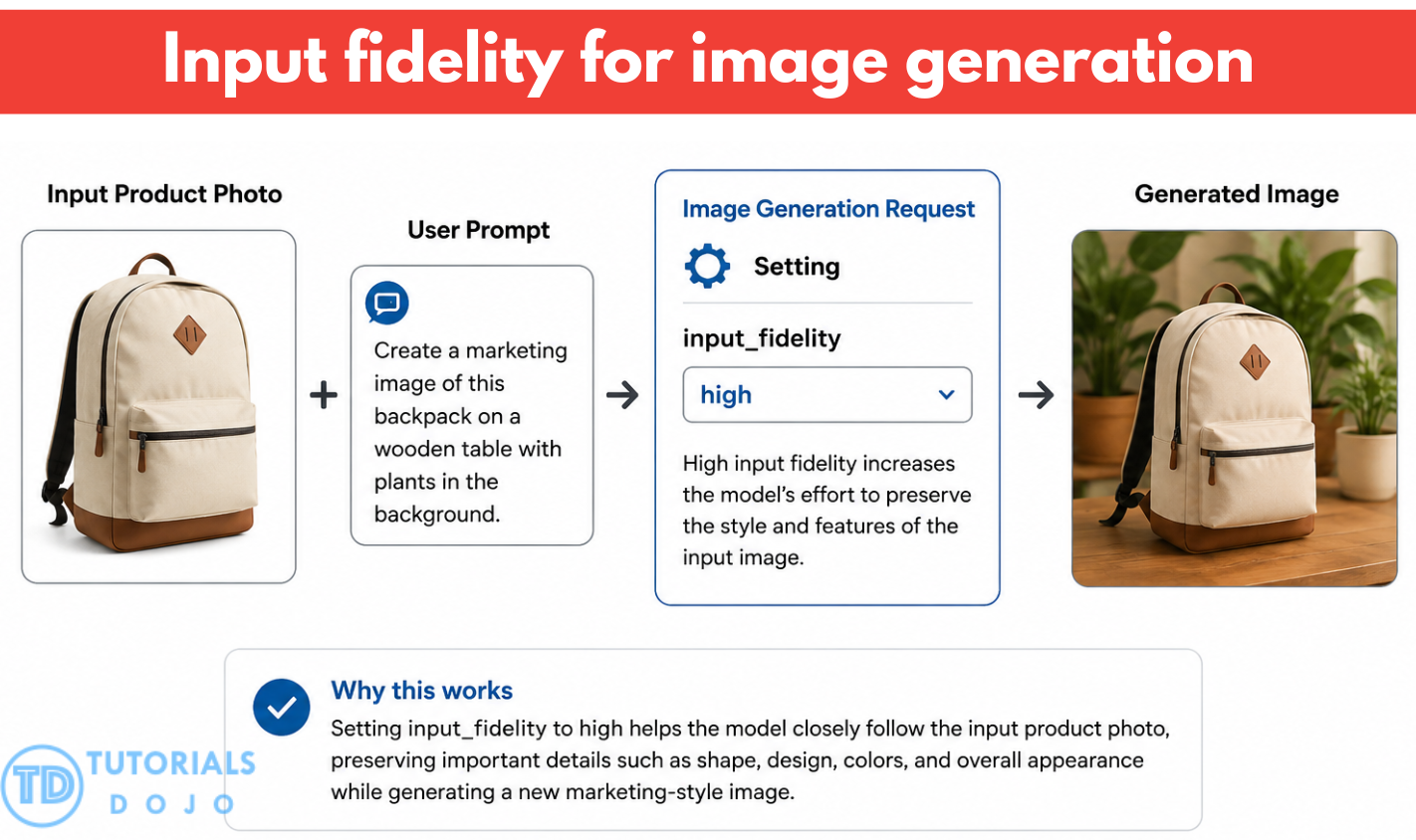
This resolves the requirement because a higher input fidelity setting helps the generated image stay more consistent with the original product photo. When an application must preserve recognizable product traits such as shape, design details, and overall appearance, using high input fidelity provides stronger adherence to the reference image while still allowing the model to generate a new image.
Hence, the correct answer is: Use high input fidelity for the image request.
The option that says: Provide a more detailed product description in the prompt is incorrect because prompts typically describe the content and visual style that the image generation model should produce. A detailed prompt can guide the requested scene or appearance, but it does not directly control how strongly the model preserves the style and features of the provided input image.
The option that says: Enable Azure AI Content Safety for image moderation is incorrect because Azure AI Content Safety is primarily used to evaluate text or images for harmful or inappropriate content. Image moderation can help check whether generated images meet content standards, but it does not maintain product identity, shape, design details, or other visual characteristics from a source photo.
The option that says: Lower the temperature setting for the request is incorrect because temperature simply controls sampling behavior, where lower values make model output more focused and deterministic while higher values make it more random. It does not serve as the image-editing control for matching the style and features of an uploaded product image.
References:
https://learn.microsoft.com/en-us/azure/foundry/openai/how-to/dall-e
https://learn.microsoft.com/en-us/azure/foundry-classic/openai/whats-new
Check out these Azure AI Services Cheat Sheets:
Question 2
You have a Microsoft Foundry project that hosts a generative AI agent for a retail operations team.
The agent uses Azure AI Search to retrieve internal policy documents. After a recent document update, store associates report that the agent’s answers now conflict with approved procedures.
You need to determine whether the retrieved content is negatively influencing the model’s generated responses.
Which evaluation metric should be reviewed to confirm whether the agent’s responses are properly supported by the retrieved content?
- Retrieval precision metrics
- Response relevance metrics
- Prediction drift metrics
- Groundedness evaluation metrics
Correct Answer: 4
Microsoft Foundry provides evaluation capabilities that help assess the quality and reliability of generative AI applications. For agents that use retrieval-augmented generation, evaluation metrics can measure how well the generated response relates to the retrieved context, the user query, and the expected answer. Groundedness evaluation metrics specifically help determine whether a model-generated response is supported by the source content provided to the model.
In this scenario, the agent uses Azure AI Search to retrieve internal policy documents, and the problem appeared after a recent document update. The main concern is not whether the search index exists or whether documents are being retrieved. The concern is whether the retrieved content is causing the model to generate answers that conflict with approved procedures. Groundedness evaluation metrics are the best signal because they check whether the response is properly backed by the retrieved content.
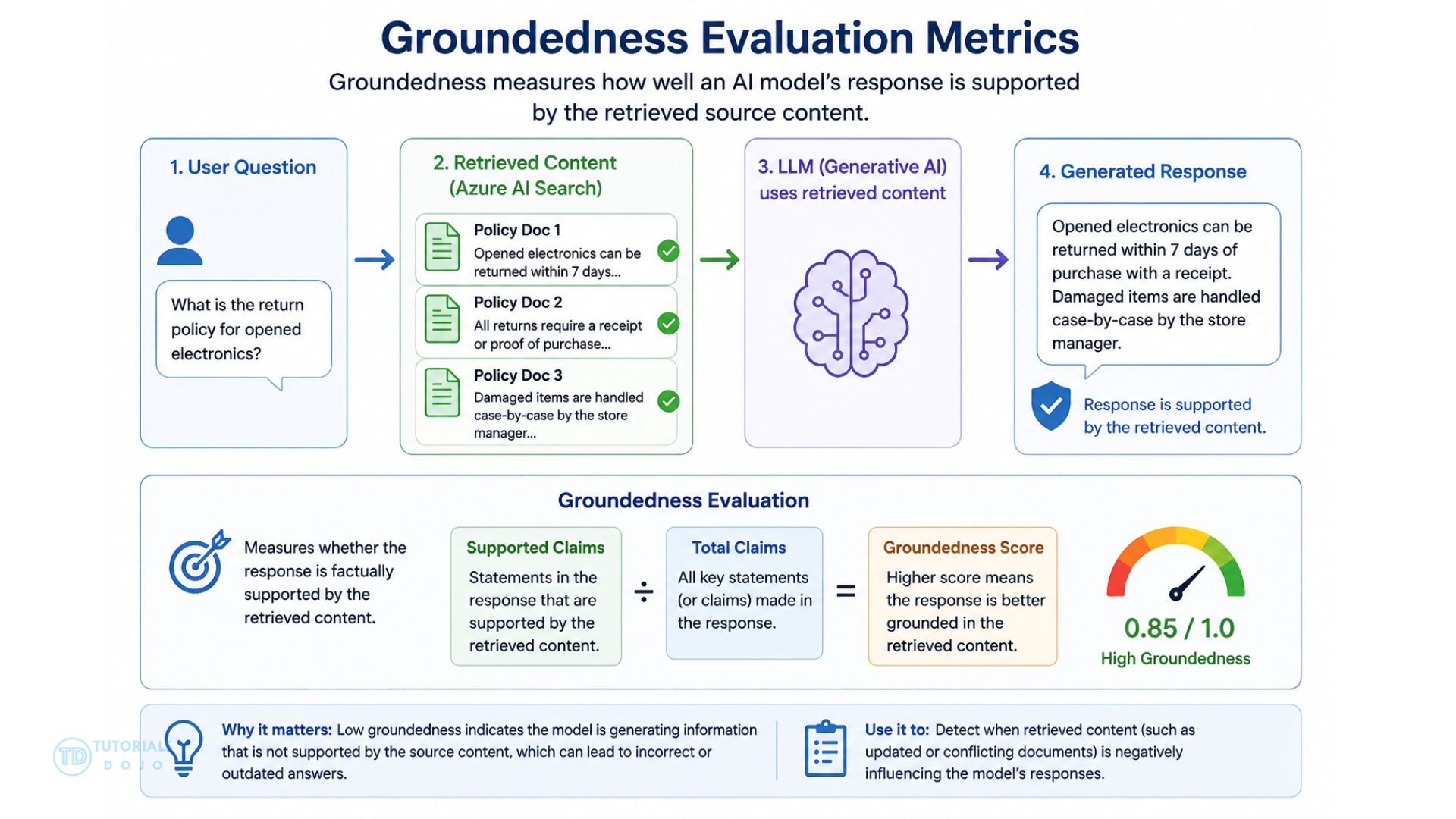
This makes groundedness evaluation metrics the correct choice. Retrieval precision can help evaluate whether the right chunks were retrieved, and response relevance can measure whether an answer is related to the user’s question. However, neither of those directly confirms whether the final response is supported by the retrieved policy documents. Prediction drift is also not appropriate because it focuses on changes in prediction patterns over time rather than being grounded in retrieved content.
Hence, the correct answer is: Groundedness evaluation metrics.
Retrieval precision metrics is incorrect because it typically focuses on whether retrieved documents or chunks are relevant to the query. It can help assess retrieval quality, but it does not directly confirm whether the final generated response is supported by the retrieved content.
Response relevance metrics is incorrect because it simply measures how relevant the response is to the user’s query. A response can be relevant to the question but still include claims that are not grounded in the retrieved policy documents.
Prediction drift metrics is incorrect because prediction drift is primarily used to identify changes in model predictions or output patterns over time. It does not evaluate whether a generated response is supported by retrieved Azure AI Search content.
References:
https://learn.microsoft.com/en-us/azure/foundry/concepts/evaluation-evaluators/rag-evaluators
https://learn.microsoft.com/en-us/azure/foundry/concepts/built-in-evaluators
Check out this Azure AI Search Cheat Sheet:
For more Azure practice exam questions with detailed explanations, check out the Tutorials Dojo Portal:


Final Remarks
Success in the AI-103 exam requires practical knowledge of building, managing, and deploying AI applications and agents with Microsoft Foundry. Focus on key areas such as generative AI, agentic workflows, retrieval-augmented generation, multimodal solutions, text and speech processing, computer vision, information extraction, monitoring, security, and responsible AI implementation. Hands-on practice with Foundry projects, model and agent deployments, Foundry Tools, the Foundry SDK, and Python can help strengthen exam readiness. Practice exams can also help identify knowledge gaps and reinforce important skills. With focused preparation, candidates can build the expertise needed to earn the Microsoft Certified: Azure AI App and Agent Developer Associate certification. Best of luck with your studies!
🚀 30% OFF All Azure Reviewers
Turn Your Team Into Cloud-Ready Professionals Today
Learn AWS with our PlayCloud Hands-On Labs
$2.99 AWS and Azure Exam Study Guide eBooks

Learn GCP By Doing! Try Our GCP PlayCloud
Learn Azure with our Azure PlayCloud
FREE AI and AWS Digital Courses

FREE AWS, Azure, GCP Practice Test Samplers

Subscribe to our YouTube Channel

Follow Us On Linkedin

Written by: Lois Angelo Dar Juan