
Last updated on May 25, 2026
Stage 5 of the AWS Data and AI Journey: Building Agentic AI Systems
Building agentic AI systems is the next frontier for organizations that have already laid the groundwork with a modern data foundation, governed pipelines, and enterprise-wide generative AI.
This is where agentic AI enters the picture. Generative AI systems can answer questions, summarize documents, and generate content. Agentic AI goes further by enabling systems to reason through tasks, interact with tools, make decisions, coordinate workflows, and complete multi-step objectives with limited human intervention.
Instead of acting only as assistants, AI systems begin operating more like autonomous digital workers capable of retrieving information, triggering workflows, collaborating with applications, and continuously improving outcomes.
Stage 5 of the AWS Data and AI journey focuses on building agentic AI systems. At this stage, organizations move from isolated AI interactions toward orchestrated AI-driven operations that can automate business processes, enhance employee productivity, and support intelligent decision-making at scale.
This article explores why agentic AI matters, what modern agent architectures look like, and how AWS Marketplace solutions can help organizations build reliable, secure, and enterprise-ready AI agents.
Why Agentic AI Matters
Most organizations adopting generative AI initially focus on conversational experiences such as chatbots, copilots, and content generation tools. While these systems provide value, they often stop at producing recommendations or responses.
Agentic AI introduces a major shift.
Instead of simply generating outputs, AI agents can:
- Understand goals and objectives
- Plan multi-step actions
- Interact with external systems and APIs
- Retrieve and analyze enterprise knowledge
- Execute workflows automatically
- Collaborate with humans and other agents
- Continuously adapt based on feedback and context
This allows organizations to automate increasingly complex workflows across departments such as operations, customer support, finance, software engineering, HR, and knowledge management.
Examples of agentic AI use cases include:
- IT support agents that diagnose and resolve incidents automatically
- Customer service agents that handle requests across multiple systems
- Sales assistants that retrieve insights and update CRM records
- Research agents that gather and summarize competitive intelligence
- Workflow agents that coordinate approvals and operational tasks
- AI coworkers that assist employees across daily business operations
As organizations scale AI adoption, the ability for AI systems to take action becomes just as important as their ability to generate content.
A strong agentic AI strategy should support:
- Multi-step reasoning and orchestration
- Secure tool and API integrations
- Access to enterprise knowledge sources
- Human-in-the-loop oversight
- Evaluation and monitoring of agent behavior
- Workflow automation across business systems
- Reliable governance and safety controls
Without these capabilities, organizations struggle to move beyond AI experimentation into operational automation.
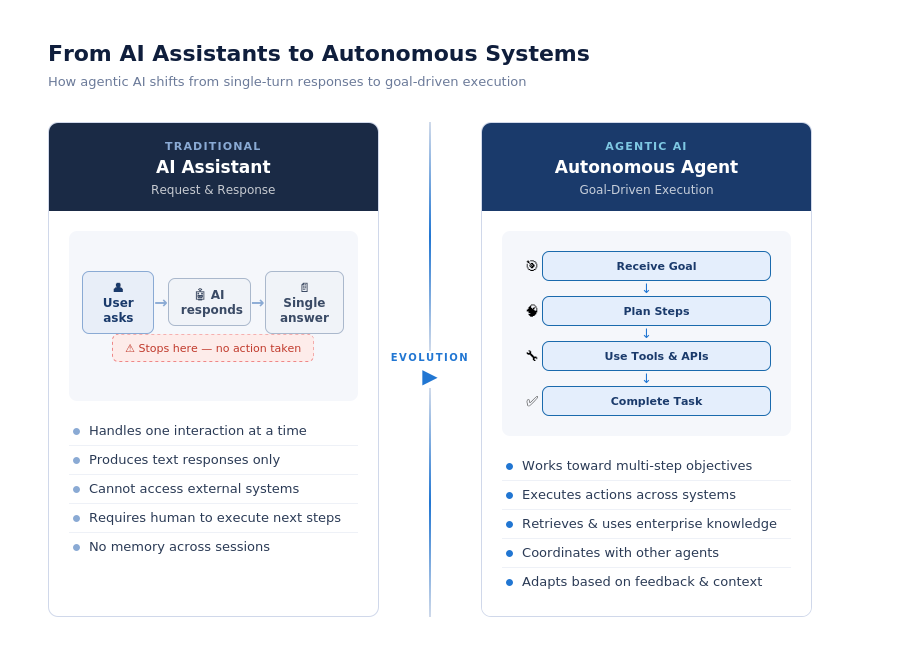
From AI Assistants to Autonomous Systems
Traditional AI assistants typically operate in a request-and-response pattern. A user asks a question, and the system produces an answer.
Agentic AI systems are designed differently.
Instead of handling a single interaction, agents work toward completing goals. They can break tasks into smaller steps, decide which tools to use, gather information from multiple systems, and execute actions based on context.
For example, an employee onboarding agent may:
- Retrieve HR records
- Create accounts across applications
- Assign access permissions
- Generate onboarding documentation
- Schedule training workflows
- Notify managers and stakeholders
Rather than manually coordinating these steps across multiple systems, the agent orchestrates the process automatically.

This transition from passive assistance to active execution is one of the most important shifts in enterprise AI adoption.
Building Blocks of an Agentic AI Architecture
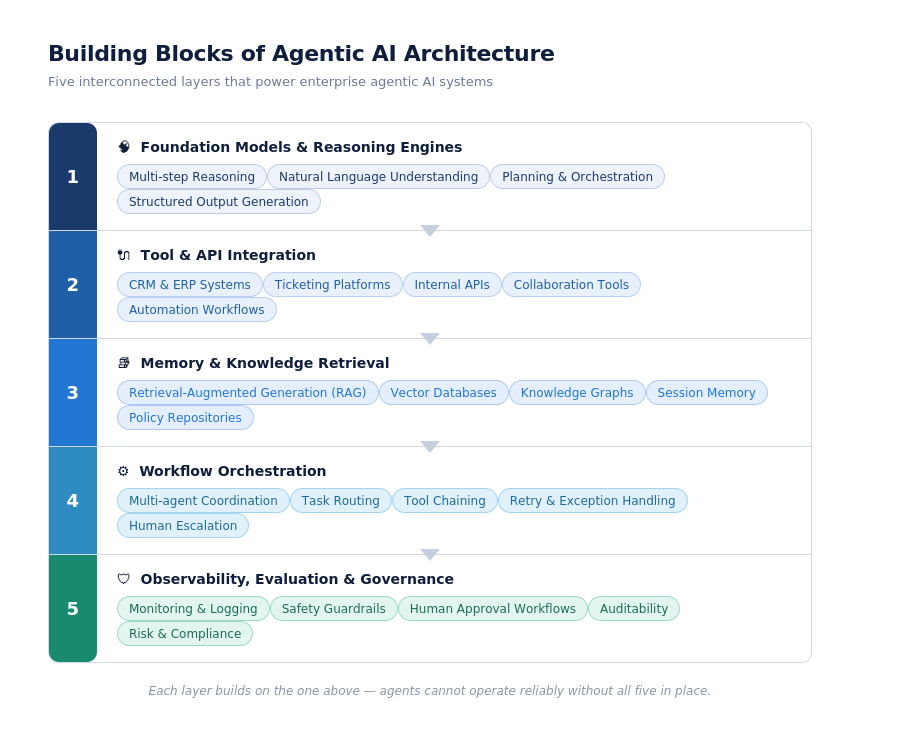
Modern agentic AI systems are composed of several interconnected layers.
Foundation Models and Reasoning Engines
At the core of agentic AI are foundation models capable of reasoning, planning, and interpreting instructions.
These models help agents:
- Understand user intent
- Generate plans and workflows
- Interpret natural language requests
- Produce structured outputs
- Coordinate multi-step tasks
Different models may be optimized for reasoning, coding, retrieval, summarization, or workflow coordination depending on the use case.
Tool and API Integration
Agents become operational when they can interact with external tools and systems.
This includes:
- CRM platforms
- ERP systems
- Ticketing systems
- Databases and knowledge bases
- Internal APIs
- Collaboration platforms
- Automation workflows
Through API integrations and orchestration frameworks, agents can move beyond conversation and begin taking action inside enterprise environments.
Memory and Knowledge Retrieval
Agentic systems require access to both short-term context and long-term organizational knowledge.
This often includes:
- Retrieval-augmented generation (RAG)
- Vector databases and semantic search
- Enterprise knowledge graphs
- Session memory and conversational context
- Internal documentation and policy repositories
These capabilities help agents produce grounded, context-aware decisions instead of generic responses.
Workflow Orchestration
Agents often need to coordinate multiple actions across systems.
Modern orchestration layers allow agents to:
- Trigger workflows
- Route tasks between systems
- Chain multiple tools together
- Coordinate multiple agents
- Handle retries and exceptions
- Escalate tasks to humans when needed
This orchestration capability enables AI systems to participate directly in operational business processes.
Observability, Evaluation, and Governance
As agents gain access to enterprise systems, organizations must maintain visibility and control.
Agentic AI systems require:
- Monitoring and logging
- Evaluation frameworks for accuracy and reliability
- Safety guardrails and policy enforcement
- Human approval workflows
- Auditability and traceability
- Risk and compliance management
Without strong observability and governance, autonomous systems introduce operational and security risks.
The Importance of Human-in-the-Loop AI
Despite advances in autonomy, most enterprise agentic AI systems still require human oversight.
Human-in-the-loop architectures help organizations:
- Review high-impact decisions
- Approve sensitive actions
- Correct inaccurate outputs
- Improve workflows through feedback
- Maintain accountability and compliance
Instead of replacing humans entirely, agentic AI often works best as a collaborative layer that augments employees and automates repetitive operational work.
This balance between automation and oversight is critical for responsible AI adoption.
Multi-Agent Systems and Collaborative AI
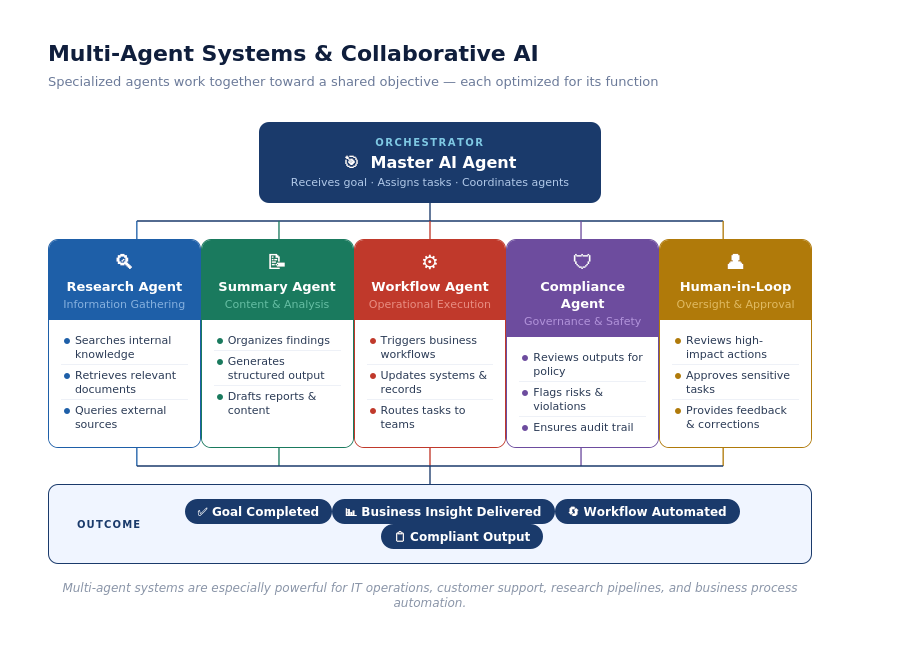
As agentic AI matures, organizations are increasingly adopting multi-agent architectures.
In a multi-agent system, several specialized agents collaborate to complete broader objectives.
For example:
- A research agent gathers information
- A summarization agent organizes findings
- A workflow agent triggers operational tasks
- A compliance agent reviews outputs for policy violations
This modular approach improves scalability, specialization, and reliability.
Instead of building one large general-purpose agent, organizations can combine smaller agents optimized for specific functions.
Multi-agent architectures are especially valuable for:
- Enterprise knowledge management
- Customer support automation
- IT operations and incident response
- Software development workflows
- Research and analytics pipelines
- Business process automation
AWS Marketplace Solutions for Stage 5
At this stage of the journey, organizations adopt orchestration frameworks, enterprise AI platforms, workflow automation tools, evaluation systems, and AI productivity platforms that help operationalize agentic AI.
AWS Marketplace offers partner solutions that integrate directly with AWS services such as Amazon Bedrock, Amazon SageMaker, AWS Lambda, Amazon ECS, and Amazon S3.
These solutions help organizations build, deploy, evaluate, and scale enterprise-ready AI agents.
Agent Orchestration and Development Frameworks
Building agentic AI systems requires frameworks that can coordinate reasoning, tool usage, memory, and workflows.
LangChain
LangChain provides one of the most widely used frameworks for developing LLM-powered applications and agents. It helps organizations:
- Build multi-step AI workflows
- Connect models to tools and APIs
- Implement retrieval-augmented generation
- Manage conversational memory
- Coordinate chains and agents
LangChain is commonly used as the orchestration layer for enterprise AI assistants and autonomous workflows.
Enterprise Knowledge and Workplace AI
Agentic AI systems become significantly more valuable when they can access enterprise knowledge securely and efficiently.
Glean
Glean provides enterprise search and workplace AI capabilities that connect organizational knowledge across applications and repositories.
Organizations use Glean to:
- Enable AI-powered enterprise search
- Surface contextual knowledge for employees
- Improve retrieval for AI assistants and agents
- Connect knowledge across SaaS and internal systems
This helps agents retrieve trusted organizational context and improve the quality of AI-driven workflows.
Coveo
Coveo focuses on AI-powered search, relevance, and personalization.

Its platform helps organizations:
- Deliver intelligent search experiences
- Improve recommendation systems
- Enhance AI retrieval and knowledge discovery
- Personalize digital experiences using AI
Coveo strengthens the retrieval and contextual understanding layers that support agentic AI systems.
AI Workflow Automation and Digital Workers
Agentic AI often overlaps with business process automation, where AI systems coordinate workflows and operational tasks.
Automation Anywhere
Automation Anywhere combines robotic process automation (RPA) with AI-powered automation capabilities.
Organizations use Automation Anywhere to:
- Automate repetitive operational workflows
- Integrate AI into enterprise processes
- Coordinate digital workers across systems
- Reduce manual tasks and operational overhead
This allows organizations to combine deterministic automation with AI-driven decision-making.
Moveworks
Moveworks provides AI assistants and workflow automation focused on enterprise employee support.
Its platform helps organizations:
- Automate IT and HR support tasks
- Resolve employee requests using AI agents
- Integrate across workplace systems
- Improve productivity through conversational automation
Moveworks demonstrates how agentic AI can streamline internal enterprise operations.
AI Decisioning and Collaborative Intelligence Platforms
Some organizations require platforms that combine data science, analytics, and AI orchestration to support operational decision-making.
Dataiku
Dataiku provides an enterprise AI and analytics platform that supports collaborative AI development, operationalization, and governance.
Organizations use Dataiku to:
- Build and operationalize AI workflows
- Combine analytics with generative AI capabilities
- Enable collaborative AI development across teams
- Govern AI systems and model lifecycles
Dataiku helps organizations bridge traditional analytics, machine learning, and agentic AI systems.
AI Evaluation, Safety, and Reliability
As AI agents gain more autonomy, organizations need stronger evaluation and governance frameworks.
Patronus AI
Patronus AI focuses on evaluating and monitoring generative AI systems.
Its solutions help organizations:
- Evaluate model outputs and agent behavior
- Detect hallucinations and reliability issues
- Measure AI performance and safety
- Improve trust in production AI systems
These capabilities become increasingly important as AI agents interact with business-critical systems.
Weights & Biases
Weights & Biases provides tools for machine learning observability, experimentation, and AI evaluation.
Organizations use Weights & Biases to:
- Track AI experiments and workflows
- Monitor model performance
- Evaluate agent behavior over time
- Improve reproducibility and operational visibility
This observability layer helps teams manage increasingly complex AI systems at scale.
How These Solutions Support an Agentic AI Strategy
The solutions highlighted in this stage help organizations build the core layers of an enterprise agentic AI capability:
Agent orchestration and workflow layer
- LangChain
Enterprise knowledge and retrieval layer
- Glean
- Coveo
Automation and operational execution layer
- Automation Anywhere
- Moveworks
Collaborative AI and operational intelligence layer
- Dataiku
AI evaluation, observability, and governance layer
- Patronus AI
- Weights & Biases
By combining these solutions with AWS services such as Amazon Bedrock, Amazon SageMaker, AWS Step Functions, AWS Lambda, Amazon ECS, and Amazon S3, organizations can build scalable agentic AI systems capable of coordinating workflows, retrieving enterprise knowledge, and automating business operations.
AWS Marketplace simplifies adoption by providing:
- Integrated partner solutions
- Faster procurement and deployment
- Flexible deployment architectures
- Enterprise-ready integrations with AWS services
References
- https://www.gartner.com/en/newsroom/press-releases/2025-08-26-gartner-predicts-40-percent-of-enterprise-apps-will-feature-task-specific-ai-agents-by-2026-up-from-less-than-5-percent-in-2025
- https://www.deloitte.com/us/en/insights/topics/technology-management/tech-trends/2026/agentic-ai-strategy.html
- https://mitsloan.mit.edu/ideas-made-to-matter/agentic-ai-explained
- https://aws.amazon.com/blogs/aws/introducing-multi-agent-collaboration-capability-for-amazon-bedrock/
🔥 $1.99 eBooks and $4.99 Video Claude Reviewers
Turn Your Team Into Cloud-Ready Professionals Today
Learn AWS with our PlayCloud Hands-On Labs

$2.99 AWS and Azure Exam Study Guide eBooks

Learn GCP By Doing! Try Our GCP PlayCloud
Learn Azure with our Azure PlayCloud
FREE AI and AWS Digital Courses

FREE AWS, Azure, GCP Practice Test Samplers

Subscribe to our YouTube Channel

Follow Us On Linkedin

Written by: April Joy Deang