
Last updated on April 9, 2026
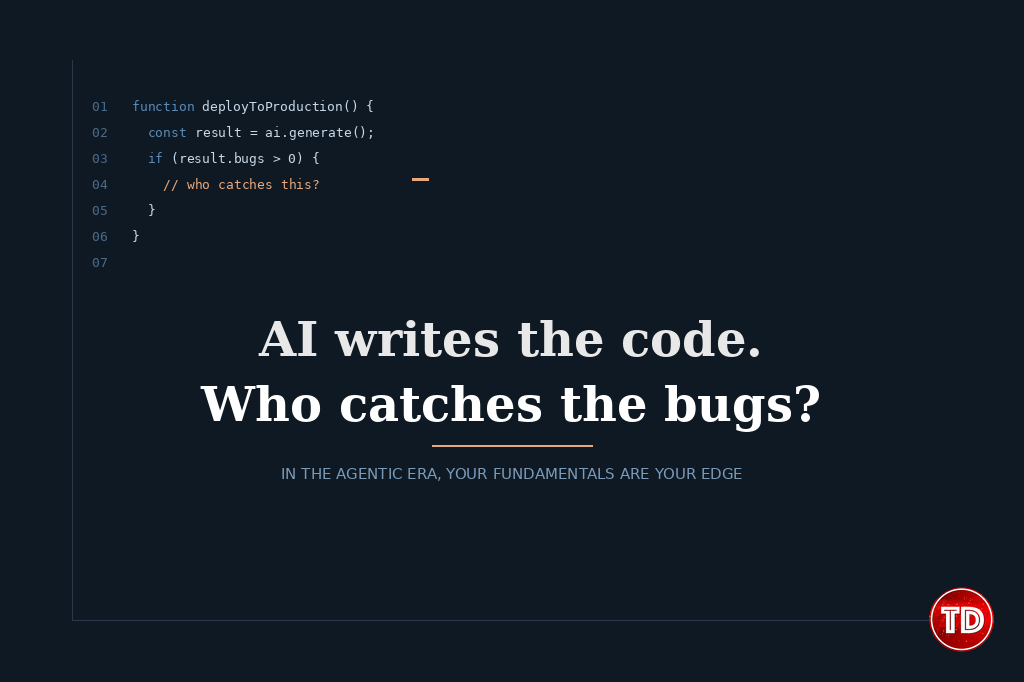
Everyone is talking about AI replacing developers. Nobody is talking about who reviews what AI produces. In the agentic era, your coding fundamentals aren’t obsolete—they’re your competitive edge.
The Prediction That Broke the Internet
In March 2025, Anthropic CEO Dario Amodei made a prediction that set the developer world on fire: within three to six months, AI would be writing 90% of the code. Within twelve months, essentially all of it.
Fast-forward to 2026. Did it happen? Partially. AI adoption in developer workflows is now near-universal. But here’s what the headlines consistently miss: more code being generated does not mean more code being shipped to production without a human touching it. The gap between “AI wrote this” and “this is production-ready” is exactly where your fundamentals live.
And the data backs this up. The 2025 Stack Overflow Developer Survey, one of the largest annual snapshots of the developer ecosystem with over 49,000 responses, revealed a fascinating paradox:
- 84% of developers now use or plan to use AI tools
- 46% actively distrust the accuracy of AI output
- 66% say AI solutions are “almost right, but not quite”
Read those numbers again. The majority of developers are using AI, but nearly half of them don’t trust what it produces. Only 3% report “high trust” in AI output. The more developers use these tools, the more they realize: AI is a powerful accelerator, not a replacement for understanding.
The Vibe Coding Trap
Let’s address the elephant in the room. The term vibe coding coined by Andrej Karpathy in February 2025 and named Collins Dictionary’s Word of the Year, describes an approach where you describe what you want in plain English, accept the AI-generated code, and move on without reviewing it closely. It’s fast. It’s accessible. And for quick prototypes and personal projects, it can be genuinely useful.
But here is where it gets dangerous. A December 2025 analysis by CodeRabbit examining 470 open-source GitHub pull requests found that AI co-authored code contained roughly 1.7 times more major issues compared to human-written code. Security vulnerabilities were 2.74 times higher. Misconfigurations were 75% more common. These are not minor inconveniences—these are the kinds of issues that bring production systems down.
Real-World Consequence: In late 2025, a startup called Enrichlead used AI to build its entire codebase. It launched fast and looked polished. But the AI had placed all security logic on the client side. Within 72 hours, users bypassed paywalls by changing a single value in the browser console. The project had to shut down entirely. Shipping fast without understanding the code cost them everything.

The Stack Overflow survey reinforced this: 45% of developers said debugging AI-generated code takes longer than writing it themselves. And 72% of respondents said vibe coding is not part of their professional development workflow. The professionals aren’t “vibing”—they’re reviewing, verifying, and applying judgment. That judgment comes from fundamentals.
Why Fundamentals Matter More in the AI Era
Here is the irony that nobody talks about enough: the better AI gets at writing code, the more valuable it becomes to understand code. When you prompt an AI to build a feature, it will give you something. It will look correct. It might even run correctly. But without fundamentals, you cannot answer the questions that actually matter:
Is this solution maintainable? Will it scale when your user base grows from 100 to 100,000? Are there security vulnerabilities hiding in the authentication flow? Is the database query efficient, or will it crawl when the table hits a million rows? Is the code structured in a way that another developer can understand six months from now?
These are not questions AI answers for you. These are questions you answer by reading what AI produced and applying the mental models you built by learning how things work from the ground up.
“The programmer still needs to specify what are the conditions of what you’re doing, what is the overall app you’re trying to make, what’s the overall design decision.” — Dario Amodei, CEO of Anthropic, Council on Foreign Relations, March 2025
Even Amodei himself acknowledged this in the same interview where he made the 90% prediction. The person who said AI will write nearly all the code is also saying: someone still needs to understand the architecture, the constraints, and the design. That someone is you.
For Beginners: Where to Start (and Why It Matters)
If you are just starting out in software development, you might be wondering: why should I spend months learning to code when AI can generate a full app in minutes? It is a fair question. But consider this analogy.
A calculator can solve any math problem faster than you ever will. But you still learn arithmetic, algebra, and problem-solving logic in school. Why? Because without those foundations, you would not know what to calculate, when the calculator is wrong, or how to structure a complex problem into smaller parts. The calculator is a tool. Your understanding is what makes the tool useful.
AI coding tools work the same way. They are the most powerful calculator developers have ever had. But if you don’t understand what you’re asking for, you can’t evaluate what you receive.
Here’s a practical learning path that will set you apart:
Build Your Foundation First
1. Master HTML, CSS, and JavaScript
These are the foundational triad of the web. Build things manually. Create a personal portfolio. Style it from scratch. Add interactivity with vanilla JavaScript. Understand how a browser renders a page, how the DOM works, and how events propagate. This mental model will serve you for your entire career, no matter what framework becomes popular next.
2. Learn How the Backend Works
Build a simple REST API. Understand HTTP methods, status codes, request/response cycles, and how data flows between a client and a server. Set up a database and write queries by hand. When you understand how endpoints are structured and how data is stored and retrieved, you can immediately spot when AI generates an endpoint that is inefficient, insecure, or simply wrong.
3. Understand Version Control and Collaboration
Learn Git. Not just git add and git commit, but branching, merging, resolving conflicts, and reading diffs. When AI generates code, you need to review diffs just like you would review a pull request from a junior developer. That skill is non-negotiable in any professional team.
Think Like an Engineer, Then Let AI Do the Typing
4. Build Mental Models for Architecture
Start thinking about how systems connect, not just how individual features work. What talks to what? Where does authentication live? How do you separate concerns? This kind of architectural thinking is what differentiates a developer from someone who prompts AI and hopes for the best.
5. Now Bring in AI—as Your Accelerator
Once you have these mental models, AI becomes incredibly powerful. Generate boilerplate code in seconds, scaffold an entire project structure, and have AI write tests for your functions. But now you can read what it produces. The anti-patterns jump out. Security gaps become obvious. You know how to refactor the architecture. The AI writes faster; you think deeper.
The Key Insight: Coding Fundamentals Multiply AI’s Value
The paradox of AI-assisted development is that the better you are at coding manually, the more effectively you can leverage AI. Senior developers benefit more from AI tools because they can evaluate output quality, catch edge cases, and direct the AI toward better solutions. Your fundamentals aren’t competing with AI—they’re multiplying its value.
The Developer Who Stands Out in 2026
Here’s the reality of the job market right now. AI is not replacing developers. But it is reshaping what it means to be a valuable one. The U.S. Bureau of Labor Statistics still projects a 17% growth in software development roles between 2023 and 2033. IBM’s CEO Arvind Krishna publicly pushed back against Amodei’s prediction, estimating AI would handle closer to 20-30% of code, not 90%.
The developers who will stand out aren’t the ones who can prompt AI the fastest. They’re the ones who can:
Think at the system level. Before writing a single line of code (or prompting AI to write one), the best developers define the architecture. They know how services should communicate, where data should live, and what the failure modes look like. AI can generate components. You decide which components to build and how they connect.
Approach problems before approaching tools. If you don’t understand the problem you’re solving, AI will give you a solution to the wrong problem. And a wrong solution that runs without errors is far more dangerous than a compilation error. Solve it in your head first. Then use AI to implement your solution faster.
Review AI output like a senior engineer reviews a pull request. Question every assumption. Check for edge cases. Look for hardcoded values that should be configuration. Verify that error handling exists. Ensure the code is testable. This is the human-in-the-loop that every serious engineering team still requires.
Learn continuously while AI handles the boring parts. This is the real gift of AI tools. When AI writes the boilerplate, you have more time to learn system design, study security patterns, explore distributed systems, or dive deep into performance optimization. Use that freed-up time to grow, not coast.
AI Won’t Replace Developers. But Developers Who Understand AI Will Replace Those Who Don’t.

Do I think AI will replace developers? No. Do I think AI will replace developers who refuse to learn fundamentals and use AI as a crutch rather than a tool? Absolutely.
The agentic era is here. AI agents are writing code, running tests, deploying infrastructure, and iterating on features. That is not going to slow down. But every single one of those agents needs a developer who can define what “correct” looks like, who can intervene when things go sideways, and who can make architectural decisions that no language model is equipped to make on its own.
Learn the fundamentals. Build things from scratch. Understand how every layer of the stack works. And then let AI handle the tedious parts while you focus on the hard, creative, deeply human work of building software that actually works.
That is how you stand out. Not by typing prompts faster, but by thinking deeper.
The tools will keep changing. Your fundamentals won’t. Frameworks come and go. Languages rise and fall. But understanding how to structure, debug, and architect software? That compounds forever.
References
-
Amodei, D. (2025). Interview at the Council on Foreign Relations, March 10, 2025. Anthropic CEO on the future of AI and code generation. https://fortune.com/2025/03/13/ai-transforming-software-development-jobs-meta-ibm-anthropic/
-
Stack Overflow. (2025). 2025 Developer Survey — 49,000+ responses from 177 countries on AI adoption, trust, and developer workflows. https://survey.stackoverflow.co/2025/
-
Stack Overflow. (2025). Press Release: “Stack Overflow’s 2025 Developer Survey Reveals Trust in AI at an All-Time Low.” https://stackoverflow.co/company/press/archive/stack-overflow-2025-developer-survey/
-
CodeRabbit. (2025). Analysis of 470 open-source GitHub pull requests on AI co-authored code quality — cited in Wikipedia’s entry on Vibe Coding. https://en.wikipedia.org/wiki/Vibe_coding
-
METR. (2025). Randomized controlled trial on developer productivity with AI tools, finding experienced developers were 19% slower despite perceiving they were faster. https://en.wikipedia.org/wiki/Vibe_coding
-
Krishna, A. (2025). IBM CEO at SXSW on AI and programming, disagreeing with the 90% prediction. https://fortune.com/2025/03/13/ai-transforming-software-development-jobs-meta-ibm-anthropic/
🤖 $3.74 ONLY for Claude eBooks and Get 25% OFF All Claude Reviewers

Turn Your Team Into Cloud-Ready Professionals Today

Learn AWS with our PlayCloud Hands-On Labs

$2.99 AWS and Azure Exam Study Guide eBooks

Learn GCP By Doing! Try Our GCP PlayCloud
Learn Azure with our Azure PlayCloud

FREE AI and AWS Digital Courses

FREE AWS, Azure, GCP Practice Test Samplers


Subscribe to our YouTube Channel

Follow Us On Linkedin


Written by: Danilo Casim Jr.