
Last updated on May 25, 2026
Stage 4 of the AWS Data and AI Journey: Applying Generative AI Across the Enterprise
Applying generative AI across the enterprise is no longer just an experiment, it’s a strategic priority for organizations ready to turn their data into real business intelligence.
This is where generative AI enters the picture. With trusted, connected, and governed data in place, organizations can confidently apply large language models, retrieval systems, and AI agents to real business problems. Generative AI shifts data from being a record of what happened into an active driver of decisions, automation, and customer experience.
Stage 4 of the AWS Data and AI journey focuses on applying generative AI across the enterprise. At this stage, organizations move beyond experimentation and begin embedding AI capabilities into products, workflows, and internal operations.
This article explores why generative AI matters at this stage, what a modern AI application strategy looks like, and how AWS Marketplace solutions can help organizations adopt foundation models, build AI-native applications, and scale generative AI responsibly.
Why Generative AI Matters Now
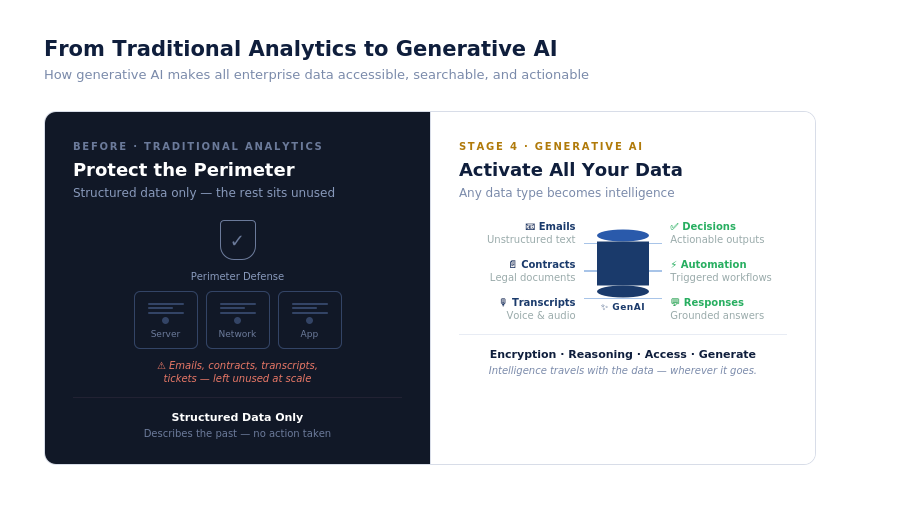
Generative AI has rapidly moved from research labs into production systems across nearly every industry. Unlike traditional analytics, which describes the past, generative AI can interpret context, generate content, summarize information, and reason across unstructured data.
This shift is significant because most enterprise data, such as documents, contracts, transcripts, support tickets, and emails, has historically been difficult to use at scale. Generative AI changes that by making unstructured data accessible, searchable, and actionable.
Organizations adopting generative AI typically face several common challenges:
- Choosing the right foundation models for their use cases
- Connecting models to internal data securely
- Managing model performance, accuracy, and cost
- Building applications that go beyond chat interfaces
- Scaling AI responsibly across teams and workloads
Without a clear application strategy, even the most advanced models produce limited business value.
A strong generative AI strategy should support:
- Access to a diverse set of foundation models
- Secure integration with enterprise data
- Use-case-specific fine-tuning and customization
- Application development tools for AI-native experiences
- Responsible AI practices for accuracy and safety
When these capabilities come together, organizations can move from isolated AI experiments into scalable, production-grade systems.
From Foundation Models to Real Applications
Many organizations begin their generative AI journey by experimenting with a single model or chatbot. While this is a useful starting point, real value comes from embedding AI into the workflows where decisions are made.
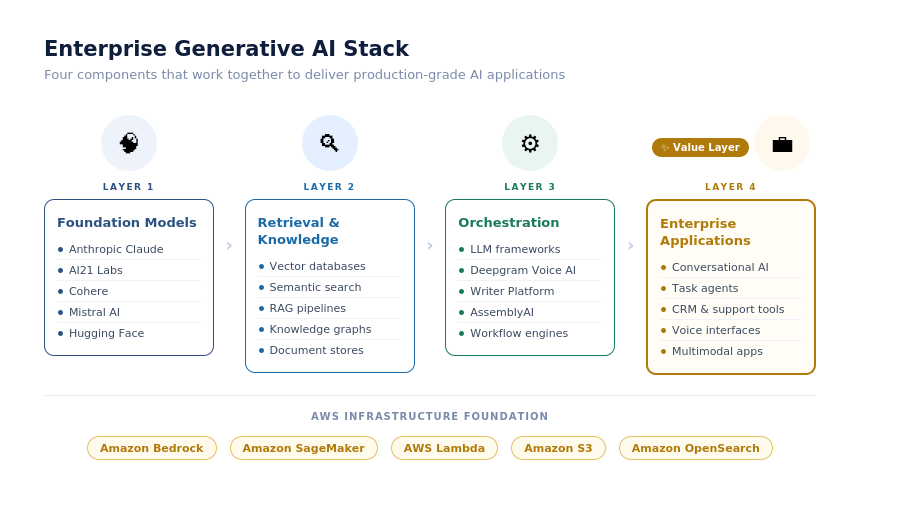
Modern generative AI applications often combine several components:

- Foundation models that handle reasoning, generation, and language understanding
- Retrieval systems that ground responses in trusted enterprise data
- Orchestration layers that coordinate multiple models, tools, and steps
- Application interfaces that deliver AI capabilities to end users
This combination, often called retrieval-augmented generation (RAG) or agent-based architecture, allows organizations to build applications that are accurate, contextual, and tailored to their business.
Instead of relying on a single general-purpose model, modern AI systems use the best model for each task. Some models are optimized for reasoning, others for code generation, transcription, summarization, or domain-specific writing. The ability to mix and match models becomes a major advantage at scale.
Choosing the Right Foundation Models
One of the most important decisions at this stage is selecting which foundation models to use. There is no single best model for every workload. Different providers offer different strengths in reasoning, accuracy, latency, cost, language coverage, and domain expertise.
A modern foundation model strategy considers:
- Model capability for the specific task
- Performance and latency requirements
- Cost per request at expected scale
- Data privacy and deployment options Availability of fine-tuning and customization Support for enterprise integrations
Most organizations end up using a portfolio of models rather than a single one. This allows them to optimize for accuracy on critical workloads while controlling cost on high-volume tasks.
Grounding AI in Enterprise Data
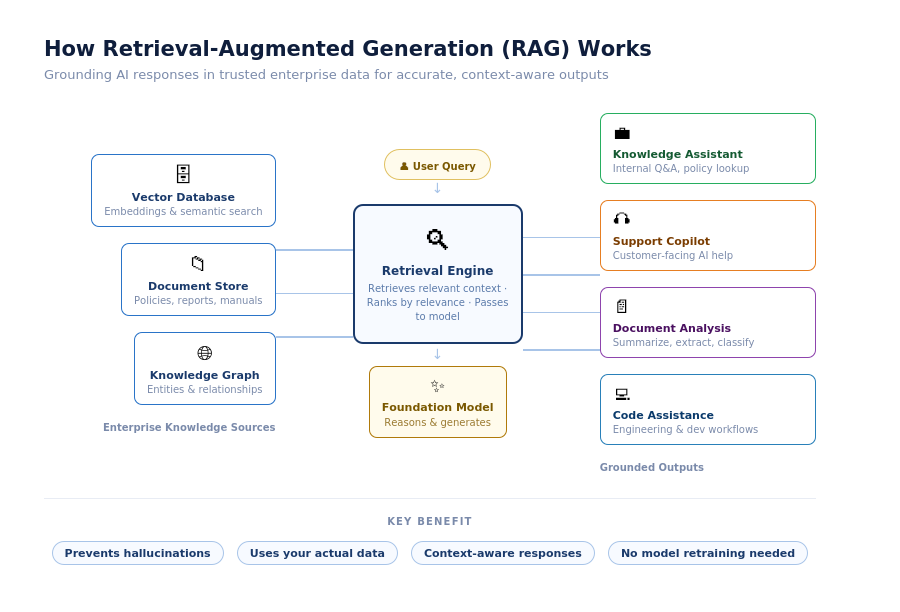
Foundation models are powerful, but on their own they do not know anything about an organization’s internal data. To produce accurate, business-relevant responses, models must be grounded in enterprise context.
This is typically achieved through retrieval-augmented generation. In a RAG architecture, the model retrieves relevant information from internal sources, such as documents, knowledge bases, or vector databases, and uses that information to generate accurate, grounded responses.
Grounding generative AI in enterprise data enables use cases such as:
- Internal knowledge assistants
- Customer support copilots
- Document analysis and summarization
- Sales and marketing content generation
- Engineering and code assistance
- Research and competitive intelligence
This is where the work done in earlier stages pays off. A strong data foundation, reliable integration, and proper governance make it possible to feed AI systems with trusted, high-quality data.
Building AI-Native Applications
Generative AI is most valuable when it is embedded directly into the tools and workflows people use every day. Instead of opening a separate chatbot, users benefit most when AI capabilities appear inside their CRM, support platform, document editor, or internal portal.
AI-native applications typically include:
- Conversational interfaces for natural interaction
- Task-specific agents that complete multi-step actions
- Embedded AI features inside existing software
- Voice and audio interfaces for hands-free use
- Multimodal capabilities across text, images, and speech
Building these applications requires more than just access to a model. Teams need development frameworks, deployment infrastructure, evaluation tools, and observability systems to deliver reliable AI experiences at scale.
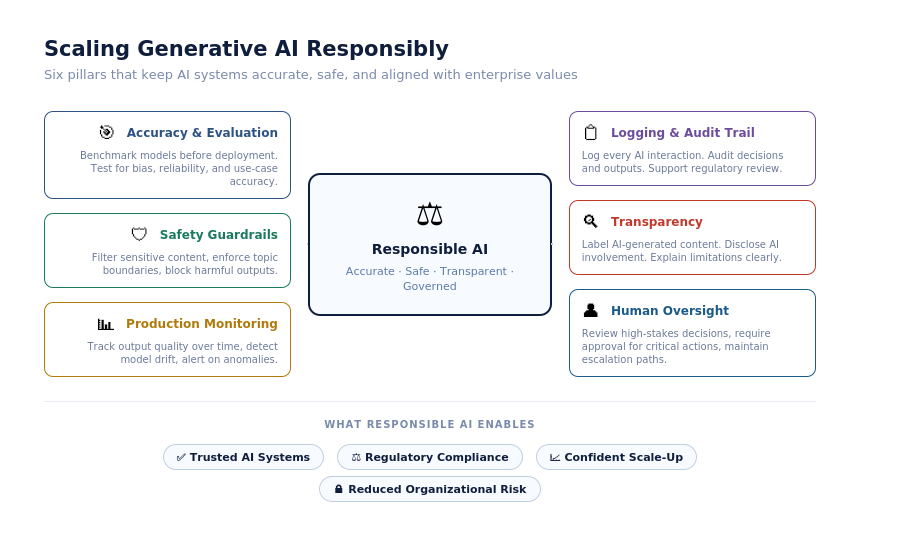
Scaling Generative AI Responsibly
As organizations expand their use of generative AI, responsible adoption becomes critical. AI systems must be accurate, safe, and aligned with organizational values, regulatory requirements, and customer expectations.
Responsible AI practices include:
- Evaluating models for accuracy, bias, and safety
- Implementing guardrails for sensitive content
- Monitoring outputs in production
- Logging and auditing AI interactions
- Providing transparency about AI-generated content
- Maintaining human oversight for high-impact decisions
This builds directly on the governance and security work from Stage 3. Without strong governance, generative AI introduces new risks. With it, organizations can scale AI confidently across the enterprise.
AWS Marketplace Solutions for Stage 4
At this stage of the journey, organizations adopt foundation models, AI development platforms, and specialized AI tools that help them apply generative AI to real business problems. AWS Marketplace offers a growing catalog of partner solutions that integrate directly with AWS services such as Amazon Bedrock, Amazon SageMaker, and Amazon S3.
These solutions help organizations access leading foundation models, build AI-powered applications, and customize models for specific industries and use cases.
1. Foundation Model Providers
Foundation Model Providers Generative AI begins with the model layer. AWS Marketplace gives organizations access to a wide range of foundation model providers, each with different strengths.
Solutions such as AI21 Labs provide models designed for enterprise reasoning, long-context understanding, and reliable text generation. AI21’s models are often used for document analysis, summarization, and structured output generation.
Anthropic offers the Claude family of models, which are designed for safety, reasoning, and helpfulness. Claude models are commonly used for customer-facing assistants, research workflows, and applications that require careful handling of nuanced instructions.
Cohere provides models optimized for enterprise search, retrieval, and language understanding. Cohere is widely used for embeddings, semantic search, and classification tasks that power RAG-based applications.
Mistral AI offers efficient, high-performance models that balance quality and cost, making them attractive for high-volume workloads, code-related tasks, and multilingual applications.

These providers give organizations the flexibility to choose the right model for each workload rather than relying on a single source.
2. Specialized AI Models and Open Model Access
Beyond general-purpose foundation models, organizations often need access to specialized models tuned for specific tasks or domains.
Hugging Face provides access to a large ecosystem of open and fine-tuned models across natural language processing, computer vision, audio, and multimodal tasks. Through AWS Marketplace, teams can deploy these models on AWS infrastructure to support custom workloads, fine-tuning, and experimentation.
This is particularly valuable for organizations that want to combine commercial foundation models with open models tailored to specific tasks, such as classification, named entity recognition, or domain-specific generation.
3. AI for Voice, Audio, and Transcription
Generative AI is not limited to text. Voice and audio play a major role in modern applications such as call centers, meeting tools, and accessibility features.
Deepgram provides speech-to-text and audio intelligence capabilities designed for enterprise use cases. Its solutions are often used for real-time transcription, call analytics, voice agents, and meeting summarization. By combining audio models with foundation models, organizations can build complete voice-driven AI experiences.
4. AI Application Platforms and Generative AI for Business
Some organizations need more than raw model access. They need full platforms that help business and technical teams build, deploy, and manage generative AI applications.
Writer offers a generative AI platform focused on enterprise content, communication, and workflow automation. It provides tools for building AI applications, agents, and assistants tailored to business teams such as marketing, support, and operations.
Assembly provides AI infrastructure and application capabilities that help organizations integrate intelligence into existing products and internal tools. These platforms are useful when teams want to deliver AI features quickly without building every component from scratch.
How These Solutions Support an Enterprise Generative AI Strategy The solutions highlighted in this stage help organizations build the core layers of an enterprise generative AI capability:
Foundation model layer
- AI21 Labs
- Anthropic
- Cohere
- Mistral AI
Open and specialized model layer
- Hugging Face
Voice and audio intelligence layer
- Deepgram
AI application and platform layer
- Assembly
- Writer
By combining these solutions with AWS services such as Amazon Bedrock, Amazon SageMaker, AWS Lambda, and Amazon S3, organizations can build a complete generative AI environment that spans models, applications, data, and infrastructure.
The next article will cover:
AWS Data and AI Journey: Applying Generative AI Across the Enterprise
References
🤖 $3.74 ONLY for Claude eBooks and Get 25% OFF All Claude Reviewers

Turn Your Team Into Cloud-Ready Professionals Today

Learn AWS with our PlayCloud Hands-On Labs

$2.99 AWS and Azure Exam Study Guide eBooks

Learn GCP By Doing! Try Our GCP PlayCloud
Learn Azure with our Azure PlayCloud
FREE AI and AWS Digital Courses

FREE AWS, Azure, GCP Practice Test Samplers


Subscribe to our YouTube Channel

Follow Us On Linkedin


Written by: April Joy Deang