
Stage 3 of the AWS Data and AI Journey: Data Governance and Security
As organizations establish a modern data foundation (Stage 1) and enable seamless data movement (Stage 2), the next critical step is ensuring that data remains trusted, secure, and compliant across the entire ecosystem.
At this stage, data is no longer confined to a single platform. It flows across cloud services, SaaS applications, analytics environments, and AI systems. Without strong governance and security, this expanded data landscape introduces risks such as unauthorized access, data leakage, compliance violations, and loss of trust in data.
Stage 3 focuses on building a governed and secure data environment one where organizations can confidently scale analytics and AI while maintaining control, visibility, and compliance.
This article explores why governance matters, what modern data governance looks like, and how AWS Marketplace solutions can help organizations enforce security and trust at scale.
Why Data Governance and Security Matter
As data becomes more distributed and accessible, the risks associated with it increase. Organizations often face challenges such as:
- Sensitive data being exposed across environments
- Lack of visibility into who is accessing data
- Inconsistent data definitions across teams
- Difficulty meeting regulatory requirements
- Limited trust in analytics and AI outputs
Without governance, even the most advanced data platforms can produce unreliable or non-compliant outcomes. A strong governance and security framework ensures that:
- Data is accurate, consistent, and trustworthy
- Access is controlled and auditable
- Sensitive information is protected across environments
- Compliance requirements are consistently enforced
This foundation is essential for scaling AI systems, where poor data governance can directly impact model performance and decision-making.
From Data Access to Data Control
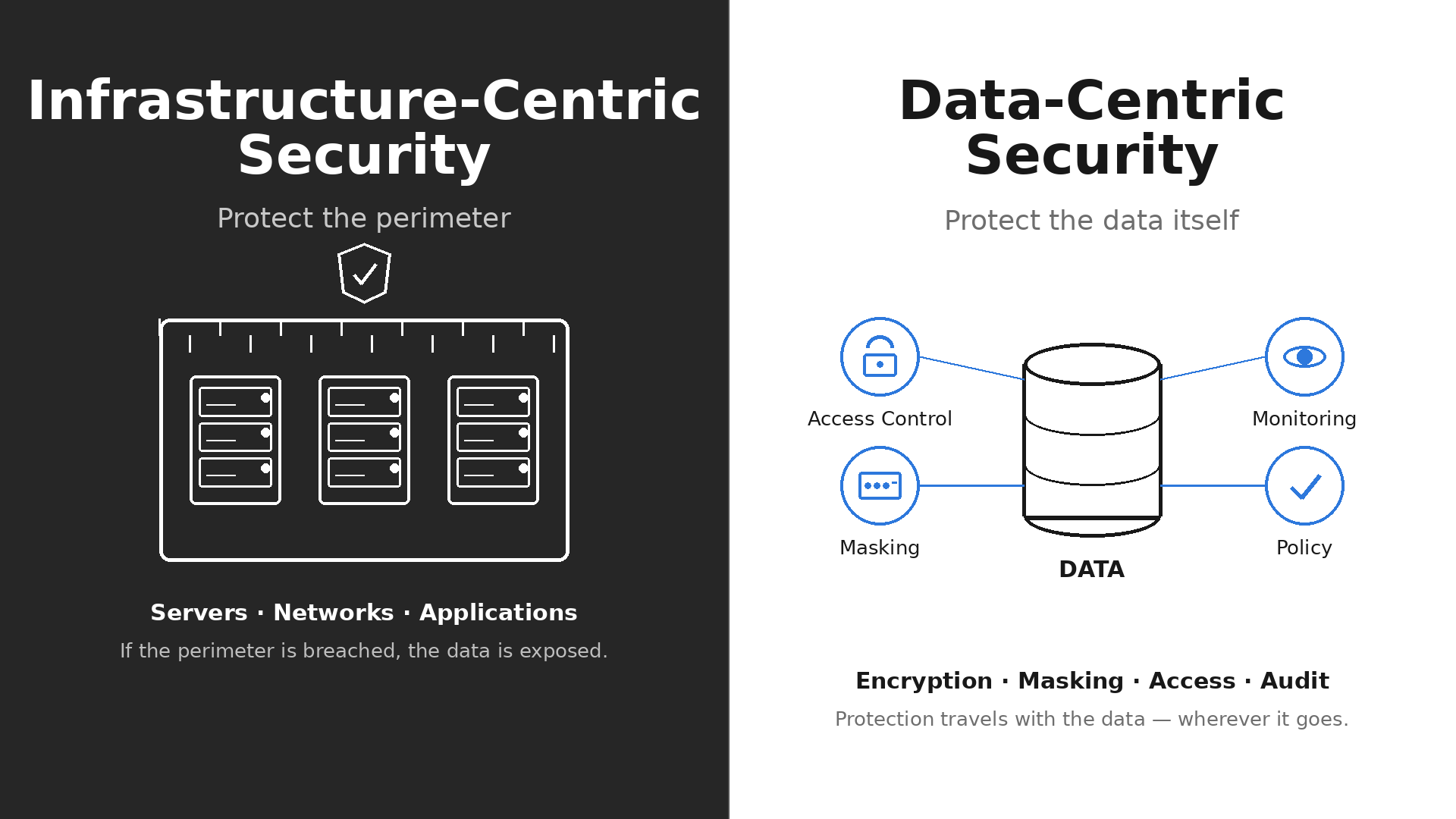
Traditional security models focused primarily on infrastructure—protecting servers, networks, and applications. However, modern architectures require a data-centric approach to security.
Instead of only securing systems, organizations must secure the data itself. This includes:
- Defining who can access what data and under what conditions
- Applying fine-grained access controls
- Enforcing data masking and tokenization
- Monitoring data usage and behavior

This shift ensures that data remains protected regardless of where it resides or how it is accessed.
Establishing a Data Governance Framework
A modern data governance strategy goes beyond policies and documentation. It introduces active systems and tooling that automate governance processes.
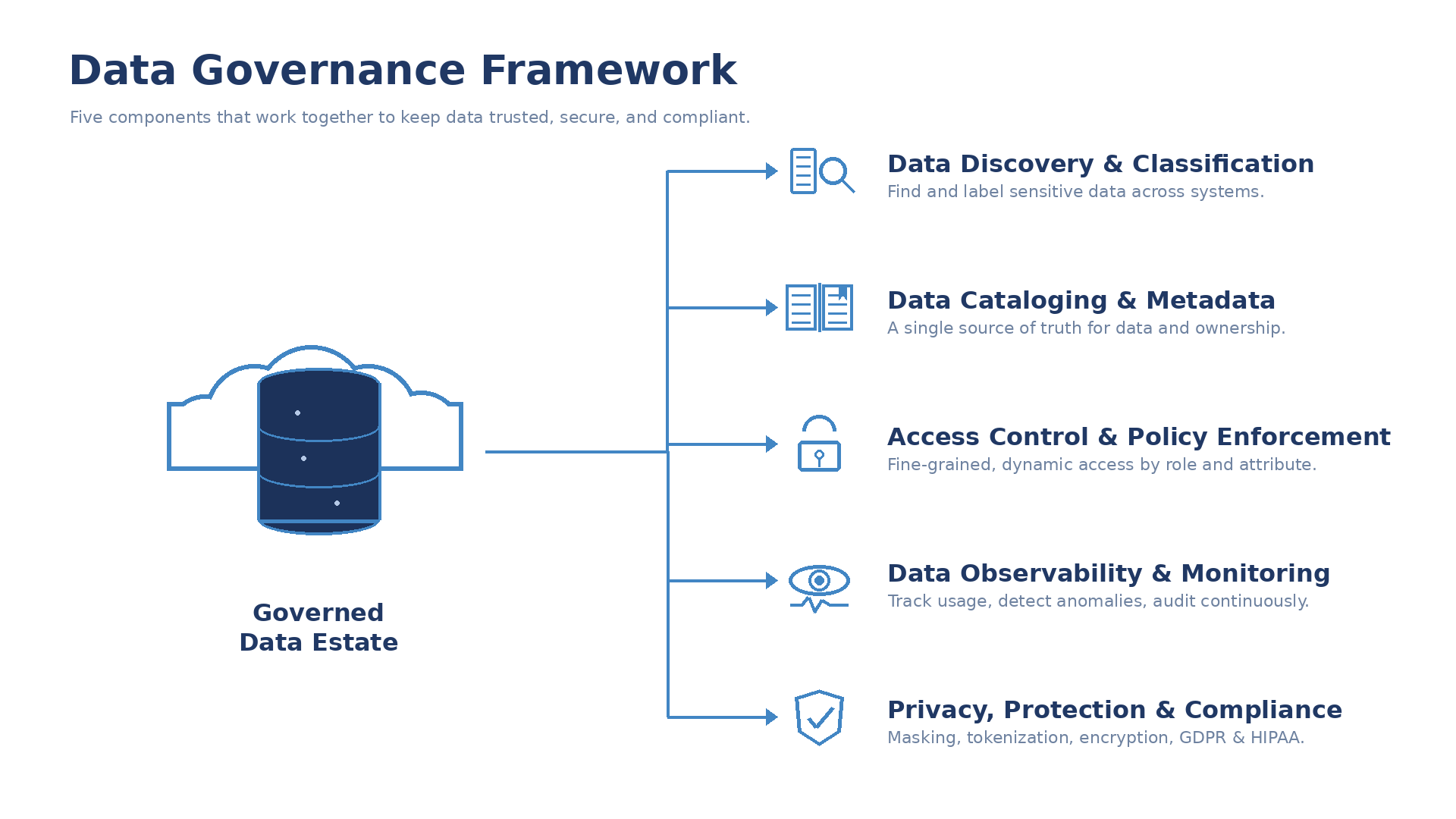
Key components include:
1. Data Discovery and Classification
- Organizations must first understand what data they have and where it resides. This involves:
- Scanning structured and unstructured data
- Identifying sensitive data (PII, financial data, etc.)
- Classifying datasets based on usage and risk
Without visibility, governance cannot be enforced effectively.
2. Data Cataloging and Metadata Management
- As data grows, teams need a centralized way to discover and understand it. Data catalogs provide:
- Business and technical metadata
- Data lineage and ownership tracking
- Search and discovery capabilities
- Standardized definitions across teams
This improves collaboration and ensures that teams are working with trusted datasets.
3. Access Control and Policy Enforcement
- Modern environments require dynamic and granular access control. This includes:
- Role-based and attribute-based access control
- Row-level and column-level security
- Policy enforcement across multiple platforms
- Integration with identity systems
The goal is to ensure that users only access the data they are authorized to see.
4. Data Observability and Monitoring
- Data systems must be continuously monitored to ensure quality, security, and reliability. Observability includes:
- Tracking data access and usage patterns
- Detecting anomalies or suspicious activity
- Monitoring data quality and freshness
- Auditing compliance and policy enforcement
This provides ongoing visibility into how data is being used across the organization.
5. Privacy, Protection, and Compliance
- With increasing regulatory requirements, organizations must ensure that sensitive data is handled appropriately. Key practices include:
- Data masking and anonymization
- Tokenization of sensitive fields
- Encryption in transit and at rest
- Compliance with frameworks such as GDPR, HIPAA, and local regulations
These controls help reduce risk while enabling safe data access.
AWS Marketplace Solutions for Stage 3
At this stage, organizations adopt tools that enable governance, security, and visibility across distributed data environments. AWS Marketplace offers partner solutions that integrate with AWS services to accelerate this process.
Data Catalog and Governance Platforms
Solutions such as Alation, Atlan, and Collibra help organizations build centralized governance frameworks. These platforms provide:
- Data discovery and cataloging
- Metadata management and lineage tracking
- Data stewardship workflows
- Governance policy management
They act as the control plane for enterprise data governance.
Data Security and Access Control
Platforms such as Satori and Skyflow focus on securing sensitive data across environments. These solutions enable:
- Fine-grained access control
- Real-time policy enforcement
- Data masking and tokenization
- Secure data access across cloud and SaaS systems
They ensure that sensitive data remains protected without limiting usability.
Data Intelligence and Governance Automation
Solutions like BigID provide advanced capabilities for data discovery, classification, and privacy management. These platforms help organizations:
- Automatically identify sensitive data
- Enforce privacy policies
- Manage compliance requirements
- Gain insights into data risk
They bring automation and intelligence into governance workflows.
How These Solutions Support a Governed Data Environment
The solutions highlighted in this stage help organizations build critical governance and security layers:

Data discovery and intelligence layer
- BigID
Data catalog and governance layer
- Alation
- Atlan
- Collibra
Data security and privacy layer
- Satori
- Skyflow
By combining these solutions with AWS-native services such as IAM, Lake Formation, and CloudTrail, organizations can create a comprehensive governance framework that spans their entire data ecosystem. AWS Marketplace simplifies adoption by providing:
- Pre-integrated solutions
- Flexible deployment options
- Faster procurement and onboarding
Enabling Trusted Data for AI and Analytics
Governance is not just about control, it is about enabling confidence. When data is well-governed:
- Analysts trust their reports
- Engineers build reliable pipelines
- AI models produce accurate results
- Organizations meet compliance requirements with confidence
Without governance, even advanced AI systems can produce misleading or risky outcomes. By investing in governance and security at this stage, organizations create a foundation for responsible and scalable AI adoption.
What Comes Next
Once data is governed and secure, organizations are ready to unlock its full value through advanced analytics, machine learning, and generative AI.
In the next stage of this series, we explore how organizations can activate data for AI and business innovation, building intelligent applications and decision systems powered by trusted data.
References
- https://aws.amazon.com/lake-formation/features/
- https://aws.amazon.com/marketplace/pp/prodview-4qh23e5eiqwow
- https://www.virtru.com/blog/data-centric-security/data-is-the-new-perimeter-insights-from-virtru-and-nist-on-cyberwire
- https://docs.aws.amazon.com/whitepapers/latest/aws-serverless-data-analytics-pipeline/security-and-governance-layer-1.html
🤖 $3.74 ONLY for Claude eBooks and Get 25% OFF All Claude Reviewers

Turn Your Team Into Cloud-Ready Professionals Today

Learn AWS with our PlayCloud Hands-On Labs
$2.99 AWS and Azure Exam Study Guide eBooks

Learn GCP By Doing! Try Our GCP PlayCloud
Learn Azure with our Azure PlayCloud
FREE AI and AWS Digital Courses

FREE AWS, Azure, GCP Practice Test Samplers

Subscribe to our YouTube Channel

Follow Us On Linkedin

Written by: April Joy Deang