
Last updated on April 15, 2026
You’ve probably done this before, especially if you’ve been learning from tutorials online. You open a YouTube video, follow along step by step, and after a few hours, you end up with something that actually works. Maybe it’s a website, an app, or just a small project you found online. It feels good, and when you close the video, you think to yourself, “Okay, I’m getting better at this.”
Then you try to build something on your own, without a tutorial this time, and everything suddenly feels different. You sit there staring at your screen, unsure where to begin. You recognize some parts and ideas, but putting everything together without guidance feels harder than expected. After a while, you do what most people do. You open YouTube again and look for another video.
Many people start learning from tutorials on platforms like Youtube, and there’s nothing wrong with that. But this is also where a lot of learners get stuck, even after weeks or months of practice.
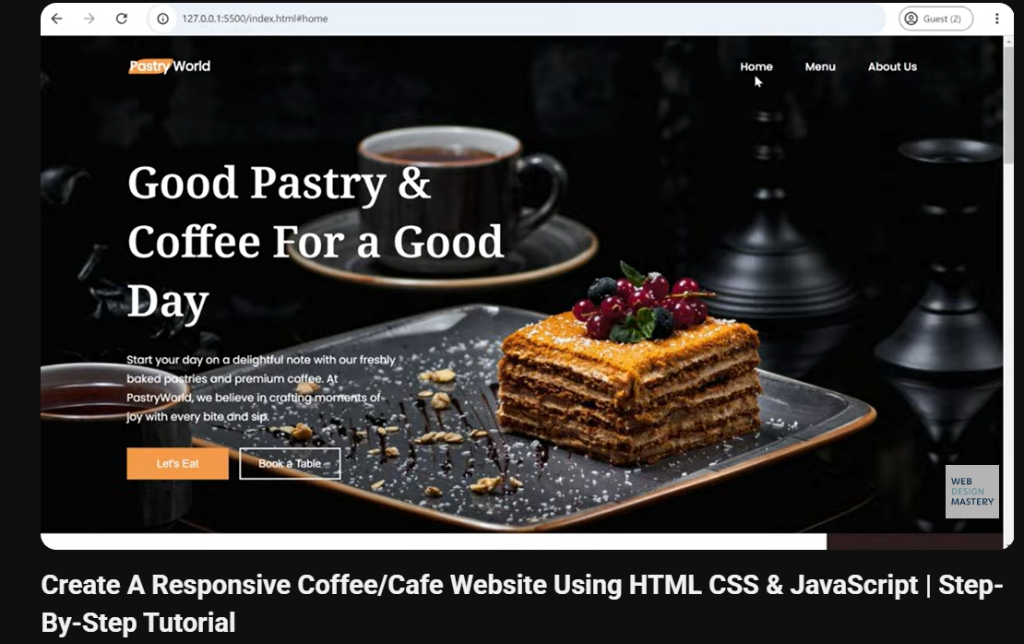
What Tutorials Don’t Teach You
While you’re learning from tutorials, everything feels clear. You understand what’s happening, you recognize the steps, and sometimes you even feel like you could have figured it out yourself. But the reality is that the tutorial has already made most of the decisions for you.
It decides what to build, what tools to use, what comes first, and what comes next. You’re not really starting from a blank page. You’re stepping into a process that’s already been mapped out.
That’s why it feels smooth. But it also means you’re not practicing one of the most important parts of building, which is figuring things out on your own.
Why Learning from Tutorials Feels Like Progress
There’s a reason this feels like real progress.
When you’re learning from tutorials, most of what you’re seeing sits in short-term memory. It feels familiar because you just watched it, and your brain recognizes the steps. But recognition is not the same as recall.

This is where the “illusion of competence” starts to show up. It’s the idea that you feel like you understand something simply because it looks familiar, even if you can’t actually do it on your own. In many cases, the knowledge never fully moves into long-term memory, which is why it disappears the moment the tutorial is gone.
That’s also why tutorials feel efficient. You start something and you finish it. You see results quickly, and there’s always a next step waiting for you.
But real building doesn’t feel like that. When you’re not learning from tutorials, things get messy. You try one approach and it doesn’t work, so you try another. You search for answers that don’t always make sense at first, and sometimes you go in the wrong direction before realizing it later.
That messy process is where most of the learning actually happens.
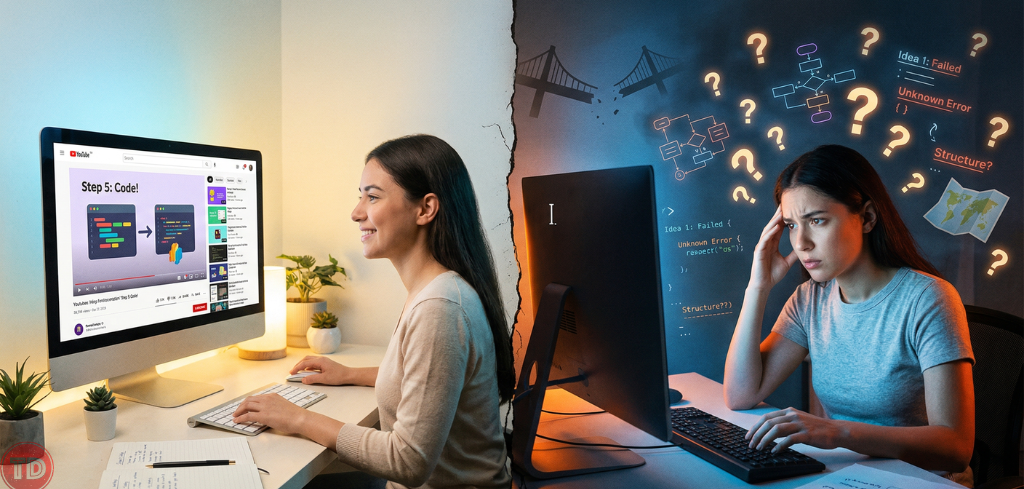
Why Learning from Tutorials Makes Building Harder
You don’t really notice the gap while you’re still following tutorials. It only becomes obvious when you try to build something without one.
That’s when simple decisions start to feel difficult. You hesitate on where to begin, how to structure things, or which approach to take. These aren’t advanced problems, but they feel like they are because you haven’t had much practice making those decisions yourself. If your entire process is based on learning from tutorials, it becomes harder to build independently. You get used to seeing solutions instead of working your way toward them.
This is why people talk about “tutorial hell.” You keep learning, you keep building things with guidance, but the moment you remove that structure, you feel stuck again. The issue isn’t effort. It’s that most of your experience has been guided, not self-directed.
This is similar to what happens when people rely only on structured learning, as discussed in Learning Outside the Curriculum: Why Students Fall Behind After Graduation.
Moving Beyond Learning from Tutorials
Tutorials aren’t the problem. You need them, especially when you’re starting or learning something new. The problem is when they become your default.
What actually helps is changing how you use them.
Instead of going through long tutorials in one sitting, it’s better to slow things down and give yourself time to process what you’ve learned. Breaking things into smaller chunks and forcing yourself to recall or rebuild parts from memory helps move that knowledge into something more permanent.
You can also pause more often and try to predict the next step instead of waiting for it to be shown. After finishing a project, close the tutorial and try to rebuild it from memory. You’ll forget parts, and that’s exactly where the learning starts.
You can also try building something small without any guide at all. It doesn’t have to be impressive, and it will probably take longer, but it forces you to make decisions instead of just following them.
What Actually Matters
At some point, the way you measure progress needs to change. It’s easy to count how many tutorials you’ve completed, but that doesn’t tell you much about what you can actually do.
A better question to ask is what you can build without help.
It’s not as comfortable, but it’s more honest, and it gives you a clearer sense of where you actually are. Learning from tutorials can help you get started, but it shouldn’t be where you stop.
At some point, learning from tutorials has to turn into building on your own. That’s where things start to click.
References:
- https://www.coursera.org/articles/illusion-of-competence
- https://www.linkedin.com/pulse/20141119094202-24983607-illusion-of-competence-how-it-affects-our-learning-and-what-we-can-do-about-it/
- https://www.linkedin.com/pulse/breaking-free-from-tutorial-trap-how-i-learned-learn-kartik-puri/
- https://dev.to/andrewlundydev/how-to-get-out-of-or-completely-avoid-the-tutorial-trap-m27
🤖 $3.74 ONLY for Claude eBooks and Get 25% OFF All Claude Reviewers

Turn Your Team Into Cloud-Ready Professionals Today
Learn AWS with our PlayCloud Hands-On Labs

$2.99 AWS and Azure Exam Study Guide eBooks

Learn GCP By Doing! Try Our GCP PlayCloud

Learn Azure with our Azure PlayCloud

FREE AI and AWS Digital Courses

FREE AWS, Azure, GCP Practice Test Samplers

Subscribe to our YouTube Channel

Follow Us On Linkedin


Written by: Jasmyn Japag