
Imagine asking an AI:
“Find me a mechanical keyboard under ₱3,000 and just order it for me.”
And instead of giving you links… it actually completes the purchase.
Sounds convenient, but also a bit unsettling at the same time.
That might sound futuristic, but this idea is becoming increasingly possible with emerging technologies like the Universal Commerce Protocol (UCP).
As AI systems evolve from simple assistants into agents capable of taking actions, UCP introduces a way for these systems to interact with real-world commerce in a structured and standardized manner.

What is UCP?
The Universal Commerce Protocol is an open, vendor-agnostic protocol designed to enable seamless AI-driven commerce.
It standardizes how AI agents, merchants, and payment providers interact, allowing AI systems to:
- discover products
- evaluate options
- negotiate or select transactions
- and complete purchases on behalf of users
One of its key goals is to eliminate the need for custom integrations per platform, which has traditionally made automation across different e-commerce systems difficult.
Instead, UCP introduces a common language and set of primitives for:
- product discovery
- checkout flows
- post-purchase processes (e.g., tracking, returns)
In simple terms, UCP allows AI to move from “helping you decide” to “helping you act.”
Why Does UCP Exist?
Despite rapid advancements in AI, there is still a major limitation:
AI can understand and recommend, but it cannot easily act across fragmented systems.
Today’s commerce ecosystem is highly inconsistent:
- each platform has different APIs
- product data formats vary
- checkout systems differ
- payment handling is siloed
This fragmentation creates friction for automation.
UCP addresses this by:
- standardizing interactions
- reducing integration complexity
- enabling interoperability across platforms
Essentially, UCP turns a fragmented commerce ecosystem into something AI can reliably navigate.
Emergence of UCP
UCP was introduced by Google in collaboration with major commerce platforms such as Shopify, Etsy, Wayfair, Target, and others.

Its emergence is closely tied to the rise of AI agents, systems that are no longer limited to generating responses but are capable of:
- planning
- decision-making
- executing tasks
As these agents become more capable, the need for a standardized execution layer becomes critical.
UCP represents one of the early steps toward enabling AI to participate directly in economic activities.
How UCP Works (Technical Overview)
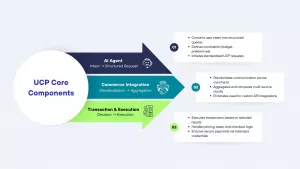
UCP operates by defining a structured interaction model between three key components. These layers work together to transform user intent into actual transactions across multiple commerce systems
1. AI Agent Layer
This is where user intent originates.
The AI:
- interprets user requests (e.g., “find budget headphones”)
- extracts key constraints such as budget, preferences, or features
- converts this intent into structured queries that follow a standardized format
Instead of working with raw natural language alone, the AI translates user intent into a form that downstream systems can process consistently. This structured output is what enables seamless interaction with multiple platforms through UCP.
2. Commerce Integration Layer
Once the request is structured, it is passed into the Commerce Integration Layer, where UCP plays its most critical role.
Through standardized schemas, UCP allows AI agents to communicate with different merchant systems without needing custom integrations for each platform.
Instead of calling different APIs per platform, UCP provides:
- unified request and response formats
- normalized product data across sources
- consistent interaction workflows
This allows AI agents to:
- query multiple merchants simultaneously
- compare results across platforms
- aggregate structured responses into a single, coherent output
In short, this layer transforms fragmented commerce systems into a unified, AI-readable environment. This is where much of the complexity is hidden from the user.
3. Transaction & Execution Layer
After identifying the best option, the process moves into the execution phase, where real-world actions take place.
UCP supports:
- checkout workflows based on selected products
- dynamic pricing and tax calculations depending on context
- secure payment handling using tokenized credentials
This ensures that transactions are not only automated but also accurate, secure, and consistent across platforms.
Core Capabilities of UCP
To better understand its technical depth, UCP defines several foundational capabilities:
Checkout
Supports complex transaction logic, including:
- cart composition
- dynamic pricing
- tax calculation
- secure payment processing
It enables both:
- human-assisted checkout
- fully automated transactions
Identity Linking
Uses standards such as OAuth 2.0 to authorize AI agents to act on behalf of users.
This enables:
- account-linked purchases
- personalized pricing
- loyalty program integration
This is essential for trust, authentication, and authorization.
Order Management
Handles post-purchase lifecycle events through structured updates.
Includes:
- order tracking
- shipping updates
- returns and refunds
Often implemented using:
- webhook-based notifications
- real-time status synchronization
Where UCP Fits in the AI Ecosystem
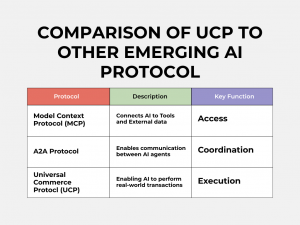
UCP is part of a broader ecosystem of emerging AI protocols that each serve a different role in enabling intelligent, autonomous systems.
For Example:
- Model Context Protocol (MCP) connects AI systems to external tools, APIs, and data sources, allowing them to access the information they need
- A2A (Agent-to-Agent) Protocol enables communication and coordination between multiple AI agents working together.

While these protocols focus on access and coordination, UCP introduces a different capability.
UCP focuses on:
enabling AI to perform real-world transactions and execute actions across commerce systems.
You can think of it as forming a layered workflow:
- MCP → access (data, tools, APIs)
- A2A → coordination (communication between agents)
- UCP → execution (real-world actions and transactions)
Together, they represent a progression:
from retrieving information → to coordinating tasks → to taking action
Looking at it this way makes it easier to understand how these protocols complement each other rather than compete.
Real-World Applications
While often associated with e-commerce, UCP extends beyond shopping:
- booking flights and accommodations
- managing subscriptions
- paying bills
- purchasing digital or physical services
In essence, any scenario involving both decision-making and transaction can benefit from UCP.
In addition, widespread adoption of UCP depends on industry alignment. Merchants, platforms, and payment providers must agree on shared standards and integrate them into their systems. Without broad adoption, the benefits of standardization may be limited.
Why It Matters
UCP represents a fundamental shift in how users interact with digital systems.
Traditionally, completing a task such as buying a product involves multiple steps:
- searching for options
- comparing alternatives
- making a decision
- manually completing the transaction
Even with AI assistance today, most systems stop at recommendation.
With UCP, this process can become significantly more streamlined.
AI systems are no longer limited to assisting users, they can now extend beyond assistance by:
- handle end-to-end workflows
- make context-aware decisions
- execute actions on behalf of the user, with defined constraints or user approval
This leads to:
- Increased efficiency – fewer manual steps required
- Reduced friction – seamless interaction across platforms
- Improved decision-making – AI can process and compare more data than a human can manually
UCP shifts AI from being a tool for guidance to a system capable of execution.
While UCP enables AI to automate many tasks, it does not necessarily eliminate the role of human decision-making. In many cases, these systems are designed to assist rather than replace users, providing recommendations or executing actions only with user approval. The goal is not full replacement, but augmentation, reducing effort while still keeping users in control.
Challenges and Considerations
Despite its potential, UCP introduces several important challenges that must be addressed before widespread adoption becomes feasible.
One of the primary concerns is trust. Allowing an AI system to make purchasing decisions on behalf of a user raises questions about reliability and intent. Users must have confidence that the AI is acting in their best interest, especially when financial transactions are involved.
Closely related to this is security. Since UCP enables automated transactions, it relies heavily on mechanisms such as tokenized credentials and authorization protocols. Ensuring that sensitive payment and identity data remain secure is critical, as any vulnerability could lead to significant risks.
Another key issue is accountability. If an AI agent makes an incorrect purchase such as selecting the wrong product or misinterpreting user intent, it becomes unclear who is responsible. Is it the user, the AI provider, or the merchant system? This lack of clear responsibility introduces both technical and legal challenges.
There is also the concern of over-automation. While automation improves efficiency, excessive reliance on AI may reduce user control. Users may still want the ability to review, approve, or override decisions before transactions are completed. Over time, heavy reliance on AI-driven systems may also reduce users’ active involvement in decision-making, potentially leading to over-dependence on automated recommendations.
Another important consideration is decision quality and bias. AI systems rely on data and algorithms, which means their recommendations may not always be neutral or optimal. Factors such as ranking logic, merchant preferences, or incomplete data could influence outcomes, potentially leading to suboptimal or biased decisions.
These considerations highlight that while UCP enables powerful new capabilities, its adoption will depend not only on technical implementation but also on how well these risks are managed.
Conclusion
AI has traditionally been viewed as a tool for assistance like answering questions, providing recommendations, and summarizing information.
However, UCP introduces a different direction.
AI is no longer just becoming smarter, it is becoming capable of acting.
This shift does not necessarily imply replacing human decision-making. Instead, it points toward a more collaborative model, where AI systems handle execution while users remain in control of key decisions.
As this capability continues to evolve, it may redefine how people interact with technology, not just as users, but as collaborators with intelligent systems.
References
Overview | Google Universal Commerce Protocol (UCP) Guide | Google for Developers
Roadmap – Universal Commerce Protocol (UCP)
Universal Commerce Protocol – Universal Commerce Protocol (UCP)
Under the Hood: Universal Commerce Protocol (UCP) – Google Developers Blog
Universal Commerce Protocol (UCP): What You Need to Know
🤖 $3.74 ONLY for Claude eBooks and Get 25% OFF All Claude Reviewers

Turn Your Team Into Cloud-Ready Professionals Today

Learn AWS with our PlayCloud Hands-On Labs

$2.99 AWS and Azure Exam Study Guide eBooks

Learn GCP By Doing! Try Our GCP PlayCloud
Learn Azure with our Azure PlayCloud

FREE AI and AWS Digital Courses

FREE AWS, Azure, GCP Practice Test Samplers


Subscribe to our YouTube Channel

Follow Us On Linkedin


Written by: Rhome Louie Saringayat