
Amazon GameLift Cheatsheet
- A fully managed service for deploying, operating, and scaling dedicated game servers for session-based multiplayer games
- Handles up to 100 million concurrent players in a single game and can launch up to 9,000 game servers per minute
- Built on AWS global infrastructure with 99.95% availability SLA across 26 Regions and 9 Local Zones
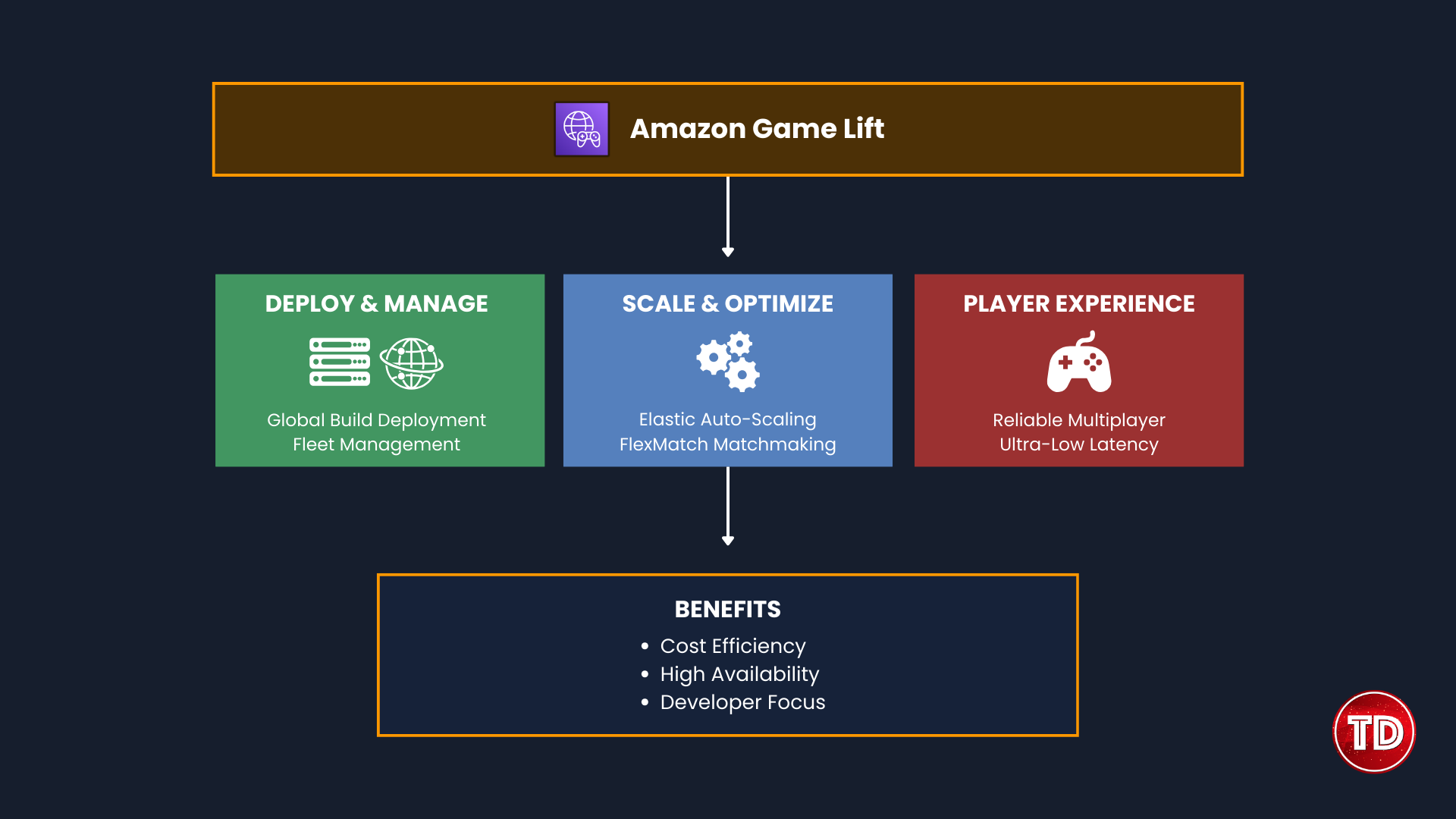
Amazon GameLift Family
- Amazon GameLift Servers – Dedicated game server hosting for session-based multiplayer games with managed or self-managed infrastructure options
- Amazon GameLift Streams – Game streaming service that delivers up to 1080p resolution at 60 fps to any browser-enabled device
Amazon GameLift Key Features
- Deploy game servers globally with multi-location fleets spanning AWS Regions and Local Zones for lowest possible latency to players
- Choose from managed EC2 hosting (Windows/Linux), managed container hosting (Linux containers), or GameLift Anywhere (your own hardware)
- Auto-scale capacity based on player demand using target-based scaling or manual adjustment, with support for both On-Demand and Spot Instances
- Use FlexMatch matchmaking to connect 2 to 200 players based on custom rules including skill level, latency, team composition, and player attributes
- Leverage game session queues that intelligently place players across multiple locations based on cost, latency, and availability
- Integrate with Unity and Unreal Engine using full-featured plugins, or use Server SDKs for C++, C#, and Go

Amazon GameLift Architecture Components
- Game Client – Runs on player devices and sends matchmaking or game session requests to your backend service with player data and latency information
- Backend Service – Coordination layer that makes API calls to GameLift for game session placement, retrieves session information, and handles authentication
- Game Server – Integrated with GameLift Server SDK to manage game sessions, report status, and handle player connections during gameplay
- GameLift Fleet – Collection of EC2 instances or containers running your game servers with configured capacity and scaling policies
- Game Session Queue – Processes placement requests and locates available resources using algorithms that optimize for player experience
Amazon GameLift Hosting Options
- Managed EC2 Hosting – Deploy on compute-optimized (C-family), memory-optimized (R-family), or ARM-based Graviton instances with Windows or Linux
- Managed Container Hosting – Deploy Linux-based containers with efficient resource utilization by running multiple game servers per instance
- GameLift Anywhere – Use your own hardware, on-premises infrastructure, or other cloud providers while leveraging GameLift’s session management capabilities
- Hybrid Hosting – Combine managed fleets and Anywhere fleets for migration scenarios or to integrate with existing infrastructure
Amazon GameLift FlexMatch Matchmaking
- Customizable matchmaking service that evaluates players based on attributes like skill level, character choice, latency, and player preferences
- Supports team-based matches for competitive or cooperative gameplay with automatic team balancing across composition
- Includes match backfilling feature to fill available player slots in existing game sessions and keep games full
- Rules can be expandable, meaning they relax over time to balance match quality with acceptable wait times
- Optional player acceptance workflow where matched players must accept before game session is created
Amazon GameLift Pricing
- Pay only for EC2 instance usage with per-second billing (1-minute minimum) plus data transfer out charges
- Spot Instances save 50-85% compared to On-Demand prices while maintaining the same performance and capabilities
- Graviton instances provide up to 20% better price-performance compared to x86-based instances for compatible workloads
- Linux instances cost significantly less than Windows Server instances due to operating system licensing differences
- Scale to zero by setting fleet capacity to zero during off-peak periods to eliminate costs when no players are online
- Volume discounts available for games with monthly costs exceeding $80,000
Amazon GameLift Monitoring and Operations
- Real-time metrics available through Amazon CloudWatch for game sessions, player activity, fleet performance, and instance health
- Automatic game server log collection with retrieval capabilities for troubleshooting and performance analysis
- Built-in OpenTelemetry (OTel) metrics collection with support for custom telemetry metrics from your game servers
- Fleet event tracking for state transitions and creation events accessible via DescribeFleetEvents API
- Remote access to instances using AWS Systems Manager (SSM) instead of SSH for secure operational management
Amazon GameLift Security Best Practices
- Use backend service pattern to make GameLift API calls rather than exposing AWS credentials to game clients
- TLS encryption for communication between game clients and game servers ensures data protection in transit
- Replace fleets every 30 days to maintain security updates and patches (fleet age warning appears at 90 days)
- Server Side Encryption (SSE) for SNS topics using AWS KMS for matchmaking event notifications
- AWS IAM for fine-grained access control and permissions management across GameLift resources

Amazon GameLift Common Use Cases
- Session-based multiplayer games including battle royale (up to 200 players), competitive shooters, team-based games, and casual multiplayer
- Hybrid cloud solutions for migrating from on-premises to cloud or combining managed fleets with existing infrastructure
- Local development and testing using GameLift Anywhere to redirect game session requests to local development environments
- Game streaming for instant-play demos, game storefronts, subscription services, and back catalog monetization without requiring downloads
Amazon GameLift AWS Service Integration
- Amazon Cognito for player authentication and identity management across your game infrastructure
- Amazon DynamoDB and Aurora DSQL for game state persistence, player data storage, and leaderboards
- Amazon S3 for game content storage and delivery of assets to game servers and clients
- Amazon Kinesis for real-time game analytics and processing of player behavior data
- Amazon Chime SDK for voice chat functionality integrated directly into your multiplayer experience
- AWS Lambda and API Gateway for custom backend logic, player parties, and game-specific features
Amazon GameLift Limitations
- Maximum 200 players per game session by default (can request increase for larger matches)
- Fleet replacement recommended every 30 days for security updates with warning appearing at 90 days
- Per-second billing with 1-minute minimum charge per instance means very short sessions still incur minimum costs
- Managed container hosting supports Linux-based containers only, Windows containers not currently available
References
- https://docs.aws.amazon.com/gameliftservers/
- https://docs.aws.amazon.com/gameliftservers/latest/developerguide/gamelift-intro.html
- https://docs.aws.amazon.com/gameliftservers/latest/flexmatchguide/match-intro.html
- https://docs.aws.amazon.com/gameliftstreams/
- https://docs.aws.amazon.com/gameliftservers/latest/developerguide/reference-serversdk.html
🤖 $3.74 ONLY for Claude eBooks and Get 25% OFF All Claude Reviewers

Turn Your Team Into Cloud-Ready Professionals Today

Learn AWS with our PlayCloud Hands-On Labs
$2.99 AWS and Azure Exam Study Guide eBooks

Learn GCP By Doing! Try Our GCP PlayCloud

Learn Azure with our Azure PlayCloud
FREE AI and AWS Digital Courses

FREE AWS, Azure, GCP Practice Test Samplers

Subscribe to our YouTube Channel

Follow Us On Linkedin


Written by: Ostline Casao

Ostline is a Computer Science undergraduate at Cavite State University. She is an AWS Certified Cloud Practitioner with experience in web development and Web3 technologies. She actively contributes to tech communities and edutech platforms that promote accessible education.