
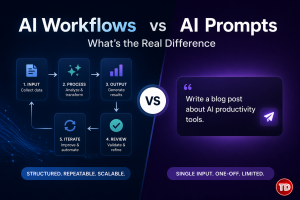
At first, using AI feels simple. You type a prompt, get a response, and move on. That’s how most people start, and for basic tasks, it works. But as you try to do more complex or repeatable work, you begin to notice something: prompts alone aren’t enough. This is where the difference between AI workflows vs AI prompts starts to matter, because the way you structure your interaction with AI directly affects the quality and consistency of your results. Over time, many users realize that the real power of AI doesn’t come from writing better one-off prompts, but from designing systems that guide how AI behaves across tasks. Understanding this shift is what separates casual AI usage from actually building reliable outputs. AI prompts are the most basic way to interact with AI. You give an instruction, the model responds, and that’s it. This works well for simple tasks like asking questions, generating quick content, or getting explanations. Prompts are fast, flexible, and easy to use, which is why they’re often the first thing people learn. However, prompts have limitations. Each interaction is usually isolated, meaning the AI doesn’t retain structured context unless you repeat it. This leads to inconsistency, especially when you expect similar outputs across multiple tasks. You might get a great response once, then struggle to replicate it again. This is why many people spend time refining prompts, trying to get the “perfect” wording. While that can help, it doesn’t fully solve the problem of repeatability. AI workflows take a different approach. Instead of relying on a single prompt, workflows structure a series of steps, rules, or systems that guide how the AI operates. This can include predefined instructions, formatting rules, task breakdowns, or even reusable templates. The key advantage of workflows is consistency. Instead of starting from scratch every time, you create a repeatable process that produces more predictable results. This is especially useful for tasks like coding, content creation, research, or automation, where structure matters. In practice, workflows reduce the need to think about “what to say” each time. The system already knows what to do. This not only saves time but also improves output quality because the AI is guided more clearly. As tasks become more complex, prompts start to show their limits. You may find yourself writing longer and more detailed instructions just to get consistent results. Even then, small changes in wording can lead to different outputs, which can be frustrating. This happens because prompts are inherently one-time instructions. They don’t enforce structure unless you manually include it every time. Over time, this creates friction, especially when you’re repeating similar tasks. This is also why many beginners feel that AI is “inconsistent.” In reality, the issue is not the AI itself, but the lack of structure in how it’s being used. Workflows solve this by turning AI usage into a system rather than a single interaction. Instead of relying on memory or repetition, the workflow defines how tasks should be handled from start to finish. This makes outputs more stable and easier to refine over time. Another advantage is scalability. Once a workflow works well, it can be reused across multiple tasks or even shared with others. This is why tools like AI agents, automation platforms, and systems like Claude Skills are becoming more popular; they are built around workflows, not just prompts. This shift reflects how real-world work happens. Most tasks are not one-step instructions; they involve processes. Workflows bring AI closer to how people actually work. The simplest way to understand the difference is this: prompts are instructions, while workflows are systems. Prompts tell AI what to do in a single moment, while workflows define how AI should behave across multiple steps. Both have their place. Prompts are great for quick tasks and exploration, while workflows are better for consistency, efficiency, and scaling work. The key is knowing when to use each one. For beginners, starting with prompts makes sense. But as your needs grow, transitioning to workflows becomes necessary if you want more reliable results. The way people use AI is changing quickly. Early users focused on writing better prompts, but the conversation is now shifting toward building better systems. This is why workflows, automation, and AI agents are becoming central to modern tech discussions. In 2026, the advantage is no longer just about accessing AI, it’s about how you structure it. People who understand workflows can get more consistent, higher-quality results with less effort. This makes workflows not just a feature, but a core skill. Understanding AI workflows vs AI prompts changes how you approach AI completely. Prompts are a great starting point, but they often fall short when tasks become repetitive or complex. Workflows solve this by adding structure, consistency, and scalability to how AI is used. As AI continues to evolve, the ability to design workflows will become more important than simply writing good prompts. In the long run, the people who build systems will always outperform those who rely on one-off instructions.
What AI Prompts Actually Do
What AI Workflows Change

Why Prompts Alone Start to Break Down

Why Workflows Feel More Reliable
The Real Difference Between AI Workflows vs AI Prompts
Why This Shift Matters in 2026
Conclusion
References
🔔 20% OFF All Reviewers + 10% OFF PlayCloud’s First Billing Use Code: TDPLAYCLOUD-101326

Turn Your Team Into Cloud-Ready Professionals Today

Learn AWS with our PlayCloud Hands-On Labs

$2.99 AWS and Azure Exam Study Guide eBooks

Learn GCP By Doing! Try Our GCP PlayCloud

Learn Azure with our Azure PlayCloud

FREE AI and AWS Digital Courses

FREE AWS, Azure, GCP Practice Test Samplers


Subscribe to our YouTube Channel

Follow Us On Linkedin


Written by: Ian Vergara