Every software team knows the feeling. You ship fast to hit a deadline, planning to clean it up late, but “later” never comes. Soon, quick fixes pile up, and instead of saving time, you’re spending more than you planned. That’s technical debt in a nutshell — and it’s not going away anytime soon.
What is changing is how we manage and deal with it. Modern systems are more distributed, interconnected, and increasingly powered by AI. In this environment, periodic clean-ups, manual code reviews, and occasional rewrites aren’t enough. Costs compound faster, dependencies deepen, and risks become harder to trace.
So the real question today isn’t whether your team has tech debt. It’s whether you have the tools and the mindset to manage it before it manages you.
What is Technical Debt?
The term was coined by Ward Cunningham, who compared it to financial debt: you borrow against future maintainability to ship something faster today. The longer you wait to “pay it back,” the more interest accumulates.
In practice, technical debt shows up as:
A trade-off — shipping quickly at the cost of long-term maintainability
A strategic decision — sometimes intentional, especially under tight deadlines
A compounding cost — making systems progressively harder to change, scale, and understand
A system-wide issue — touching not just code, but architecture, infrastructure, and processes too
Not all technical debt is bad. Done intentionally, it’s a valid engineering trade-off. Problems arise when it accumulates silently without visibility or a plan, turning a shortcut into a huge constraint.
What Causes Technical Debt?
Technical debt rarely stems from a single mistake. It slowly builds from daily decisions under real-world constraints. Common causes include:
Time pressure and tight deadlines
Teams prioritize speed to meet delivery goals, reaching for quick solutions over well-structured ones.
Legacy systems and outdated architecture
Older systems weren’t designed for modern scalability, making it harder to integrate new features cleanly.
Poor documentation and knowledge gaps
When system behavior is unclear, developers rely on assumptions, which introduce inconsistencies over time.
Changing requirements
As products evolve, earlier design decisions can become misaligned with current needs, leading to patchwork solutions.
Lack of standards and governance
Inconsistent coding practices across teams create fragmentation that compounds over time.
The takeaway here is that tech debt isn’t a sign of poor engineering; it’s often a natural byproduct of how software gets built in the real world.
Types of Technical Debt
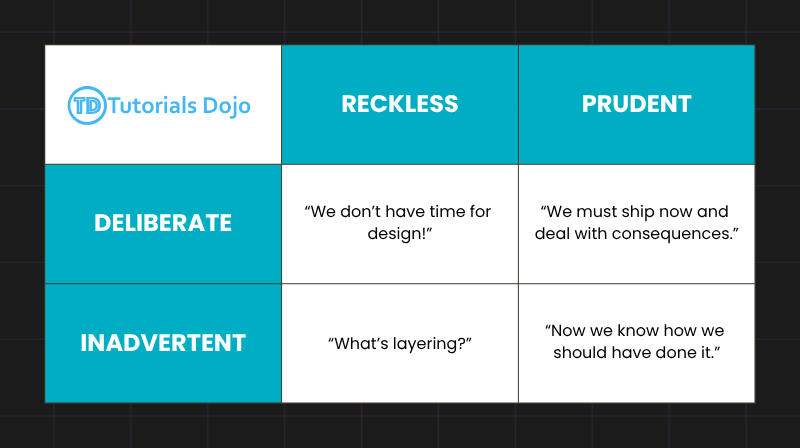
Technical debt quietly accumulates across all layers of a system, often going unnoticed until it must be addressed. Martin Fowler’s Technical Debt Quadrant classifies it by two dimensions: whether it was deliberate or inadvertent, and whether it was reckless or prudent. But beyond intent, it’s equally important to understand where it lives.
Architectural Debt
This is debt baked into the system’s foundation: tight coupling, monolithic designs, and structures that weren’t built to scale. Even small changes become expensive when the architecture isn’t flexible. Over time, architectural debt slows development and limits the system’s ability to evolve.
Code Debt
This is the most visible form: duplicated logic, unclear naming, missing documentation, and inconsistent patterns. Individually, these seem minor, but together, they make code harder to debug, test, and extend.
Infrastructure and DevOps Debt
Outdated CI/CD pipelines, unmanaged dependencies, and poorly configured cloud environments cause deployment and delivery friction. This debt is often overlooked until something breaks.
Process Debt
This one lives outside the codebase. Poor collaboration practices, unclear workflows, missing documentation, and growing backlogs slow teams and make consistency harder as systems grow.
Security Debt
Weak authentication, unpatched vulnerabilities, and missing encryption — security debt is especially dangerous because it doesn’t just slow you down, it puts your systems and users at risk. Unlike other forms of debt, this one can’t wait for a convenient sprint to fix.
Why Technical Debt is Harder in Modern Systems
Managing tech debt has never been simple, but modern architectures make it even more challenging. Moving from monolithic to distributed, cloud-native systems introduces new challenges.
Today’s systems span microservices, APIs, third-party integrations, and increasingly, AI-driven components. That means:
Dependencies are less visible — A change in one service can ripple across dozens of others in ways that are hard to trace.
Complexity is distributed — There’s no single codebase to audit. Debt accumulates across infrastructure, workflows, and services simultaneously.
Rapid iteration cycles — The pressure to ship continuously means there’s rarely a natural pause to address underlying issues.
AI integrations introduce unpredictability — AI components exhibit behavior that’s harder to reason about than traditional logic, making it harder to predict how changes will propagate.
In this environment, tech debt is no longer isolated to one team or module—it’s systemic, and that’s when it’s most expensive.
The Role of AI in Managing Technical Debt
The irony is that the AI-driven pace of creating tech debt also brings better tools for managing it. AI can’t eliminate technical debt, but it changes the game in meaningful ways. Here’s where Artificial Intelligence (AI) is actually making a difference:
Code analysis and pattern detection
AI tools can scan large codebases to identify duplicated logic, inconsistencies, and hidden design issues that would take weeks to find manually.
Refactoring assistance
Instead of rewriting legacy code from scratch, developers can use AI-assisted tools to suggest improvements, standardize implementations, and modernize outdated structures.
Documentation generation
AI can reconstruct system context, explain code behavior, and fill gaps left by years of missing documentation, one of the most common (and invisible) sources of tech debt.
Observability and system visibility
By analyzing logs, dependencies, and usage patterns, AI tools can surface hidden relationships between services, making it easier to understand downstream effects of changes.
Predictive insights
Rather than reacting to problems after they compound, AI can help teams identify where debt is likely to emerge and address it earlier in the development cycle.
These capabilities make managing tech debt more continuous and data-informed. AI brings a new level of visibility, allowing teams to surface, measure, and prioritize technical debt in real time, something not previously achievable. While engineering judgment remains crucial, AI uniquely empowers teams to proactively address debt with targeted accuracy.
AI in Practice: Tools Doing the Work
These tools aren’t theoretical. They are already in production, used by real engineering teams to reduce debt that once took years to untangle. Here are some tools leading the charge:
AWS Transform is an enterprise-focused intelligent agent built for large-scale code modernization. It supports upgrades to Java, Node.js, and Python, and lets teams define custom transformations using organization-specific policies. Since launch, customers have used it to save over 1,000,000 hours of manual effort while analyzing 1.8 billion lines of code. Air Canada used it to modernize thousands of Lambda functions in days, cutting expected time and costs by 80%.
GitHub Copilot tackles debt at the developer level. Its coding agent can handle large-scale refactors autonomously, embedded directly into existing IDEs and PR workflows. GitHub’s own billing team cut tech debt removal from weeks of split-focus work down to a few hours of reviewing and iterating on a pull request.
Other tools like Qodo, Cursor, and Augment round out the ecosystem, each targeting different layers of the debt problem.
The common thread: AI handles the repetitive, high-risk parts of refactoring so teams can keep systems evolving without grinding to a halt.
Limitations: AI Does Not Eliminate Technical Debt
That said, it’s worth being clear-eyed about what AI can and can’t do here. The hype around these tools is real, but so are the limitations.
A few things to keep in mind:
AI lacks full system context — AI can analyze patterns in code, but it doesn’t understand business logic, historical decisions, or domain-specific constraints. Some recommendations will miss critical nuances that only a developer with deep system knowledge and experience would catch.
Risk of accelerating poor practices — When used without proper oversight, AI can generate code that follows existing patterns, even if those patterns are already problematic. It’s possible to automate your way deeper into debt if you’re not careful.
Dependence on input quality — Garbage in, garbage out. If the underlying system is poorly structured, the AI’s outputs are likely to reflect the same problems rather than resolve them.
Over-reliance on automation — Teams that lean too heavily on AI-generated suggestions may end up with surface-level fixes instead of addressing deeper architectural issues. The tool can implement changes, but the decision about what to fix still has to come from the devs.
AI falls flat when it needs to account for all the hidden business logic in legacy applications, and that’s not a knock on the tools; it’s just an honest assessment of what they’re designed to do. They’re built to handle repetitive and pattern-driven work. The strategic decisions still belong to engineering teams.
Tech Debt Over Time
Technical debt is as old as software development itself, and it’s not going anywhere. What has changed is the scale and complexity of the systems we’re building and the tools we now have to manage the debt those systems accumulate. AI makes tech debt more visible. It helps make remediation more efficient. And it enables a more continuous approach to maintaining system quality, rather than relying on periodic cleanup sprints that never seem to get prioritized.
But none of that replaces the fundamentals: deliberate design choices, clear standards, and teams that actually understand the systems they’re building. AI shifts what’s possible — it doesn’t shift the responsibility.
In the end, tech debt is still debt. The teams that manage it best aren’t the ones who avoid it entirely; they’re the ones who stay aware of it, address it deliberately, and use every tool available to keep it from running the show.
⚡$4.99 Claude Certified Architect Foundations CCAR-F Practice Exams
Turn Your Team Into Cloud-Ready Professionals Today
Learn AWS with our PlayCloud Hands-On Labs
$2.99 AWS and Azure Exam Study Guide eBooks
Learn GCP By Doing! Try Our GCP PlayCloud
Learn Azure with our Azure PlayCloud
FREE AI and AWS Digital Courses
FREE AWS, Azure, GCP Practice Test Samplers
Subscribe to our YouTube Channel
Follow Us On Linkedin
Written by: Cristieneil Ceballos
Cristieneil Ceballos, “Cris” for short, is a Computer Science student at the University of the Philippines Mindanao and an IT Intern at Tutorials Dojo. Passionate about continuous learning, she volunteers and engages with various tech communities—viewing each experience as both a chance to contribute and an opportunity to explore areas she’s interested in.
AWS, Azure, and GCP Certifications are consistently among the top-paying IT certifications in the world, considering that most companies have now shifted to the cloud. Earn over $150,000 per year with an AWS, Azure, or GCP certification!
Follow us on LinkedIn, YouTube, Facebook, or join our Slack study group. More importantly, answer as many practice exams as you can to help increase your chances of passing your certification exams on your first try!
Around 95-98% of our students pass the AWS Certification exams after training with our courses.
200k+
students
Over 200k enrollees choose Tutorials Dojo in preparing for their AWS Certification exams.
~4.8
ratings
Our courses are highly rated by our enrollees from all over the world.
What our students say about us?
I’m deeply impressed by the quality of the practice tests from Tutorial Dojo. They are extremely well-written, clean and on-par with the real exam questions. Their practice tests and cheat sheets were a huge help for me to achieve 958 / 1000 — 95.8 % on my first try for the AWS Certified Solution Architect Associate exam. Perfect 10/10 material. The best $14 I’ve ever spent!
S. M. Shoaib
Khulna, Bangladesh
Given the enormous number of students and therefore the business success of Jon's courses, I was pleasantly surprised to see that Jon personally responds to many, including often the more technical questions from his students within the forums, showing that when Jon states that teaching is his true passion, he walks, not just talks the talk. I much respect and thank Jon Bonso.
Rowan Williams
Brisbane, Australia
The explanation to the questions are awesome. Lots of gap exposed in my learning. I used the practice tests along with the TD cheat sheets as my main study materials. This is a must training resource for the exam.
Using the practice exam helped me to pass. I think I wouldn't have passed if not for Jon's practice sets.
Jessica Chen
Guangzhou, China
I can say that Tutorials Dojo is a leading and prime resource when it comes to the AWS Certification Practice Tests. I also tried other courses but only Tutorials Dojo was able to give me enough knowledge of Amazon Web Services. My favorite part of this course is explaining the correct and wrong answers as it provides a deep understanding in AWS Cloud Platform. The course I purchased at Tutorials Dojo has been a weapon for me to pass the AWS Certified Solutions Architect - Associate exam and to compete in Cloud World. A Big thank you to Team Tutorials Dojo and Jon Bonso for providing the best practice test around the globe!!!
I highly recommend Jon and Tutorials Dojo!!!
Mikelito Luistro
Manila, Philippines
Did you find our content helpful?
X
⚡$4.99 Claude Certified Architect Foundations CCAR-F Practice Exams