
Last updated on December 23, 2025
The Problem: Security Can’t Keep Up
In the current engineering landscape of our industry, modern software teams are supposed to be built to be able to move fast. Continuous integration, automated deployments, and agile workflows have seen the rise of weekly and even daily releases to be the norm. With rising business and customer demands in the time of rapid advancements in technology, new features, fixes, and changes are constantly pushed to production.
However, we all know that security is not meant to be fast and shouldn’t be, lest we leave behind vulnerabilities and loopholes in the pursuit of speed. Consequently, in most systems, security processes have not evolved at the same pace. Application security reviews and penetration tests are still commonly performed on a monthly or quarterly basis, often requiring manual effort, scheduling, and specialized expertise. This results in a widening gap between how frequently applications change and how often they are able to be thoroughly tested for security issues.
As this gap continues to grow, security inevitably becomes a bottleneck, with teams having to either delay releases or continue to move forward knowing that vulnerabilities may exist. Over time, this mismatch will and eventually increase risk, gaps in coverage across applications, and makes it harder for organizations to ship software with confidence in security at speed.
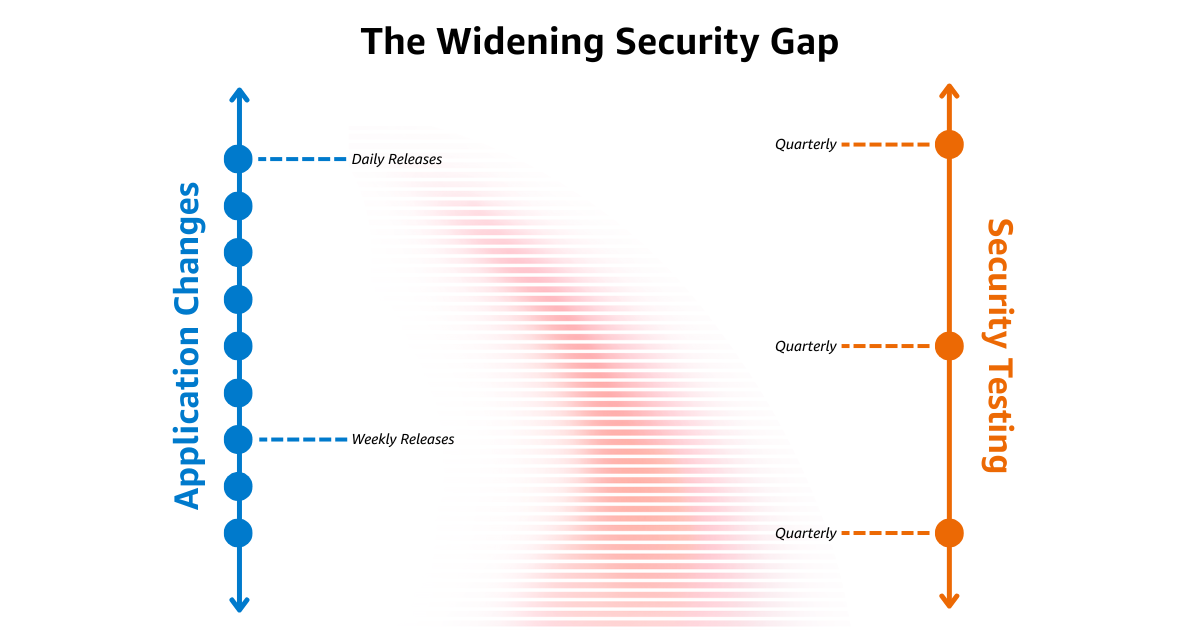
Why Traditional AppSec Tools Aren’t Enough
Traditional AppSec tools focus on narrow slices of the application. SAST analyzes source code without understanding how the application runs, while DAST tests live endpoints without insight into the underlying code or design. Each approach sees only part of the system.
Because these tools lack application context, they often produce noisy results and miss deeper issues tied to architecture or business logic. Security teams must manually interpret findings, which ends up slowing down feedback and limits how often security testing can happen. In environments that are fast-moving (which is a must in today’s world), traditional AppSec tools fall short on their own.
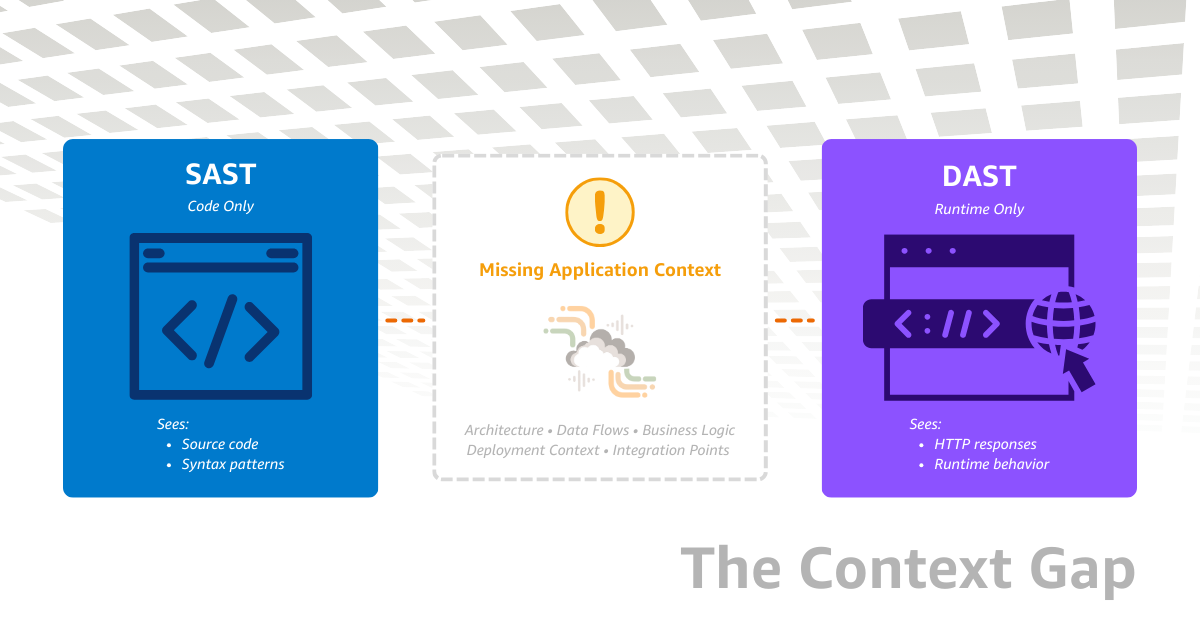
What AWS Security Changes
AWS Security Agent shifts application security from isolated checks to a context-aware approach. Instead of looking only at code or only at running applications, it understands the ins-and-outs of how an application is designed, built, and how it was deployed.

By using this broader context, security reviews and penetration testing can happen continuously and on demand, without waiting on manual processes. This reduces bottlenecks, surfaces more meaningful issues earlier, and allows security to keep pace with modern development workflows.
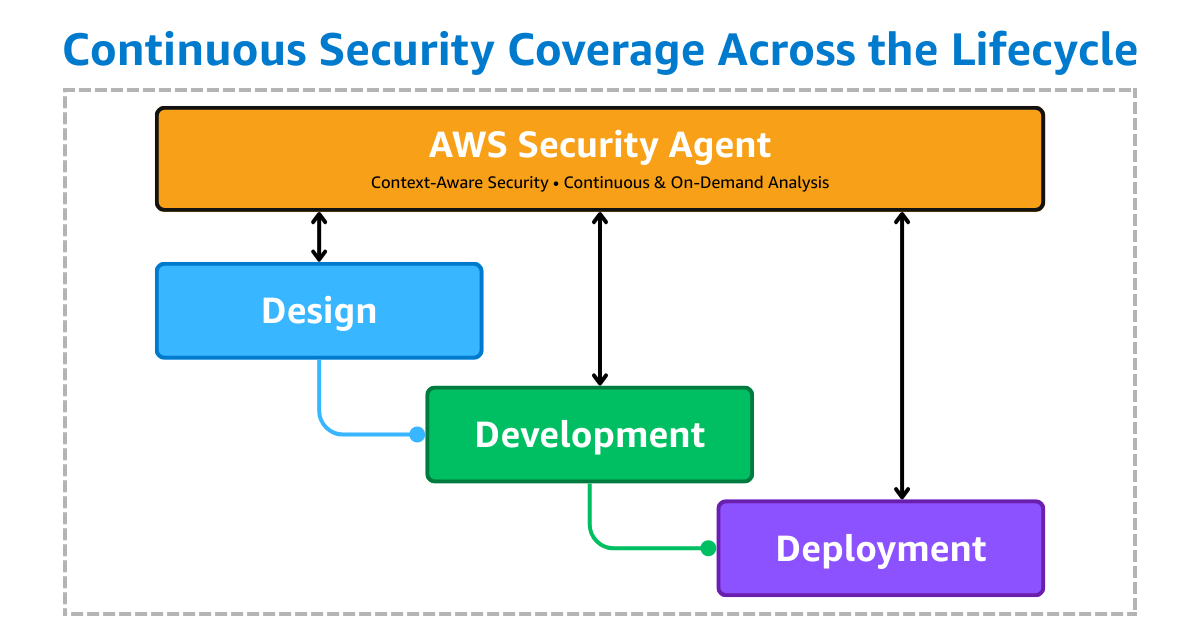
Core Capabilities
AWS Security Agent provides three core capabilities that work together to deliver continuous application security across the development lifecycle: design, security review, code security review, and on-demand penetration testing.
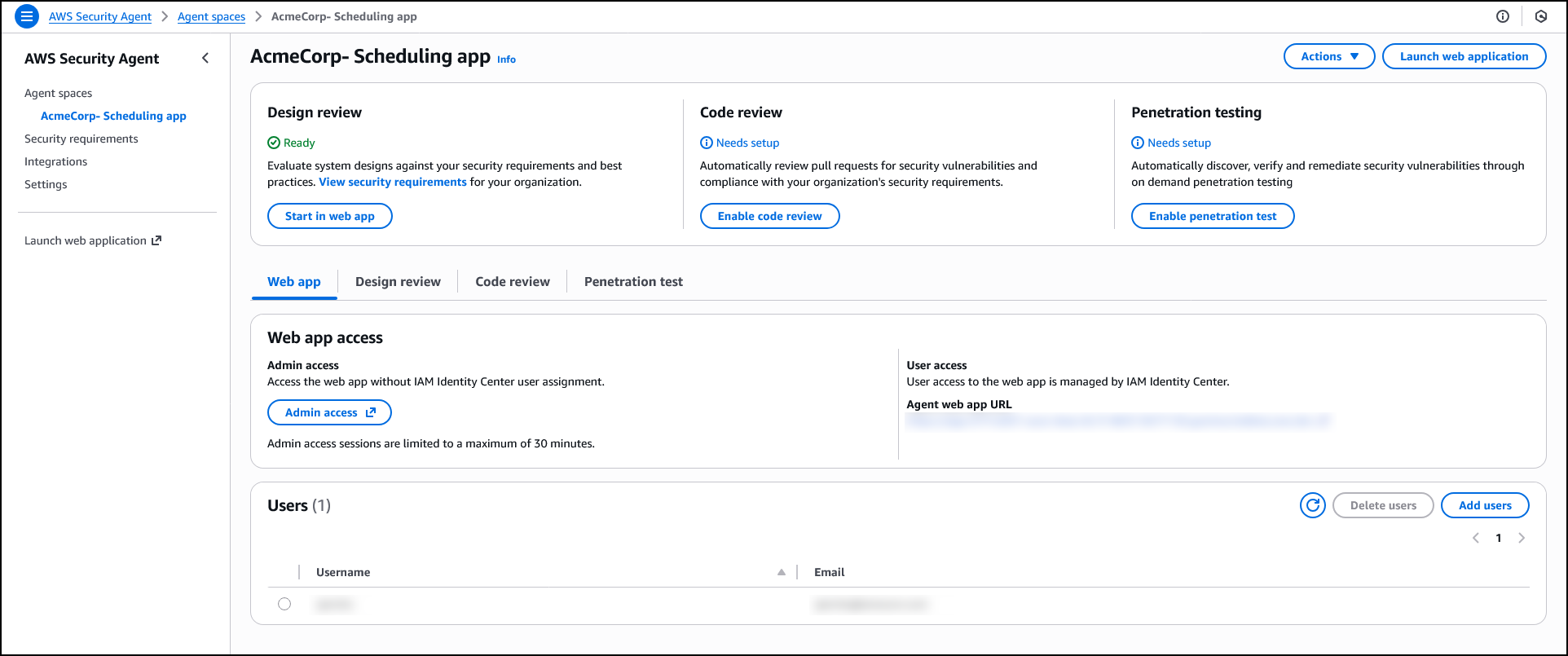
To begin, open the AWS Security Agent console and choose Set up AWS Security Agent. This walks you through the initial configuration and creates your first agent space, which represents a single application or project.
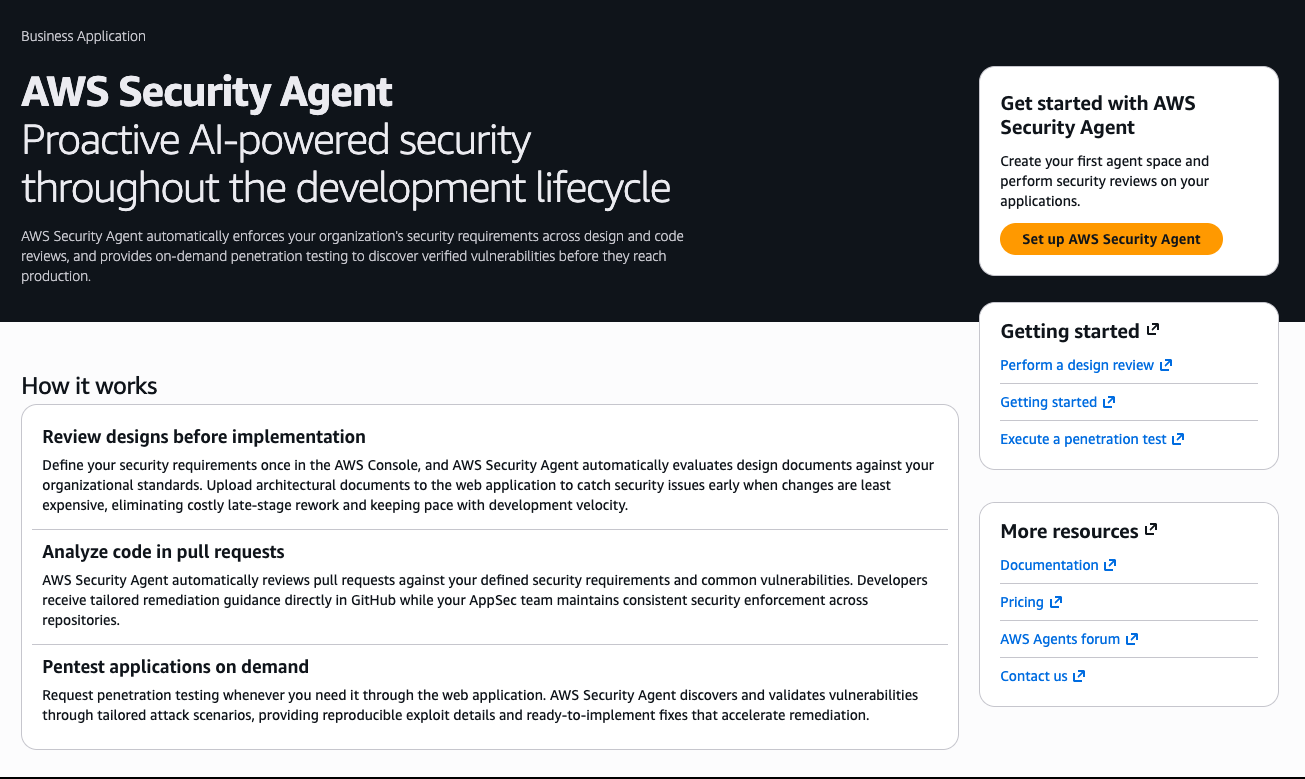
Each agent space has its own security scope and configuration, helping teams keep assessments organized. AWS recommends creating one agent space per application or project.
When an agent space is created, AWS automatically provisions the Security Agent Web Application. This is where teams run design reviews and execute penetration tests within the boundaries you define.
For further details, you can explore here on the official post: https://aws.amazon.com/blogs/aws/new-aws-security-agent-secures-applications-proactively-from-design-to-deployment-preview/
For documentation, you can also explore the official AWS Security Agent docs.
Why This Matters in Practice
In fast-moving development environments, security cannot simply be an afterthought. AWS Security Agent ensures that security keeps pace with rapid release cycles by embedding context-aware checks throughout the development lifecycle.
By combining design reviews, code reviews, and on-demand penetration testing, it helps teams catch vulnerabilities earlier, reduce manual bottlenecks, and consistently enforce organizational security requirements. This approach not only protects applications from risks but also allows teams to release software with confidence, without slowing down innovation.
Who Should Pay Attention
For teams that release software frequently and want security to keep up. This includes AppSec teams, DevOps and platform teams, and development teams building web applications or APIs. Organizations aiming to reduce security bottlenecks, enforce consistent policies, and catch vulnerabilities early will benefit the most.
Closing Remarks
AWS Security Agent brings context-aware, continuous security to modern development workflows. By combining design reviews, code reviews, and on-demand penetration testing, it helps teams catch vulnerabilities early and on time, reduce bottlenecks, and release software with confidence.
Adopting this kind of approach allows organizations to keep pace with fast release cycles with increasing customer demands without compromising on security, making it an essential tool for any team focused on safe, efficient software delivery.
References
🤖 $3.74 ONLY for Claude eBooks and Get 25% OFF All Claude Reviewers

Turn Your Team Into Cloud-Ready Professionals Today

Learn AWS with our PlayCloud Hands-On Labs

$2.99 AWS and Azure Exam Study Guide eBooks

Learn GCP By Doing! Try Our GCP PlayCloud

Learn Azure with our Azure PlayCloud

FREE AI and AWS Digital Courses

FREE AWS, Azure, GCP Practice Test Samplers


Subscribe to our YouTube Channel

Follow Us On Linkedin


Written by: Waffen Sultan