Home » AWS » Are AI Engineers the New Full-Stack Developers?
Are AI Engineers the New Full-Stack Developers?
Last updated on March 3, 2026
Something has been quietly shifting in the tech industry. Job titles that used to sit in completely separate corners of a hiring platform are starting to blur together, and engineers on both sides are feeling it. The full-stack developer who’s suddenly expected to integrate LLMs. The AI engineer who’s now responsible for the frontend, too. But this shift didn’t happen overnight. Compare job postings from three years ago to today, and the difference is hard to ignore. Responsibilities are expanding. Skill expectations are overlapping. And a question that used to sound hypothetical is now very much worth taking seriously: Are AI engineers becoming the new full-stack developers, or do these roles still serve fundamentally different purposes?
Understanding the Roles in Modern Software Development
What Is a Full-Stack Engineer?
A full-stack engineer designs and maintains complete software applications. They’re responsible for the whole picture — from the interface a user clicks on, to the database storing their data, to the infrastructure keeping everything alive. In practice, that means:
Building frontend interfaces that ensure a smooth, intuitive UI/UX experience
Implementing backend services that handle the logic and processes running behind the scenes
Managing databases and cloud deployments so data can be stored, retrieved, and scaled reliably
Ensuring applications perform securely under real-world conditions, not just in a test environment
Most importantly, full-stack engineering centers on system integration, connecting all layers of the application stack so that everything functions as one cohesive unit. Their work relies on deterministic logic: defined inputs produce predictable outputs, every time. As a result, reliability and performance remain their primary concerns.
💡 A deterministic system always produces the same output from the same input. In software engineering, this is crucial for predictability, testing, and debugging. You need to be able to trust that the same process yields identical results.
What Is an AI Engineer?
An AI engineer, by contrast, builds systems that learn. Rather than writing explicit rules for every scenario, they develop models that derive behavior from data and improve over time. That work typically involves:
Training and fine-tuning models using frameworks (e.g., TensorFlow, PyTorch)
Evaluating performance metrics such as accuracy, precision, recall, and inference latency
Optimizing algorithms to improve efficiency and reduce error rates over time
Deploying models into production so applications can perform tasks like prediction, classification, or language generation at scale
Unlike traditional software, AI-driven applications produce outputs based on learned patterns rather than predefined rules. This probabilistic nature means results can vary and are heavily influenced by data quality and the training process. Because of this, AI engineers must actively address model uncertainty, mitigate bias, and maintain data integrity. Their effectiveness isn’t just measured by writing functional code, but by consistently improving the system’s reliability and accuracy over time.
Core Differences Between AI Engineers and Full-Stack Developers
Although both roles require strong programming skills, they differ in focus, methodology, and how they define success.
1. Primary Focus
Full-stack developers prioritize application architecture and user experience. They design systems that respond quickly, handle traffic efficiently, and maintain consistent behavior across all conditions. AI engineers, on the other hand, prioritize intelligent functionality. They measure success using metrics such as accuracy, recall, precision, and inference latency.
2. Problem-Solving Approach
Traditional full-stack development follows a deterministic logic: developers explicitly define workflows and test them against expected outcomes. AI engineers work with probabilistic systems, which means the approach looks completely different: experimenting with datasets, tuning hyperparameters, and validating models statistically. Instead of tracing a clearly defined bug, engineers often analyze patterns that may be statistically misaligned. Debugging and optimization, as a result, require an entirely different mental model.
3. Tooling and Ecosystems
Full-stack engineers typically work with frontend frameworks, backend runtimes, containerization tools, and cloud services. AI engineers rely on machine learning libraries, data pipelines, model training frameworks, and increasingly, vector databases and inference APIs. Both roles touch cloud infrastructure, but the depth of specialization in each layer is where they diverge.
4. Nature of the Output
This part often gets overlooked. A full-stack developer’s output is a piece of software; something you can run, test, and ship with a clear pass or fail. An AI engineer’s output is a model; something that works in a statistical sense and requires continuous refinement as real-world data evolves. A deployed model can degrade silently over time without a single line of code changing. That’s a fundamentally different kind of responsibility to manage.
5. Performance Metrics
Finally, each role measures success differently. Full-stack developers track uptime, scalability, and responsiveness. AI engineers evaluate model accuracy, bias mitigation, and prediction reliability. These aren’t just different scoreboards. They shape how each professional approaches system design from the very beginning.
Despite these real differences, the modern software landscape is evolving fast. Understanding where these roles diverge is only half the picture; the more interesting part is where they’re starting to meet.
Category
Full-Stack Developer
AI Engineer
Primary Focus
Application architecture & UX
Model behavior & intelligence
Logic Type
Deterministic
Probabilistic
Output/s
Software System
Trained Model
Tooling
Web frameworks, APIs, cloud infrastructure
ML frameworks, data pipelines
Success Metrics
Uptime, scalability, responsiveness
Accuracy, precision, recall
Where the Roles Begin to Overlap
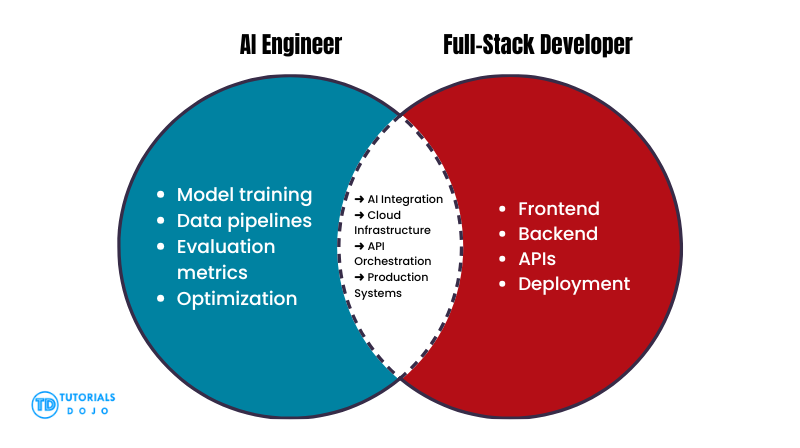
Although AI engineers and full-stack developers remain distinct in expertise, several industry trends are bringing their responsibilities closer together:
AI is now embedded in mainstream products.
Organizations increasingly integrate large language models (LLMs), recommendation systems, and intelligent automation directly into web and mobile applications.
Production integration requires collaboration.
Full-stack developers connect AI services to user interfaces and backend logic. Meanwhile, AI engineers ensure that models run efficiently, scale appropriately, and remain reliable in production environments.
Startups encourage hybrid skill sets.
In smaller or AI-native companies, engineers often handle both application architecture and AI integration. One developer may build the frontend, manage APIs, and deploy inference pipelines.
Cloud-native systems blur responsibilities.
Both roles now interact with containerization, orchestration, and managed AI services. As a result, understanding infrastructure becomes valuable across disciplines.
Team structure determines boundaries.
Large enterprises may preserve clear distinctions between AI engineering and full-stack development. In contrast, agile teams may prioritize cross-functional capabilities.
These trends don’t eliminate the distinction between AI engineers and full-stack developers, but they do reshape how the roles interact in modern teams. Rather than merging into a single entity, the responsibilities are simply becoming more interconnected across the software lifecycle.
Market Demand and the Rise of Hybrid Skill Sets
As AI becomes embedded in everyday software, hiring expectations are evolving and not just for roles with “AI” in the title. This shift doesn’t signal the disappearance of traditional full-stack development. Instead, it reflects something broader, an expansion of what it means to be a capable engineer.
Hybrid Skill Sets in the Age of AI
Beyond technical specialization, many organizations are now emphasizing hybrid skill sets: a combination of deep technical expertise and human-centered capabilities. Being highly technical is no longer sufficient on its own. Professionals must also communicate effectively, frame problems clearly, and translate AI outputs into decisions that actually mean something to the business (Pexelle, 2024).
In practice, hybrid skills typically look like this:
Strong technical foundations in software or AI systems — you still need to know how to build things
Critical thinking and contextual judgment — knowing when to trust the model and when to question it
Communication and cross-functional collaboration — bridging the gap between what the system does and what the team needs to act on
The ability to interpret and validate AI-generated outputs — not just produce them, but take responsibility for what they mean
This shift aligns with a broader industry observation: AI systems increasingly support human decision-making rather than replace it. Research on human–AI collaboration suggests that the most effective systems pair machine intelligence with human oversight and interpretation (McKinsey Global Institute, 2023).
Why Hybrid Skills Are Gaining Traction
AI automates execution, not judgment.
AI systems can generate outputs at scale and speed no human team can match, but humans still define the objectives, validate the results, and decide what to do with them. Engineers who understand both sides of that equation are increasingly the ones driving decisions.
Product teams need translators.
There’s a growing gap between what AI systems are technically capable of and what non-technical stakeholders can understand or act on. Engineers who can speak both the language of model behavior and the language of user experience are filling a role that didn’t really exist five years ago.
Organizations are structured differently.
A startup building an AI-native product often needs a single engineer to handle the frontend, backend, and model pipeline. A large enterprise might have separate specialized teams, but even there, cross-functional awareness is becoming a real differentiator.
That said, specialization still matters. Hybrid skills enhance your flexibility and your value, but they don’t replace the importance of going deep in at least one area. Think of it less as “know everything” and more as “know your domain, and understand enough of the adjacent ones to work effectively across them.”
Distinct Roles in an Evolving Landscape: AI Engineers & Full-Stack Developers
So, are AI engineers the new full-stack developers?
The honest answer is: not exactly. AI engineers and full-stack developers continue to serve distinct technical functions. Full-stack engineers focus on cohesive application architecture, performance, and scalability. AI engineers prioritize model behavior, data integrity, and intelligent system optimization. Their workflows, evaluation metrics, and problem-solving approaches remain fundamentally different – and those differences aren’t going away.
At the same time, the increasing integration of AI into production environments is reshaping how these roles interact. Cross-functional awareness is becoming more valuable, and in certain contexts, particularly in AI-native companies and fast-moving startup environments, hybrid expectations aren’t just welcome, they are the default. But it’s worth being clear about what that actually means: this convergence reflects collaboration, not replacement. The future of software engineering doesn’t point toward the disappearance of either role. Instead, it favors engineers who understand both worlds well enough to move between them. You might choose to specialize deeply, broaden your skill set, or operate at the intersection of both — and the right answer depends on where you are, what you’re building, and what kind of problems you actually want to solve.
The more useful question was never which role will prevail. It’s this: how will you adapt as intelligent systems become a permanent layer of modern software? Because they already are, and the engineers who thrive will be the ones building for that reality, not just watching it unfold.
📚 $2.99 USD Starting Price — Save 40% on All eBooks
Turn Your Team Into Cloud-Ready Professionals Today
Learn AWS with our PlayCloud Hands-On Labs
$2.99 AWS and Azure Exam Study Guide eBooks
Learn GCP By Doing! Try Our GCP PlayCloud
Learn Azure with our Azure PlayCloud
FREE AI and AWS Digital Courses
FREE AWS, Azure, GCP Practice Test Samplers
Subscribe to our YouTube Channel
Follow Us On Linkedin
Written by: Cristieneil Ceballos
Cristieneil Ceballos, “Cris” for short, is a Computer Science student at the University of the Philippines Mindanao and an IT Intern at Tutorials Dojo. Passionate about continuous learning, she volunteers and engages with various tech communities—viewing each experience as both a chance to contribute and an opportunity to explore areas she’s interested in.
AWS, Azure, and GCP Certifications are consistently among the top-paying IT certifications in the world, considering that most companies have now shifted to the cloud. Earn over $150,000 per year with an AWS, Azure, or GCP certification!
Follow us on LinkedIn, YouTube, Facebook, or join our Slack study group. More importantly, answer as many practice exams as you can to help increase your chances of passing your certification exams on your first try!
Around 95-98% of our students pass the AWS Certification exams after training with our courses.
200k+
students
Over 200k enrollees choose Tutorials Dojo in preparing for their AWS Certification exams.
~4.8
ratings
Our courses are highly rated by our enrollees from all over the world.
What our students say about us?
I’m deeply impressed by the quality of the practice tests from Tutorial Dojo. They are extremely well-written, clean and on-par with the real exam questions. Their practice tests and cheat sheets were a huge help for me to achieve 958 / 1000 — 95.8 % on my first try for the AWS Certified Solution Architect Associate exam. Perfect 10/10 material. The best $14 I’ve ever spent!
S. M. Shoaib
Khulna, Bangladesh
Given the enormous number of students and therefore the business success of Jon's courses, I was pleasantly surprised to see that Jon personally responds to many, including often the more technical questions from his students within the forums, showing that when Jon states that teaching is his true passion, he walks, not just talks the talk. I much respect and thank Jon Bonso.
Rowan Williams
Brisbane, Australia
The explanation to the questions are awesome. Lots of gap exposed in my learning. I used the practice tests along with the TD cheat sheets as my main study materials. This is a must training resource for the exam.
Using the practice exam helped me to pass. I think I wouldn't have passed if not for Jon's practice sets.
Jessica Chen
Guangzhou, China
I can say that Tutorials Dojo is a leading and prime resource when it comes to the AWS Certification Practice Tests. I also tried other courses but only Tutorials Dojo was able to give me enough knowledge of Amazon Web Services. My favorite part of this course is explaining the correct and wrong answers as it provides a deep understanding in AWS Cloud Platform. The course I purchased at Tutorials Dojo has been a weapon for me to pass the AWS Certified Solutions Architect - Associate exam and to compete in Cloud World. A Big thank you to Team Tutorials Dojo and Jon Bonso for providing the best practice test around the globe!!!