
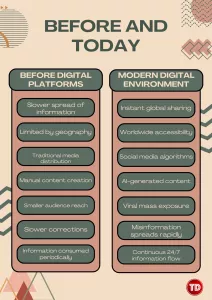
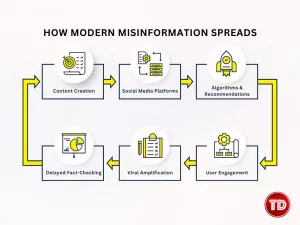
Modern technology has transformed how people access and share information. News, opinions, videos, and discussions can now spread globally within seconds through social media platforms, recommendation systems, and digital communication tools. Information is now more accessible than ever before, allowing people to stay connected in real time regardless of location. However, this level of connectivity also creates new challenges. In fast-moving digital environments, information often spreads faster than people can properly verify it. As online systems continue evolving through algorithms, automation, and artificial intelligence, misinformation has become more difficult to identify, control, and prevent. Today, misinformation is no longer just about false content itself. It is also about the digital systems that influence visibility, engagement, and how information moves across the internet. Misinformation has existed long before the internet. In the past, false information typically spread through rumors, manipulated stories, edited media, or unreliable publications. While misinformation was still harmful, its reach was often limited by geography, communication speed, and traditional media distribution. Today, digital platforms have removed many of those limitations. A single post, image, or video can quickly reach thousands or even millions of users through shares, reposts, recommendation systems, and algorithm-driven feeds. Smartphones and social media platforms also allow people to consume information constantly throughout the day. Because of this, people are often exposed to large amounts of information in very short periods of time. In many cases, users react immediately before verifying whether the information is accurate. This shift in speed and accessibility has transformed misinformation from an isolated issue into a large-scale digital challenge. One of the defining characteristics of the modern internet is speed. Digital platforms are designed to deliver information instantly. Trending topics, breaking news, viral posts, and short-form content continuously compete for user attention in real time. In these environments, speed often becomes more valuable than accuracy. People are encouraged to react quickly, repost content immediately, and stay constantly updated. However, the faster information moves, the less time users often spend verifying whether something is reliable or misleading. This creates an environment where misinformation can spread rapidly before fact-checking or corrections even have the opportunity to catch up. As digital communication continues evolving, the challenge is no longer simply accessing information. It is learning how to slow down enough to evaluate it critically. Social media algorithms play a major role in how information spreads online. Most digital platforms are designed around engagement. Content that receives more clicks, reactions, comments, and shares is more likely to appear in recommendation systems and user feeds. The problem is that emotionally charged content often performs better than neutral information. Posts that trigger fear, anger, outrage, or shock tend to generate stronger engagement, allowing them to spread faster across platforms. In many cases, misleading or sensationalized content gains visibility not because it is accurate, but because it captures attention effectively. This creates an environment where misinformation can spread rapidly through recommendation systems without users fully realizing how heavily algorithms influence what they see online. Algorithms themselves are not inherently designed to spread misinformation. However, engagement-driven systems can unintentionally amplify content that keeps users active on platforms, regardless of whether the information is accurate or misleading. Artificial intelligence and automation have introduced a new layer to the misinformation problem. Generative AI tools are now capable of producing realistic text, images, audio, and videos within seconds. At the same time, automated systems can rapidly distribute content across multiple platforms at massive scale. Today, digital systems can generate: Because these tools are becoming increasingly accessible, creating convincing misinformation no longer requires advanced technical expertise. However, AI itself is not inherently harmful. Many AI technologies provide useful applications in education, productivity, creativity, accessibility, and communication. The challenge lies in how these systems are used. When combined with engagement-driven platforms and rapid information sharing, AI-generated content can make misinformation more difficult to identify and easier to distribute at scale. One of the most concerning developments in modern misinformation is the rise of deepfakes and synthetic media. Deepfakes are AI-generated or AI-manipulated videos, images, or audio recordings designed to imitate real people. Modern AI systems can now replicate facial expressions, speech patterns, and human voices with surprising realism. This creates serious concerns regarding authenticity and trust online. For example, manipulated videos can make it appear as though someone said or did something that never actually happened. Voice cloning technologies can imitate public figures, celebrities, or even ordinary individuals. While synthetic media technologies can also be used for entertainment, education, and creative projects, they can become dangerous when used deceptively or maliciously. As these technologies continue improving, distinguishing between authentic and manipulated content may become increasingly difficult for everyday users. Modern digital systems have drastically increased both the speed and scale of information sharing. A single post can be reshared thousands of times within minutes. Viral culture, short-form content, and instant communication encourage rapid interaction before verification takes place. Automation also contributes to this speed. Bots and automated accounts can repeatedly distribute content across multiple platforms, increasing visibility and engagement. Trending systems and recommendation algorithms can further amplify already popular content, regardless of accuracy. Because of this, misinformation no longer spreads only through individual users. It can also spread through interconnected digital ecosystems designed to maximize reach, interaction, and visibility. In many cases, corrections and fact-checks simply move slower than viral content itself. The spread of misinformation is not only a technology issue. Human behavior also plays an important role. People often respond emotionally to information before critically analyzing it. Content that aligns with existing beliefs or strong emotions is more likely to be accepted and shared quickly. This can be influenced by: Modern digital environments also expose users to enormous amounts of information every day. Because of this, many people rely on headlines, short clips, or summarized content instead of fully verifying sources. Misinformation often succeeds because it appears believable, emotionally engaging, urgent, or easy to consume. Modern digital platforms operate within what is often called the “attention economy.” In simple terms, platforms compete for user attention because attention drives engagement, traffic, and revenue. As a result, many systems are optimized to keep users scrolling, reacting, and interacting for as long as possible. This creates a difficult challenge when it comes to misinformation. Content that is controversial, emotionally intense, or highly sensationalized often performs better in engagement-driven systems. Because of this, misleading information can sometimes gain visibility more easily than carefully verified content. The issue is not always intentional manipulation by platforms themselves. Rather, it is a consequence of digital systems that prioritize visibility, interaction, and user retention at massive scale. As artificial intelligence becomes more integrated into recommendation systems and digital platforms, discussions about ethical design and responsible algorithms will likely become even more important. Although misinformation continues to evolve, there are still ways to reduce its impact. One of the most important tools is digital literacy. Learning how to verify sources, evaluate information critically, and identify misleading content can help users navigate online spaces more responsibly. Other helpful practices include: Technology companies, developers, educators, content creators, and users all play a role in addressing misinformation. As digital systems continue becoming more advanced, responsible technology use becomes increasingly important. Technology will likely continue reshaping how people consume and interact with information. Artificial intelligence, automation, recommendation systems, and digital media platforms are becoming more advanced, more accessible, and more deeply integrated into everyday life. Because of this, trust in online information may become one of the defining challenges of the digital era. Future discussions surrounding technology will likely focus not only on innovation and capability, but also on verification, transparency, accountability, and ethical use. As digital systems continue evolving, the ability to critically evaluate information may become just as important as the technology itself. Modern technology has transformed communication, accessibility, and the way people interact with information online. At the same time, these systems have also changed how misinformation spreads across digital spaces. The rise of misinformation in modern digital environments highlights the growing relationship between technology, responsibility, and digital awareness. Artificial intelligence, algorithms, automation, and social media platforms are not inherently harmful technologies. However, the speed and scale of modern information systems make critical thinking and responsible technology use more important than ever. In a world where information can spread globally within seconds, learning how to verify, question, and critically evaluate digital content may become one of the most valuable skills of the modern internet era. Alternative Social Media and its Role in the News and Information Environment | Pew Research Center Media and Information Literacy | UNESCO Deepfake technology: What is it, how does it work, and what can it be used for? – BBC Newsround Institute of Internet Economics The next wave of disinformation: AI, fact-checks, and the fight for truth

Misinformation Before vs Today
The Speed of Modern Information
Algorithms and Engagement Systems

Automation and AI-Generated Content
Deepfakes and Synthetic Media
Why Misinformation Spreads So Quickly
Why People Fall for Misinformation
The Attention Economy and Digital Platforms
What Can Help

The Future of Information Trust
The Importance of Digital Awareness
References
🔥 $1.99 eBooks and $4.99 Video Claude Reviewers

Turn Your Team Into Cloud-Ready Professionals Today

Learn AWS with our PlayCloud Hands-On Labs

$2.99 AWS and Azure Exam Study Guide eBooks

Learn GCP By Doing! Try Our GCP PlayCloud

Learn Azure with our Azure PlayCloud

FREE AI and AWS Digital Courses

FREE AWS, Azure, GCP Practice Test Samplers


Subscribe to our YouTube Channel

Follow Us On Linkedin


Written by: Rhome Louie Saringayat