
Last updated on August 11, 2026
The Claude Certified Architect – Professional (CCAR-P) certification is designed for experienced professionals who build and deliver production-grade AI solutions with Claude. It validates the ability to select suitable models, architectural patterns, and API approaches; apply prompt and context engineering; connect Claude with enterprise systems; and include evaluation, security, compliance, and governance requirements in the overall design.
The exam assesses whether candidates can translate business problems into scalable Claude-powered solutions and support the full solution lifecycle, from discovery and architecture design through deployment, monitoring, and continuous improvement. Candidates should be prepared to design workflow-based, agentic, augmented LLM, and multi-agent systems, develop RAG pipelines, integrate tools and external data sources, and evaluate trade-offs involving accuracy, latency, cost, performance, safety, and maintainability.
Candidates seeking more information about the CCAR-P certification should review the official exam guide. The document outlines the exam format, weighted domains, expected experience, detailed objectives, scoring approach, and recommended preparation activities.
CCAR-P Exam Domains
The exam domains for the Claude Certified Architect – Professional (CCAR-P) certification reflect the advanced capabilities required to plan, implement, and operate Claude-powered solutions in production environments. Candidates should be able to translate business requirements into scalable architectures, select suitable models and integration methods, design effective prompt and context strategies, build retrieval and agent-based systems, evaluate solution quality, manage security and compliance risks, communicate technical decisions, and support ongoing development and operations.
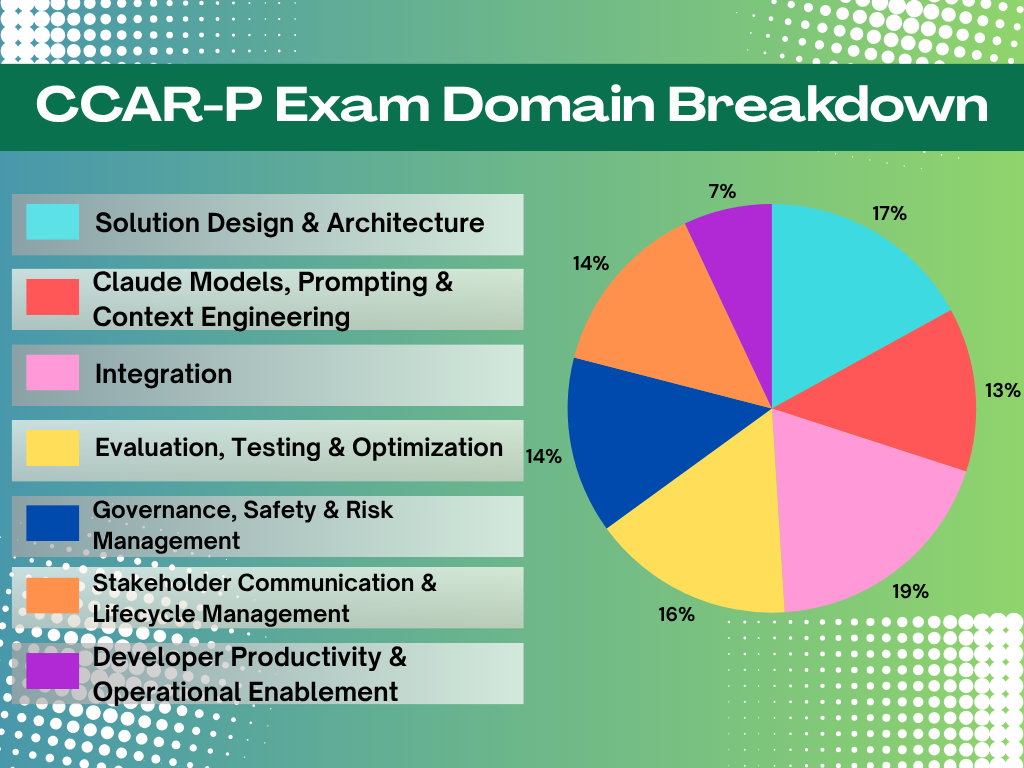
- Solution Design and Architecture – 17%
- Claude Models, Prompting, and Context Engineering – 13%
- Integration – 19%
- Evaluation, Testing, and Optimization – 16%
- Governance, Safety, and Risk Management – 14%
- Stakeholder Communication and Lifecycle Management – 14%
- Developer Productivity and Operational Enablement – 7%
CCAR-P Study Materials
Before taking the Claude Certified Architect – Professional (CCAR-P) certification exam, candidates should study the resources listed below. These materials can help strengthen the advanced technical and architectural skills required to design production-ready Claude solutions, including selecting suitable models and system patterns, developing prompt and context strategies, implementing RAG and agentic workflows, integrating enterprise tools and data sources, evaluating system performance, managing security and compliance risks, and supporting solutions throughout their operational lifecycle.
- Tutorials Dojo’s Claude Certified Architect Professional Practice Exams
- Claude Certified Architect – Professional Certification Page
- Claude Certified Architect – Professional Certification Exam Guide
- Claude Certified Architect – Professional Certification Prep Course
Claude Features to Focus on for the CCAR-P Exam
Here is the list of Claude features and capabilities to focus on for the Claude Certified Architect – Professional (CCAR-P) exam:
Claude Models
- Understand how different Claude models vary in reasoning ability, performance, response speed, context capacity, and cost.
- Learn how to select an appropriate model according to the complexity of the workload, quality requirements, latency targets, and available budget.
Claude Context Windows
- Understand how the context window determines the amount of information Claude can process within a request.
- Learn how to organize and prioritize context, remove unnecessary content, preserve important instructions, and manage token consumption for long or complex tasks.

Prompt Caching
- Understand how prompt caching allows applications to reuse frequently submitted prompt content instead of processing the same information repeatedly.
- Learn when caching can reduce response latency and token-related costs, particularly when an application repeatedly sends large system instructions, reference documents, or reusable context.
Claude Skills
- Understand how Skills provide reusable instructions and resources that help Claude perform specialized or recurring tasks consistently.
- Learn how modular Skills can support prompt reuse, standardize team workflows, and prevent large collections of instructions from being placed into every request.
Claude Code
- Understand how Claude Code supports software development activities such as exploring codebases, implementing changes, debugging issues, and working with development tools.
- Learn how to configure Claude Code and its working environment for teams, improve AI-assisted development workflows, and support debugging and operational issue resolution.
CCAR-P Key Exam Topics by Domain
Domain 1: Solution Design and Architecture
- Business requirements and solution planning: Convert business challenges into practical Claude-powered solutions and connect architectural choices to measurable outcomes such as productivity, efficiency, transformation, cost reduction, and performance targets.
- End-to-end architecture design: Design the complete flow of a solution, covering inputs, processing, outputs, and feedback mechanisms while selecting an appropriate workflow-based, agentic, or augmented LLM architecture.
- Decomposition and orchestration: Divide complex problems into manageable components and design coordination strategies for tools, agents, and multi-agent systems.
Domain 2: Claude Models, Prompting, and Context Engineering
- Model selection and trade-offs: Choose an appropriate Claude model by considering workload complexity, output quality, processing speed, context requirements, and cost.
- Prompt design and behavioral controls: Develop system prompts, reusable templates, examples, and guardrails while applying techniques such as zero-shot, few-shot, and structured reasoning prompts.
- Context and prompt reuse: Manage context windows and token consumption efficiently by prioritizing relevant information and using prompt caching, modular prompts, and Skills for recurring instructions.
Domain 3: Integration
- Tools, access, and security: Review tool and agent configurations to prevent unnecessary capability expansion, identify authentication or authorization weaknesses, and apply least-privilege access.
- Retrieval and context architecture: Design RAG pipelines with suitable chunking, indexing, and retrieval methods based on document structure, data characteristics, and expected query patterns.
- Protocols, observability, and performance: Select among MCP, APIs, command-line tools, and agent-to-agent communication while balancing accuracy and latency, planning scalable monitoring, and deciding between progressive discovery and large monolithic contexts.
Domain 4: Evaluation, Testing, and Optimization
- Evaluation strategy and metrics: Define measurable criteria for accuracy, latency, cost, safety, and security, and build representative evaluation datasets using automated and human assessment methods.
- Testing and failure diagnosis: Conduct comparative or A/B testing, analyze prompt failures, hallucinations, and model mismatches, and use the results to guide iterative improvements.
- Performance monitoring and optimization: Use logging and observability data to track system behavior and optimize token consumption, response time, operating cost, and overall solution quality.
Domain 5: Governance, Safety, and Risk Management
- Guardrails and risk controls: Implement safety mechanisms and identify common LLM risks, limitations, misuse scenarios, and technical failure modes before deploying a solution.
- Human oversight and validation: Apply human-in-the-loop processes to review sensitive, uncertain, or high-impact outputs and ensure that important decisions are not fully automated without appropriate approval.
- Compliance and ethical AI: Design solutions that address regulatory obligations such as GDPR, HIPAA, and FedRAMP while accounting for bias, fairness, transparency, privacy, and responsible data use.
Domain 6: Stakeholder Communication and Lifecycle Management
- Discovery and requirements gathering: Conduct structured discussions with stakeholders to identify business needs, technical constraints, expected outcomes, risks, and service-level requirements.
- Architecture communication and documentation: Explain design decisions and trade-offs to technical and non-technical audiences, document the architecture, and provide clear implementation guidance.
- Feedback and lifecycle support: Manage stakeholder expectations and feedback throughout discovery, design, implementation handoff, monitoring, maintenance, and continuous improvement.
Domain 7: Developer Productivity and Operational Enablement
- Team tools and environments: Configure Claude tools and shared development environments, including Claude Code, to support secure and consistent use across engineering teams.
- AI-assisted development workflows: Improve software delivery by applying Claude to code analysis, implementation, testing, documentation, and other repeatable development activities.
- Debugging and operational support: Use Claude-assisted tools to investigate technical issues, resolve application or infrastructure problems, and support ongoing production operations.
CCAR-P Important Skills to Focus on
Solution Architecture and Technical Design
- Translate business requirements into complete Claude-powered solutions with clearly defined inputs, processing stages, outputs, and feedback mechanisms.
- Select between workflow-based, agentic, augmented LLM, and multi-agent patterns based on scalability, reliability, cost, performance, and business value requirements.
Claude Model, Prompt, and Context Engineering
- Select an appropriate Claude model by evaluating reasoning capability, response quality, latency, token usage, context requirements, and operating cost.
- Design system prompts, templates, examples, guardrails, and reusable instructions while managing context windows through prompt caching, modular prompts, and Skills.
Enterprise Integration and RAG Design
- Design retrieval-augmented generation pipelines with appropriate document preparation, chunking, indexing, retrieval, and context-assembly strategies.
- Choose among MCP, direct APIs, command-line interfaces, and agent-to-agent communication while addressing authentication, authorization, least-privilege access, and unnecessary tool capabilities.
Evaluation, Testing, and Performance Optimization
- Define evaluation criteria for accuracy, task completion, latency, cost, safety, and security using representative datasets and a combination of automated and human review.
- Diagnose hallucinations, prompt failures, and model mismatches through A/B testing, logging, monitoring, and iterative improvements to token usage and system performance.
Governance, Safety, and Compliance
- Identify risks such as prompt injection, sensitive-data exposure, excessive permissions, bias, unreliable outputs, and inappropriate automation.
- Implement guardrails, human-in-the-loop validation, and governance controls that support regulatory requirements such as GDPR, HIPAA, and FedRAMP.
Stakeholder Communication and Lifecycle Management
- Gather business, technical, legal, security, and operational requirements through structured discovery and stakeholder discussions.
- Document architectural decisions, communicate trade-offs and service-level expectations, and support the solution through design, implementation handoff, monitoring, feedback, and continuous improvement.
Developer Productivity and Operational Support
- Configure Claude Code and related development environments to improve code analysis, implementation, debugging, documentation, and team workflows.
- Use Claude-assisted tooling to investigate operational problems, support production issue resolution, and establish consistent development practices across engineering teams.
Validate Your CCAR-P Exam Readiness
After reviewing the recommended materials, candidates can test their knowledge with Tutorials Dojo’s Claude Certified Architect – Professional CCAR-P Practice Exams.
These practice tests cover major exam topics, including solution architecture, model selection, prompt and context engineering, RAG, integration, evaluation, governance, and developer enablement. They include multiple-choice and multiple-response questions, detailed explanations, and reference links that help clarify why each correct answer is the best solution.
Using the official exam guide together with Tutorials Dojo’s practice exams can help candidates identify knowledge gaps, strengthen weaker domains, and build the architectural judgment needed to pass the CCAR-P exam.

CCAR-P Sample Practice Test Questions:
Question 1
A global retailer uses Claude to review inbound freight quotes before selecting carriers for weekly shipments. The system must first extract shipment costs and service terms, then validate the results against procurement policies, and finally generate a recommendation for the transportation team. Because the stages follow consistent rules and later stages depend on the output of earlier stages, the company needs a predictable and auditable architectural pattern.
Which architectural pattern best meets these requirements?
- Use a fixed workflow where each step is a discrete, sequenced LLM call for extracting quote details, validating policy compliance, and generating the recommendation.
- Use a single monolithic prompt that asks Claude to interpret the quotes and autonomously decide whether additional processing or external actions are required.
- Use an autonomous agent that dynamically creates its own processing plan and selects tools based on each set of inbound freight quotes.
- Use parallel LLM calls that independently extract, validate, and generate the recommendation at the same time without waiting for preceding results.
Correct Answer: 1
Anthropic distinguishes workflows from agents based on how the system determines the execution path. In a workflow, LLM calls and tools are orchestrated through predefined code paths, while an agent dynamically decides how to proceed. A prompt-chaining workflow decomposes a task into a sequence of smaller steps, with each Claude call processing the output produced by the preceding call. Programmatic checks or validation gates can also be inserted between steps to confirm that the output meets the required criteria before processing continues.
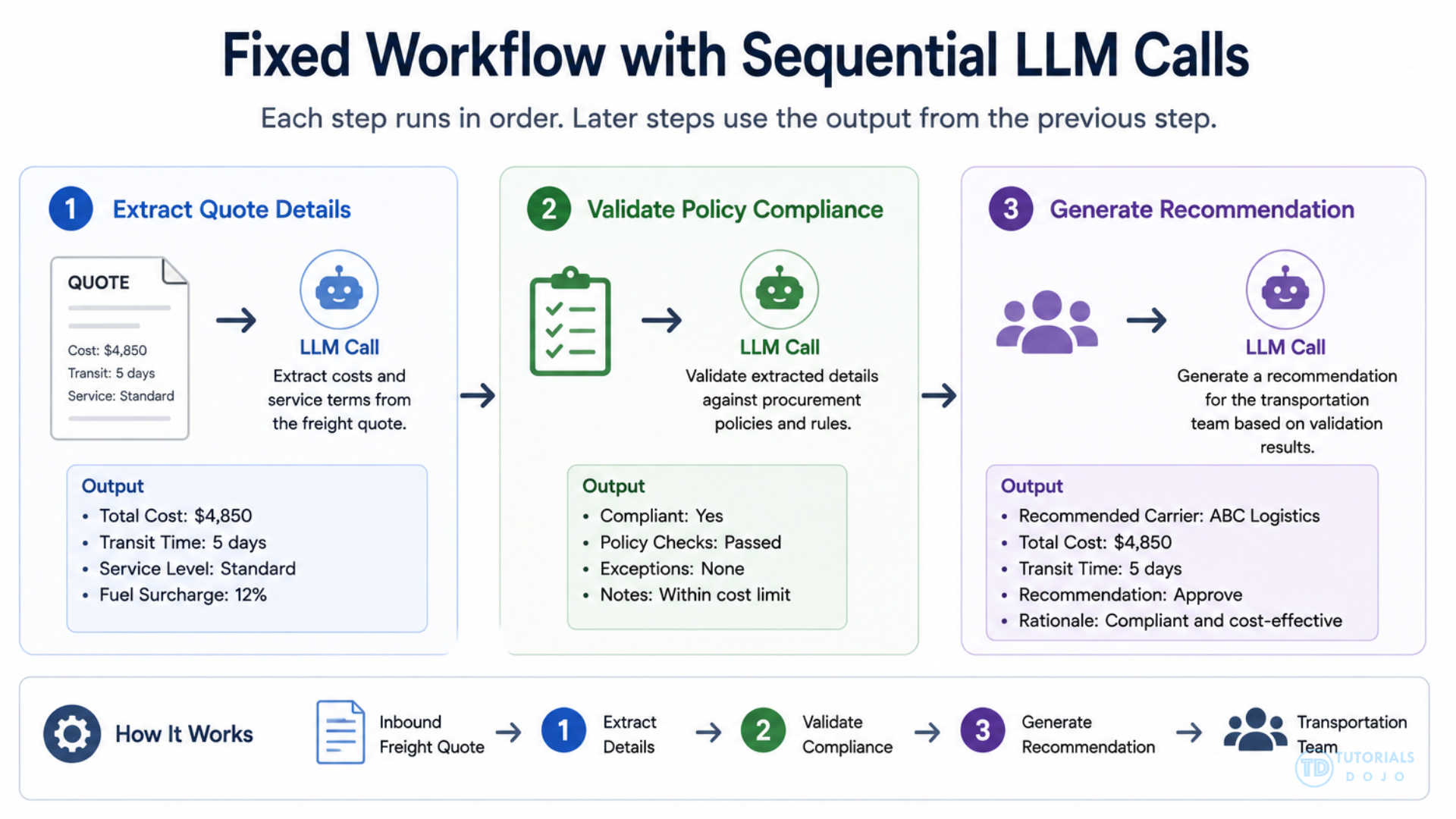
In this scenario, processing the inbound freight quotes follows a predictable sequence. Claude must first extract prices, delivery schedules, and service terms. The extracted information must then be validated against procurement policies before Claude can generate a carrier recommendation. Because every stage has a defined responsibility and depends on the preceding output, the solution primarily requires controlled orchestration rather than autonomous planning. Only the records that pass validation should proceed to recommendation generation, allowing failed stages to be identified, corrected, or retried without repeating the entire process.
A fixed workflow therefore provides the appropriate architectural pattern. It makes each LLM call easier to evaluate, provides clear intermediate outputs for auditing, and allows validation logic to prevent inaccurate freight information from reaching the final recommendation. Although this approach may introduce additional latency because several calls run sequentially, Anthropic recommends prompt chaining when a task can be cleanly divided into fixed subtasks and improved accuracy is more important than completing everything in a single call.
Hence, the correct answer is: Use a fixed workflow where each step is a discrete, sequenced LLM call for extracting quote details, validating policy compliance, and generating the recommendation.
The option that says: Use a single monolithic prompt that asks Claude to interpret the quotes and autonomously decide whether additional processing or external actions are required is incorrect because it would simply combine extraction, validation, and recommendation generation into one request. This approach provides fewer intermediate checkpoints and makes it harder to determine which stage caused an inaccurate result. It also prevents the application from selectively retrying a failed extraction or validation step.
The option that says: Use an autonomous agent that dynamically creates its own processing plan and selects tools based on each set of inbound freight quotes is incorrect because agents are typically appropriate for open-ended tasks where the necessary steps cannot be predicted or hardcoded in advance. The quote-processing stages are already known, ordered, and repeatable, so granting Claude additional autonomy would introduce unnecessary complexity, cost, and the possibility of inconsistent execution paths.
The option that says: Use parallel LLM calls that independently extract, validate, and generate the recommendation at the same time without waiting for preceding results is incorrect because parallelization works best when subtasks are independent. The validation stage requires the extracted quote details, while recommendation generation requires the validated results. Running the stages concurrently would just ignore these data dependencies and could produce a recommendation before the quote information has been verified.
References:
https://platform.claude.com/docs/en/build-with-claude/prompt-engineering/overview
https://www.anthropic.com/engineering/building-effective-agents
Check out these Claude Cheat Sheets:
https://tutorialsdojo.com/other-cheat-sheets/claude-cheat-sheets/
Question 2
An organization is standardizing Claude Code across multiple engineering teams and must enforce security settings that developers cannot override while centrally distributing approved tools and reusable workflows. Which actions should the organization take? (Select TWO.)
- Establish a managed plugin marketplace to distribute approved skills, agents, hooks, and MCP servers across teams.
- Allow developers to install tools independently, then audit local configurations periodically for policy compliance.
- Use server-managed settings to enforce organization-wide security controls and prevent lower-level configuration overrides.
- Publish recommended settings in a shared repository and require each team to apply them during project setup.
- Store approved tools in project-level configuration so individual teams can update or disable them when needed.
Correct Answer: 1, 3
Server-managed settings provide centralized administrative control over Claude Code configurations across an organization. These settings can define security policies, tool permissions, environment variables, and other operational controls from the Claude admin console. They occupy the highest level of the settings hierarchy and cannot be overridden by command-line arguments or user-, project-, and local-level settings. This approach helps organizations establish a consistent security baseline rather than depending on each developer or team to configure and maintain policies independently.
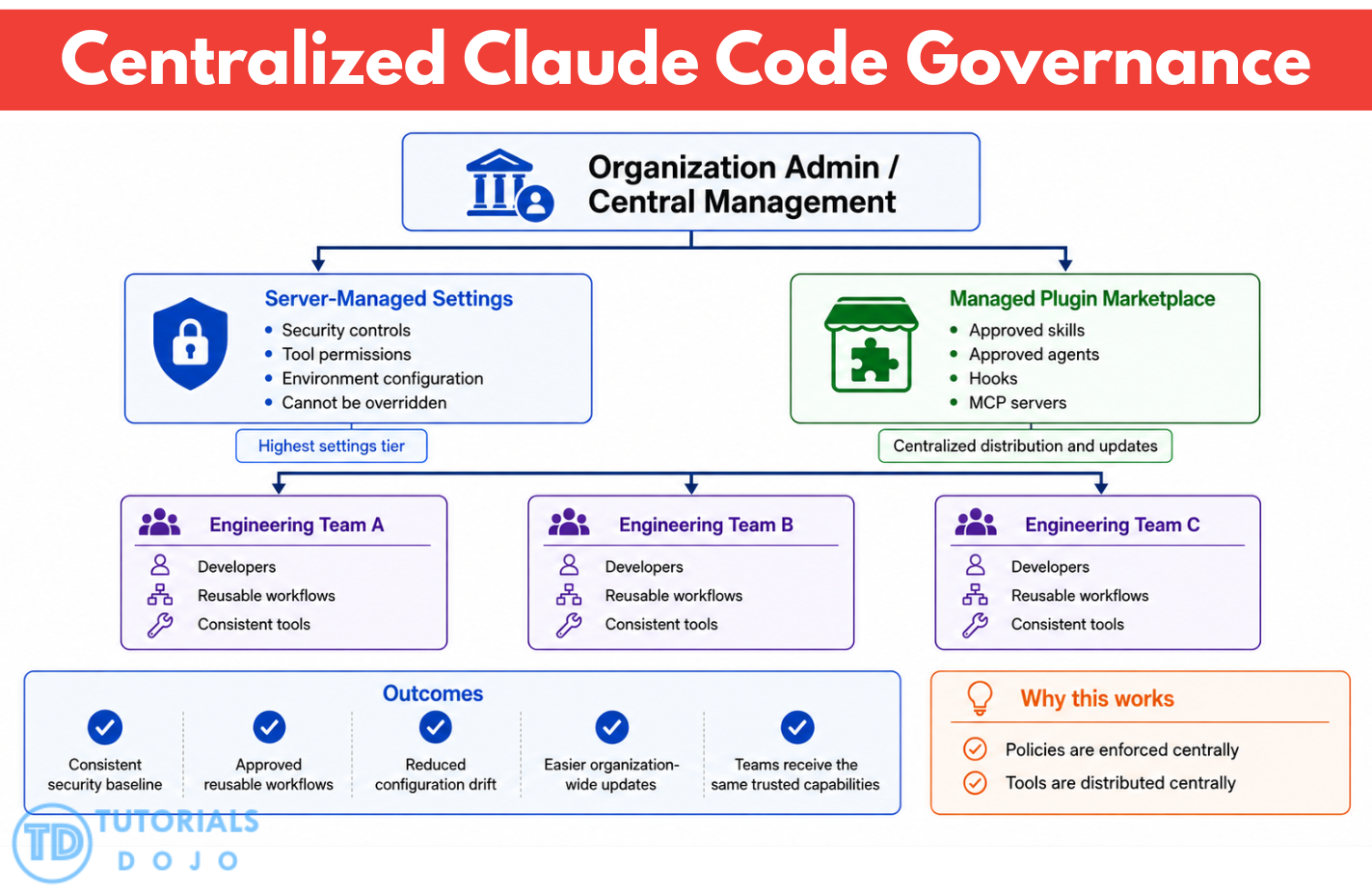
A managed plugin marketplace complements these controls by providing a central catalog for distributing approved Claude Code extensions. Plugins can package skills, agents, hooks, MCP servers, and other reusable components, while marketplaces support centralized discovery, version tracking, and automatic updates. Together, managed settings and an organization-controlled marketplace separate policy enforcement from capability distribution: administrators retain control over mandatory restrictions, while engineering teams receive consistent, tested tools and workflows. This reduces configuration drift, limits unauthorized changes, and makes updates easier to apply across multiple teams.
Hence, the correct answers are:
– Establish a managed plugin marketplace to distribute approved skills, agents, hooks, and MCP servers across teams.
-Use server-managed settings to enforce organization-wide security controls and prevent lower-level configuration overrides.
The option that says: Allow developers to install tools independently, then audit local configurations periodically for policy compliance is incorrect because this decentralized approach typically permits configuration differences and unauthorized plugin sources to exist before an audit detects them. Claude Code supports managed settings and marketplace restrictions that allow administrators to enforce approved configuration and plugin sources proactively rather than relying on retrospective compliance checks.
The option that says: Publish recommended settings in a shared repository and require each team to apply them during project setup is incorrect because recommended files simply provide shared project configuration and do not guarantee that every team applies or preserves the required controls. Project settings can be changed at the repository level, whereas managed settings occupy the highest configuration tier and cannot be overridden by project, user, local, or command-line settings.
The option that says: Store approved tools in project-level configuration so individual teams can update or disable them when needed is incorrect because project-level configuration is intended primarily for settings shared within a particular repository, not for enforcing consistent organization-wide capabilities. Allowing teams to modify or disable approved tools would create configuration drift, while an organization-managed plugin marketplace supports centralized distribution, source restrictions, and controlled updates across teams.
References:
https://code.claude.com/docs/en/settings
https://code.claude.com/docs/en/server-managed-settings
https://code.claude.com/docs/en/plugin-marketplaces
https://code.claude.com/docs/en/plugins-reference
Check out this Claude Code Cheat Sheet:
Check out our other practice exam offerings for AWS, Azure, and Google Cloud, featuring detailed explanations, by visiting the Tutorials Dojo Portal:


Final Remarks
Success in the CCAR-P exam requires advanced knowledge of Claude architecture and practical experience designing production-ready AI solutions. Focus on solution design, model selection, prompt and context engineering, RAG, enterprise integration, evaluation, governance, and lifecycle management. Strengthen architectural decision-making by comparing workflow, agentic, and multi-agent patterns while balancing quality, latency, cost, security, and maintainability. Candidates should also become familiar with Claude models, prompt caching, Skills, Claude Code, the Claude API, and MCP. Practice exams can help measure readiness and highlight domains that require additional review. With focused study and hands-on experience, candidates can build the confidence needed to earn the Claude Certified Architect – Professional certification. Good luck with your preparation!
📚 $2.99 USD Starting Price — Save 40% on All eBooks

Turn Your Team Into Cloud-Ready Professionals Today
Learn AWS with our PlayCloud Hands-On Labs
$2.99 AWS and Azure Exam Study Guide eBooks

Learn GCP By Doing! Try Our GCP PlayCloud
Learn Azure with our Azure PlayCloud
FREE AI and AWS Digital Courses

FREE AWS, Azure, GCP Practice Test Samplers

Subscribe to our YouTube Channel

Follow Us On Linkedin

Written by: Lois Angelo Dar Juan