
Last updated on August 11, 2026
The Claude Certified Developer – Foundations (CCDV-F) certification is designed for technical professionals who build, integrate, and deliver Claude-powered applications at a foundational level. It validates the ability to use the Claude API and client SDKs, construct agents and workflows, operate Claude Code, create effective prompts, manage context, develop tools and MCP servers, and apply appropriate security, evaluation, and model-selection practices.
The exam assesses whether candidates can translate technical and business requirements into working Claude applications and support their development, deployment, operation, and maintenance. Candidates should be prepared to build agentic workflows with the Claude Agent SDK and other frameworks, integrate streaming and batch API capabilities, manage structured outputs and errors, configure Claude Code components, and evaluate trade-offs involving model capability, latency, cost, token usage, caching, safety, and tool selection.
Candidates seeking more information about the CCDV-F certification should review the official exam guide. The document describes the exam format, weighted content domains, recommended technical experience, detailed objectives, scoring method, exam policies, and suggested preparation activities.
CCDV-F Exam Domains
The exam domains for the Claude Certified Developer – Foundations (CCDV-F) certification represent the foundational skills required to build, integrate, and maintain Claude-powered applications, agents, and workflows. Candidates should be able to design agent and workflow architectures, integrate Claude through APIs and SDKs, operate Claude Code, debug application failures, select suitable models, manage prompts and context, apply security controls, and implement custom tools and MCP servers.
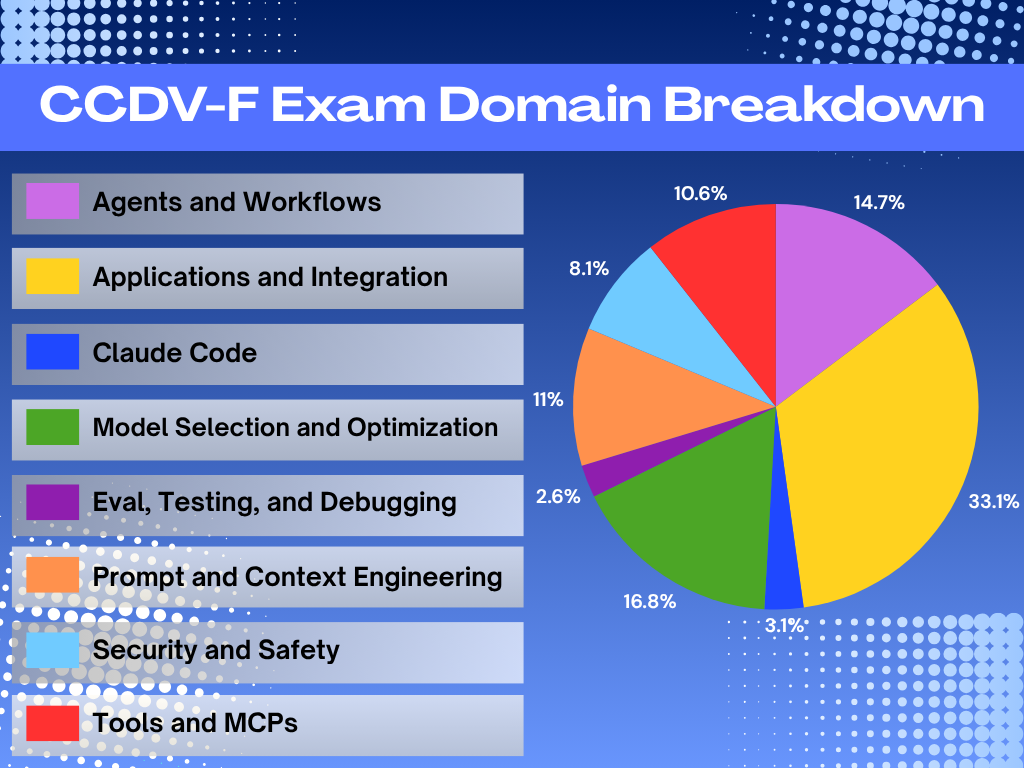
- Agents and Workflows – 14.7%
- Applications and Integration – 33.1%
- Claude Code – 3.1%
- Eval, Testing, and Debugging – 2.6%
- Model Selection and Optimization – 16.8%
- Prompt and Context Engineering – 11.0%
- Security and Safety – 8.1%
- Tools and MCPs – 10.6%
CCDV-F Study Materials
Before taking the Claude Certified Developer – Foundations (CCDV-F) certification exam, candidates should review the resources listed below. These materials can help strengthen the practical development skills required to build and integrate Claude-powered applications, including using the Claude API and SDKs, creating agents and workflows, operating Claude Code, applying prompt and context engineering, selecting appropriate models, managing tokens and costs, debugging application issues, implementing security controls, and developing custom tools or MCP servers.
- Tutorials Dojo’s Claude Certified Developer Foundations Practice Exams
- Claude Certified Developer – Foundations Certification Page
- Claude Certified Developer – Foundations Certification Exam Guide
- Claude Certified Developer – Foundations Certification Prep Course
Claude Features to Focus on for the CCDV-F Exam
Here is a list of Claude features and capabilities to focus on for the Claude Certified Developer – Foundations (CCDV-F) exam:
Claude API and Client SDKs
- Focus on integrating Claude into applications through the API, client SDKs, and third-party vendors.
- Review how the Claude API handles messages, tools, streaming, vision, thinking, caching, and multi-format input. Candidates should also be familiar with Messages API data access patterns, error handling, asynchronous programming, batch API use, and the trade-offs between real-time and batch processing.
Claude Models
- Compare the capabilities and common use cases of Claude Opus, Sonnet, and Haiku.
- Know how quality, latency, cost, and task requirements influence model selection. Important areas also include fast mode, extended thinking, adaptive thinking, effort levels, model version pinning, and possible breaking behavioral changes across model releases.

Claude Agent SDK
- Practice building agents and workflows with the Claude Agent SDK, custom agent loops, agent harnesses, and agentic frameworks.
- Be prepared to determine when a deterministic workflow is more appropriate than an agent. Review manager and supervisor hierarchies, subagents, tool-use loops, memory, context-window management, hooks for deterministic actions, and self-hosted versus Anthropic-hosted deployment models.
Claude Tools and Function Calling
- Study how tool use and function calling allow Claude applications to interact with external systems.
- Pay attention to function schemas, tool descriptions, external system configuration, tool error handling, and tool set construction. Candidates should recognize the differences between client-side and server-side tools, agentic harness dispatch, and approval patterns.
Claude Context Windows
- Know how tokens and context windows affect the amount of information Claude can process during a task.
- Apply context and memory management techniques that reduce context drift and bloat. These techniques include pruning tool output, compacting accumulated context, and isolating work through subagents or multi-step agentic workflows.
Model Context Protocol
- Review how MCP servers are authored, deployed, and integrated with Claude applications.
- Become familiar with MCP resources, tools, prompts, client and server responsibilities, and communication patterns involving standard input and output, sockets, and client-server interactions.
Claude Code
- Explore the primary Claude Code components, including Rules, Skills, Commands, Agents, and Agent Memory.
- Candidates should know how session management, built-in and custom slash commands, headless mode, streaming mode, and auto-mode are used. Other important areas include repository initialization, the CLAUDE.md hierarchy, settings.json configuration, and plugin management.
Claude Skills
- Recognize how Claude Skills support reusable customization within Claude-powered development workflows.
- Compare Skills with built-in tools, custom tools, and MCPs to determine which approach best matches a particular technical requirement.
CCDV-F Key Exam Topics by Domain
Domain 1: Agents and Workflows
- Agent and workflow architecture: Compare deterministic workflows with agents and identify which approach is more suitable for a given task. Review manager and supervisor hierarchies and how subagents can improve multi-step task execution.
- Agent construction and deployment: Build Claude agents using the Claude Agent SDK, custom agent loops, harnesses, and hooks for deterministic actions. Be familiar with self-hosted and Anthropic-hosted deployment models.
- Agent patterns and frameworks: Apply tool-use loops, memory, subagents, and context-window management. Review how frameworks such as Strands, LangGraph, and PydanticAI support agentic workflows.
Domain 2: Applications and Integration
- Requirements and systems lifecycle: Translate business requirements into functional and infrastructure requirements. Account for the development, implementation, operation, and maintenance of Claude-powered systems.
- Claude API and software integration: Work with messages, tools, streaming, vision, thinking, caching, multi-format input, third-party vendors, and batch processing. Review REST APIs, JSON, asynchronous programming, WebSockets, version control, code review, SDLC integration, and refactoring.
- Application and configuration design: Consider how Claude interprets instructions across Claude Code, Claude Desktop, claude.ai, APIs, and SDKs. Manage content boundaries, schemas, sessions, plugins, CLAUDE.md, settings.json, model versions, prompt versions, and plugin dependencies.
Domain 3: Claude Code
- Claude Code operation: Work with Rules, Skills, Commands, Agents, and Agent Memory. Review session management, built-in and custom slash commands, headless mode, streaming mode, auto-mode, repository initialization, the CLAUDE.md hierarchy, and settings.json.
Domain 4: Eval, Testing, and Debugging
- Debugging and error handling: Identify application error types and select suitable recovery strategies. Use trace analysis to locate failure modes and determine whether an issue originates from the integration layer or the model output.
Domain 5: Model Selection and Optimization
- LLM and technical fundamentals: Review tokens, context windows, sampling, non-determinism, and next-token generation. Be familiar with fast mode, extended thinking, adaptive thinking, effort levels, SDK-based REST API integration, and WebSockets.
- Model selection and trade-offs: Compare Opus, Sonnet, and Haiku according to task requirements. Evaluate quality, latency, cost, adaptive thinking support, and potential behavioral changes between model releases.
- Cost and token management: Track token usage, establish token budgets, model application costs, and apply prompt caching and cache checkpointing to improve cost efficiency.
Domain 6: Prompt and Context Engineering
- Context and memory management: Control context growth by pruning tool output, compacting accumulated information, and isolating work through subagents or multi-step agentic workflows.
- Prompt engineering: Write clear instructions, apply few-shot examples, choose appropriate system and user message placement, define output constraints, sanitize inputs, and refine prompts through repeated testing and adjustment.
- Output handling: Produce and validate structured outputs, apply defensive parsing, and avoid accepting confident model responses without appropriate verification.
Domain 7: Security and Safety
- AI application security: Protect Claude applications against prompt injection, jailbreaks, untrusted inputs, data leakage, and improper handling of personally identifiable information. Maintain authentication, authorization, confidentiality, privacy, and integrity.
- Guardrails and safe deployment: Apply content policies, layered guardrails, secure-by-design practices, identity and access management, and least-privilege permissions.
- Hooks, identities, and secrets: Use hooks to prevent destructive actions. Secure API keys, credentials, and secrets while validating identities, verifying access levels, approving access, and monitoring authorized use.
Domain 8: Tools and MCPs
- Tool implementation: Create tools and function schemas that allow Claude to interact with external systems. Write clear tool descriptions, handle errors, construct suitable tool sets, and apply client-side, server-side, dispatch, and approval patterns.
- MCP server development: Author, deploy, and integrate MCP servers. Review MCP resources, tools, prompts, client-server responsibilities, standard input and output, and socket-based communication.
- Agentic customization: Compare built-in tools, custom tools, Skills, and MCPs to select the most appropriate method for a given application requirement.
CCDV-F Important Skills to Focus on
Claude Application Design and Integration
- Translate business and technical requirements into working Claude applications with suitable functional and infrastructure components.
- Integrate Claude through the API, client SDKs, and third-party vendors while handling messages, streaming, vision, thinking, tools, caching, batch requests, errors, and multi-format input.
Agent and Workflow Development
- Determine whether a task requires a predefined workflow or an autonomous agent.
- Build agents with the Claude Agent SDK, custom loops, harnesses, subagents, memory, hooks, and supported agentic frameworks.
Prompt, Context, and Output Engineering
- Create clear prompts with suitable examples, instruction placement, output constraints, and input sanitization.
- Prevent context drift and bloat through pruning, compaction, and task isolation. Validate structured responses and use defensive parsing when consuming model output.
Claude Code and Configuration Management
- Operate Claude Code through its Rules, Skills, Commands, Agents, Agent Memory, session controls, slash commands, and operating modes.
- Configure CLAUDE.md, settings.json, model versions, prompt versions, plugins, and related dependencies consistently.
Security and Safe Deployment
- Defend applications against prompt injection, jailbreaks, untrusted input, data leakage, and destructive actions.
- Apply layered guardrails, hooks, least-privilege access, secure identity controls, and proper management of API keys, credentials, secrets, and personally identifiable information.

Tools, Skills, and MCP Development
- Implement custom tools and function schemas with suitable descriptions, approval patterns, dispatch methods, and error handling.
- Build and integrate MCP servers and compare built-in tools, custom tools, Skills, and MCPs according to the needs of the application.
Validate Your CCDV-F Exam Readiness
After reviewing the recommended materials, candidates can test their knowledge with Tutorials Dojo’s Claude Certified Developer – Foundations CCDV-F Practice Exams.
These practice tests cover major exam topics such as agents and workflows, Claude API integration, Claude Code, model selection, prompt and context engineering, debugging, security, tools, and MCP servers. They include multiple-choice and multiple-response questions, detailed explanations, and reference links that help candidates understand why each correct answer is the most appropriate solution.
Using the official exam guide together with Tutorials Dojo’s practice exams can help candidates identify knowledge gaps, strengthen weaker domains, and build the practical development skills needed to prepare for the CCDV-F exam.
CCDV-F Sample Practice Test Questions:
Question 1
Your development team is building a retail support assistant that uses an MCP server with a search_customers tool described as “Find customer records” and a search_orders tool described as “Find customer order records.” During testing, Claude sometimes retrieves a customer profile for an order-related request and sometimes searches orders for a customer-related request. Which change should the team make to improve Claude’s tool selection?
- Remove the less frequently used tool and retain only the tool invoked most often by users.
- Add keyword-based routing rules that choose a tool before Claude evaluates the request context.
- Merge both tools into one multipurpose search tool controlled by a generic record-type parameter.
- Revise each tool description to clearly distinguish the tool’s purpose, inputs, and intended use.
Correct Answer: 4
Claude selects and invokes tools using the information provided in each tool definition, including the tool name, description, and input schema. A strong tool description should explain what the tool does, when it should be used, how its parameters affect its behavior, and any relevant limitations. Clear and distinct descriptions are especially important when multiple tools perform related operations because they provide the context Claude needs to match a request with the correct capability.
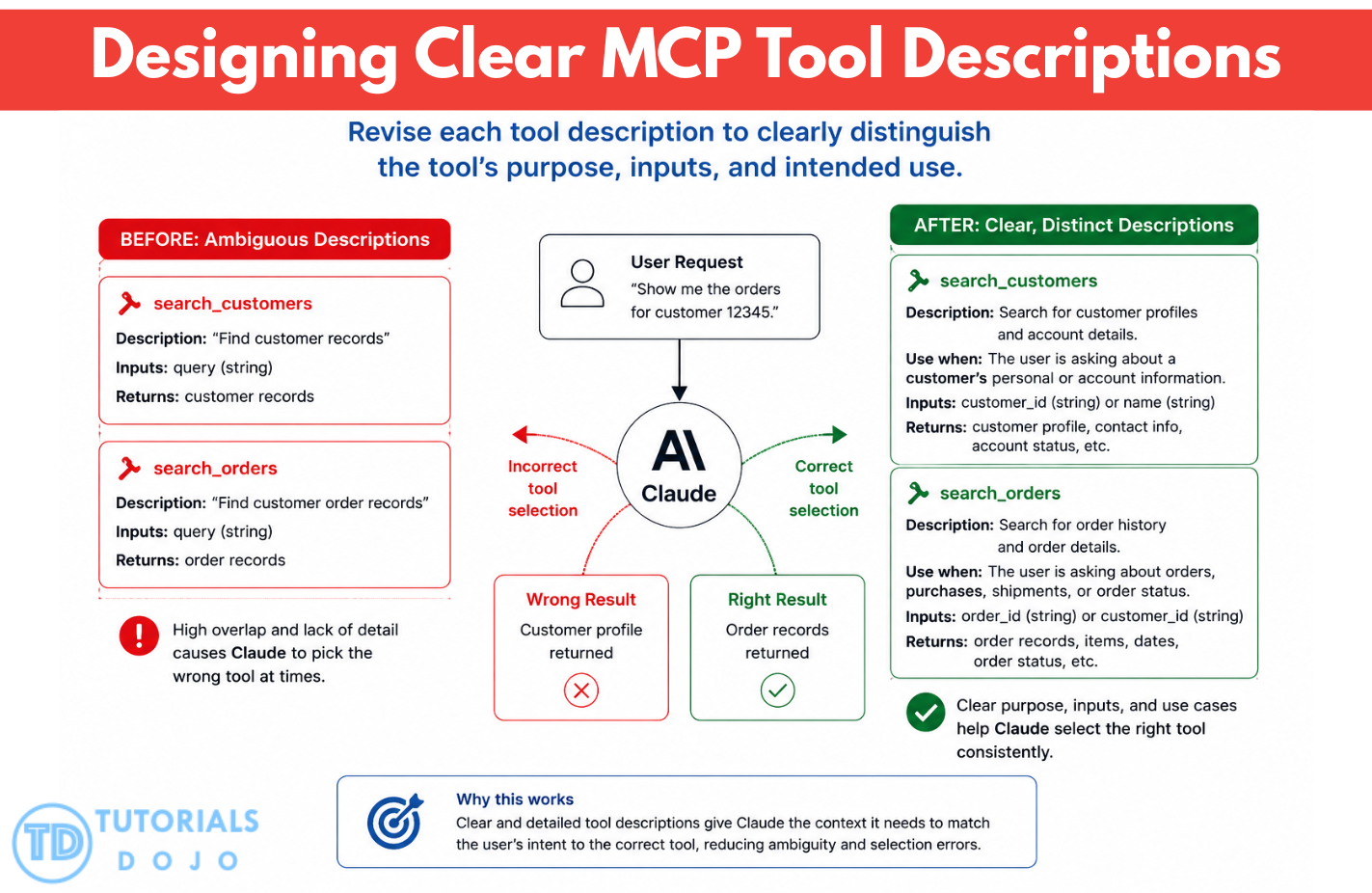
Revising the descriptions resolves the issue by establishing clearer boundaries between the available tools. Each description can identify the type of record being searched, the expected input, the data returned, and the situations in which the tool is appropriate. This reduces ambiguity without removing useful capabilities, relying on rigid keyword rules, or triggering unnecessary tool calls.
Hence, the correct answer is: Revise each tool description to clearly distinguish the tool’s purpose, inputs, and intended use.
The option that says: Remove the less frequently used tool and retain only the tool invoked most often by users is incorrect because it would only eliminate a valid capability rather than correct the unclear information affecting tool selection. Claude determines whether to call a tool by evaluating the request against the tool’s described capability. Removing one tool would prevent the assistant from completing requests that require the deleted operation, while the remaining description could still be insufficiently defined.
The option that says: Add keyword-based routing rules that choose a tool before Claude evaluates the request context is incorrect because keyword matching simply reduces natural-language requests to predetermined terms that may not capture the complete intent. Claude is designed to evaluate the conversation together with tool names, descriptions, and input schemas. Clearer tool definitions therefore address the selection issue more directly and remain effective when users express the same request using different wording.
The option that says: Merge both tools into one multipurpose search tool controlled by a generic record-type parameter is incorrect because this approach primarily moves the ambiguity into a broad tool and requires Claude to choose the correct parameter value instead. Official guidance recommends explaining what each tool does, when it should or should not be used, what every parameter means, and any relevant limitations. Keeping the operations distinct and improving their descriptions provides clearer behavioral boundaries for customer and order searches.
References:
https://platform.claude.com/docs/en/agents-and-tools/tool-use/define-tools
https://platform.claude.com/docs/en/agents-and-tools/tool-use/overview
https://code.claude.com/docs/en/mcp
Check out these Claude Cheat Sheets:
https://tutorialsdojo.com/other-cheat-sheets/claude-cheat-sheets/
Question 2
Your application uses Claude to generate structured JSON for an inventory management system. The response is automatically consumed by another application that extracts product details and updates the database. When implementing the output handling logic, you should…
- render the response as plain text before passing it to downstream services to simplify output processing.
- retry the request whenever the response contains invalid JSON, and process the first response that can be parsed successfully.
- parse the response, validate it against the expected JSON schema, and handle validation failures before processing.
- compare the response with an example JSON template and continue processing if the overall format appears similar.
Correct Answer: 3
Parsing and validating structured output against an expected JSON schema is the recommended approach when consuming Claude’s responses in production applications. Anthropic advises treating model output as untrusted input rather than assuming it always conforms to the requested format. Even when Claude is prompted to produce structured JSON, applications should defensively parse the response and validate that it matches the required schema before relying on it. This helps ensure that downstream systems receive data in the expected format and can safely handle cases where the output is incomplete, malformed, or otherwise does not meet the application’s requirements.
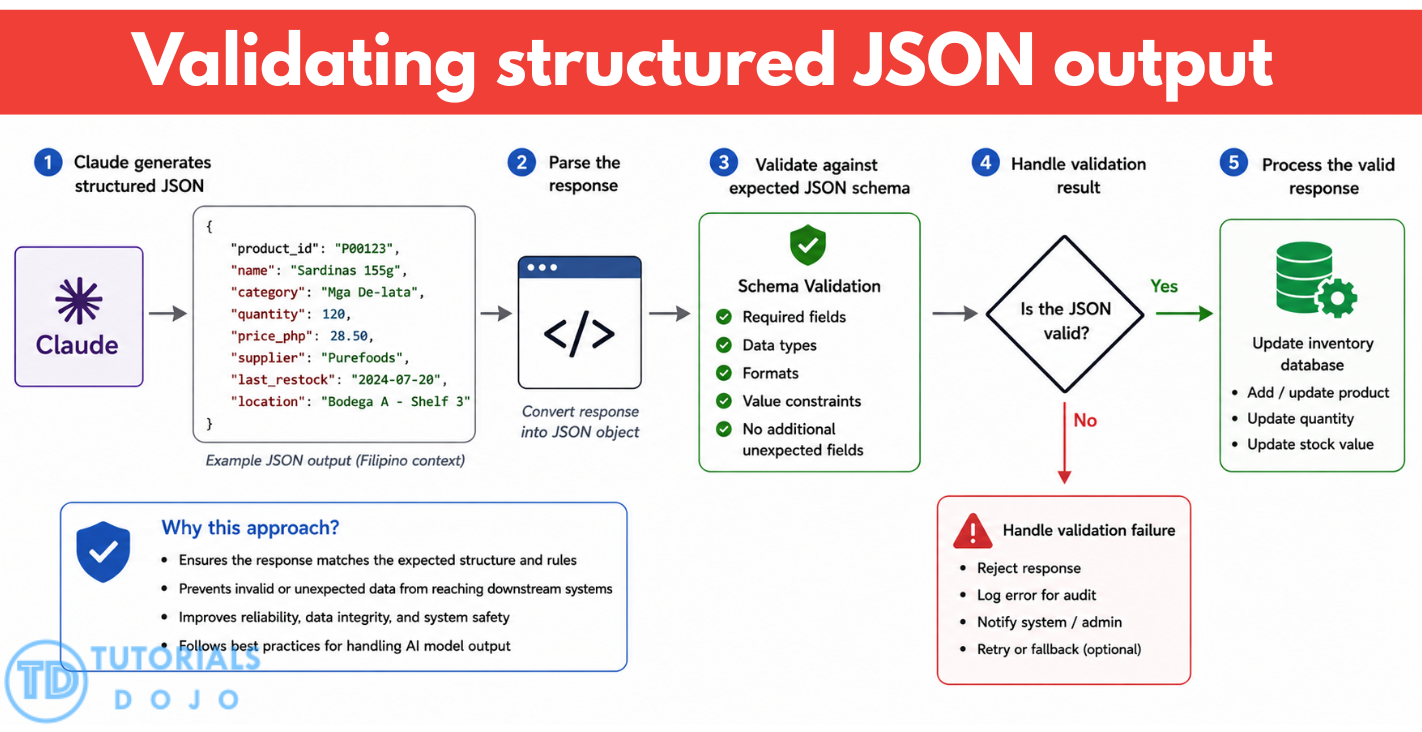
Applying schema validation before processing structured output improves the reliability and robustness of AI-powered applications. Instead of relying on the model’s confidence or the appearance of valid JSON, applications can detect validation failures early, reject or remediate invalid responses, and prevent unexpected behavior from propagating to downstream services. This defensive approach supports consistent integration with automated workflows while reducing the risk of processing incorrect or improperly structured model output.
Hence, the correct answer is: parse the response, validate it against the expected JSON schema, and handle validation failures before processing.
The option that says: render the response as plain text before passing it to downstream services to simplify output processing is incorrect because converting structured JSON into plain text removes the machine-readable format required by the inventory management system. Claude-generated structured data should remain in a format that downstream applications can parse and process reliably. This approach would only make the output harder to validate and could introduce additional processing errors.
The option that says: retry the request whenever the response contains invalid JSON, and process the first response that can be parsed successfully is incorrect because a successful JSON parse does not guarantee that the response contains the correct fields, values, or structure required by the application. Handling output failures requires more than retrying requests, as the generated content must still be checked against the expected requirements. Simply accepting the first parseable response can allow incorrect inventory data to enter the database.
The option that says: compare the response with an example JSON template and continue processing if the overall format appears similar is incorrect because a template comparison does not verify whether the response contains the required fields, correct data types, or valid values. Structured data processing requires checking the actual output structure instead of relying on visual similarity. This method typically fails to detect issues that could affect database updates or downstream operations.
References:
https://platform.claude.com/docs/en/test-and-evaluate/strengthen-guardrails/increase-consistency
Check out these Claude Cheat Sheets:
https://tutorialsdojo.com/other-cheat-sheets/claude-cheat-sheets/
Check out our other practice exam offerings for AWS, Azure, and Google Cloud, featuring detailed explanations, by visiting the Tutorials Dojo Portal:


Final Remarks
Success in the CCDV-F exam requires a strong foundation in software development and practical experience building Claude-powered applications, agents, and workflows. Focus on Claude API integration, agent construction, Claude Code, model selection, prompt and context engineering, debugging, security, tools, and MCP server development. Strengthen technical decision-making by comparing workflows and agents, selecting suitable Claude models, managing tokens and costs, validating structured outputs, and applying appropriate guardrails and access controls. Candidates should also become familiar with the Claude Agent SDK, client SDKs, prompt caching, Skills, hooks, CLAUDE.md, and settings.json. Practice exams can help measure readiness and identify domains that require further review. With focused study and hands-on development experience, candidates can build the confidence needed to earn the Claude Certified Developer – Foundations certification. Good luck with your preparation!
📚 $2.99 USD Starting Price — Save 40% on All eBooks

Turn Your Team Into Cloud-Ready Professionals Today

Learn AWS with our PlayCloud Hands-On Labs
$2.99 AWS and Azure Exam Study Guide eBooks

Learn GCP By Doing! Try Our GCP PlayCloud
Learn Azure with our Azure PlayCloud
FREE AI and AWS Digital Courses

FREE AWS, Azure, GCP Practice Test Samplers

Subscribe to our YouTube Channel

Follow Us On Linkedin


Written by: Lois Angelo Dar Juan