
Caude Ship Cheat Sheet
Claude Ship is Anthropic’s pull request workflow for GitHub. It combines Code Review, PR Steward, and Claude Approvals to identify issues, help address feedback and failing checks, and evaluate a pull request against a team’s approval policy.
Anthropic introduced Claude Ship in beta on November 23, 2026 for Claude Team and Enterprise. Code Review is generally available, while PR Steward and Claude Approvals are in beta.
What Is Claude Ship?
Claude Ship operates on pull requests. Teams can enable repository-wide workflows in GitHub, or developers can use the /ship command in Claude Code for an individual change. GitHub branch rules, required checks, and the applicable permissions determine whether a pull request can merge.
The Core Concept
-
Your team provides the repository, CI checks, review standards, and approval policy.
-
Claude Ship provides review findings, assistance with follow-up fixes, and a policy-based approval decision.
-
GitHub enforces branch protection, required checks, and merge permissions.
Architecture Overview 
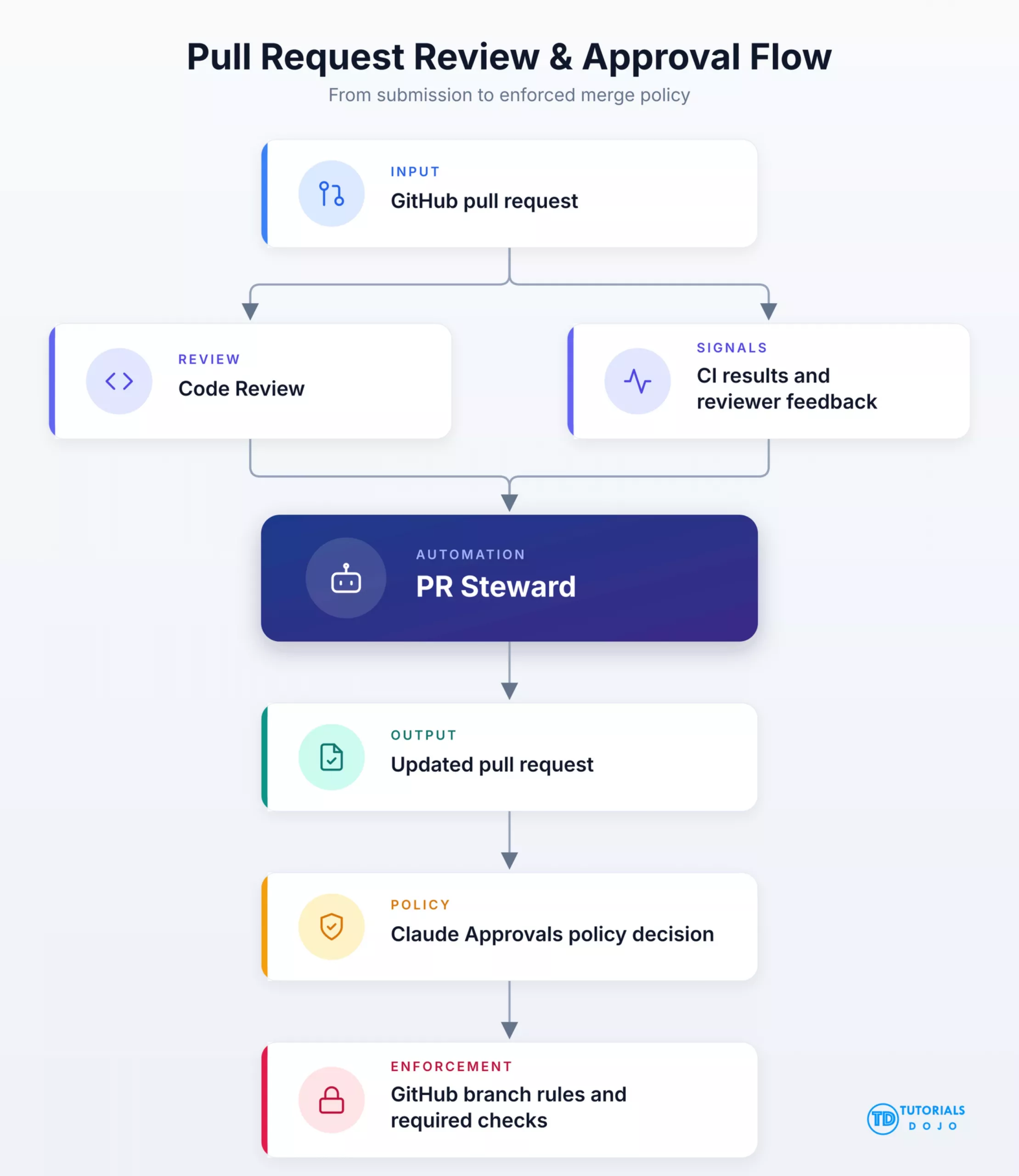
The diagram shows a typical workflow. A repository can enable features individually, and the approval policy determines which signals Claude Approvals evaluates.
Key Components & Features
| Component | What it does |
|---|---|
| Code Review | Analyzes pull requests in repository context and posts findings. Administrators can choose Quick, Standard, or Deep review and configure when reviews run. |
| PR Steward | Helps resolve failing CI checks, merge conflicts, and review feedback. It can push fixes and explain the changes in the pull request. |
| Claude Approvals | Evaluates a pull request against a policy file on the repository’s default branch. The policy determines which changes qualify and which require human review. |
| Observe mode | Evaluates approval decisions so teams can compare them with human decisions before making the result a required check. |
/ship |
In Claude Code, can push a prepared change, open a pull request, review it, and work through feedback and failing checks. The developer’s permissions and branch rules still apply. |
Primary Use Cases
-
Identify which comments require action before merging.
-
Let PR Steward address a routine test or formatting failure, then inspect the resulting diff and CI results.
-
Use a defined policy for routine changes and route changes outside that policy to human reviewers.

Key Benefits & Value Proposition
-
Review findings and follow-up fixes stay in the pull request.
-
A versioned repository policy makes it easier to review how decisions are made.
-
Configure repositories independently and compare approval results in observe mode first.
Deployment Process & Timeline
| Phase | Activities | Estimated duration |
|---|---|---|
| Define scope | Choose a pilot repository and identify which changes require human review. | Depends on ownership and policy review. |
| Connect GitHub | Enable Code Review and choose review depth, triggers, and a spending limit. Enable PR Steward where appropriate. | Depends on repository access and approvals. |
| Observe decisions | Add the approval policy to the default branch and compare observe-mode results with human review. | Depends on pull request volume and policy coverage. |
| Roll out | Review quality and usage, then decide whether to require the approval check in branch protection. | Depends on pilot results. |
Example Workflow
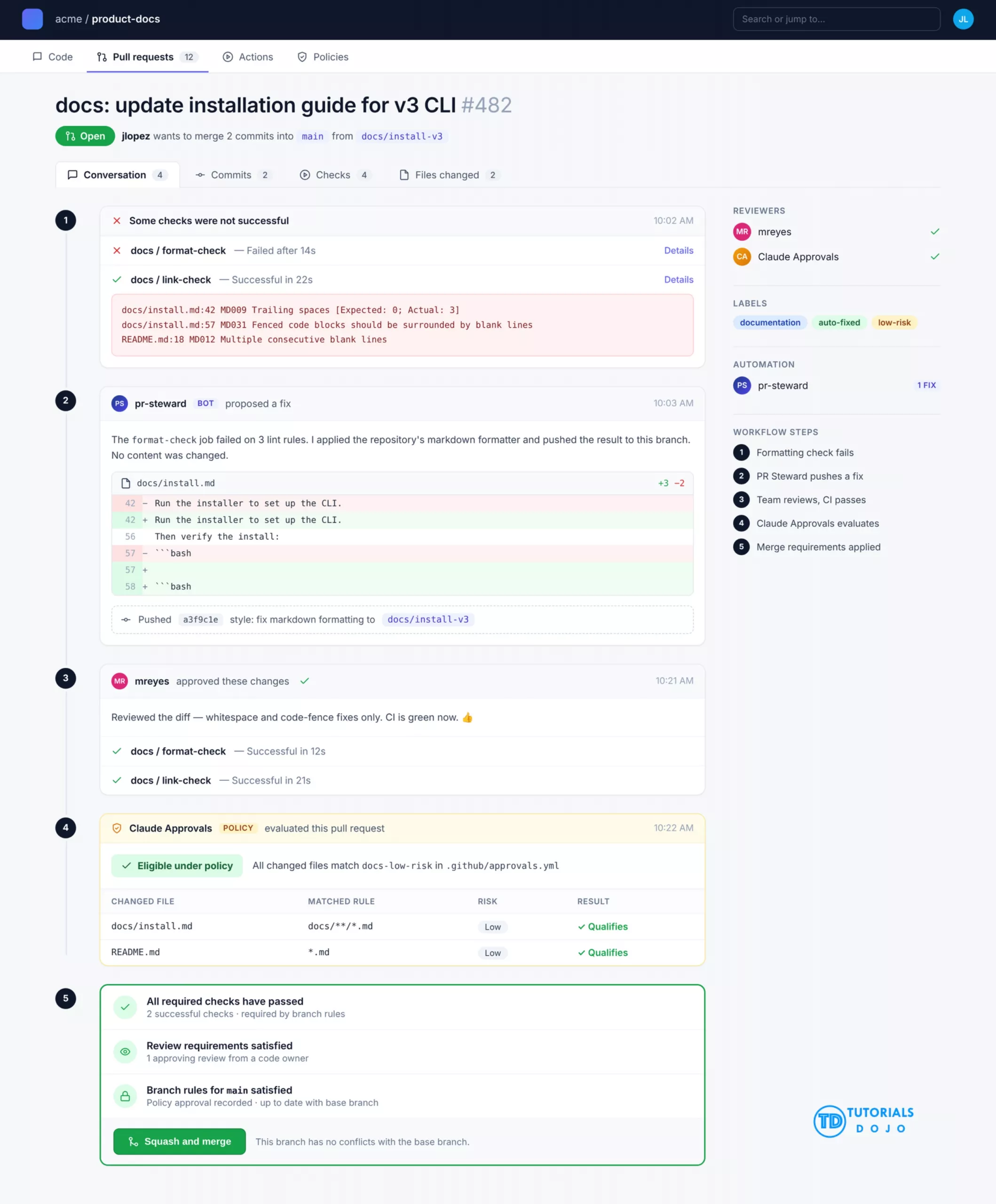
A documentation pull request fails a formatting check. PR Steward proposes a fix and updates the branch. The team reviews the diff and confirms CI passes. Claude Approvals evaluates whether the changed files qualify under the repository’s policy. GitHub applies the configured merge requirements.
Ideal Customer Profile
-
Engineering teams on GitHub that already use CI and branch protection.
-
Platform and developer productivity teams that want versioned approval policies and a way to compare automated decisions with human review.
Key Considerations & Planning Factors
-
Repository-level Claude Ship is available for GitHub on Claude Team and Enterprise. Anthropic lists Zero Data Retention, HIPAA configuration, and customer-managed encryption keys as unsupported for Claude Ship.
-
Repository-level usage is token-based. Cost depends on pull request size and volume, review depth and frequency, and Steward activity. Administrators can set spend limits for Code Review and PR Steward.
-
Claude Approvals has no base charge. Policy classifiers consume billable tokens. A policy that invokes Code Review can incur review charges even in observe mode.
-
Running
/shipcounts as regular Claude Code usage. -
Review Steward commits, keep independent CI checks, and define which changes require a human reviewer. A favorable approval decision is one input to the repository’s merge requirements.
Claude Ship vs. Adjacent Tools
| Factor | Claude Ship | Claude Code | Claude Tag |
|---|---|---|---|
| Best fit | Review, follow-up fixes, and policy decisions for GitHub pull requests. | Implementing and testing changes in a codebase. | Delegating shared work in Slack. |
| Starting point | A GitHub pull request or a change ready for /ship. |
A repository and an engineering task. | An @Claude mention in a configured Slack channel. |
| Typical output | Review findings, fix commits, or an approval decision. | Code changes and test results. | A response or deliverable in a Slack thread. |
Conclusion
Use Claude Ship when your team wants to shorten the time between opening a pull request and reaching a review decision. Pilot it on one GitHub repository, compare policy decisions with human review, and measure usage before expanding.
Claude Ship Cheat Sheet References:
https://claude.com/resources/articles/introducing-claude-ship
https://code.claude.com/docs/en/claude-ship
🛍️ $0.99 eBooks Are Here and Save Up to 75% on All Practice Exams & Video Courses

Turn Your Team Into Cloud-Ready Professionals Today

Learn AWS with our PlayCloud Hands-On Labs
50% OFF ON OUR YEARLY PLAN

Learn GCP By Doing! Try Our GCP PlayCloud
Learn Azure with our Azure PlayCloud
FREE AI and AWS Digital Courses

FREE AWS, Azure, GCP Practice Test Samplers


Subscribe to our YouTube Channel

Follow Us On Linkedin


Written by: Ace Kenneth Batacandulo