
Last updated on June 18, 2026
The AI-901 Microsoft Certified Azure AI Fundamentals certification exam is designed for candidates who need foundational knowledge of AI concepts, responsible AI principles, and AI solutions within Azure and Microsoft Foundry. Candidates are expected to understand common AI workloads, including generative AI, agentic AI, text analysis, speech, computer vision, image generation, and information extraction.
Candidates should be familiar with Azure AI resources, Microsoft Foundry tools, and basic Python programming concepts used to build lightweight AI applications. The exam focuses on identifying appropriate AI models, configuring and deploying AI solutions, working with prompts and agents, and applying responsible AI practices such as fairness, privacy, security, transparency, and accountability when implementing AI solutions.
For more information about the AI-901 exam, you can check out this exam skills outline. This study guide will provide comprehensive review materials to help you pass the exam successfully.
AI-901 Exam Domains
Below are the exam domains, or “Skills Measured,” for the AI-901 Microsoft Azure AI Fundamentals certification exam. These domains represent the foundational AI concepts, responsible AI principles, and practical Azure AI implementation skills that candidates are expected to demonstrate when working with AI solutions in Azure and Microsoft Foundry.
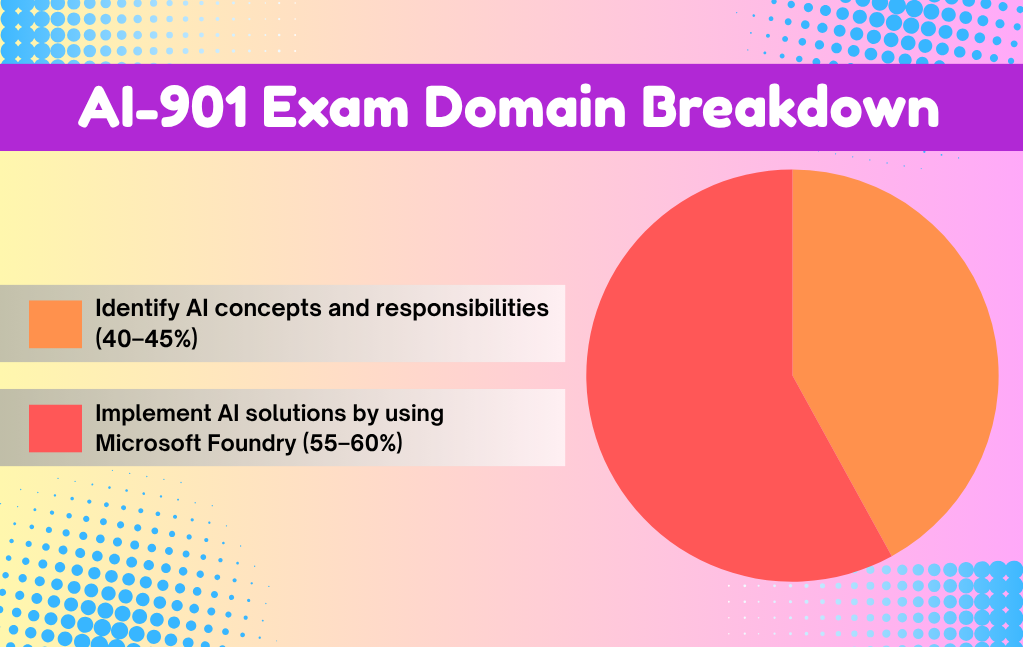
- Identify AI concepts and responsibilities (40–45%)
- Implement AI solutions by using Microsoft Foundry (55–60%)
AI-901 Study Materials
Before attempting the AI-901 Microsoft Certified Azure AI Fundamentals exam, it is highly recommended to review the following study materials. These resources are designed to help candidates understand the key concepts, tools, and services that are commonly evaluated in the certification. By studying these materials in advance, candidates can strengthen their knowledge of machine learning operations, automation, and deployment practices within the Microsoft ecosystem.
- Tutorials Dojo’s Azure Cheat Sheets — Quick reference guides that summarize key Azure services and concepts commonly covered in certification exams.
- Azure PlayCloud Hands-On Labs — Guided labs that allow you to practice deploying and managing Azure resources in a real environment.
- Azure Practice Exams — Our very own set of practice exams designed to help evaluate your readiness for the certification and identify topics that require further study.
- Microsoft Official Documentation and Learning Resources:
- Artificial Intelligence overview
- Generative AI documentation
- Microsoft 365 Copilot documentation
- Microsoft 365 documentation
- Microsoft Q&A | Microsoft Docs
- Microsoft 365 Copilot community hub
Microsoft 365 community hub - Microsoft Learn – Microsoft Tech Community
- Exam Readiness Zone
- Microsoft Learn Show
- Azure Blog
- Azure Free Account — Enables you to explore Azure services and gain hands-on experience while preparing for the exam.

Azure Services to Focus on for the AI-901 Exam
Here is the list of Azure services that you have to focus on for your upcoming AI-901 Microsoft Certified Azure AI Fundamentals exam:
Azure Cognitive & AI Services
- Azure AI Vision — image classification, object detection, optical character recognition (OCR) fundamentals using Azure AI Vision capabilities.
- Azure AI Language & NLP — essential natural language processing tasks such as sentiment analysis, key phrase extraction, and entity recognition with Azure AI Language service.
- Azure AI Speech — introductory speech recognition and text‑to‑speech functionality for building basic voice‑enabled solutions
- Azure OpenAI & Generative AI Services — features and capabilities of Azure AI Foundry and Azure OpenAI (generative AI tools on Azure).
Microsoft Foundry
- Foundry Resources & Project Setup — configure Microsoft Foundry for building AI applications, including setting up project environments, deploying foundation models, and managing prompt versioning.
- AI Model Management — deploy and monitor foundation models, manage prompt versioning, and evaluate metrics such as latency, throughput, and token usage within Microsoft Foundry.
- AI Workflows in Foundry — design and manage multistep reasoning workflows, ensuring smooth operation within Microsoft Foundry environments.
Azure Machine Learning Fundamentals
- Azure Machine Learning basics — fundamental understanding of machine learning principles on Azure, including supervised and unsupervised learning concepts and the role of automated machine learning (AutoML).
- Model concepts & capabilities — overview of model training, evaluation, and the purpose of compute and data services in Azure ML.
Responsible AI & AI Workload Considerations
- Responsible AI principles — fairness, reliability, security, privacy, and transparency in AI solutions.
- AI workloads identification — recognize common AI scenarios (machine learning, computer vision, NLP, generative AI) and understand basic guidance for choosing appropriate Azure services.
Supportive Azure Capabilities
- Azure Bot Services Concepts — foundational knowledge of creating conversational AI (chatbots) using Azure Bot Services as a scenario for natural language and AI integration.
- Azure Cloud Fundamentals — basic awareness of cloud concepts, identity, and compute as they relate to deploying and consuming Azure AI services.
AI-901 Key Exam Topics by Domain
Identify AI concepts and responsibilities
- Responsible AI principles: Understand the core principles of responsible AI, including fairness, reliability and safety, privacy and security, inclusiveness, transparency, and accountability, while applying these principles when designing and evaluating AI solutions.
- AI model components and configurations: Learn how generative AI models work, how to select an appropriate AI model based on capabilities, and how deployment options and configuration parameters affect model behavior.
- Common AI workloads: Identify scenarios for generative AI, agentic AI, text analysis, speech, computer vision, image generation, and information extraction.
- Text, speech, and vision capabilities: Understand common text analysis techniques such as keyword extraction, entity detection, sentiment analysis, and summarization, as well as the features of speech recognition, speech synthesis, computer vision, and image-generation models.
- Information extraction techniques: Recognize how AI can capture useful details from documents, forms, images, audio, and videos for analysis and automation.
Implement AI solutions by using Microsoft Foundry
- Generative AI apps and agents in Foundry: Practice creating prompts, deploying models, testing model responses in the Foundry portal, and connecting apps through the Foundry SDK.
- Agent development in Foundry: Work with single-agent solutions by creating, testing, and accessing agents through the Foundry portal and lightweight client applications.
- Text and speech solutions in Foundry: Apply Foundry capabilities to analyze text, respond to spoken prompts, and use Azure Speech features in lightweight applications.
- Computer vision and image-generation capabilities: Use multimodal and generative models to interpret visual inputs, generate new images, and add vision capabilities to applications.
- Information extraction with Content Understanding: Apply Azure Content Understanding in Foundry Tools to extract structured information from documents, forms, images, audio, and videos.
- Lightweight AI application development: Combine Foundry services and tools to create simple applications that use generative AI, agents, text analysis, speech, vision, image generation, and information extraction.
AI-901 Important Skills to Focus on
- Responsible AI Concepts — understand how AI solutions should be designed and evaluated using principles such as fairness, reliability and safety, privacy and security, inclusiveness, transparency, and accountability.
- AI Workload Identification — recognize common AI workloads, including generative AI, agentic AI, text analysis, speech, computer vision, image generation, and information extraction, and identify suitable scenarios for each workload.
- Model Selection and Deployment — choose appropriate AI models based on their capabilities, deploy models in Microsoft Foundry, and configure deployment settings that influence model behavior and output.
- Generative AI and Agent Development — create effective system and user prompts, interact with deployed models in the Foundry portal, build lightweight chat applications with the Foundry SDK, and create simple agent-based solutions.
- Text, Speech, Vision, and Information Extraction — build lightweight AI applications that analyze text, respond to spoken prompts, interpret visual inputs, generate images, and extract information from documents, forms, images, audio, and video using Microsoft Foundry and Foundry Tools.
Validate Your AI-901 Exam Readiness
If you feel confident after going through the suggested materials above, it’s time to put your knowledge of different Azure concepts and services to the test. For top-notch practice exams, consider using Tutorials Dojo’s AI-901 Microsoft Certified Azure AI Fundamentals Practice Exams.
These practice tests cover the relevant topics that you can expect from the real exam. It also contains different types of questions, such as single-choice, multiple-response, hotspot, yes/no, and drag-and-drop. Every question on these practice exams has a detailed explanation and adequate reference links that help you understand why the correct answer is the most suitable solution. After you’ve taken the exams, it will highlight the areas you need to improve. Together with our cheat sheets, we’re confident that you’ll be able to pass the exam and have a deeper understanding of how Azure works.
AI-901 Sample Practice Test Questions:
Question 1
Your company uses an AI assistant to review customer requests and recommend whether each request should be approved, rejected, or escalated.
You need to apply the Responsible AI principle of transparency so customers know when AI is involved and understand why a recommendation was made.
Which action best demonstrates transparency in this AI solution?
- Encrypt customer request data at rest and in transit to protect sensitive personal information.
- Train the AI system with varied customer data to reduce unfair treatment across account groups.
- Explain the AI-generated recommendation using clear factors that influenced the outcome.
- Add accessible portal features that support customers with different abilities and user needs.
Correct Answer: 3
Azure Responsible AI guidance includes transparency as one of the core principles for designing trustworthy AI solutions. Microsoft describes responsible AI as a framework based on principles such as fairness, reliability and safety, privacy and security, inclusiveness, transparency, and accountability. Transparency is important because people should be able to understand when they are interacting with an AI system and how that system supports or influences decisions.
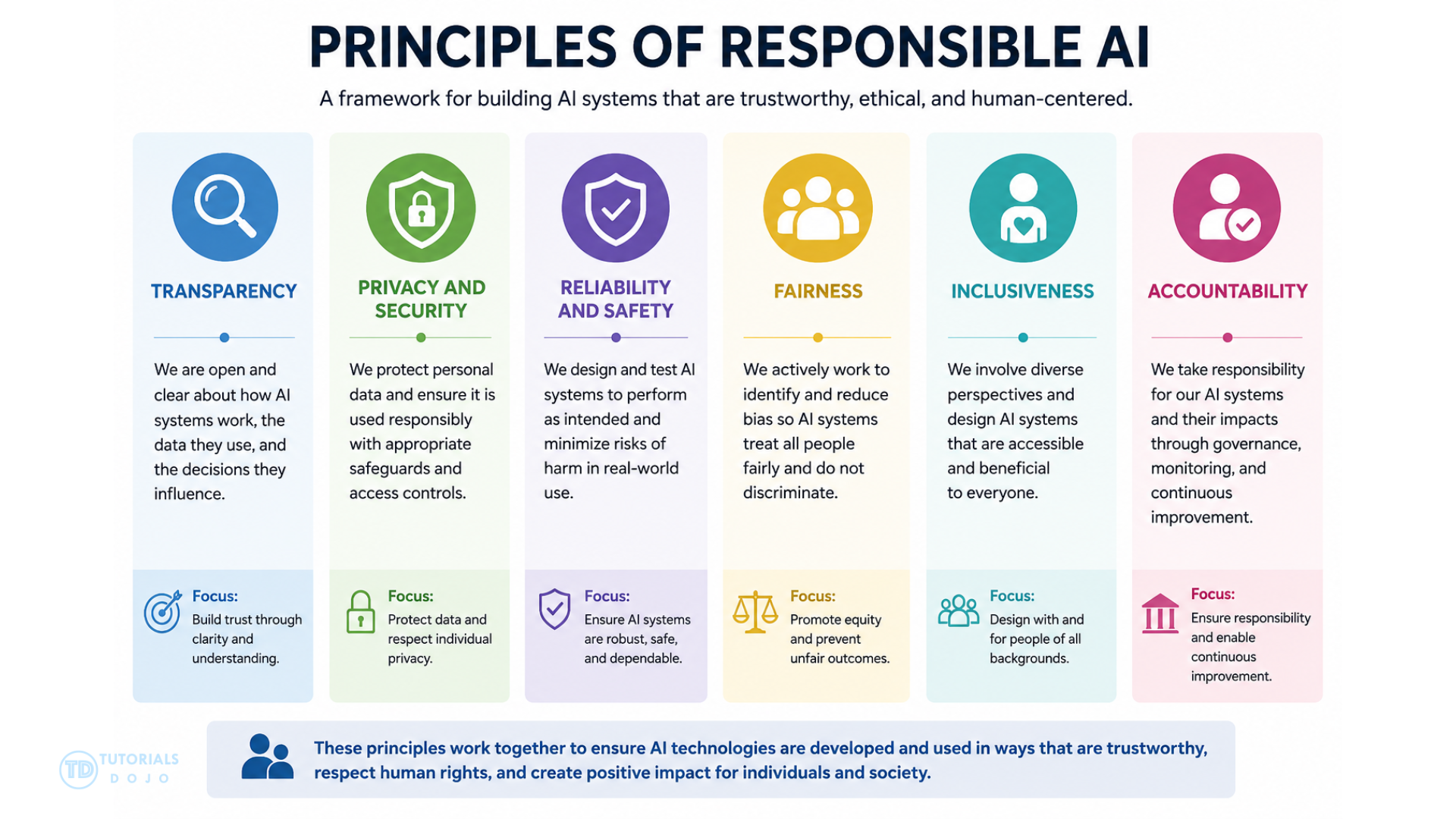
Transparency helps people understand how an AI system works, what the system can do, what its limitations are, and what choices can influence its behavior. Microsoft Transparency Notes explain how AI technology works, how system owners can affect performance and behavior, and how the system should be considered in the context of the people and environment around it. These notes can also be shared with people who use or are affected by an AI system.
Explaining an AI-generated recommendation using clear factors supports transparency because it makes the AI output easier to understand and evaluate. Instead of simply presenting a result, the solution gives users more context about why the system produced that result. This helps build trust, supports informed decision-making, and allows users or reviewers to better recognize when human judgment may still be needed.
Hence, the correct answer is: Explain the AI-generated recommendation using clear factors that influenced the outcome.
The option that says: Encrypt customer request data at rest and in transit to protect sensitive personal information is incorrect because this primarily describes privacy and security. Microsoft responsible AI guidance treats privacy and security as a separate principle focused on protecting data from misuse, unauthorized access, and exposure.
The option that says: Train the AI system with varied customer data to reduce unfair treatment across account groups is incorrect because this typically describes fairness. Microsoft responsible AI guidance describes fairness as helping AI systems treat people equitably and avoid unfair bias across different groups.

The option that says: Add accessible portal features that support customers with different abilities and user needs is incorrect because this simply describes inclusiveness. Microsoft’s responsible AI guidance describes inclusiveness as designing AI systems that empower and engage people with different abilities, needs, and experiences.
References:
https://www.microsoft.com/en/ai/responsible-ai
https://learn.microsoft.com/en-us/azure/machine-learning/concept-responsible-ai?view=azureml-api-2
https://learn.microsoft.com/en-us/azure/foundry/responsible-ai/openai/transparency-note?tabs=text
Check out this Azure Responsible AI Cheat Sheet:
Question 2
You are developing an application that analyzes photos taken inside grocery stores.
The application must identify specific product brands on shelves by using labeled sample images because the brands are not included in standard image analysis categories.
Which AI workload best matches this scenario?
- Text analysis
- Information extraction
- Speech
- Computer vision
Correct Answer: 4
Computer vision is a common AI workload used to analyze and interpret visual content such as images and videos. It can support scenarios such as image classification, object detection, optical character recognition, and visual feature analysis. Microsoft’s AI learning path for AI applications and agents includes computer vision as one of the common workloads, along with generative AI and agents, text analysis, speech, and information extraction.
In this scenario, the application works with grocery store photos and must identify specific product brands from labeled sample images. Since the input is visual content and the goal is to recognize product categories in images, the workload is primarily computer vision. Azure Vision in Foundry Tools provides image-processing capabilities and object detection as a feature that can identify objects in an image and return their locations.
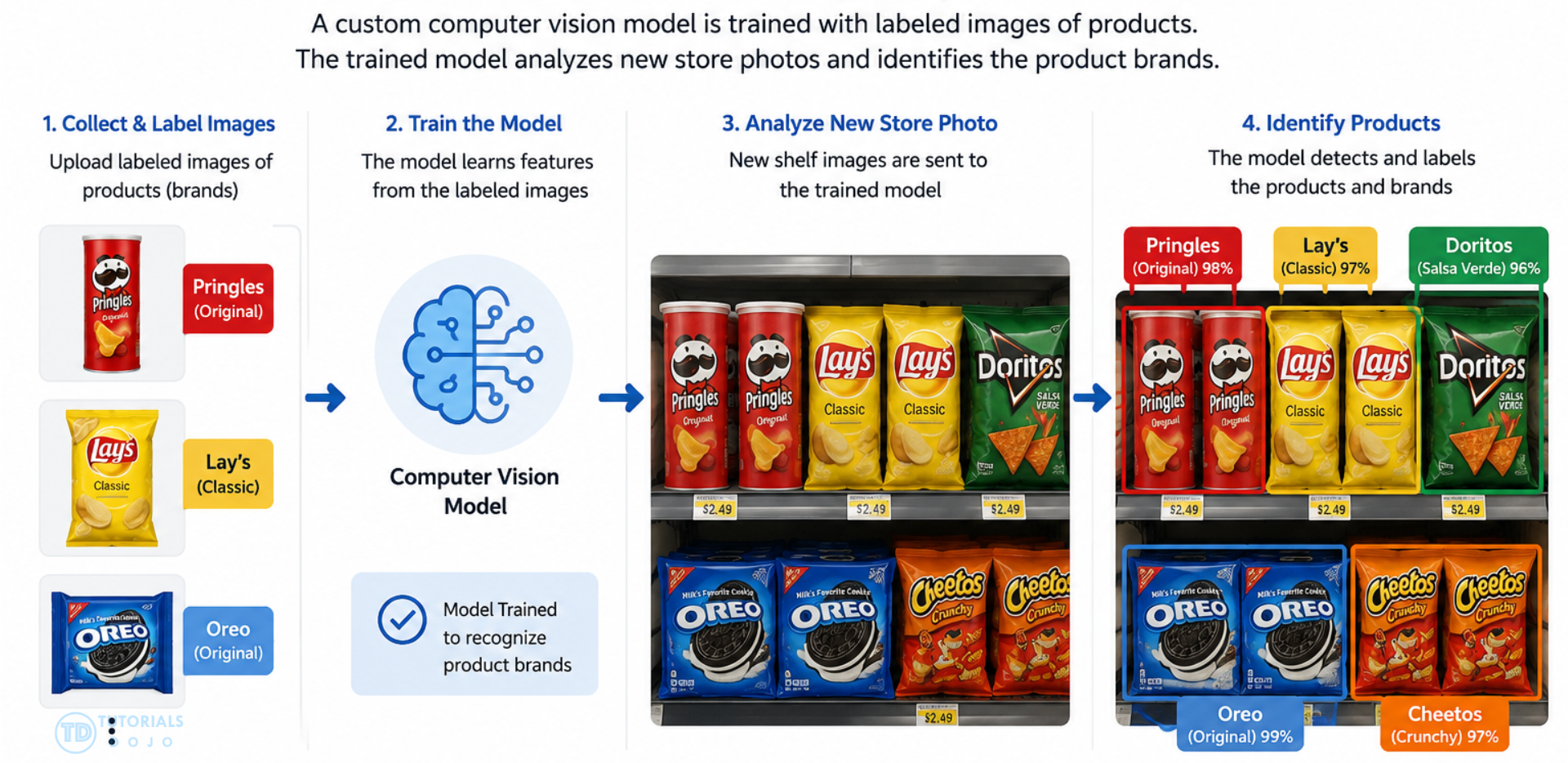
The use of labeled sample images also supports the idea that the application needs to learn visual categories that are specific to the business scenario. Computer vision workloads are typically used for this type of image-based recognition task because the solution is not just reading text, processing speech, or extracting structured fields from documents. Automated ML also supports computer vision tasks such as image classification and object detection when training models on image data is required.
Hence, the correct answer is: Computer vision.
Text analysis is incorrect because it primarily focuses on written language, such as extracting key phrases, detecting sentiment, identifying entities, or analyzing text content. The scenario simply involves product recognition from photos, not processing written text.
Speech is incorrect because it typically involves spoken audio, such as converting speech to text, generating spoken output, or translating speech. The scenario only involves images captured inside grocery stores, not voice or audio input.
Information extraction is incorrect because it primarily focuses on pulling structured data from content such as forms, records, receipts, or documents. Although product information may be useful, the task is just visual recognition from store photos, so computer vision is a better workload.
References:
https://learn.microsoft.com/en-us/training/paths/get-started-ai-apps-agents/
https://learn.microsoft.com/en-us/azure/ai-services/computer-vision/concept-object-detection
Check out this Azure Vision in Microsoft Foundry Cheat Sheet:
For more Azure practice exam questions with detailed explanations, check out the Tutorials Dojo Portal:


Final Remarks
Success in the AI-901 exam requires a solid understanding of AI concepts, responsible AI principles, and how AI solutions are built with Microsoft Foundry. Focus on Microsoft Learn topics such as generative AI, agentic AI, text analysis, speech, computer vision, image generation, and information extraction. Hands-on practice in the Foundry portal, basic Python, and the Foundry SDK can help reinforce key skills. Practice exams can also help measure readiness and identify areas for review. With focused preparation, candidates can build the knowledge needed to earn the Microsoft Certified Azure AI Fundamentals certification. Best of luck with your studies!
🤖 $3.74 ONLY for Claude eBooks and Get 25% OFF All Claude Reviewers
Turn Your Team Into Cloud-Ready Professionals Today
Learn AWS with our PlayCloud Hands-On Labs
$2.99 AWS and Azure Exam Study Guide eBooks

Learn GCP By Doing! Try Our GCP PlayCloud
Learn Azure with our Azure PlayCloud
FREE AI and AWS Digital Courses

FREE AWS, Azure, GCP Practice Test Samplers

Subscribe to our YouTube Channel

Follow Us On Linkedin

Written by: Lois Angelo Dar Juan