
AWS Supply Chain Cheat Sheet
- A cloud-based supply chain management service that helps organizations gain end-to-end visibility, predict risks, and optimize supply chain planning using AWS-native data, analytics, and machine learning.
Features
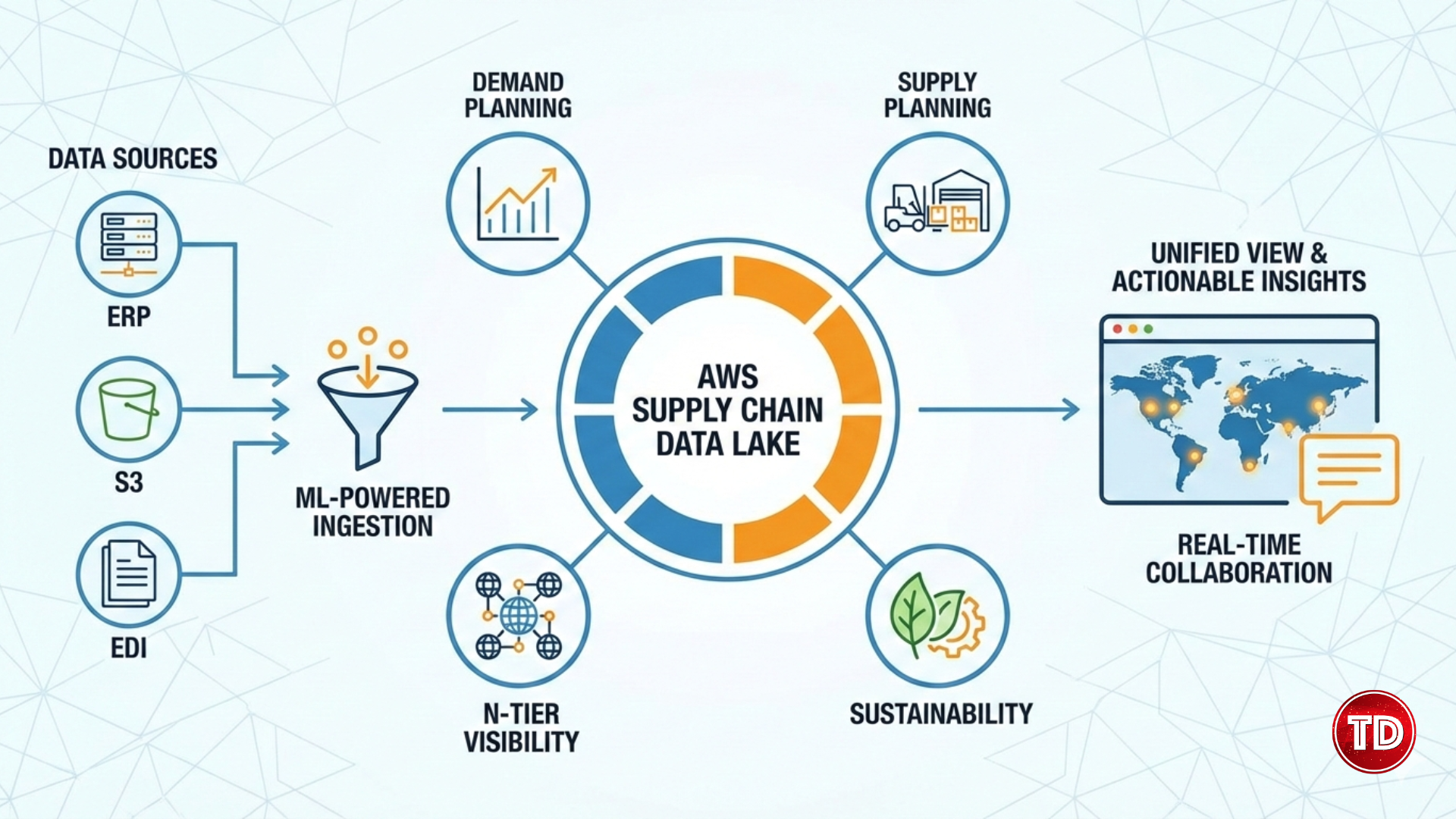
- Provides end-to-end supply chain visibility across demand, supply, inventory, and logistics data.
- Utilizes AWS-managed data ingestion pipelines to unify data from ERP systems, data lakes, and third-party sources.
- Applies machine learning or ML models to identify risks such as demand volatility, supplier delays, and inventory shortages.
- Delivers pre-built insights and dashboards without requiring custom ML model development.
- Supports scenario planning to evaluate trade-offs between cost, service levels, and inventory positions.
- Enables near real-time updates as new supply chain data is ingested.
- Offers a modular architecture, allowing organizations to adopt individual capabilities incrementally.
- Integrates natively with AWS analytics, storage, and AI services.
Key Concepts
Data Integration
AWS Supply Chain aggregates data from multiple enterprise and external sources into a single service.

It simplifies data onboarding by handling ingestion, validation, and transformation, allowing organizations to focus on insights rather than data plumbing.
Key points:
- Ingests data from ERP systems, data lakes, and third-party sources
- Supports structured and semi-structured supply chain data
- Continuously update data as new information arrives
Supply Chain Data Model
AWS Supply Chain, at its core, is a managed and standardized data model.
This unified model ensures that demand, supply, and inventory data are represented consistently across the organization, enabling accurate analytics and machine learning.
Core entities include:
- Prodeucts and SKUs
- Locations (plants, warehouses, stores)
- Suppliers and customers
- Orders, shipments, and inventory positions
Visibility
AWS Supply Chain provides end-to-end visibility across the supply chain.
It allows users to understand what is happening now and what is likely to happen next by correlating data across multiple domains.
Capabilities include:
- Inventory levels across locations
- Demand and supply alignment
- Upstream and downstream dependencies
Demand Forecasting
Demand forecasting uses machine learning to predict future customer demands based on historical data and trends.
Forecasts are continuously refined as new data is ingested, helping planners make proactive decisions.
Key characteristics:
- ML-based forecasting models
- Incorporates seasonality and trends
- Supports short-term and long-term planning
Supply Planning
- Evaluates supply constraints, lead times, and capacity limitations.
- Identifies potential shortages or excess inventory scenarios.
- Supports trade-off analysis between cost, service level, and risk.
Collaboration & Decision Support
- Provides a shared, centralized view of supply chain data for planners and stakeholders.
- Enables data-driven decision-making through consistent metrics and insights.
High-Level Architecture Diagram
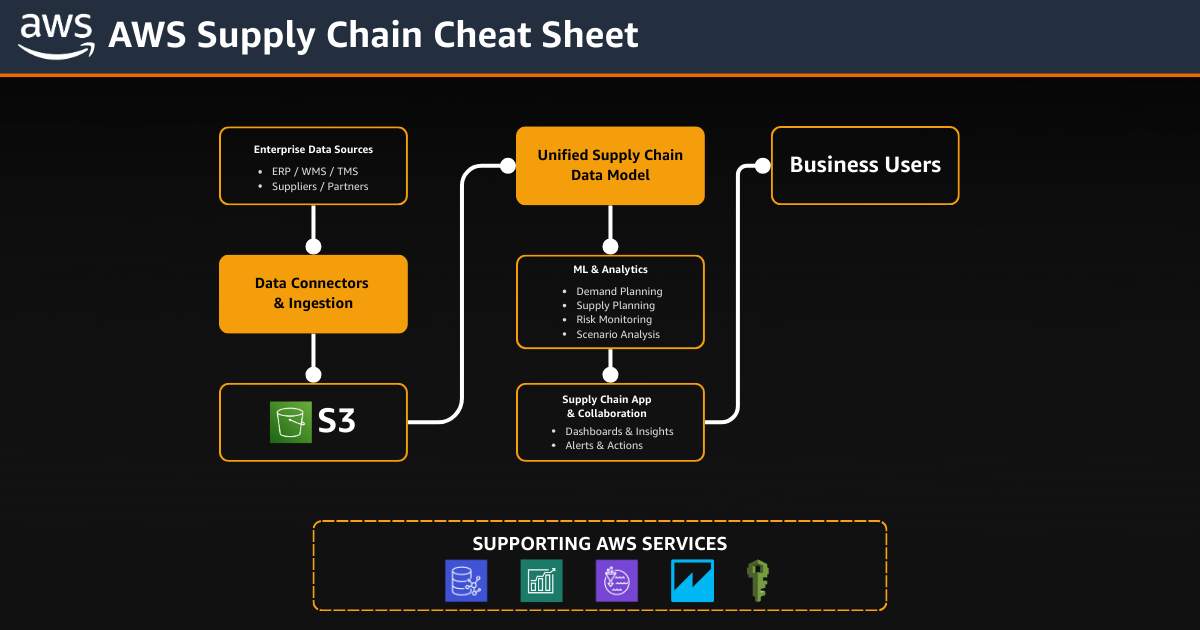
The supporting services (in the following order as the diagram): Neptune, Forecast, Lake Formation, QuickSight, and IAM.
Use Cases
- Improving end-to-end supply chain visibility across global operations
- Reducing inventory carrying costs while maintaining service levels
- Identifying and mitigating supply risks such as supplier delays or demand spikes
- Enhancing demand forecasting accuracy using machine learning
- Supporting scenario planning for supply disruptions, promotions, or market changes
- Modernizing legacy supply chain planning systems with cloud-native analytics
Best Practices
- Start by integrating high-impact data sources such as ERP order, inventory, and shipment data.
- Adopt a phased approach by enabling visibility first, then forecasting and planning capabilities.
- Continuously validate and improve data quality to maximize ML insight accuracy.
- Align business stakeholders on common definitions for demand, supply, and inventory metrics.
- Use scenario planning to test assumptions before executing major supply chain decisions.
- Leverage AWS analytics services for deeper customization if required.
Security
- Integrates with IAM for fine-grained access control.
- Supports role-based access to supply chain data, dashboards, and insights.
- Encrypts data at rest and in transit using AWS-managed encryption mechanisms.
- Uses AWS CloudTrail to log user activity and configuration changes for auditing.
- Align with AWS Compliance programs to meet regulatory and industry requirements.
Region Availability
AWS Supply Chain is available in select AWS regions.
Region availability may vary by feature and capability.
Customers typically deploy AWS Supply Chain in Regions aligned with their data residency and operational requirements.
Pricing
Pricing is based primarily on:
- Data ingestion volume
- Data storage
- Analytics and ML-driven insights consumption
Costs vary depending on the amount of supply chain data processed and the features enabled.
There are no upfront commitments, and pricing follows a pay-as-you-go model.
References
- https://aws.amazon.com/aws-supply-chain/
- https://docs.aws.amazon.com/aws-supply-chain/latest/userguide/what-is-service.html
- https://docs.aws.amazon.com/aws-supply-chain/
- https://aws.amazon.com/aws-supply-chain/pricing/
🌸 25% OFF All Reviewers on our International Women’s Month Sale! Save 10% OFF All Subscriptions Plans & 5% OFF Store Credits/Gift Cards!

Learn AWS with our PlayCloud Hands-On Labs

$2.99 AWS and Azure Exam Study Guide eBooks

New AWS Generative AI Developer Professional Course AIP-C01

Learn GCP By Doing! Try Our GCP PlayCloud

Learn Azure with our Azure PlayCloud
FREE AI and AWS Digital Courses

FREE AWS, Azure, GCP Practice Test Samplers


Subscribe to our YouTube Channel

Follow Us On Linkedin


Written by: Waffen Sultan