
Last updated on December 12, 2025
Azure Table Storage Cheat Sheet
- A NoSQL key-value store for large semi-structured datasets.
- Supports flexible data schema.
- Query using a subset of the OData protocol and filter on the PartitionKey and RowKey properties for fast, indexed lookups. Azure Cosmos DB for Table offers enhanced query capabilities.
Important Update (2024): Microsoft’s strategic direction for table storage is Azure Cosmos DB for Table. This offering provides the Azure Table Storage API with significant enhancements: guaranteed single-digit millisecond latency, automatic global distribution, dedicated throughput, and a comprehensive SLA. For all new development, Microsoft recommends using Azure Cosmos DB for Table. The classic Azure Storage Tables service is being maintained but is not the focus for new feature development.
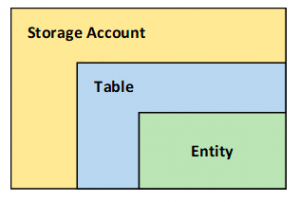
Features
- Allows you to store and query huge sets of structured, non-relational data. And as demand grows, your tables will scale-out.
- Supports transactional batch operations (Entity Group Transactions) for atomic updates of up to 100 entities within the same partition.
- Scale-up without having to manually shard your dataset.
- The data is replicated three times within a region using geo-redundant storage. Analytical Store (Preview): Enables large-scale analytics on table data using tools like Apache Spark and Synapse Analytics without impacting transactional performance.
- An entity has a limit of 1MB in size.
- Store data sets that do not require complex joins, foreign keys, or stored procedures, and can be denormalized for fast access.
- Table storage is used to store flexible data sets such as user data for web applications, device information, or other types of metadata the service requires.
- You can store any number of entities in a table, up to the storage account’s capacity limit.
- Throughput Management: Azure Cosmos DB for Table offers provisioned throughput (RU/s) with autoscale options, providing predictable performance and cost for demanding workloads.

Performance and Pricing Models
-
Standard Azure Table Storage: Offered in General-purpose v2 (GPv2) storage accounts. Billed based on storage capacity, transaction operations, and data transfer.
-
Azure Cosmos DB for Table: Offers two capacity modes:
-
Provisioned Throughput: Reserve throughput (Request Units/sec) billed hourly. Best for steady, predictable workloads.
-
Serverless: Pay only for consumed Request Units. Ideal for intermittent, unpredictable traffic with bursts.
-
Validate Your Knowledge
Question 1
Question Type: Matrix Sorting Choice
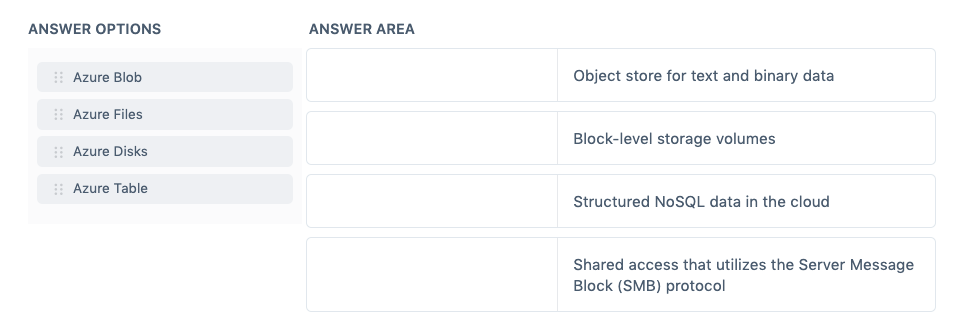
Match the Azure Storage service to its correct description.
Instructions: To answer, drag the appropriate Azure service from the column on the left to its description on the right. Each correct match is worth one point.
Correct Answer:
- Azure Blob – Object store for text and binary data
- Azure Disks – Block-level storage volumes
- Azure Table – Structured NoSQL data in the cloud
- Azure Files – Shared access that utilizes the Server Message Block (SMB) protocol
The Azure Storage platform is Microsoft’s cloud storage solution for modern data storage scenarios. Core storage services offer a massively scalable object store for data objects, disk storage for Azure virtual machines (VMs), a file system service for the cloud, a messaging store for reliable messaging, and a NoSQL store.

Azure Blob storage is Microsoft’s object storage solution for the cloud. Blob storage is optimized for storing massive amounts of unstructured data. Unstructured data is data that doesn’t adhere to a particular data model or definition, such as text or binary data.
Blob storage is designed for:
– Serving images or documents directly to a browser.
– Storing files for distributed access.
– Streaming video and audio.
– Writing to log files.
– Storing data for backup and restore disaster recovery, and archiving.
– Storing data for analysis by an on-premises or Azure-hosted service.
Azure Disks are block-level storage volumes that are managed by Azure and used with Azure Virtual Machines. Managed disks are like a physical disk in an on-premises server but virtualized. With managed disks, all you have to do is specify the disk size, the disk type, and provision the disk. Once you provision the disk, Azure handles the rest.
Disks come in many different sizes and performance levels, from solid-state drives (SSDs) to traditional spinning hard disk drives (HDDs), with varying performance abilities. Details on pricing are available on the Managed Disks pricing page.
Azure Table stores large amounts of structured data. The service is a NoSQL datastore which accepts authenticated calls from inside and outside the Azure cloud. Azure tables are ideal for storing structured, non-relational data. Common uses of Table storage include:
– Storing TBs of structured data capable of serving web-scale applications.
– Storing datasets that don’t require complex joins, foreign keys, or stored procedures and can be denormalized for fast access.
– Quickly querying data using a clustered index.
You can use Table storage to store and query huge sets of structured, non-relational data, and your tables will scale as demand increases.
Azure Files enables you to set up highly available network file shares that can be accessed by using the standard Server Message Block (SMB) protocol. That means that multiple VMs can share the same files with both read and write access. You can also read the files using the REST interface or the storage client libraries.
One thing that distinguishes Azure Files from files on a corporate file share is that you can access the files from anywhere in the world using a URL that points to the file and includes a shared access signature (SAS) token. You can generate SAS tokens; they allow specific access to a private asset for a specific amount of time.
File shares can be used for many common scenarios:
– Many on-premises applications use file shares. This feature makes it easier to migrate those applications that share data to Azure. If you mount the file share to the same drive letter that the on-premises application uses, the part of your application that accesses the file share should work with minimal, if any, changes.
– Configuration files can be stored on a file share and accessed from multiple VMs. Tools and utilities used by multiple developers in a group can be stored on a file share, ensuring that everybody can find them and that they use the same version.

– Diagnostic logs, metrics, and crash dumps are just three examples of data that can be written to a file share and processed or analyzed later.
Hence, the following are the correct match for each Azure Storage service:
Azure Blob – Object store for text and binary data.
Azure Disks – Block-level storage volumes.
Azure Table – Structured NoSQL data in the cloud.
Azure Files – Shard access that utilizes Server Message Block (SMB) protocol.
References:
https://docs.microsoft.com/en-us/azure/storage/blobs/storage-blobs-introduction
https://docs.microsoft.com/en-us/azure/storage/files/storage-files-introduction
https://docs.microsoft.com/en-us/azure/virtual-machines/managed-disks-overview
https://docs.microsoft.com/en-us/azure/storage/tables/table-storage-overview
Azure Storage Services Cheat Sheets:
https://tutorialsdojo.com/azure-cheat-sheets-storage-services/
Note: This question was extracted from our AZ-900 Microsoft Azure Fundamentals Practice Exams.
For more Azure practice exam questions with detailed explanations, check out the Tutorials Dojo Portal:

Azure Table Storage Cheat Sheet Resources:
https://azure.microsoft.com/en-us/services/storage/tables/
https://docs.microsoft.com/en-us/azure/storage/tables/table-storage-overview
🌸 25% OFF All Reviewers on our International Women’s Month Sale Extension! Save 10% OFF All Subscription Plans & 5% OFF Store Credits/Gift Cards!

Learn AWS with our PlayCloud Hands-On Labs
$2.99 AWS and Azure Exam Study Guide eBooks

New AWS Generative AI Developer Professional Course AIP-C01

Learn GCP By Doing! Try Our GCP PlayCloud

Learn Azure with our Azure PlayCloud
FREE AI and AWS Digital Courses

FREE AWS, Azure, GCP Practice Test Samplers


Subscribe to our YouTube Channel

Follow Us On Linkedin


Written by: Jon Bonso