
Last updated on August 11, 2026
The Claude Certified Architect – Foundations (CCAR-F) certification validates that professionals have the foundational knowledge required to design and implement production-grade AI solutions using Claude. This exam assesses expertise in core technologies like Claude Code, the Claude Agent SDK, the Claude API, and the Model Context Protocol (MCP), which are essential for building AI-powered applications and systems.
This exam tests practical skills in real-world scenarios, including building agent-based systems, integrating Claude into CI/CD pipelines, and managing context across multi-agent workflows. Candidates must show proficiency in making informed decisions about architecture and tradeoffs in production environments.
For more information about the CCAR-F exam, you can check out their official study guide. This will provide comprehensive review materials to help you pass the exam successfully.
CCAR-F Exam Domains
Below are the exam domains for the Claude Certified Architect – Foundations (CCAR-F) certification exam. These domains represent the core competencies candidates must demonstrate in architecting solutions with Claude. Candidates need to understand designing agentic systems, integrating Claude Code, configuring the Claude Agent SDK, and managing the Model Context Protocol (MCP). Additionally, candidates must showcase skills in prompt engineering, managing context, and making informed decisions for AI deployments.
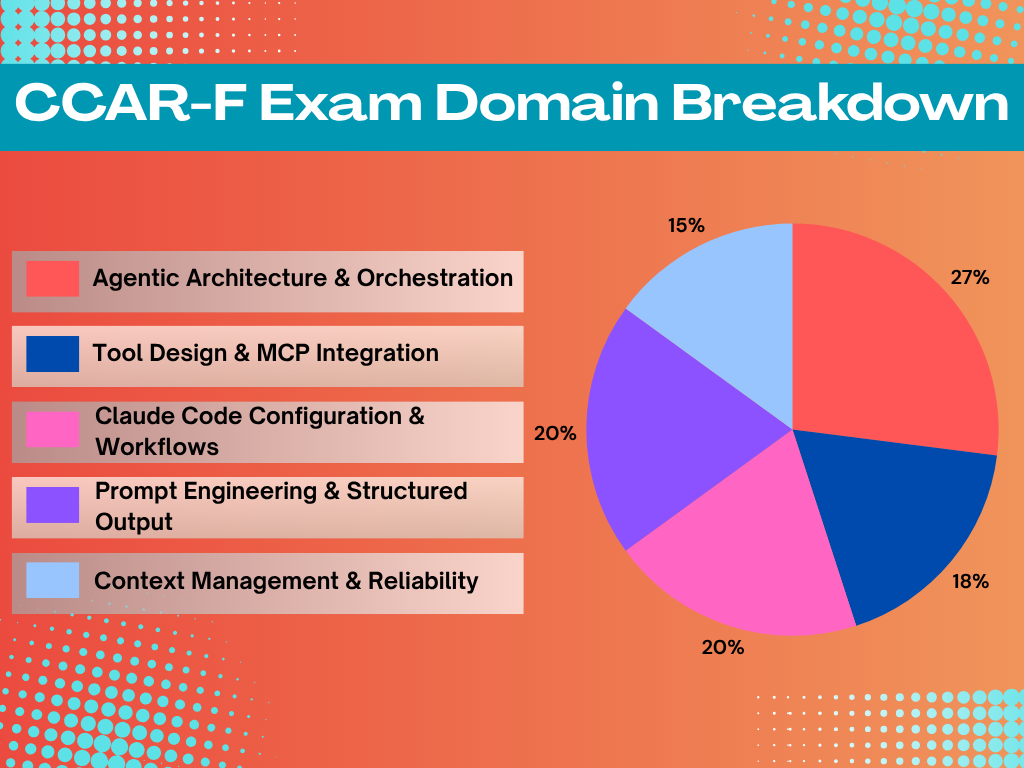
- Agentic Architecture & Orchestration – 27%
- Tool Design & MCP Integration – 18%
- Claude Code Configuration & Workflows – 20%
- Prompt Engineering & Structured Output – 20%
- Context Management & Reliability – 15%
CCAR-F Study Materials
Before attempting the Claude Certified Architect – Foundations (CCAR-F) certification exam, it is highly recommended to review the following study materials. These resources are designed to help candidates understand key concepts, tools, and best practices for implementing solutions with Claude. By studying these materials in advance, candidates can strengthen their knowledge of Claude’s core technologies, including Claude Code, the Claude Agent SDK, and the Model Context Protocol (MCP).
- Tutorials Dojo’s Claude Certified Architect Foundations CCAR-F Practice Exams
- Claude Certified Architect – Foundations Access Request
- Claude Certified Architect – Foundations Certification Exam Guide
- Claude Certified Architect – Foundations Certification Prep Course
- Anthropic Official Documentation and Learning Resources:
Anthropic Services to Focus on for the CCAR-F Exam
Here is the list of Anthropic services to focus on for your Claude Certified Architect Foundations (CCAR-F) exam:
Claude Agent SDK
- Understand agent definitions, agentic loops, and
stop_reasonhandling. - Learn how to manage subagent spawning, tool call interception, and configure
allowedTools.

Model Context Protocol (MCP)
- Master MCP servers, tools, resources, and the
isErrorflag. - Learn how to configure tools, manage tool distribution, and use environment variables in
.mcp.json.
Claude Code
- Gain proficiency in the
CLAUDE.mdconfiguration hierarchy and path scoping with YAML frontmatter. - Use
.claude/commands/for slash commands, manage plan mode, and control sessions with commands like/memoryand/compact.
Claude API
- Use
tool_usewith JSON schemas and handletool_choiceoptions such as “auto” and “any”. - Configure
max_tokens, system prompts, and managestop_reasonvalues.
Message Batches API
- Learn cost-saving features and request/response correlation using
custom_id. - Understand the 24-hour processing window and limitations such as no support for multi-turn tool calling.
Others
- JSON Schema: Understand required vs optional fields, enum types, and strict mode for validation.
- Pydantic: Study schema validation, semantic error handling, and retry logic.
- Built-in Tools: Learn use cases for tools like Read, Write, Edit, Bash, Grep, and Glob.
CCAR-F Key Exam Topics by Domain
Agentic Architecture & Orchestration
- Agentic systems: Learn how to design and implement agent-based architectures using the Claude Agent SDK.
- Agent orchestration: Manage multi-agent systems, including interaction, delegation, and task coordination.
- Subagent management: Spawn and manage subagents, use task tools, and configure
allowedTools. - Agent lifecycle: Understand the full lifecycle, including hooks (e.g.,
PostToolUse) and task-specific interactions.
Tool Design & MCP Integration
- Tool design: Design and configure tools using the Model Context Protocol (MCP).
- MCP server and tool management: Set up MCP servers, tools, and resources, and manage configurations in
.mcp.json. - MCP integration: Integrate MCP with external systems and handle flags like
isError. - Environment variables: Use environment variable expansion for dynamic tool configuration.
Claude Code Configuration & Workflows
- Claude Code architecture: Understand configuration hierarchy using
CLAUDE.mdacross user, project, and directory scopes. - Workflows and execution: Configure workflows with
.claude/rules/, path scoping, and commands like/memoryand/compact. - Plan mode and execution: Use plan mode for orchestration and direct execution for real-time tasks.
- Slash commands: Create custom commands via
.claude/commands/.
Prompt Engineering & Structured Output
- Prompt engineering: Craft precise prompts for reliable and structured outputs.
- Few-shot learning: Use examples to guide responses and handle ambiguous scenarios.
- Structured data output: Extract and format data using JSON schemas.
- Tool-based prompting: Use built-in tools like Read, Write, and Bash for efficient data handling.
Context Management & Reliability
- Context window management: Optimize token usage and apply progressive summarization.
- Session management: Handle session resumption, isolation, and use commands like
fork_session. - Reliability and error handling: Design for robustness with error handling, escalation, and confidence scoring.
- Long-term context preservation: Maintain important context across long documents and multi-turn interactions.
CCAR-F Important Skills to Focus on
Implementing the Agentic Loop
- Manage agent control flow using
stop_reasonto handle tool results and terminate loops effectively. - Structure agentic loops to manage task execution and refine termination conditions for efficient orchestration.
Multi-Agent Orchestration
- Coordinate subagents using coordinator-subagent patterns for task decomposition and parallel execution.
- Apply iterative refinement loops where multiple agents collaborate in stages to improve efficiency and accuracy.
Tool Interface and Resource Design
- Create clear and concise tool descriptions, and decide when to consolidate or split tools.
- Design tools and resources for content catalogs with high-quality descriptions for better usability.
MCP Configuration and Server Management
- Configure and manage tools within the Model Context Protocol (MCP) across project and user scopes.
- Handle multi-server access and use environment variable expansion for flexible configuration.
Error Handling and Escalation Strategies
- Design structured error responses for transient, business, and permission errors.
- Define escalation criteria for cases like policy gaps, user preferences, or stalled progress.
Prompt Engineering and Structured Output
- Craft effective few-shot prompts to handle ambiguity and improve accuracy.
- Design schemas and configure
tool_usefor structured output, including nullable fields to reduce hallucinations.
Validate Your CCAR-F Exam Readiness
If you feel confident after going through the suggested materials above, it’s time to put your knowledge of different Claude concepts and services to the test. For top-notch practice exams, consider using the Tutorials Dojo’s Claude Certified Architect Foundations CCAR-F Practice Exams.
These practice tests cover key topics from the CCAR-F exam, featuring multiple-choice questions with one correct answer and three incorrect responses (distractors). Each question includes a detailed explanation and reference links to help you understand why the correct answer is the best solution. After taking the exams, you’ll see areas to improve, allowing you to focus your study efforts. With a thorough study of their official study guide combined with our practice tests, you’ll be well-prepared to pass the CCAR-F exam and deepen your understanding of Claude technologies.

CCAR-F Sample Practice Test Questions:
Question 1
A team is designing a multi-step data processing workflow where incoming records must first pass through an extract_metadata tool to standardize the structure before any enrichment tools are applied. During testing, inconsistent outputs appear because some enrichment steps are executed on unprocessed data, indicating that the extraction step is sometimes skipped.
The team needs to enforce that the extraction step always executes first within a single request turn, without redesigning the overall pipeline.

Which tool_choice configuration will correctly enforce this execution order?
- Set tool_choice to auto and add system prompt instructions specifying that extract_metadata must always run before enrichment tools are called.
- Set tool_choice to any to require that some tool is called, then rely on tool description ordering to guide the model toward calling extract_metadata first.
- Set tool_choice to {type: tool, name: extract_metadata} for the first turn, then use auto or any in follow-up turns to process enrichment steps.
- Set tool_choice to auto for the first turn and implement a post-processing validator that detects when enrichment ran first and re-invokes the extraction tool retroactively.
Correct Answer: 3
The Claude API provides four tool_choice modes: auto, any, tool, and none. While auto and any allow flexibility, they still rely on the model’s judgment, which means execution order cannot be strictly guaranteed. In workflows where correctness depends on a prerequisite step, such as normalizing data before enrichment, relying on model behavior alone introduces risk.
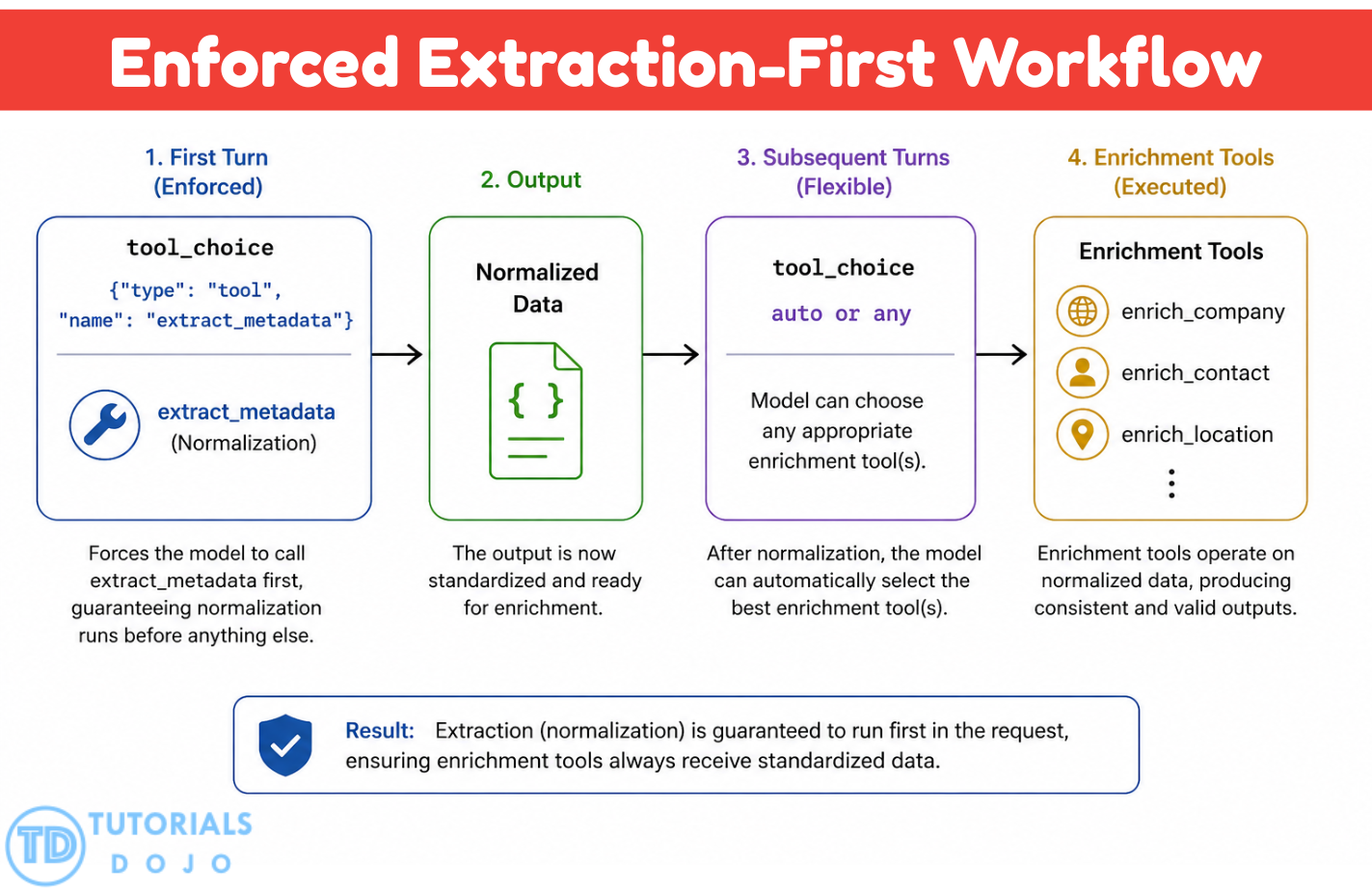
The tool_choice: {"type": "tool", "name": "..."} configuration removes that uncertainty by explicitly forcing the model to call a specific tool on that turn. This creates a deterministic checkpoint in the pipeline, ensuring that the required preprocessing step, in this case extract_metadata, always executes before anything else. It shifts control from probabilistic model decisions to enforced API behavior.
After this initial step is guaranteed, subsequent turns can safely switch back to auto or any. At that point, the input has already been standardized, allowing the model to flexibly choose the most appropriate enrichment tools without risking malformed outputs.
Hence, the correct answer is: Set tool_choice to {type: tool, name: extract_metadata} for the first turn, then use auto or any in follow-up turns to process enrichment steps.
The option that says: Set tool_choice to auto and add system prompt instructions specifying that extract_metadata must always run before enrichment tools are called is incorrect because prompt-based enforcement simply cannot guarantee tool selection order, the model retains full discretion to skip extract_metadata regardless of system prompt instructions.
The option that says: Set tool_choice to any to require that some tool is called, then rely on tool description ordering to guide the model toward calling extract_metadata first is incorrect because tool_choice: any does not specify which tool runs first, the model could legitimately select an enrichment tool on the first turn.
The option that says: Set tool_choice to auto for the first turn and implement a post-processing validator that detects when enrichment ran first and re-invokes the extraction tool retroactively is incorrect because a validator only detects ordering failures after they have already occurred, and retroactive re-invocation does not undo malformed enrichment output already produced.
References:
https://platform.claude.com/docs/en/agents-and-tools/tool-use/define-tools
https://platform.claude.com/docs/en/agents-and-tools/tool-use/how-tool-use-works
https://platform.claude.com/docs/en/agents-and-tools/tool-use/overview
Check out this Claude API Cheat Sheet:
Question 2
Your web search subagent is designed to handle research tasks, but it sometimes times out when searching for complex topics. Currently, when a timeout occurs, the subagent returns an empty result set, but it marks the result as successful with no error flag.
Which is the main issue with this approach?
- Returning an empty result as success prevents the coordinator from distinguishing between a search that found nothing and a search that failed, eliminating the opportunity for recovery.
- The empty result is too small to be useful, so the subagent should generate synthetic placeholder results instead
- Empty results consume unnecessary tokens in the conversation context without providing value.
- The timeout should be handled by the coordinator, not the subagent, since only the coordinator has the authority to decide on retry strategies.
Correct Answer: 1
In multi-agent research systems built with Claude, error propagation is a core architectural concern. When a subagent encounters a failure, such as a timeout during web search, how it communicates that failure to the coordinator determines whether the system can recover intelligently or silently degrade.
Accordingly, the Multi-Agent Research System scenario identifies silently suppressing errors as a critical anti-pattern. Returning an empty result set marked as successful is one of the most damaging forms of silent suppression because it actively misleads the coordinator. From the coordinator’s perspective, an empty success result is indistinguishable from a valid search that genuinely found no matches. This eliminates two critical recovery paths:
Retry logic – the coordinator cannot decide to retry a timed-out search if it does not know a timeout occurred
Fallback strategies – the coordinator cannot route to an alternative search approach, broaden the query, or escalate to a human if it believes the search succeeded
The correct approach is structured error propagation. When a timeout occurs, the subagent should return a response that includes an isError flag set to true, an errorCategory identifying the failure type (e.g., timeout), an isRetryable indicator, the attempted query, and any partial results retrieved before the failure. This structured context gives the coordinator everything it needs to make an intelligent recovery decision – retry, fallback, or escalate -rather than treating a failure as a completed task.
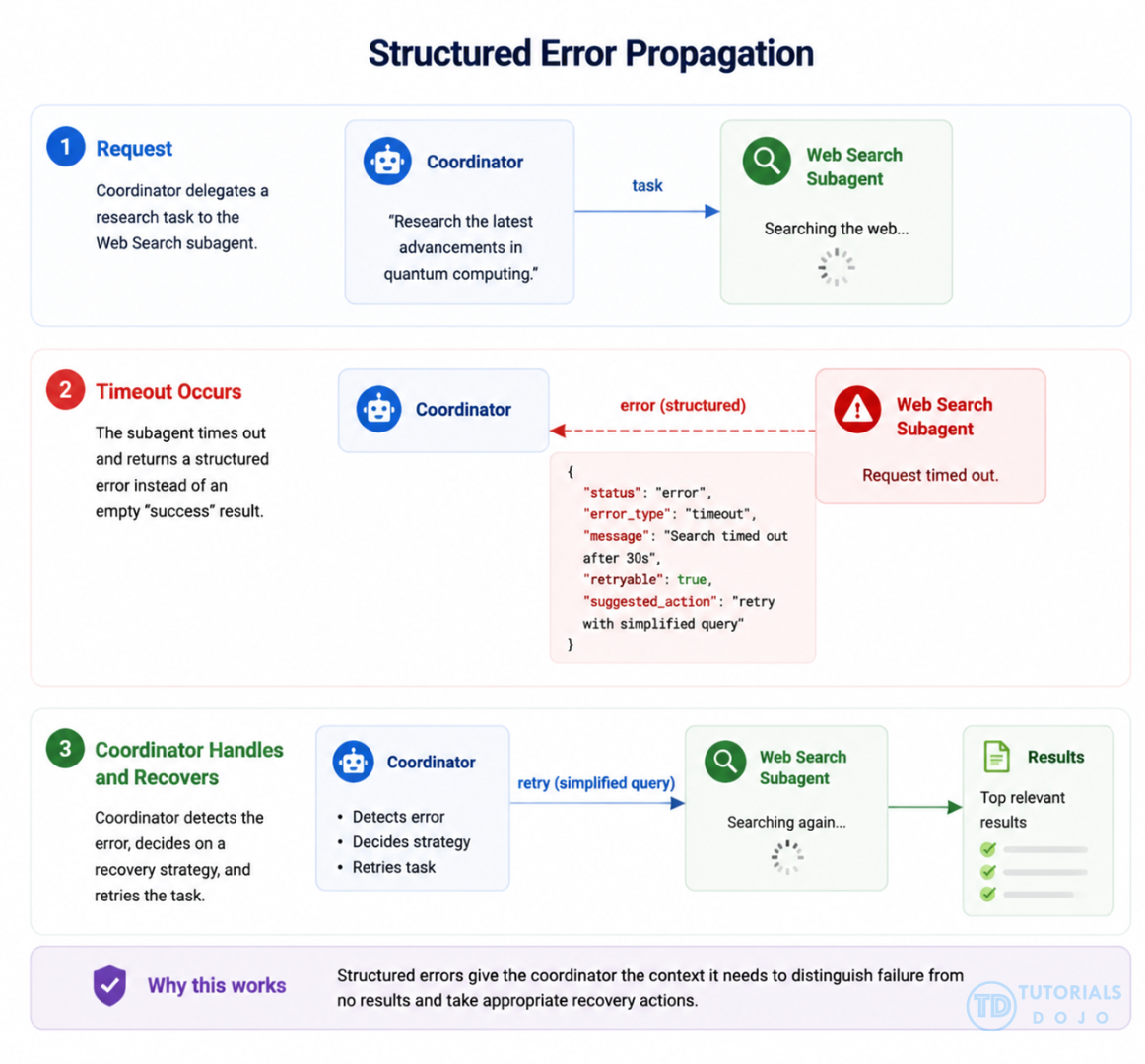
Hence, the correct answer is: Returning an empty result as success prevents the coordinator from distinguishing between a search that found nothing and a search that failed, eliminating the opportunity for recovery.
The option that says: The empty result is too small to be useful, so the subagent should generate synthetic placeholder results instead is incorrect because generating synthetic results introduces fabricated information into the research pipeline. The problem is not just the size of the result; it is the misrepresentation of a failure as a success. Synthetic placeholders would compound the issue by adding false data on top of an already hidden failure.
The option that says: Empty results consume unnecessary tokens in the conversation context without providing value is incorrect because token consumption is a negligible concern compared to the fundamental architectural problem. An empty result consumes minimal tokens regardless of whether it is flagged as an error or a success. The issue is that the coordinator cannot make any recovery decision, retry, fallback, or escalate when it cannot distinguish a timeout from a genuine empty result.
The option that says: The timeout should be handled by the coordinator, not the subagent, since only the coordinator has the authority to decide on retry strategies is incorrect because subagents should implement local recovery for transient failures before escalating. The issue is not about who owns the timeout; it is about how the failure is communicated. The subagent’s responsibility is primarily to report failures accurately with structured context. The coordinator’s responsibility is to decide what to do with that information. Both roles are necessary, and suppressing the error at the subagent level removes the coordinator’s ability to act.
References:
https://platform.claude.com/docs/en/api/errors
https://code.claude.com/docs/en/hooks?
Check out these Claude Cheat Sheets:
https://tutorialsdojo.com/other-cheat-sheets/claude-cheat-sheets/
Check out our other practice exam offerings for AWS, Azure, and Google Cloud, featuring detailed explanations, by visiting the Tutorials Dojo Portal:


Final Remarks
Success in the CCAR-F exam requires both conceptual knowledge and hands-on experience with Claude technologies. Focus your preparation on mastering core components such as the Claude Agent SDK, Model Context Protocol (MCP), and Claude Code. Strengthen your skills by practicing tool design, subagent orchestration, and prompt engineering to create efficient agentic systems. Additionally, familiarize yourself with best practices for structured data extraction, error handling, and context management. Practice exams will assess your readiness and pinpoint areas for improvement. By following this focused study approach, you’ll be well-prepared to earn the Claude Certified Architect – Foundations certification. Good luck with your preparation!
🤖 $3.74 ONLY for Claude eBooks and Get 25% OFF All Claude Reviewers

Turn Your Team Into Cloud-Ready Professionals Today

Learn AWS with our PlayCloud Hands-On Labs

$2.99 AWS and Azure Exam Study Guide eBooks

Learn GCP By Doing! Try Our GCP PlayCloud
Learn Azure with our Azure PlayCloud

FREE AI and AWS Digital Courses

FREE AWS, Azure, GCP Practice Test Samplers


Subscribe to our YouTube Channel

Follow Us On Linkedin


Written by: Lois Angelo Dar Juan