
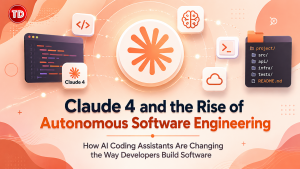
Artificial Intelligence is entering a new phase in software development. Over the past few years, developers have become familiar with AI-powered coding assistants that can generate functions, explain programming concepts, write documentation, and help troubleshoot technical issues. Tools such as GitHub Copilot, ChatGPT, Claude, Cursor, and Amazon Q Developer have become common parts of modern development environments. What began as simple code suggestions has evolved into something far more powerful.
Today, AI is no longer limited to helping developers write individual lines of code. Modern AI systems are beginning to understand entire projects, analyze repository structures, execute development tasks, and assist with complex engineering workflows. This shift is changing how software is built, tested, and maintained across organizations of all sizes.
Among the technologies driving this transformation, Claude 4 has attracted significant attention from developers, startups, and engineering teams. Rather than functioning solely as a coding assistant, Claude 4 is increasingly being used as an engineering partner capable of handling larger scopes of work. Developers are now experimenting with workflows where AI can analyze repositories, modify multiple files, generate tests, explain architectures, and help manage development tasks that traditionally required substantial manual effort.
Why AI Coding Assistants Are Evolving Beyond Autocomplete
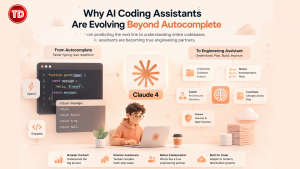
For many years, coding assistants primarily focused on code completion. Their purpose was straightforward: help developers write code faster by predicting the next line, generating common functions, and reducing repetitive typing. These tools delivered measurable productivity gains, especially for routine development tasks, but their scope remained relatively limited.
Modern software development, however, involves far more than writing code. Developers must understand project architectures, coordinate changes across multiple services, maintain infrastructure, write tests, manage deployments, and ensure security requirements are satisfied. As applications become increasingly distributed and cloud-native, the complexity of software engineering continues to grow. This growing complexity has created demand for AI systems capable of understanding broader contexts. Rather than assisting with individual functions, developers now want AI tools that can reason about entire applications. They want systems that can identify relationships between components, understand project structures, and assist with larger engineering objectives.
Claude 4 represents part of this evolution. Developers are increasingly using it not only to generate code but also to analyze repositories, review implementation plans, explain architectural decisions, and coordinate changes across multiple files. Instead of acting as a sophisticated autocomplete engine, AI is beginning to function more like a collaborative engineering assistant.
How Claude 4 Understands Large Software Projects
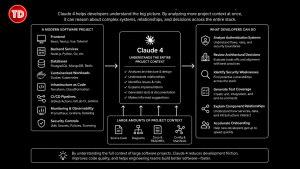
One of the biggest limitations of earlier AI coding assistants was their difficulty in understanding large software projects. While they were effective at generating functions, fixing syntax errors, and answering programming questions, they often lacked awareness of the broader application structure. Modern software systems are far more complex than a collection of source files. A typical production environment may include frontend frameworks, backend services, databases, containerized workloads, infrastructure-as-code configurations, CI/CD pipelines, monitoring platforms, and security controls. Understanding how these components interact requires a level of contextual awareness that previous AI tools often struggled to provide.
Claude 4 is helping address this challenge by allowing developers to work with larger amounts of project context at once. Instead of focusing on isolated code snippets, developers can ask the AI to analyze authentication systems, review architectural decisions, identify potential security weaknesses, generate test coverage, or explain relationships between components. This capability is particularly valuable for organizations managing large repositories with multiple contributors, where onboarding new developers can take significant time. By helping engineers navigate complex codebases and understand implementation patterns more quickly, AI can reduce development friction while improving productivity across teams.

The Rise of Agentic Development Workflows
One of the most exciting developments in software engineering today is the rise of agentic workflows. Unlike traditional AI assistants that simply answer questions or generate snippets of code, AI agents can carry out a series of tasks to achieve a larger goal. A developer can ask an agent to implement authentication, update a database schema, generate tests, and create documentation, allowing the AI to handle multiple stages of the development process instead of a single request.
In many ways, working with an AI agent feels less like using a search engine and more like collaborating with a junior engineer. The developer defines the objective while the AI helps execute parts of the work, often inspecting repositories, suggesting changes, and validating results along the way. As these tools continue to improve, software engineering may become less about manually implementing every detail and more about guiding intelligent systems toward the desired outcome. One popular saying among developers captures this shift well: “The future developer won’t just write code, they’ll orchestrate it.”
What This Means for Cloud and DevOps Engineers
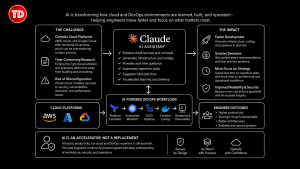
AI is not only changing how applications are developed but also how cloud and DevOps environments are managed. Modern cloud platforms such as AWS, Azure, and Google Cloud offer hundreds of services, making them powerful but often overwhelming for developers who are still learning infrastructure concepts. AI assistants help simplify this learning curve by explaining services, generating configurations, and providing guidance in real time.
For DevOps engineers, AI can automate many repetitive tasks that traditionally required extensive documentation research. Developers can generate Terraform templates, Kubernetes manifests, CI/CD pipelines, and container configurations within seconds, allowing them to focus more on architecture and operational strategy rather than syntax and setup.
However, AI should be viewed as an accelerator rather than a replacement for cloud expertise. Infrastructure mistakes can still lead to security vulnerabilities, downtime, and performance issues. As cloud environments continue to grow in complexity, the most successful engineers will be those who combine AI-assisted productivity with a strong understanding of cloud architecture and DevOps fundamentals.
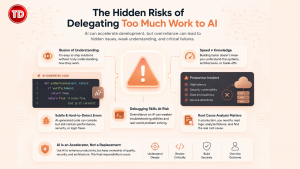
The Hidden Risks of Delegating Too Much Work to AI
Despite the impressive capabilities of modern AI systems, there are important risks associated with excessive reliance on generated output. One of the most common concerns is the illusion of understanding.
Developers can now build sophisticated applications faster than ever before. However, speed does not necessarily translate into knowledge. Some engineers may successfully implement authentication systems, cloud architectures, or database integrations without fully understanding the underlying concepts. AI-generated code can also contain subtle errors that are difficult to detect. An implementation may compile successfully while introducing performance bottlenecks, insecure configurations, or logic flaws that only appear under specific conditions. Another concern involves debugging. Developers who rely heavily on AI-generated solutions may have fewer opportunities to develop troubleshooting skills. When systems fail in production, engineers must understand how to investigate logs, analyze failures, identify root causes, and implement corrective actions.
The most successful developers will be those who treat AI as an accelerator rather than a replacement for technical understanding. AI can assist with implementation, but responsibility for software quality ultimately remains with human engineers.
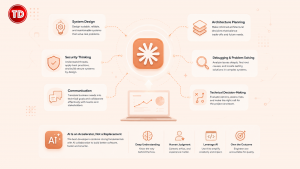
The Skills Developers Must Focus on in the AI Era
As AI systems become increasingly capable, the skills that differentiate successful engineers are beginning to change. Writing code remains important, but many routine implementation tasks are becoming easier to automate.
This means developers must place greater emphasis on higher-level engineering abilities. System design, architecture planning, security analysis, debugging, and technical decision-making are becoming increasingly valuable. These areas require contextual understanding, critical thinking, and judgment that extend beyond code generation. Communication is also becoming more important. Developers must effectively translate business requirements into technical objectives while coordinating with stakeholders, team members, and AI-assisted workflows. The ability to define problems clearly may become just as valuable as the ability to implement solutions.
The future will likely reward developers who combine strong technical foundations with effective AI collaboration. Rather than competing against AI systems, successful engineers will learn how to leverage them responsibly while maintaining a deep understanding of the technologies they use.
Final Thoughts
The rise of Claude 4 and modern AI agents represents one of the most significant developments in software engineering since the widespread adoption of cloud computing and DevOps practices. AI is no longer limited to generating isolated code snippets or answering programming questions. It is increasingly capable of participating in broader engineering workflows that involve planning, implementation, testing, documentation, and problem solving.
For developers, this creates exciting opportunities to improve productivity and reduce time spent on repetitive tasks. Teams can move faster, experiment more frequently, and focus greater attention on innovation and system design. AI-assisted development is helping make complex technologies more accessible to developers around the world. At the same time, the importance of strong engineering fundamentals has not diminished. Understanding system behavior, debugging production issues, designing scalable architectures, and maintaining secure applications remain critical responsibilities. AI can support these activities, but it cannot replace the need for technical expertise and professional judgment.
The future of software engineering will likely be defined by collaboration between humans and intelligent systems. Developers who embrace AI while continuing to strengthen their technical foundations will be best positioned to succeed in this rapidly evolving industry.
References
- Anthropic Claude Documentation
- Claude Code Documentation
- OpenAI Platform Documentation
- GitHub Copilot Documentation
- Cursor Documentation

🔔 20% OFF All Reviewers + 10% OFF PlayCloud’s First Billing Use Code: TDPLAYCLOUD-101326

Turn Your Team Into Cloud-Ready Professionals Today

Learn AWS with our PlayCloud Hands-On Labs

$2.99 AWS and Azure Exam Study Guide eBooks

Learn GCP By Doing! Try Our GCP PlayCloud
Learn Azure with our Azure PlayCloud
FREE AI and AWS Digital Courses

FREE AWS, Azure, GCP Practice Test Samplers


Subscribe to our YouTube Channel

Follow Us On Linkedin


Written by: Precious Grace Deborah Manucom