
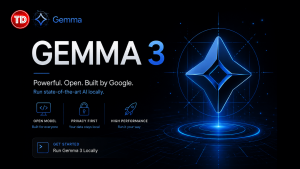
Artificial intelligence is becoming an essential part of modern software development, but many AI-powered applications still depend on cloud-hosted models accessed through APIs. While this approach offers powerful capabilities, it also introduces recurring costs, internet dependency, and privacy concerns for developers working with sensitive data. As open-weight large language models continue to improve, more developers are exploring ways to run AI entirely on their own machines. This shift has made local AI development more accessible than ever, allowing engineers to build, test, and experiment without relying on external services.
One of the latest models driving this trend is Gemma 3, Google’s family of lightweight open-weight language models. Built from the same research that powers the Gemini ecosystem, Gemma 3 enables developers to experience advanced AI capabilities locally while maintaining full control over their environment. Whether you are learning about generative AI, prototyping applications, or experimenting with machine learning workflows, Gemma 3 provides a practical starting point for local AI development.
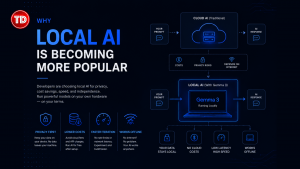
Why Local AI Is Becoming More Popular
The growing popularity of local AI is driven by more than curiosity. Developers are increasingly looking for ways to reduce cloud expenses, protect sensitive information, and eliminate dependence on constant internet connectivity. Running an AI model locally allows prompts and responses to remain on the user’s machine, making it an attractive option for organizations handling confidential documents or proprietary source code. Local deployment also enables faster experimentation since developers can iterate on prompts and applications without worrying about API quotas or network latency.
Advancements in consumer hardware have also contributed to this trend. Modern laptops equipped with Apple Silicon processors or dedicated NVIDIA graphics cards now provide enough computing power to run surprisingly capable language models. Combined with lightweight deployment tools such as Ollama, developers can launch sophisticated AI assistants within minutes, making local inference a practical option rather than a niche experiment.
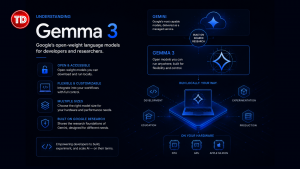
Understanding Gemma 3
Gemma 3 is Google’s latest generation of open-weight language models designed to make AI more accessible to researchers and developers. Unlike proprietary cloud models that can only be accessed through managed APIs, Gemma 3 can be downloaded and executed on local hardware, giving developers greater flexibility over how they build AI-powered applications. The model is available in multiple sizes to accommodate different hardware configurations, allowing users to balance performance, memory requirements, and inference speed according to their needs.
Although Gemma shares research foundations with Google’s Gemini models, it serves a different purpose. Instead of providing a managed AI service, Gemma empowers developers to integrate language models directly into their own workflows, whether for experimentation, education, or production deployments that require greater control over infrastructure.
Running Gemma 3 Locally
One of the reasons Gemma 3 has gained attention is its straightforward deployment process. Tools such as Ollama simplify the installation experience by automatically downloading optimized model weights and handling much of the configuration behind the scenes. Rather than manually configuring inference frameworks and dependencies, developers can install a lightweight runtime, retrieve the desired model, and begin interacting with it through a terminal or local API in just a few commands.

This simplified workflow lowers the barrier for developers who want to explore local AI without extensive machine learning expertise. Once running, Gemma 3 can answer questions, generate code, summarize documents, assist with debugging, and perform many of the same tasks commonly associated with cloud-hosted AI assistants, all while executing entirely on the local machine.
Practical Applications for Developers
Running Gemma 3 locally opens the door to a wide range of development scenarios beyond simple chat interactions. Developers can integrate the model into code editors to create private coding assistants, build document summarization tools that never transmit data externally, or develop retrieval-augmented generation (RAG) applications using internal knowledge bases. Local deployment also makes it easier to prototype AI-powered desktop applications, automate repetitive programming tasks, and experiment with prompt engineering without incurring usage-based costs.
Because developers retain complete control over the execution environment, Gemma 3 is particularly valuable for organizations that must comply with strict privacy or security requirements. Teams can deploy AI within isolated environments while maintaining confidence that sensitive information remains under their control.
Challenges of Running AI Locally
Despite its advantages, local AI deployment is not without limitations. Performance depends heavily on the available hardware, with larger models requiring substantial amounts of memory and, ideally, dedicated GPU acceleration. Developers using CPU-only systems may experience slower response times, particularly during complex reasoning tasks or long conversations. In addition, local deployments often require careful selection of model sizes and quantization techniques to achieve a balance between speed, resource usage, and output quality.
Cloud-hosted AI services continue to offer advantages in raw computational power, larger context windows, and continuously updated infrastructure. As a result, developers should view local and cloud-based AI as complementary approaches rather than direct competitors, selecting the deployment model that best fits their project’s requirements.
The Future of Local AI Development
The rapid growth of open-weight language models suggests that local AI will become an increasingly important part of the software development ecosystem. As hardware continues to improve and inference frameworks become more efficient, developers will gain access to increasingly capable AI systems that can operate entirely on personal computers and private infrastructure. This evolution reduces reliance on centralized services while encouraging experimentation, innovation, and greater transparency in AI development.
Gemma 3 represents an important milestone in this movement by demonstrating that powerful language models no longer need to exist exclusively in the cloud. For developers interested in understanding how modern AI works, building privacy-focused applications, or simply exploring new technologies, running Gemma 3 locally provides an accessible and practical entry point into the rapidly evolving world of generative AI.
Key Takeaways
The rise of open-weight language models is changing how developers experiment with and deploy artificial intelligence. Rather than relying entirely on cloud-hosted services, developers now have the flexibility to run capable AI models directly on their own hardware, giving them greater control over privacy, costs, and customization. Gemma 3 demonstrates how Google’s latest open AI model makes local AI development more accessible, allowing developers to build intelligent applications without extensive infrastructure or ongoing API expenses.
While local AI cannot completely replace cloud-based models for every workload, it provides an excellent environment for learning, rapid prototyping, and privacy-sensitive applications. As hardware continues to improve and deployment tools become more user-friendly, running AI locally is likely to become a standard part of the modern developer workflow. Whether you are exploring generative AI for the first time or building production-ready applications, getting started with Gemma 3 is a valuable step toward understanding the future of open AI development.
References
- Google AI for Developers – Get Started with Gemma
- Google Developers Blog – Introducing Gemma Open Models
- Ollama Documentation
- Hugging Face – Gemma Model Collection
- Open WebUI Documentation

🔔 20% OFF All Reviewers + 10% OFF PlayCloud’s First Billing Use Code: TDPLAYCLOUD-101326

Turn Your Team Into Cloud-Ready Professionals Today

Learn AWS with our PlayCloud Hands-On Labs

$2.99 AWS and Azure Exam Study Guide eBooks

Learn GCP By Doing! Try Our GCP PlayCloud
Learn Azure with our Azure PlayCloud
FREE AI and AWS Digital Courses

FREE AWS, Azure, GCP Practice Test Samplers


Subscribe to our YouTube Channel

Follow Us On Linkedin


Written by: Precious Grace Deborah Manucom