
The Google Cloud Certified Generative AI Leader certification validates your ability to understand and strategically apply generative AI technologies within a business context. This certification is designed for visionary professionals who possess comprehensive business-level knowledge of generative AI and can effectively lead AI transformation initiatives across their organizations.
A Generative AI Leader demonstrates expertise in recognizing how Google Cloud’s AI-first approach and enterprise-ready solutions can drive innovation and responsible AI adoption. This role requires the ability to bridge technical and non-technical teams, identify strategic use cases for gen AI across various business functions, and influence AI-powered initiatives without necessarily handling technical implementation.
The certification exam is structured around four key domains that reflect the comprehensive knowledge required for strategic AI leadership:
Exam Structure:
- Fundamentals of Generative AI (approximately 30% of the exam)
- Google Cloud’s Gen AI Offerings (approximately 35% of the exam)
- Techniques to Improve Gen AI Model Output (approximately 20% of the exam)
- Business Strategies for a Successful Gen AI Solution (approximately 15% of the exam)
You can view the detailed exam outline in the official exam guide.
While Google recommends relevant industry experience in business strategy and technology leadership, this comprehensive study guide provides all necessary materials to help you succeed on the exam, regardless of your background.
Study Materials
The following resources will equip you with the knowledge needed to pass the Generative AI Leader certification exam.
1. Google Cloud AI Documentation
Google provides comprehensive documentation covering generative AI concepts, products, and implementation strategies. This documentation includes detailed guides, tutorials, architectural patterns, and best practices that frequently appear on the exam.
Key documentation to review:
2. Google Cloud Skills Boost
Google Cloud Skills Boost offers hands-on labs and learning paths specifically designed for generative AI. These interactive experiences allow you to practice with real Google Cloud products and services in a sandboxed environment.
3. Google Cloud Blog and Updates
Stay current with the latest announcements, features, and innovations in Google’s generative AI ecosystem. The blog features real-world case studies, product launches, and expert insights that provide context for exam scenarios.

4. Gemini Product Documentation
Understanding Google’s Gemini family of models is crucial for the exam. Review the capabilities, use cases, and implementation approaches for Gemini across different products.
5. Google Cloud Free Tier
Google Cloud offers a 90-day trial with $300 in credits for new accounts. Additionally, many AI services include always-free usage tiers. Take advantage of these offerings to gain hands-on experience with Vertex AI, Gemini models, and other gen AI products.
6. Model Garden and Foundation Models
Familiarize yourself with the various foundation models available in Vertex AI Model Garden, including their capabilities, modalities, and appropriate use cases.
7. Prompt Engineering Guide
Master the techniques for effective prompt engineering, including zero-shot, few-shot, chain-of-thought, and ReAct prompting strategies.
Key Concepts to Master
Understanding the following concepts and Google Cloud services is essential for exam success. These topics appear frequently across multiple exam domains.
Foundational Gen AI Concepts
- Core Terminology – Understand definitions and relationships between AI, machine learning, deep learning, natural language processing, and generative AI
- Foundation Models – Know what foundation models are, their characteristics, and how they differ from traditional ML models
- Model Types – Differentiate between large language models (LLMs), diffusion models, and multimodal models
- Machine Learning Approaches – Understand supervised, unsupervised, and reinforcement learning methods
- ML Lifecycle –Recognize the stages from data ingestion through model management and the Google Cloud tools supporting each phase
Data and Quality Considerations
- Structured vs. Unstructured Data – Identify differences and real-world examples of each type
- Labeled vs. Unlabeled Data – Understand the distinction and implications for model training
- Data Quality Dimensions – Completeness, consistency, relevance, availability, cost, and format
- Data Accessibility – How data access affects AI implementation and business outcomes
Google’s Foundation Models
- Gemini – Google’s most capable multimodal model family, available across consumer and enterprise products
- Gemma – Open-source lightweight models designed for developer innovation and research
- Imagen – Text-to-image generation model for creating and editing visual content
- Veo – Video generation model for creating high-quality video content from text prompts
Essential Google Cloud Gen AI Products
- Vertex AI Platform – Comprehensive ML platform including Model Garden, AutoML, Vertex AI Search, and Agent Builder. Know how developers use these tools to build, deploy, and manage AI solutions
- Gemini App and Gemini Advanced – Consumer-facing AI assistant with advanced capabilities including Gems (custom chatbots)
- Gemini Enterprise – Business-grade AI features including Cloud NotebookLM API, multimodal search, and custom agent capabilities
- Gemini for Google Workspace – AI assistance integrated across Gmail, Docs, Sheets, Slides, and Meet
- Vertex AI Search – Enterprise search with gen AI capabilities for internal and external use cases
- Customer Engagement Suite – Conversational Agents, Agent Assist, Conversational Insights, and Contact Center AI (CCAI)
- Vertex AI Agent Builder – Platform for creating custom AI agents with tool integration capabilities
Techniques for Improving Model Performance
- Prompt Engineering – Zero-shot, one-shot, few-shot, role prompting, chain-of-thought, ReAct, and prompt chaining techniques
- Grounding – Connecting models to enterprise data, third-party data, or world knowledge via Google Search
- Retrieval-Augmented Generation (RAG) – Pre-built RAG with Vertex AI Search and RAG APIs for enhancing model responses with external data
- Fine-tuning – Customizing models with domain-specific data for specialized tasks
- Human-in-the-Loop (HITL) – Incorporating human feedback for quality assurance and continuous improvement
- Sampling Parameters – Temperature, top-p, token limits, and safety settings to control output behavior
Business Implementation and Strategy
- Use Case Identification – Recognize opportunities for text, image, code, and video generation, data analysis, and personalization
- Solution Selection – Match business requirements to appropriate gen AI solutions based on technical and business constraints
- Integration Steps – Understand the process of incorporating gen AI into organizational workflows
- Impact Measurement – Techniques for evaluating ROI and business value of AI initiatives
- Model Monitoring – Continuous evaluation, performance tracking, drift monitoring, and versioning strategies
Security and Responsible AI
- Secure AI Framework (SAIF) – Google’s comprehensive framework for protecting AI systems throughout their lifecycle
- Security Tools – IAM, Security Command Center, secure-by-design infrastructure, and workload monitoring
- Responsible AI Principles – Fairness, accountability, transparency, and explainability in AI systems
- Privacy Considerations – Data anonymization, pseudonymization, and privacy risk mitigation
- Bias and Fairness – Understanding and addressing data quality issues, bias, and fairness implications
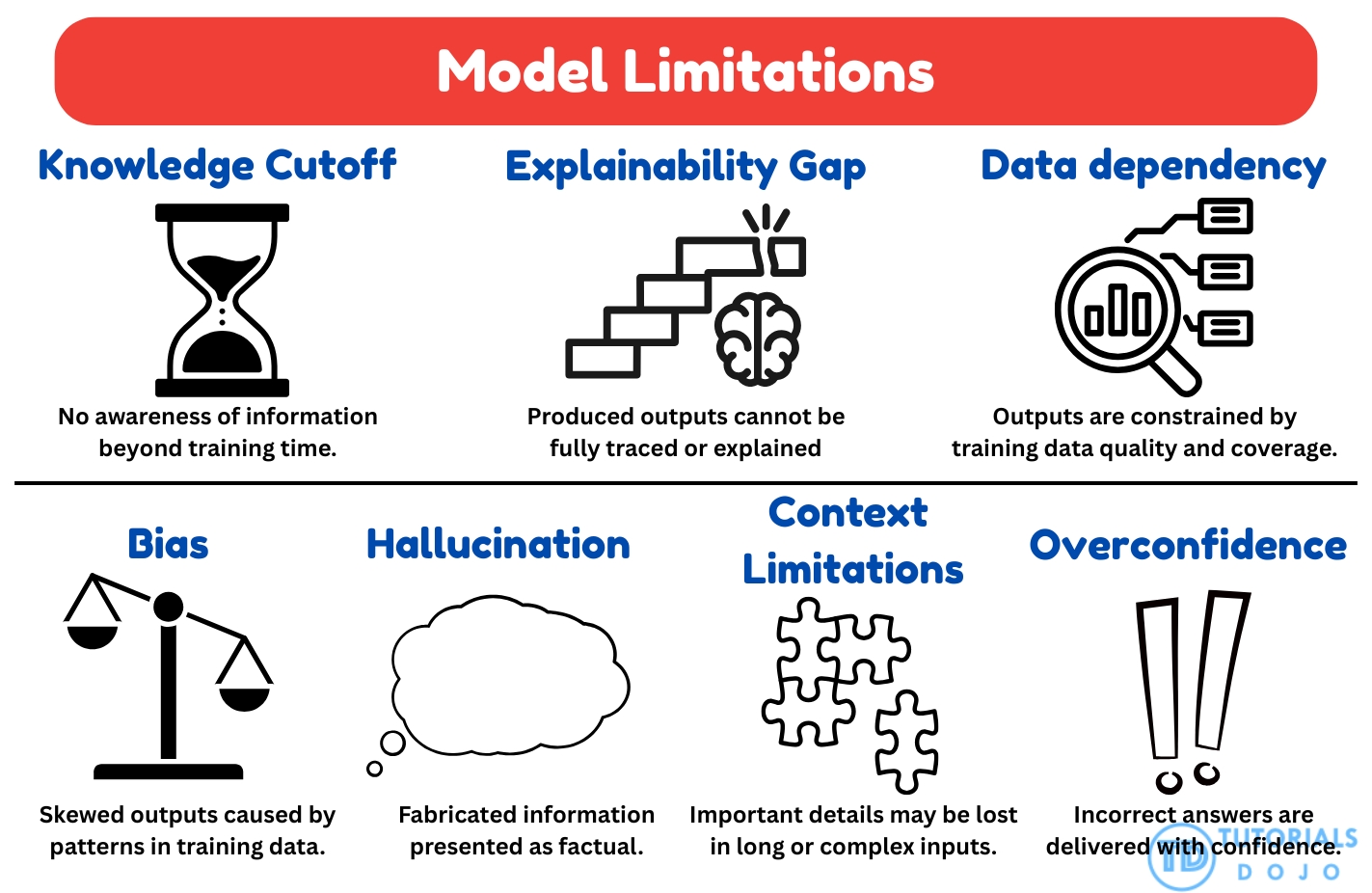
- Model Limitations – Hallucinations, data dependency, knowledge cutoffs, and edge cases
AI Agent Tooling and Extensions
- Tool Types – Extensions, functions, data stores, and plugins for agent capabilities
- Google Cloud Services – Cloud Storage, databases, Cloud Functions, Cloud Run integration for agents
- Pre-built AI APIs – Speech-to-Text, Text-to-Speech, Translation, Document AI, Vision, Video Intelligence, Natural Language
- Studio Comparison – Know when to use Vertex AI Studio versus Google AI Studio
Exam Preparation Strategies
1. Understand the Business Context
This certification focuses on business leadership rather than technical implementation. Frame your understanding around business value, strategic decision-making, and organizational impact. Think about how gen AI transforms workflows, enhances customer experiences, and drives innovation across industries.
2. Master the Google Cloud Ecosystem
Deeply understand Google Cloud’s unique strengths in gen AI: the AI-first approach, enterprise-ready platform features, comprehensive AI ecosystem, open approach, AI-optimized infrastructure including TPUs, and the advantages of Google’s foundation models. Be able to articulate why organizations choose Google Cloud for their AI initiatives.
3. Connect Concepts Across Domains
The exam tests your ability to synthesize knowledge across all four domains. A question about security might also involve model selection and business requirements. Practice thinking holistically about gen AI implementations rather than viewing each topic in isolation.
4. Learn Through Use Cases
Study real-world implementation examples across various industries. Understand how gen AI solves specific business problems in healthcare, finance, retail, manufacturing, and other sectors. This contextual learning helps you recognize appropriate solutions for different scenarios on the exam.
5. Stay Current with Product Updates
Google Cloud’s gen AI offerings evolve rapidly. Regularly review the Google Cloud Blog, product release notes, and documentation updates. The exam reflects current product capabilities, so staying informed about recent launches and feature enhancements is essential.
Gen AI Leader Services to Focus on
We list all the Google Cloud Gen AI services and concepts that are often included in the exam scenarios. Having a high-level knowledge of these services will almost guarantee that you will pass the exam.
- Gemini App and Gemini Advanced – Understand the consumer-facing AI assistant capabilities. Know what Gems are (custom AI assistants) and how Gemini Advanced differs from the standard Gemini app. Understand use cases for personal productivity and creative work.
- Gemini for Google Workspace – Learn how Gemini integrates with Gmail, Docs, Sheets, Slides, and Meet. Know the business value of AI-powered document creation, email drafting, data analysis, and meeting summaries. Understand how it improves workplace productivity.
- Gemini Enterprise – Know the enterprise features including Cloud NotebookLM API, multimodal search capabilities, and custom agent development. Understand how it differs from consumer Gemini products and provides enterprise-grade security and customization.
- Vertex AI Platform – Learn the core capabilities: Model Garden (access to foundation models), Vertex AI Studio (experimentation), and AutoML (automated model training). Know when to use pre-built models versus custom training. Understand the end-to-end ML lifecycle management.
- Vertex AI Search – Understand how to implement enterprise search with gen AI capabilities. Know the difference between grounded search and traditional search. Learn use cases for internal knowledge bases, customer support, and e-commerce applications.
- Vertex AI Agent Builder – Learn how to build custom AI agents without extensive coding. Understand agent tools, extensions, and how agents interact with external systems. Know when to use pre-built agents versus custom agents.
- Foundation Models (Gemini, Gemma, Imagen, Veo) – Know the strengths and use cases of each model family. Understand Gemini’s multimodal capabilities, Gemma’s open-source nature, Imagen for image generation, and Veo for video generation. Know how to select the right model based on modality, context window, and cost.
- Retrieval-Augmented Generation (RAG) – Understand how RAG grounds model outputs with relevant data. Know the difference between pre-built RAG with Vertex AI Search and custom RAG using RAG APIs. Learn when RAG is needed to reduce hallucinations and provide up-to-date information.
- Prompt Engineering Techniques – Learn zero-shot, one-shot, and few-shot prompting. Understand advanced techniques like chain-of-thought and ReAct prompting. Know how to structure effective prompts with clear instructions, examples, and role definitions.
- Grounding Techniques – Understand the three types of grounding: first-party enterprise data, third-party data, and world data (Google Search). Know when to use each approach and how grounding improves output quality and reduces hallucinations.
- Customer Engagement Suite – Learn about Conversational Agents (chatbots/virtual agents), Agent Assist (real-time assistance for human agents), and Conversational Insights (analytics). Understand use cases in contact centers and customer service operations.
- Model Parameters and Settings – Know how to adjust temperature, top-p (nucleus sampling), token limits, and safety settings. Understand how each parameter affects output creativity, randomness, and safety. Learn when to use high vs. low temperature settings.
- Google AI Studio vs. Vertex AI Studio – Understand when to use each platform. Know that Google AI Studio is for rapid prototyping and experimentation, while Vertex AI Studio is for enterprise production deployments with advanced features and security.
- Google AI Studio: https://ai.google.dev/aistudio
- Vertex AI Studio: https://cloud.google.com/generative-ai-studio
- Fine-tuning and Model Customization – Learn when fine-tuning is necessary versus prompt engineering or RAG. Understand the process of adapting foundation models to specific domains or tasks. Know the trade-offs between customization effort and performance gains.
- Google’s Secure AI Framework (SAIF) – Understand the six core pillars of SAIF for securing AI systems. Know security considerations throughout the ML lifecycle including data protection, model security, and monitoring. Learn about IAM, Security Command Center, and workload monitoring.
- Responsible AI Principles – Learn Google’s approach to fairness, bias mitigation, privacy, transparency, and accountability. Understand data anonymization and pseudonymization techniques. Know how to implement human-in-the-loop (HITL) processes.
- Data Types and Quality – Understand structured vs. unstructured data and labeled vs. unlabeled data. Know the characteristics of quality data: completeness, consistency, relevance, and accessibility. Learn how data quality impacts model performance.
- ML Lifecycle Stages – Know the five stages: data ingestion, data preparation, model training, model deployment, and model management. Understand which Google Cloud tools support each stage and how they integrate.
- Model Limitations and Mitigation – Learn common limitations: hallucinations, bias, knowledge cutoff, data dependency, and edge cases. Know mitigation strategies: grounding, RAG, prompt engineering, fine-tuning, continuous monitoring, and automatic model upgrades.

Validate Your Knowledge
If you believe you have sufficient theoretical and hands-on knowledge, we strongly recommend taking our Google Cloud Certified Generative AI Leader Practice Exams. Every question in our practice exam is categorized into the various exam domains provided by Google. After taking the practice exam, you can quickly identify your strengths and the exam domains that you should continually work on. You should be able to identify the what and hows through the explanation provided on every question. Each answer is backed up with references, which we recommend that you thoroughly read if you want to understand the topic further. With our Generative AI Leader Practice Exams and GCP Cheat Sheets, we guarantee that you will be able to pass the exam on the first try.
Sample Practice Test Questions:
Question 1
A retail company wants to build a Generative AI chatbot to help customer service agents handle inquiries. The team prefers pre-trained models that can be quickly adapted to their business needs without retraining from scratch. They also want to experiment with multiple model types for text generation and summarization.
Which Google Cloud solution best meets this requirement?
- Use pre-trained models from Model Garden in Vertex AI.
- Store datasets in BigQuery for manual rule-based generation.
- Deploy models only through Cloud Run functions.
- Build a custom model from scratch using Vertex AI training pipelines.
Correct Answer: 1
Model Garden is Google Cloud’s centralized repository of pre-trained, ready-to-use AI models available through Vertex AI. It provides organizations with access to a wide range of models for tasks such as text generation, summarization, code generation, and multimodal applications. By leveraging Model Garden, teams can quickly experiment with multiple model architectures without retraining from scratch, saving time and computational resources. The models are maintained and updated by Google, ensuring high quality, reliability, and alignment with best practices.
One of the key benefits of Model Garden is its integration with Vertex AI, which allows teams to seamlessly deploy, fine-tune, and manage AI models in a fully managed environment. This eliminates much of the operational complexity typically associated with training and hosting models, enabling faster development cycles. Teams can also adapt pre-trained models to their specific business needs, such as customizing a chatbot for customer service, while still leveraging the robustness and scale of Google’s infrastructure.
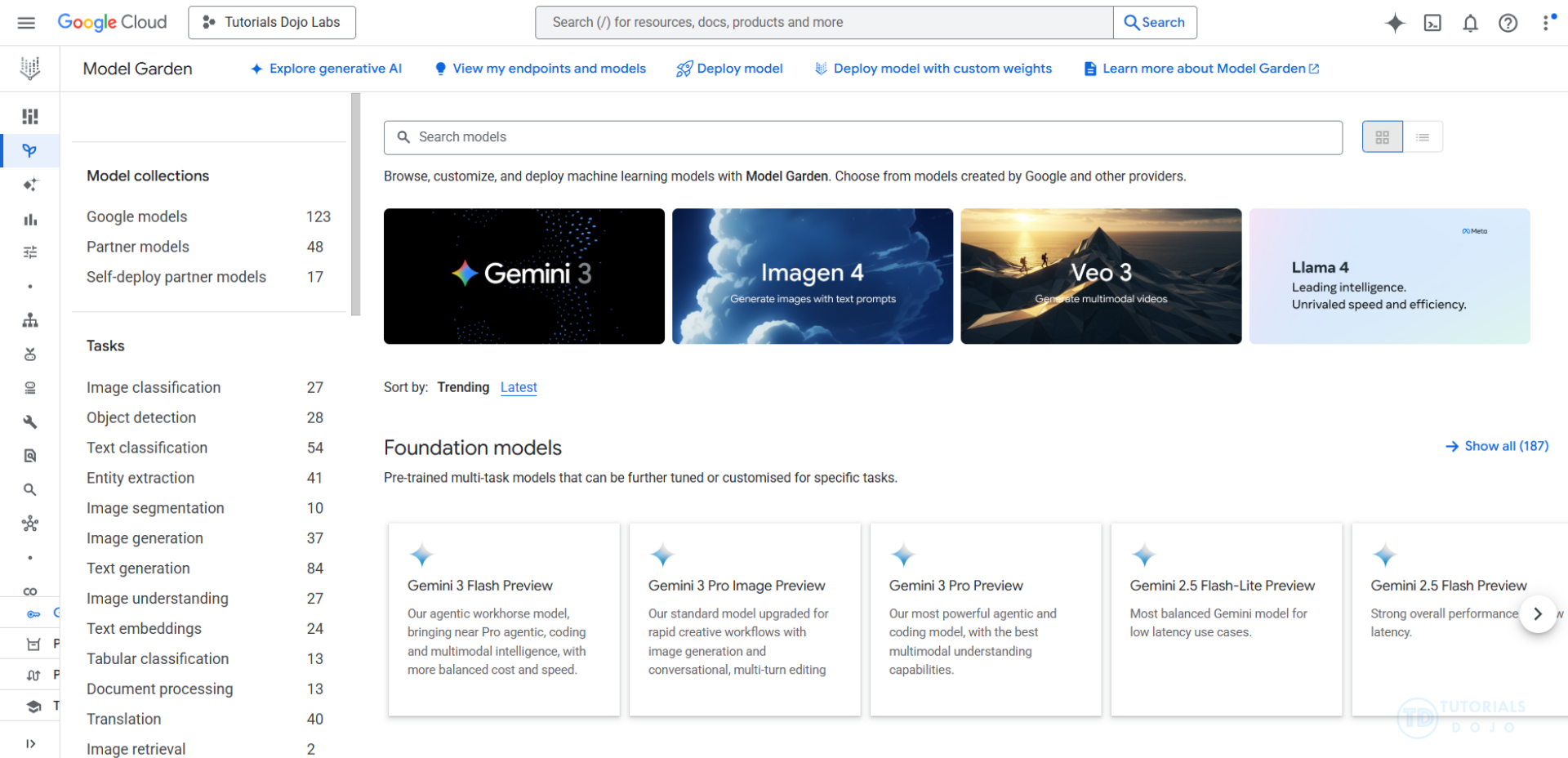
Overall, Model Garden reduces time-to-market, minimizes operational overhead, and provides flexibility for experimentation and fine-tuning. For organizations like the retail company in this scenario, it allows them to deploy AI solutions efficiently and safely, leveraging Google Cloud’s state-of-the-art models while focusing on business-specific customization rather than building models from the ground up.
Hence, the correct answer is: Use pre-trained models from Model Garden in Vertex AI.
The option that says: Store datasets in BigQuery for manual rule-based generation is incorrect because BigQuery simply stores and queries data; it does not provide pre-trained AI models or generative capabilities. Using BigQuery for manual, rule-based text generation would be highly labor-intensive and cannot match the efficiency or flexibility of Model Garden’s pre-trained models for tasks like summarization or chatbot responses.
The option that says: Deploy models only through Cloud Run functions is incorrect because Cloud Run only provides a serverless deployment environment. It primarily manages infrastructure for running code, but does not supply any pre-trained AI models. Teams would still need to acquire or train models separately, which simply defeats the goal of rapid experimentation and fast deployment using pre-trained models.
The option that says: Build a custom model from scratch using Vertex AI training pipelines is incorrect because training a model from scratch is typically time-consuming, resource-intensive, and operationally complex. While it offers complete control, it just delays time-to-market and is unnecessary when Model Garden already provides high-quality, pre-trained models that can be quickly adapted and fine-tuned for business use.
References:
https://docs.cloud.google.com/vertex-ai/generative-ai/docs/model-garden/use-models
https://docs.cloud.google.com/vertex-ai/generative-ai/docs/model-garden/explore-models
Check out these Google Cloud Cheat Sheets:
https://tutorialsdojo.com/google-cloud-platform-gcp-cheat-sheets/
Question 2
A user asks an AI system whether a proposed experimental engine design can generate unlimited energy. The model provides a step-by-step explanation, cites fabricated physics principles, and asserts that the design is feasible under “accepted scientific laws,” without noting that the concepts originate from speculative or fictional material.
Which model limitation is demonstrated in this situation?
- Overconfidence
- Explainability Gap
- Knowledge cutoff
- Hallucination
Correct Answer: 4
Hallucination is a known limitation of generative AI systems in which a model produces responses that are fluent and convincing but factually incorrect or entirely fabricated. Because these models generate text by predicting likely language patterns rather than verifying claims against real-world scientific laws, they can invent theories, mechanisms, or explanations and present them as established facts when prompted with speculative or misleading inputs.
This behavior arises from the absence of inherent fact-checking or scientific validation within the generation process. When asked about hypothetical or unrealistic concepts, a model may construct detailed explanations that resemble legitimate scientific reasoning, even if the content contradicts well-known physical principles. The confidence and structure of the response can make these inaccuracies difficult to detect, especially when no uncertainty or disclaimers are provided.
To mitigate hallucination, generative AI systems are often combined with grounding techniques, such as retrieving information from trusted external sources or constraining responses to verified data. These methods help anchor generated outputs in a factual context and reduce the likelihood of fabricated content being presented as accurate information. Applying such controls improves reliability, particularly in technical, scientific, or educational use cases.
Hence, the correct answer is: Hallucination.
Overconfidence is incorrect because this limitation primarily describes how a model expresses certainty in its responses, not whether the underlying information is factual or fabricated. In the scenario, the failure is not limited to the tone of confidence but stems from the generation of entirely fictional scientific principles, which goes beyond an issue of confidence alone.
Explainability Gap is incorrect because this limitation simply refers to the difficulty in understanding or interpreting how a model arrives at a particular output. The scenario does not involve a lack of transparency in the model’s reasoning process; instead, it involves the production of false content presented as legitimate science.
Knowledge cutoff is incorrect because this limitation only applies when a model lacks access to information that emerged after its training period. The scenario involves invented theories and fabricated explanations rather than missing or outdated real-world knowledge, making the knowledge cutoff irrelevant to the issue being demonstrated.
References:
https://cloud.google.com/discover/what-are-ai-hallucinations
https://docs.cloud.google.com/vertex-ai/generative-ai/docs/grounding/overview
Check out these Google Cloud Cheat Sheets:
https://tutorialsdojo.com/google-cloud-platform-gcp-cheat-sheets/
Final Remarks
The level of preparation required for the Generative AI Leader exam varies based on your background and experience with AI technologies. Fortunately, Google Cloud provides comprehensive resources and learning materials to support your study efforts. The 90-day free trial period offers ample time to familiarize yourself with the Google Cloud Console, experiment with generative AI models in Vertex AI Studio and Google AI Studio, and gain hands-on experience with various AI products.
To reinforce your knowledge and close any gaps in understanding, leverage high-quality practice materials, study guides, and community resources to sharpen your comprehension of gen AI concepts and the Google Cloud enviroment. These tools ensure you are fully equipped to demonstrate your expertise in strategic AI leadership and business transformation.
When you feel ready, you can book your certification exam here. If you feel uncertain about any domain or topic area, take the time to refine your understanding before scheduling or rescheduling your exam. The certification exam is available in both on-site testing centers and remote proctored formats, allowing you to choose the environment where you perform best.
A well-rested mind and calm demeanor are key to performing at your best during the exam. If you’re taking the exam at a testing center, arriving 15-20 minutes early allows you to settle in, relax, and perhaps do a final mental review of key concepts to boost your confidence. For remote exams, ensure your testing environment is properly set up and free from distractions well in advance of your scheduled time.
🐰 25% OFF Easter Sale! Use code TDPLAYCLOUD-04022026 for 10% OFF ALL PlayClouds Subscription & 5% OFF gift cards!

Learn AWS with our PlayCloud Hands-On Labs

$2.99 AWS and Azure Exam Study Guide eBooks

New AWS Generative AI Developer Professional Course AIP-C01

Learn GCP By Doing! Try Our GCP PlayCloud
Learn Azure with our Azure PlayCloud
FREE AI and AWS Digital Courses

FREE AWS, Azure, GCP Practice Test Samplers


Subscribe to our YouTube Channel

Follow Us On Linkedin


Written by: Nikee Tomas