
Last updated on March 13, 2026
Google’s Secure AI Framework (SAIF) is a conceptual framework designed to help organizations secure AI systems. It addresses top-of-mind concerns for security professionals, such as AI/ML model risk management, security, and privacy. SAIF helps ensure that when AI models are implemented, they are secure by default. 1. Expand strong security foundations to the AI ecosystem 2. Extend detection and response to bring AI into an organization’s threat universe 3. Automate defenses to keep pace with existing and new threats 4. Harmonize platform level controls to ensure consistent security across the organization 5. Adapt controls to adjust mitigations and create faster feedback loops for AI deployment 6. Contextualize AI system risks in surrounding business processes Data Poisoning Protections Denial of ML Service Protections Google’s AI Principles describe the company’s commitment to developing technology with dimensions such as Fairness, Interpretability, Security, and Privacy. SAIF is the framework for creating a standardized approach to integrating security and privacy measures into ML-powered applications. SAIF aligns with the Security and Privacy dimensions of building AI responsibly. Enhancing AI security: Google’s AI Red Team – Insights from Google’s AI Red Team on tactics to enhance security for AI systems Securing AI systems with Mandiant – Guidance from Mandiant on proactive security integration in AI systems Android: Secure development guidelines – Real-time vulnerability alerts and secure development guidelines for machine-learning code Securing AI with Google Cloud – Resources for boards of directors focusing on cybersecurity, AI deployment, risk governance, and secure transformation Securing the AI software supply chain – White paper addressing AI supply-chain security using provenance information Google Safety Centre – Secure AI Framework (SAIF) Secure AI Framework (SAIF) and Google Cloud Google Blog – Introducing Google’s Secure AI Framework
Google’s Secure AI Framework (SAIF) Cheat Sheet
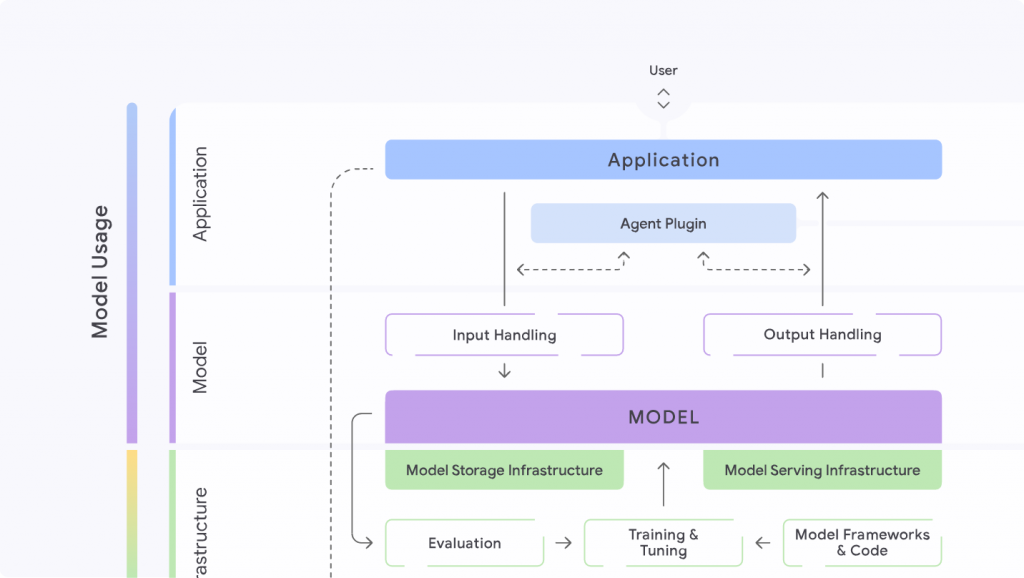
Six Core Elements of SAIF
Organizations can build on secure by default infrastructure protections developed over the last two decades to protect AI systems, applications and users. They should develop organizational expertise to keep pace with advances in AI and adapt infrastructure protections in the context of AI and evolving threat models. For example, injection techniques like SQL injection have existed for some time, and organizations can adapt mitigations such as input sanitization and limiting to help defend against prompt injection style attacks.
Timeliness is critical in detecting and responding to AI-related cyber incidents. Organizations should monitor inputs and outputs of generative AI systems to detect anomalies and use threat intelligence to anticipate attacks. This effort typically requires collaboration with trust and safety, threat intelligence, and counter abuse teams.
Adversaries will likely use AI to scale their impact, so organizations should use AI and its current and emerging capabilities to stay nimble and cost effective in protecting against them.
Consistency across control frameworks can support AI risk mitigation and scale protections across different platforms and tools. Organizations should extend secure by default protections to AI platforms like Vertex AI and Security AI Workbench, and build controls and protections into the software development lifecycle.
Constant testing through continuous learning helps ensure detection and protection capabilities address the changing threat environment. This includes techniques like reinforcement learning based on incidents and user feedback. Organizations should update training data sets, fine-tune models to respond strategically to attacks, and conduct regular red team exercises.
Organizations should conduct end-to-end risk assessments related to how they will deploy AI. This includes assessment of data lineage, validation, and operational behavior monitoring for certain types of applications. Organizations should also construct automated checks to validate AI performance.
Secure AI Framework Ecosystem and Initiatives

Google Cloud Security Controls for AI Risks
Secure AI Framework and Responsible AI
Additional Resources
References
🎉 PlayCloud Sale Extension – Get 10% OFF and Save Big on All PlayCloud Subscription Plans!

Learn AWS with our PlayCloud Hands-On Labs

$2.99 AWS and Azure Exam Study Guide eBooks

New AWS Generative AI Developer Professional Course AIP-C01

Learn GCP By Doing! Try Our GCP PlayCloud
Learn Azure with our Azure PlayCloud
FREE AI and AWS Digital Courses

FREE AWS, Azure, GCP Practice Test Samplers


Subscribe to our YouTube Channel

Follow Us On Linkedin


Written by: Joshua Emmanuel Santiago