
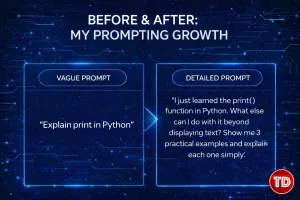
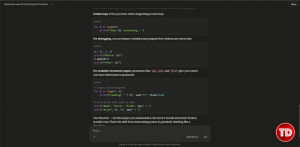
Companies today are aggressively hiring for AI and tech skills. The job postings are everywhere. But here is the uncomfortable truth: the education most of us received did not prepare us for this shift. I took Computer Engineering in college, but it was not coding-focused. I am about to finish my degree but still without the specific skills the market is demanding. I felt that gap every time I looked at a job listing. I did not enroll in a bootcamp. I did not buy a course. Instead, I opened an AI chatbot and started asking it to teach me, specifically Python and AI tools. My approach was simple: ask AI to generate code, then ask it to explain that same code back to me line by line until I understood what was actually happening. It sounds almost too simple. But it worked. Having something explain a concept in plain language, at my own pace, without judgment, made all the difference. I was not just copying code anymore. I was starting to understand it. And eventually, I realized something even bigger: I did not have to struggle writing code from scratch. I could describe what I wanted, let AI generate it, and then focus my energy on understanding the output rather than fighting the syntax. It was not always smooth. There were moments where I kept getting the same unhelpful response no matter how many times I tried. That is when I realized the problem was not the AI. It was my prompt. I started studying how to ask better questions. The key insight was this: details matter. A vague prompt gives you a vague answer. The more context you give, what you are trying to do, what you already tried, what result you expected, the more useful the response becomes. That shift, from asking surface-level questions to asking specific and contextual ones, changed everything. The responses became richer, more useful, and more tailored to where I actually was in my learning. My first breakthrough came from a surprisingly small thing. I was learning the print function in Python and asked AI: “What else can I do with print beyond just showing text?” The response showed me how the same function could be used inside loops, for debugging, and for formatting readable output. That moment made me realize that understanding one concept deeply opens up ten more. I was not just learning syntax. I was starting to think like a developer. I will not pretend I am a developer now. It is still hard. There are concepts in Python and AI tools that I am still wrapping my head around. Some days feel like two steps forward, one step back. But I understand things I genuinely did not before. Programming concepts that used to feel like a foreign language are slowly becoming familiar, and I have zero prior coding experience. That progress is real, even if it is incremental. Prompting guide: https://www.promptingguide.ai/techniques
The problem: our education was not enough
My solution: use AI to learn Python
The journey: getting stuck, then getting better at asking

The “aha!” moment
What I have learned so far
Where I am now, and being honest about it
References
🐰 25% OFF Easter Sale! Use code TDPLAYCLOUD-04022026 for 10% OFF ALL PlayClouds Subscription & 5% OFF gift cards!

Learn AWS with our PlayCloud Hands-On Labs

$2.99 AWS and Azure Exam Study Guide eBooks

New AWS Generative AI Developer Professional Course AIP-C01

Learn GCP By Doing! Try Our GCP PlayCloud
Learn Azure with our Azure PlayCloud

FREE AI and AWS Digital Courses

FREE AWS, Azure, GCP Practice Test Samplers


Subscribe to our YouTube Channel

Follow Us On Linkedin

Written by: Edgar Joaquin Rodriguez