
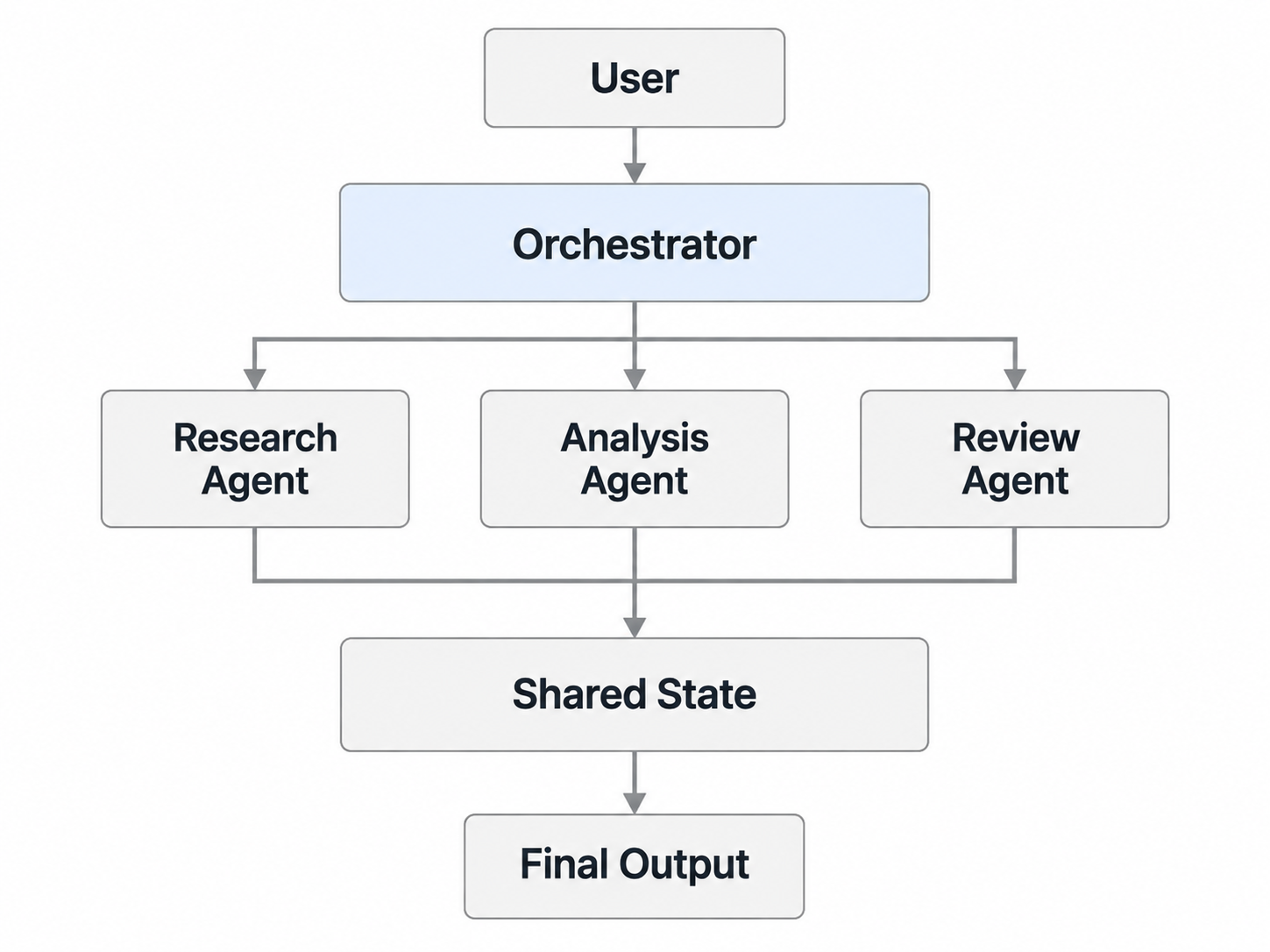
What if I told you that a “team of AI agents” can sometimes be the same language model being called multiple times with different instructions? No digital employees sitting inside a virtual office. No group of AIs secretly gathering around a table to discuss your request. Behind the scenes, many multi-agent systems are built from something much more familiar: LLMs, tools, shared data, and software that decides who does what next. Once you understand that architecture, multi-agent AI becomes much less mysterious. An AI agent is essentially a language model given a specific responsibility, some context, and access to certain tools. For example, one agent might be assigned to research information while another is responsible for reviewing the result. Both agents could be powered by the exact same underlying model. What makes them different is their instructions, tools, context, and responsibilities. One searches. Another analyzes. Another reviews. Put these specialized roles together and you have the beginnings of a multi-agent system. Agents usually do not decide the entire workflow themselves. There is often another layer responsible for coordinating everything: the orchestrator. The orchestrator receives a request, determines which tasks need to be performed, and sends those tasks to the appropriate agents. Figure 1. Simplified architecture of a multi-agent AI system. The orchestrator delegates tasks to specialized agents while shared state allows information to move between them before the final response is produced. The orchestrator manages the process. The agents perform specialized work. Shared state keeps the information connected. This is where multi-agent systems become interesting. Agents often do not communicate directly with one another. Instead, the application takes the output produced by one agent and passes it to another as context. From the user’s perspective, it looks like this: But underneath, the application is mostly passing information from one LLM call to the next. That is an important detail: the “conversation” between agents is often software moving context around. If several agents are working on the same problem, they need somewhere to keep their results. That is where shared state comes in. A simple shared state might look like this: One agent can add information to the state, another can read it, and the orchestrator can track which parts of the workflow have already been completed. In larger applications, this information may be stored in systems such as PostgreSQL, Redis, files, or vector databases. An LLM can reason about information and generate text, but tools allow an agent to interact with other systems. An agent might have access to tools such as: A typical interaction looks something like this: This is what turns an LLM from something that simply generates answers into an agent capable of gathering information and performing actions as part of a larger workflow. The biggest reason is that some problems can naturally be divided into smaller, independent tasks. Imagine that you want to research three competing companies. A single agent might process them sequentially: A multi-agent system could instead assign each company to a separate agent: Those agents can perform their work independently, and another agent can later combine or review the results. This approach can be especially useful for workflows involving research, software development, data analysis, document processing, and verification. There is an obvious temptation when working with agent systems: If one agent is useful, ten agents must be better. Not necessarily. Every additional agent can introduce more cost, latency, token usage, duplicated work, conflicting answers, and debugging complexity. A poorly coordinated system with ten agents can easily perform worse than one capable agent with good tools. The goal is not to create as many agents as possible. The goal is to divide work only when there is a meaningful reason to divide it. Under the hood, a practical multi-agent system usually comes down to a few core components: The LLMs provide reasoning. The tools provide capabilities. Shared state keeps information available across the workflow. And the orchestrator determines how all of those pieces work together. That orchestration layer is often the part hidden behind impressive multi-agent demos. Multi-agent AI sounds futuristic, but the underlying architecture is surprisingly practical. You take language models, give them specialized responsibilities, connect them to tools, and build software that coordinates their work. One agent researches. Another analyzes. Another reviews. The orchestrator keeps everything moving. The real advantage is not simply having more agents. It is designing a workflow where multiple agents can contribute without introducing unnecessary complexity. Once you see multi-agent AI from that perspective, it starts looking less like science fiction and much more like software engineering.
Multi-Agent AI Isn’t What You Think: Here’s What’s Really Happening Under the Hood
So, What Is an AI Agent?
researcher = Agent(
    role="Researcher",
    tools=["web_search"]
)

reviewer = Agent(
    role="Reviewer"
)The Orchestrator Holds Everything Together
How Do Agents Actually “Talk” to Each Other?

research = researcher.run(task)

analysis = analyst.run(
    context=research
)

review = reviewer.run(
    context=analysis
)Researcher → Analyst → ReviewerShared State Is the Team’s Workspace
{
  "research": "...",
  "analysis": "...",
  "review": "..."
}Tools Give Agents Real Capabilities
Agent needs information
        |
        v
   Calls a tool
        |
        v
 Receives a result
        |
        v
Reasons about the result
        |
        v
Continues the taskWhy Use More Than One Agent?
Company A → Company B → Company CAgent 1 → Company A
Agent 2 → Company B
Agent 3 → Company CBut More Agents Don’t Automatically Mean Better AI
What Multi-Agent AI Really Looks Like
LLMs
 +
Orchestration
 +
Tools
 +
Shared State
 +
Evaluation
Final Thoughts
Further Reading
https://openai.github.io/openai-agents-python/multi_agent/
https://docs.langchain.com/oss/python/langchain/multi-agent/
https://microsoft.github.io/autogen/
https://arxiv.org/abs/2308.08155
https://arxiv.org/abs/2210.03629🤖 $3.74 ONLY for Claude eBooks and Get 25% OFF All Claude Reviewers
Turn Your Team Into Cloud-Ready Professionals Today

Learn AWS with our PlayCloud Hands-On Labs

$2.99 AWS and Azure Exam Study Guide eBooks

Learn GCP By Doing! Try Our GCP PlayCloud
Learn Azure with our Azure PlayCloud
FREE AI and AWS Digital Courses

FREE AWS, Azure, GCP Practice Test Samplers


Subscribe to our YouTube Channel

Follow Us On Linkedin


Written by: Danilo Casim Jr.