
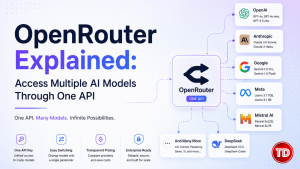
The rapid advancement of generative AI has given developers access to an ever-growing collection of large language models from providers such as OpenAI, Anthropic, Google, Meta, Mistral AI, and xAI. Each model offers different strengths, whether in reasoning, code generation, content creation, multilingual support, or cost efficiency. While having multiple options is beneficial, integrating several AI providers into a single application often introduces additional complexity. Developers must manage different API endpoints, authentication methods, SDKs, pricing models, and rate limits, making it difficult to build flexible AI-powered applications.
To address this challenge, platforms such as OpenRouter provide a unified API that allows developers to access multiple AI models through a single interface. Rather than building separate integrations for every provider, developers can use one API while selecting the model that best fits their application. This approach simplifies development, accelerates experimentation, and reduces the effort required to keep pace with the rapidly evolving AI landscape.
Why Developers Need Multiple AI Models
Modern AI applications often perform a wide variety of tasks, and no single language model consistently delivers the best performance across every use case. Some models excel at writing production-ready code, while others are better suited for reasoning through complex problems, summarizing long documents, generating creative content, or processing multilingual conversations. Developers frequently compare models throughout the software development lifecycle to determine which offers the best balance of quality, speed, context window size, and operating cost.
Supporting multiple providers individually can quickly become difficult. Every API introduces its own authentication process, request format, software development kit (SDK), and documentation. As new models are released, maintaining separate integrations becomes increasingly time-consuming. A unified API layer allows developers to experiment with different models while keeping their application architecture consistent, reducing maintenance and improving development efficiency.
What Is OpenRouter?
OpenRouter is an API gateway that provides access to multiple large language models through a single endpoint. Instead of serving as a language model itself, it acts as an intermediary that forwards requests to supported AI providers. Developers authenticate once using an OpenRouter API key and specify the model they want to use within the request. OpenRouter then routes the request to the appropriate provider and returns the generated response using a standardized API format.
This abstraction makes AI integrations significantly more flexible. Rather than rewriting application logic whenever switching from GPT models to Claude, Gemini, DeepSeek, Mistral, or Llama-based models, developers can simply update the model identifier while keeping the rest of their application unchanged. This flexibility has made OpenRouter increasingly popular among developers building AI assistants, chatbots, automation tools, and production AI services.
How OpenRouter Works Behind the Scenes
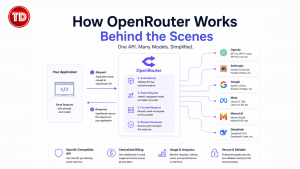
One of OpenRouter’s greatest strengths is its role as an abstraction layer between applications and AI providers. When an application sends a request, OpenRouter receives the prompt, validates the API key, identifies the requested model, and securely forwards the request to the appropriate provider. Once the provider generates a response, OpenRouter returns the output to the application using a familiar API structure.
Because OpenRouter follows an OpenAI-compatible API design, developers already using the OpenAI SDK often need only minor configuration changes to begin using multiple providers. In many cases, switching to OpenRouter simply involves updating the API base URL, replacing the API key, and specifying a different model name. This compatibility significantly reduces migration effort while allowing developers to experiment with a broader range of AI models.

The platform also provides a centralized interface for billing and usage management, allowing developers to monitor requests across multiple providers without maintaining separate accounts for each service.
OpenAI-Compatible API Design
One reason OpenRouter has gained widespread adoption is its compatibility with the OpenAI API specification. Many popular AI frameworks, SDKs, and development tools already support the OpenAI request format, making integration straightforward for developers familiar with existing AI workflows.
A typical request continues to use familiar parameters such as the selected model, conversation messages, temperature, and maximum token limits. Since these parameters remain largely consistent across supported models, developers spend less time adapting code for each provider and more time evaluating which model performs best for their application.
This compatibility extends beyond custom applications. Frameworks such as LangChain, LlamaIndex, Continue.dev, Open WebUI, and various AI IDE extensions can often connect to OpenRouter with little or no additional customization, making it easier to integrate multiple AI providers into existing development workflows.
Building AI Applications with OpenRouter
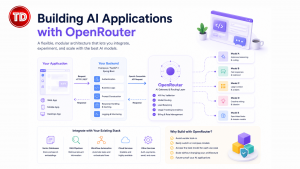
OpenRouter is particularly valuable for developers building applications that may evolve over time. Instead of tightly coupling an application to a single AI provider, developers can treat language models as interchangeable components. This design allows engineering teams to compare model performance, test new releases, or migrate providers without restructuring their backend services.
A common architecture consists of a frontend application communicating with a backend built using frameworks such as Express.js, FastAPI, or Spring Boot. The backend manages authentication, business logic, prompt construction, and communication with OpenRouter, while OpenRouter handles routing requests to the selected AI model. This layered approach keeps AI integrations modular and easier to maintain as requirements change.
Many organizations also combine OpenRouter with Retrieval-Augmented Generation (RAG), vector databases, and workflow automation systems. In these architectures, external services retrieve relevant documents while OpenRouter provides access to the language model responsible for generating context-aware responses.
Practical Use Cases
The flexibility offered by OpenRouter makes it suitable for a wide variety of AI-powered applications. Software development teams can evaluate multiple coding assistants before selecting one for production. AI chatbots can dynamically choose different models depending on response quality or operating costs. Content generation platforms may use specialized models for technical writing, marketing copy, or document summarization.
Developers building AI agents can also benefit from routing different tasks to different models. A reasoning-intensive model might be selected for planning and decision-making, while a smaller, lower-cost model handles routine conversational responses. This strategy allows applications to balance performance and operational expenses while taking advantage of each model’s strengths.
Considerations Before Using OpenRouter
Although OpenRouter simplifies access to multiple providers, developers should still evaluate models carefully before deploying them in production. Response quality, latency, context window size, token pricing, and availability vary significantly between providers. A model that performs exceptionally well for software engineering may not be the best choice for creative writing or multilingual conversations.
Developers should also consider prompt engineering and testing. Even though OpenRouter standardizes API access, different language models interpret prompts differently and may require slight adjustments to achieve optimal results. Benchmarking several models using real application data remains one of the most effective ways to identify the best solution for a specific workload.
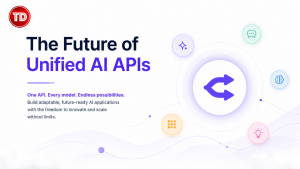
The Future of Unified AI APIs
As the generative AI ecosystem continues to expand, developers are moving away from building applications around a single model provider. Instead, they are designing systems that can adapt as new models become available. Unified API platforms such as OpenRouter support this shift by allowing engineering teams to evaluate emerging models without making major architectural changes.
This flexibility encourages experimentation, reduces vendor lock-in, and helps organizations adopt innovations more quickly. As AI becomes a standard component of modern software development, unified AI gateways will likely become an important part of cloud-native and AI-driven application architectures.
Key Takeaways
OpenRouter simplifies AI development by providing a single API for accessing multiple language models from different providers. Instead of maintaining separate integrations for OpenAI, Anthropic, Google, Meta, Mistral, and other vendors, developers can build applications against one interface while retaining the flexibility to switch models as requirements evolve.
Beyond simplifying integration, OpenRouter encourages a more modular approach to AI architecture. Developers can benchmark models, optimize costs, and adopt newly released AI technologies without significant code changes. Whether building AI chatbots, coding assistants, Retrieval-Augmented Generation (RAG) systems, workflow automation tools, or enterprise AI applications, understanding how OpenRouter fits into the modern AI ecosystem can help create more scalable, adaptable, and future-ready software solutions.
References

🔔 20% OFF All Reviewers + 10% OFF PlayCloud’s First Billing Use Code: TDPLAYCLOUD-101326

Turn Your Team Into Cloud-Ready Professionals Today

Learn AWS with our PlayCloud Hands-On Labs

$2.99 AWS and Azure Exam Study Guide eBooks

Learn GCP By Doing! Try Our GCP PlayCloud
Learn Azure with our Azure PlayCloud

FREE AI and AWS Digital Courses

FREE AWS, Azure, GCP Practice Test Samplers


Subscribe to our YouTube Channel

Follow Us On Linkedin


Written by: Precious Grace Deborah Manucom