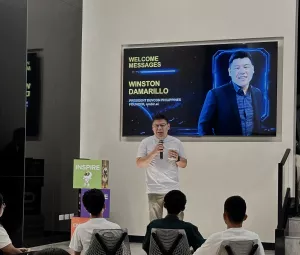
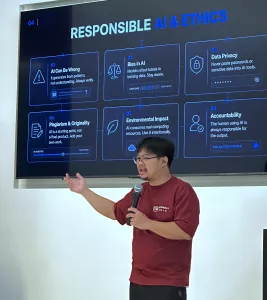
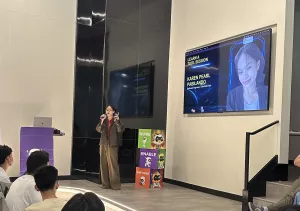
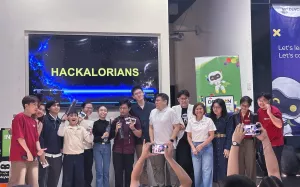
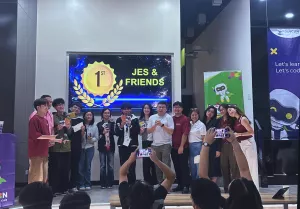
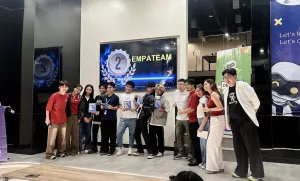
On June 20, 2026, thirty junior and senior high school students spent a day at Programmable Makati building working AI applications. The event was PromptWars: AI-Powered, Student-Built, a hackathon run by DEVCON Kids Philippines and Tutorials Dojo. This event demonstrated how beginners can build with high impact solutions through the use of AI. Hosts Ace Batacandulo and Franchesca Asignacion of Tutorials Dojo opened the day with a “Bring Me with a Twist” icebreaker built around sustainability themes, which the students from Sta. Lucia High School won. Winston Damarillo of nmblr.ai gave the welcome message. He traced his own path through the tech industry, including time working abroad at Intel, and described how the internet shrank the world and opened global opportunities for Filipino IT and software talent. He framed AI not as just another tool but as a basic change in how computers work. Tying the idea to the event’s Star Wars theme, he compared AI to “the force”, which is exactly why it has to be guided with care. For a country that sits in a disaster-prone region, he argued, AI could become a genuine advantage. Pam Ros Damarillo, who leads DEVCON Kids, introduced the organization’s mission of AI education for Filipino youth. She shared that DEVCON has run for about 17 years and that DEVCON Kids has reached more than 10,000 children since 2018, through programs like Hour of AI, cardboard robotics built around the micro:bit microcontroller, and CreateAI, plus teacher training in places such as Bohol and Pangasinan. Dom De Leon, DEVCON’s executive director, followed with a look at local AI and robotics work using the Jetson Nano, a small board built for AI projects, and an invitation to Devcon’s internship program. Setting the stage of the event PromptWars paired two organizations with complementary missions. DEVCON Kids Philippines is a nonprofit that teaches AI and technology to Filipino learners aged 17 and under, and Tutorials Dojo is a ed-tech company known for its cloud certification reviewers while nmblr.ai hosted the event at Programmable Makati. The event proper begun with thirty students formed six team, each paired with a facilitator guide, and spent three and a half hours building. Every team had to tie its project to one of the Sustainable Development Goals and pitch it to a panel of judges by the afternoon deadline. Jon Bonso of Tutorials Dojo, gave a keynote on responsible AI. He started by recalling his own beginnings in development as a second-year high school student, then traced how Tutorials Dojo grew from simple web tutorials into cloud training across AWS, Azure, and Google Cloud, and into AI work from around 2023. His central point is, how you write a prompt shapes what you get back. Rather than lecture, he asked the students why AI matters to them. Students talked about AI as a study aid that speeds up finding information, the trade-off between using AI to shortcut schoolwork and using it to actually learn, and how quick AI answers have changed how often people reach for a library. The keynote closed on data privacy and accountability. Pasting personal details, passwords, or a classmate’s information into an AI tool can expose data you cannot pull back, and the person who submits an AI-generated output, not the tool, owns the result. He pointed to founders like Steve Jobs and Bill Gates who started young, to encourage students to build and not fear failure. Karen Pearl Pabilando, a software engineer at Tutorials Dojo, ran the hands-on session. She defined AI as a software that learns from data to generate text, images, video, and code, and that AI is built by people rather than a sentient machine. She showed how much of it students already use, from Google Translate to delivery routing in Grab and Foodpanda to the recommendation feeds on their phones. Then she defined the event’s core skill. Vibe coding, means building software by describing what you want in plain language instead of writing the code by hand. She demonstrated this live, generating a working app from a single prompt and refining it with follow-up instructions. To help students get useful results, she taught a five-part prompt framework called R-T-C-F-C: state the Role the AI should take, the Task you want done, the Context around it, the Format of the output, and the Constraints it must respect. A vague prompt produces a vague app, so each element narrows the result. For more on this, Tutorials Dojo’s write-up on turning AI prompts into real-world results and its library of prompt engineering guides are useful reads. Ms. Tina Gonzales-Saulo of DEVCON Kids led the problem-solving session, and she ran it offline with pen and paper. She opened by asking what students actually knew about the Sustainable Development Goals: the 17 global goals the United Nations adopted in 2015, with a 2030 deadline, covering poverty, health, education, clean water, climate action, and more. Each team would pick one goal as the basis for its project. Her guiding question was; if you could solve one problem in your community, what would it be? From there, she pushed every team to answer five harder questions about their idea such as who exactly benefits, what problem they are solving rather than what app they want to make, how they would know it worked, whether people could keep using it, and why technology is even necessary. Those questions pointed to a single message that ran through the whole day: do not start with the technology, start with the problem. She paired this with the DEVCON Kids framework of define, plan, create, then test and reflect, along with team roles so each group had a lead, a prompt engineer, a researcher, a designer, and a presenter. By the deadline, each team had a problem, a Sustainable Development Goal, and a working prototype to show. The range of ideas says a lot about what these students notice in their own lives. Hackalorians tackled doomscrolling with a focus app. Rather than blocking apps outright, it locks a target app until the user finishes a real task, then unlocks scrolling as a reward. The team tied better study habits and well-being to SDG 3 (Good health & Well Being) , SDG 4 (Quality Education) and SDG 8 (Decent work and economic growth). Techknowledge made TulongKamAI, a healthcare-access navigator. Its symptom translator turns a plain language description into possible conditions and first-aid suggestions. The design asks for consent before using data, camera, or microphone, and the team was upfront that users should double-check anything the AI suggests, mapping the work to SDG 3 (Good health & Well Being), SDG 8 (Decent work and economic growth), and SDG 10 (Reduced Inequalities). Jes & Friends created BantAI, a barangay reporting app. Residents file incident reports that the AI sorts into urgent and non-urgent, with location tagging, real-time alerts, and status tracking. ID-based verification is built in to cut down on fake and troll reports. Empateam developed a mental-health support chatbot. It uses conversational AI to offer first-line guidance for people who lack immediate access to help, with a transparent consent screen at the start. The team framed it as a safe space and an early check-in, not a replacement for professional care, in line with SDG 3 (Good health & Well Being). Padawan Programmers put together Ontrack Santolan, an attendance and homework tracker. It pairs QR-based attendance with homework management and a catch-up mode that flags missed work for students who were absent. The goal was to fix slow roll call and the blind spots teachers face without a central system. A guest team of teachers also presented, outside the competition, their lesson-plan generator drafts plans aligned to the Department of Education’s MATATAG curriculum, organized by quarter and duration for teachers who handle many sections. They were clear that a human still reviews every output, since the tool only works as well as the input it is given. Judges scored the projects on a weighted rubric covering problem understanding, use of AI tools, creativity, functionality of the prototype, presentation, responsible AI, and community impact. After deliberation, the standings were, Empateam in second, Jes & Friends in first and the winner is Hackalorians. The Winner of Promptwars 2026 Jes & Friends Won 1st Place at Promptwars 2026 Empateam bagged 2nd Place at Promptwars 2026 Prizes went beyond medals. Winning teams received cash prizes along with DEVCON Kids and Tutorials Dojo merchandise and vouchers, and the champions earned access to Tutorials Dojo’s learning resources. The most useful lesson of the day was not any single app. It was that a first version is rarely right, and good projects get better through iteration, which is why the closing reflection asked each team how they would improve their work given more time, resources, or tokens. That question is worth keeping long after the event ends. The practical part is that none of it required a budget. The same AI app builders the students used tools like Lovable, Bolt, and Replit that turn plain-language prompts into working web apps are free to try, so anyone can keep building at home. DEVCON Kids runs ongoing programs and communities for young builders, and you can keep learning the underlying cloud and AI skills through Tutorials Dojo’s exam study guides. The skills the students practiced asking sharper questions, scoping a real problem, and working as a team carry well past a one-day hackathon and into school, work, and whatever they build next.

Welcome messages: AI as more than a tool
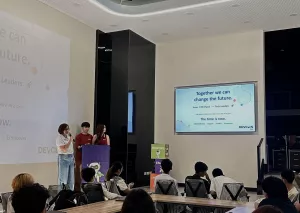
A keynote on using AI responsibly

Learning to vibe code
Start with the problem, not the technology
What the six teams built
And the winners
What students can do next

References
🤖 $3.74 ONLY for Claude eBooks and Get 25% OFF All Claude Reviewers
Turn Your Team Into Cloud-Ready Professionals Today
Learn AWS with our PlayCloud Hands-On Labs

$2.99 AWS and Azure Exam Study Guide eBooks

Learn GCP By Doing! Try Our GCP PlayCloud
Learn Azure with our Azure PlayCloud

FREE AI and AWS Digital Courses

FREE AWS, Azure, GCP Practice Test Samplers

Subscribe to our YouTube Channel

Follow Us On Linkedin

Written by: Vince Austria