Ends in
00
days
00
hrs
00
mins
00
secs
ENROLL NOW

🚀 Extended! 25% OFF All Practice Exams & Video Courses, $2.99 eBooks, Savings on PlayCloud and CodeQuest!

AWS Vector Databases Explained: Semantic Search and RAG Systems

Home » Agentic » AWS Vector Databases Explained: Semantic Search and RAG Systems

AWS Vector Databases Explained: Semantic Search and RAG Systems

The generative AI (GenAI) revolution has transformed how organizations extract value from their data. While large language models (LLMs) demonstrate remarkable capabilities in understanding and generating human-like text, their true enterprise potential is unlocked only when they can access proprietary, domain-specific information. This necessity has propelled vector databases from a specialized niche into an essential pillar of modern AI infrastructure.

But First, What Are Vector Databases?
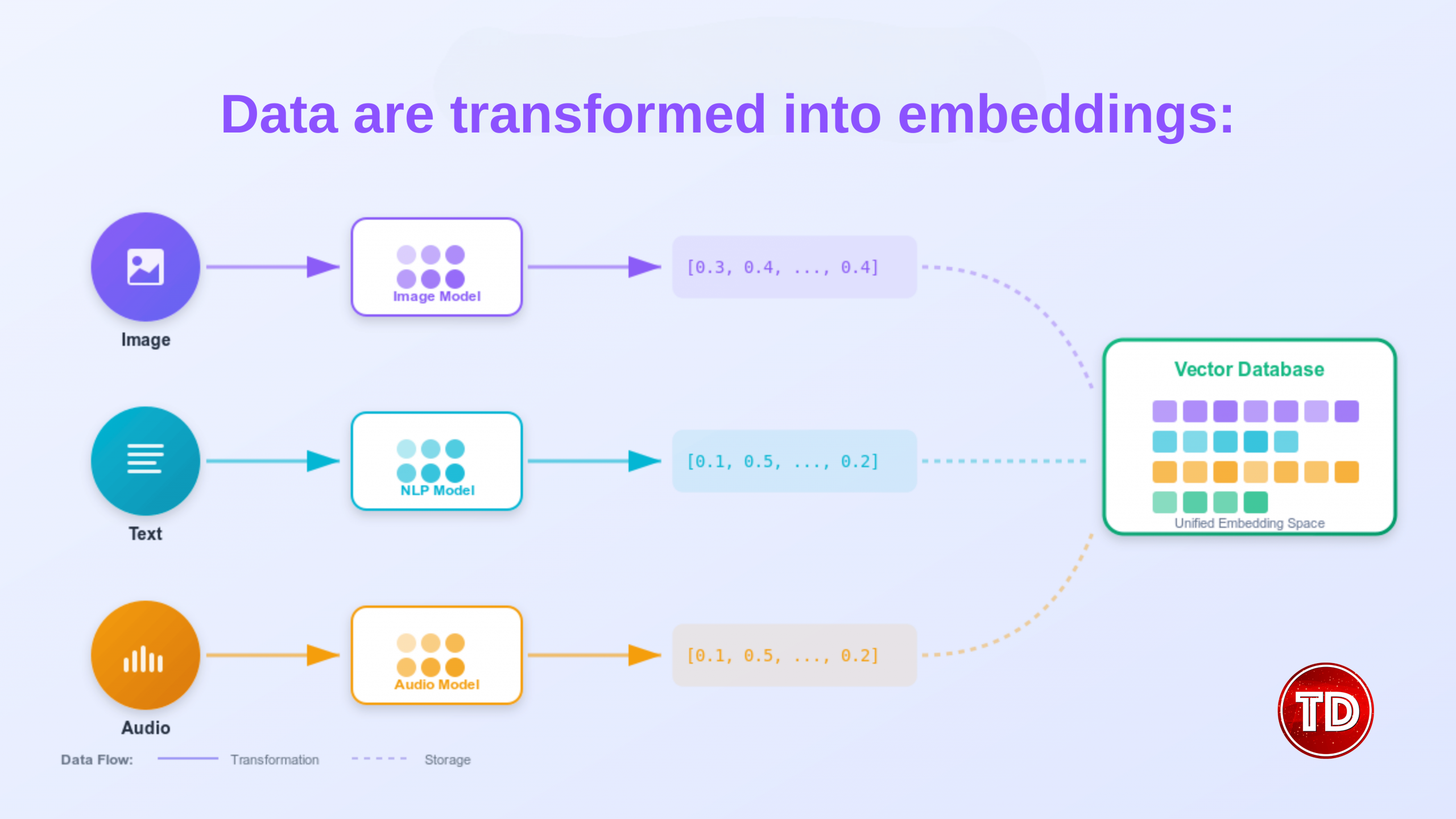
Vector Databases Data Embedding

A vector database, as its name suggests, is a type of database designed to store, index, and efficiently search vector embeddings. These vectors are high-dimensional points that represent meaning. 

At its core, a vector database is designed to provide several capabilities beyond simple storage: efficient nearest-neighbor search algorithms, sophisticated indexing structures optimized for high-dimensional data, fault tolerance and durability guarantees, authentication and access control mechanisms, and query engines that support complex filtering alongside similarity search.

Embeddings (Vectors)

Embeddings are number arrays that capture the meaning of text, images, or audio. When text, images, audio, or other content passes through an embedding model, it is transformed into a dense vector where each dimension contributes to representing some aspect of the content’s meaning.

Consider a practical example: the words “king,” “queen,“prince, and “princess would occupy neighboring regions in the embedding space because they share semantic relationships around royalty. Similarly, “Paris and “France would be closer to each other than either would be to “Tokyo or “Japan, yet all four would share some relationship as capital-country pairs. This geometric representation of meaning enables machines to understand relationships that would be impossible to capture solely through keyword matching.

Vector Search

Traditional databases rely on exact matching. For example, if I search for “y2k tops for women, the products returned to me will include the specific words: “y2k”, “top”, and “women. Vector search operates on an entirely different principle: it finds items whose vector representations are closest to the query vector in the embedding space, regardless of the specific words used. 

This capability enables semantic search. When I search for “y2k tops for women, a vector-powered system understands my intent and retrieves trendy tops that match the Y2K aesthetic, even if the product descriptions never use that exact phrase. The system accomplishes this by converting the query into a vector embedding using the same model that generated the product embeddings, then finding the query’s nearest neighbors in the database.

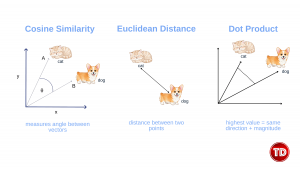
Vector search typically relies on distance metrics to quantify similarity between vectors:

Vector Search Common Metrics

  • Cosine Similarity – measures the angle between two vectors, making it ideal for comparing direction regardless of magnitude.
  • Euclidean Distance – measures the straight-line distance between two points in the vector space, which works well when magnitude differences carry meaning.
  • Dot Product – considers both magnitude and direction, making it computationally efficient for normalized vectors.

Indexing and Algorithms

To speed up similarity search, vector databases use algorithms such as:

Hierarchical Navigable Small World (HNSW)

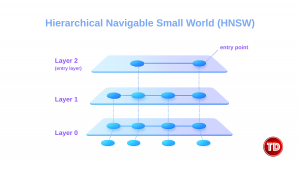
  • HNSW (Hierarchical Navigable Small World)
    • Combines two powerful ideas: 
      • Small-world property of graphs, where any two nodes can be reached through a small number of hops
      • Hierarchical structure that enables efficient navigation from coarse to fine granularity.
    • How it works:
    • The algorithm begins at the top layer and performs a greedy search to find the nearest node to the query vector. It then descends to the next layer, using that nearest node as the starting point for a more refined search. This process continues layer by layer until reaching the bottom, where the final nearest neighbors are identified. The hierarchical structure enables HNSW to efficiently eliminate large regions of the search space at higher levels, dramatically reducing the number of distance calculations.

Inverted File Index (IVF)

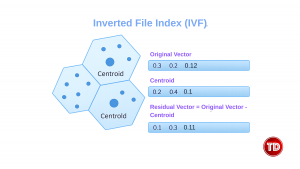
  • IVF (Inverted File Index)
    • clustering-based approach
    • The algorithm partitions the dataset into clusters using methods such as k-means, assigning each data point to the cluster whose centroid it is closest to.
    • Every vector in the dataset is assigned to the cluster whose centroid is closest to it.

The GenAI Imperative: Semantic Search and RAG

Vector databases are the backbone of two significant AI capabilities today: semantic search and Retrieval-Augmented Generation (RAG). Both applications leverage the ability to find contextually relevant information based on meaning rather than keywords, but they serve different purposes and operate in other contexts.

Semantic Search

Semantic Search Diagram

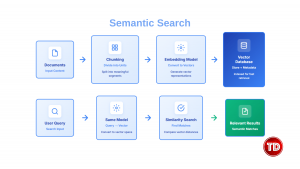
Semantic search lets users ask questions using natural language. Instead of matching keywords, it searches by meaning.

Example:

If someone searches for “heart attack symptoms, they would find documents that discuss “myocardial infarction or “cardiac arrest because the embedding model will understand that these concepts are related.

This works by:

  1. Using a chunking strategy in the indexing phase to divide documents into semantically meaningful units
  2. Each chunk is then passed through an embedding model to generate vector representations, which will be stored in a vector database alongside any relevant metadata.
  3. Query is converted into a vector using the same embedding model, and the model returns chunks whose vectors are most similar to the query vector.
  4. Tutorials dojo strip

Retrieval-Augmented Generation (RAG)
Retrieval-Augmented Generation (RAG)

LLMs sometimes produce incorrect answers, also known as hallucinations. RAG addresses this challenge by grounding LLM responses in evidence retrieved from trusted data sources.

How it works:

  1. The vector database serves as a knowledge base that provides relevant information to augment LLMs’ prompts
  2. As user queries, the system retrieves relevant documents from the vector database based on semantic similarity
  3. Retrieved materials are incorporated as a prompt and will be sent to the LLM

As a result, the adoption of RAG in enterprises has accelerated dramatically.

AWS Vector Database Services: A Simple Overview

AWS provides a range of vector database services built into its existing platforms. Rather than forcing a one-size-fits-all approach, you can pick the service that best matches your needs and keep your data close to where you use it.

PostgreSQL with Vector Search (pgvector) using Amazon Aurora and Amazon RDS

What It Does:

  • Adds vector search directly to PostgreSQL
  • Let’s you search by meaning (not just keywords) using similarity measurements
  • Works alongside normal database operations like filtering and sorting

Why Use It:

  • Auto-scaling: Aurora Serverless v2 grows and shrinks automatically based on demand
  • Built-in AI: Generate embeddings directly in the database using Amazon Bedrock or SageMaker, without external tools
  • Easy to scale: Add read copies of your database to handle more search requests
  • Bedrock integration: Works directly with Amazon’s managed RAG system for instant AI capabilities

Amazon OpenSearch Service

What Makes It Different:

  • Combines keyword search with vector (meaning-based) search in one query
  • Supports multiple search engines and can handle vectors with up to 16,000 dimensions
  • Use keyword matching when users search for exact terms, and semantic search when they describe concepts

Amazon Memory DB

Why Use It:

  • The fastest vector search on AWS
  • Queries answer in single-digit milliseconds
  • Can handle thousands of searches per second

Amazon Neptune Analytics

What Makes It Different:

  • Combines vector search with relationship mapping
  • It understands how ideas connect

Amazon DocumentDB

How It Works:

  • A document database (like MongoDB) that stores vectors alongside your documents, so everything related stays together

What It Provides:

  • Search millions of vectors at millisecond speeds.
  • Free AWS Courses
  • Store text, metadata, and embeddings in a single location.
  • Combine vector search with text filtering into a single query.

Amazon Bedrock Knowledge Bases

Simplifies Work:

  • Upload your documents to cloud storage (S3). Bedrock does everything else: breaking documents into chunks, creating vectors, storing them, and handling searches.

Storage Options:

  • OpenSearch Serverless: Automatic scaling, no setup
  • Aurora PostgreSQL: If you like relational databases
  • Neptune Analytics: If relationships between data matter

New Capabilities:

  • More intelligent parsing: Reads tables and charts from documents
  • Complex question handling: Breaks big questions into small ones, finds answers, and puts them together
  • Auto-filtering: Understands what filters to apply to your data without being told
  • Relationship awareness: Understands connections between topics in your documents

To summarize, here is a table explaining when to use the service and its strengths:

Service

When to Use

Main Strength

Aurora PostgreSQL + pgvector

You already use PostgreSQL or need both normal and vector search

Familiar database, powerful flexibility

Amazon OpenSearch 

Large searches, complex queries, mixing keywords with semantic search

Hybrid search (keywords + meaning)

Amazon MemoryDB

Instant responses matter (AI chat, recommendations, fraud detection)

Fastest search possible

Neptune Analytics

Questions need answers from multiple connected sources

Understands relationships

Amazon DocumentDB

MongoDB users, documents + vectors together

MongoDB compatibility

Knowledge Bases for Bedrock

Want AI search working quickly with minimal setup

Completely managed, turn-key solution


Quick Recap

To build strong and scalable semantic search systems:

  • Vector databases store embeddings and efficiently run similarity searches.
  • RAG ensures LLMs give accurate, grounded answers.
  • AWS provides a whole stack of vector-enabled services for many use cases, including hybrid storage, large-scale search, real-time retrieval, and full RAG pipelines.

Conclusion

Vector databases are now essential for modern AI. They help LLMs access accurate, relevant, and meaningful information, which leads to better results for users and organizations.

AWS strengthens this approach by adding vector features directly into its core services. Because of this, developers can choose the right tool for their existing systems, whether they need relational storage, fast search, or a complete RAG solution.

In the end, this means faster development, higher accuracy, and AI systems that are ready to scale with your business.

Resources:


🚀 Extended! 25% OFF All Practice Exams & Video Courses, $2.99 eBooks, Savings on PlayCloud and CodeQuest!

Tutorials Dojo portal

Learn AWS with our PlayCloud Hands-On Labs

🧑‍💻 50% OFF – CodeQuest Coding Labs

$2.99 AWS and Azure Exam Study Guide eBooks

tutorials dojo study guide eBook

New AWS Generative AI Developer Professional Course AIP-C01

AIP-C01 Exam Guide AIP-C01 examtopics AWS Certified Generative AI Developer Professional Exam Domains AIP-C01

Learn GCP By Doing! Try Our GCP PlayCloud
Learn Azure with our Azure PlayCloud
FREE AI and AWS Digital Courses

FREE AWS, Azure, GCP Practice Test Samplers


Subscribe to our YouTube Channel

Tutorials Dojo YouTube Channel

Follow Us On Linkedin



Written by: Dearah Mae Barsolasco

Dearah Mae Barsolasco is an AWS Certified Cloud Practitioner and a Tutorials Dojo Intern. She's also a UI/UX Design and Frontend Development enthusiast, currently pursuing her Bachelor of Science in Computer Science at Cavite State University-Main Campus. She is a one-of-a-kind driven by a commitment to share knowledge and empower women in tech.

AWS, Azure, and GCP Certifications are consistently among the top-paying IT certifications in the world, considering that most companies have now shifted to the cloud. Earn over $150,000 per year with an AWS, Azure, or GCP certification!

Follow us on LinkedIn, YouTube, Facebook, or join our Slack study group. More importantly, answer as many practice exams as you can to help increase your chances of passing your certification exams on your first try!

View Our AWS, Azure, and GCP Exam Reviewers Check out our FREE courses

Our Community

~98%
passing rate
Around 95-98% of our students pass the AWS Certification exams after training with our courses.
200k+
students
Over 200k enrollees choose Tutorials Dojo in preparing for their AWS Certification exams.
~4.8
ratings
Our courses are highly rated by our enrollees from all over the world.

What our students say about us?