
Getting started with AWS can feel overwhelming, especially when you’re exposed to dozens of services, dashboards, and acronyms right away. Many beginners assume that struggling means they’re “not cut out” for cloud computing, but that’s rarely true. The real challenge is not intelligence or effort, it’s understanding how to approach learning AWS fundamentals without getting lost in the noise. Once you shift how you think about AWS, the platform becomes far more approachable and logical. AWS was not designed to be learned all at once, even though it often feels that way at the beginning. The platform grew over time to solve specific problems at massive scale, which is why it includes so many specialized services. When beginners try to absorb everything at once, the learning process becomes exhausting instead of empowering. Understanding why AWS feels overwhelming is the first step toward learning it properly. One common mistake beginners make is treating AWS as one big application instead of a collection of tools. Each AWS service exists to solve a specific infrastructure or application problem, not to be memorized for its own sake. Services like Amazon EC2, Amazon S3, and AWS Lambda are not alternatives to each other, they serve completely different roles. When you stop comparing services randomly and start viewing AWS as a toolbox, the platform immediately feels more structured. This perspective also explains why AWS documentation can feel fragmented at first. Each service has its own learning curve because each one addresses a different need. You are not expected to master all of them simultaneously. Focusing on understanding what problem a service solves is far more effective than trying to remember configuration options. AWS introduces beginners to an enormous list of services without always providing context for when to use them. Seeing dozens of options can make it feel like you’re missing critical knowledge before you even start. In reality, most real-world projects use a surprisingly small subset of AWS services. The rest exist for specific edge cases, scale requirements, or advanced architectures. When learning AWS fundamentals, context matters more than coverage. Instead of asking, “What does this service do?” a better question is, “In what situation would I need this?” This mental shift reduces anxiety and helps you prioritize what actually matters at your current stage. The AWS Management Console can feel intimidating because it exposes configuration details early. Beginners often confuse visibility with complexity, assuming that seeing many settings means they must understand all of them. In practice, most setups rely on defaults, templates, or managed services that abstract complexity away. The console is built for flexibility, not for teaching. This is why many learners feel stuck even after following tutorials. Clicking through the console without understanding the underlying concepts leads to shallow learning. Focusing on the conceptual flow—what happens before and after a service is used, builds confidence much faster. Another reason AWS feels overwhelming is the pressure to “learn everything for the exam.” Certifications are useful, but they often encourage memorization instead of intuition. Beginners may know service names without understanding how those services work together. This gap makes AWS feel fragile and unpredictable. Learning AWS fundamentals works best when you connect services through real scenarios. For example, understanding how a user request travels from a browser to a backend service is more valuable than memorizing feature lists. Once the system makes sense end-to-end, individual services become easier to learn. Instead of starting with services, start with problems. Ask how an application stores data, handles traffic, secures access, and recovers from failure. Then map AWS services to those needs. This approach mirrors how cloud engineers actually design systems in the real world. AWS becomes far less overwhelming when you accept that you don’t need to know everything. You only need to understand enough to solve the problem in front of you. Over time, patterns repeat, confidence grows, and new services feel like extensions rather than obstacles. AWS feels overwhelming at first because it exposes beginners to scale, flexibility, and choice all at once. The challenge is not the platform itself, but how learners approach it without a clear mental model. By focusing on problems, understanding core concepts, and prioritizing learning AWS fundamentals, the cloud becomes far more manageable. With the right mindset, AWS stops being intimidating and starts feeling like a powerful set of tools you can grow into. AWS Cloud Practitioner Essentials – AWS Training AWS Well-Architected Framework – AWS AWS Training and Certification Blog – AWS AWS Architecture Center – AWS
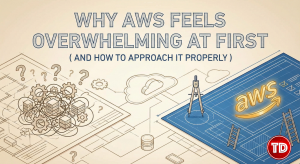
AWS Is a Toolbox, Not a Single Product

Too Many Services, Too Little Context
The Console Makes Everything Look Harder Than It Is
Certifications vs. Understanding

A Better Way to Think About AWS
References
https://aws.amazon.com/training/course-descriptions/cloud-practitioner-essentials/
https://aws.amazon.com/architecture/well-architected/
https://aws.amazon.com/blogs/training-and-certification/
https://aws.amazon.com/architecture/🤖 $3.74 ONLY for Claude eBooks and Get 25% OFF All Claude Reviewers

Turn Your Team Into Cloud-Ready Professionals Today

Learn AWS with our PlayCloud Hands-On Labs

$2.99 AWS and Azure Exam Study Guide eBooks

Learn GCP By Doing! Try Our GCP PlayCloud
Learn Azure with our Azure PlayCloud
FREE AI and AWS Digital Courses

FREE AWS, Azure, GCP Practice Test Samplers

Subscribe to our YouTube Channel

Follow Us On Linkedin


Written by: Ian Vergara