
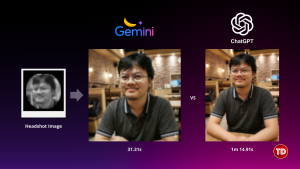
You only have four hours left to create an eye-catching social media post introducing the judges of your upcoming hackathon and all you have are inconsistent headshot images. This is not just another graphic. You are designing a visual that represents respected professionals–people whose credibility reflects directly on your event. But working with mismatched headshots (different angles, lighting, crops, and backgrounds) makes it nearly impossible to achieve a cohesive design. And it’s already 1 AM. Reaching out to them for new photos isn’t an option. So what do you do? If you’ve worked in event marketing or design, you’ve likely faced this exact scenario: tight deadlines, incomplete assets, and high expectations. Traditionally, your options would be limited: All of which cost time–time you no longer have. This is where AI augmentation in design becomes not just helpful, but essential. Instead of compromising quality or rushing through manual edits, I turned to Nano Banana, an AI-powered design tool that has fundamentally changed how I approach creative workflows. Rather than replacing the designer, Nano Banana enhances what designers can do–especially under pressure. In this case, it solved a very specific problem: All with just one prompt: Image blurred for privacy concerns. Please do not attempt to steal any photo for any other intentions. Nano Banana solved my problem within 2 Minutes! Here’s how AI augmentation streamlined the entire design process: Using Nano Banana, I was able to intelligently extend headshots into half-body portraits. The AI generated realistic clothing, posture, and framing–aligned with each judge’s professional image. What would have taken hours of manual compositing was completed in minutes. One of the biggest challenges in multi-subject layouts is inconsistency. Different lighting conditions, backgrounds, and resolutions can make a design look unpolished. With AI, image was standardized: The result was a unified, high-quality visual identity across all judges. Time pressure usually limits creativity. But with Nano Banana, iteration became fast and frictionless. I could: Without worrying about redoing image assets from scratch. There’s a common misconception that using AI in design diminishes creativity. In reality, it does the opposite. AI handles the repetitive and technical constraints, allowing designers to focus on: In this project, AI didn’t design the post for me. It enabled me to execute my vision faster and better. Within the four-hour window, I delivered: Click here to see the full post. Most importantly, it looked intentional–not rushed. And that’s the difference AI augmentation makes. Is Nano Banana the optimal generative AI tool? Let’s try to compare two prominent generative AIs in the market. Image blurred for privacy concerns. Please do not attempt to steal any photo for any other intentions. As you can see, both Gemini’s Nano Banana and GPT-4o generated astonishing results! But only differs with the time and image specifications generated. Gemini is much faster than GPT with 31 seconds compared to the other that reached 1 minute to completely generate the image. GPT also generated a much brighter and highly enhanced image compared to Gemini which retained the original image’s quality, lighting, and tone. Gemini extended the subject’s body up to the specified part which in comparison, GPT has fully extended the image up to the third-party object, which is a table. If you’re working on tight deadlines, especially in events, marketing, or tech communities–here’s what you should consider: Tools like Nano Banana allow you to do more with less time, without sacrificing quality. Incomplete or inconsistent materials can now be enhanced, extended, and standardized. When execution becomes faster, you gain more room to think, experiment, and refine. AI in design is no longer a “nice-to-have.” It’s becoming a core part of modern creative workflows. As expectations for content quality and turnaround speed continue to rise, designers who embrace AI augmentation will have a clear advantage. Not because they rely on AI. But because they know how to use it effectively. At 1 AM, with only four hours left and incomplete assets, the situation could have easily led to a mediocre output. Instead, it became an opportunity to rethink the process. By integrating AI tools like Nano Banana into the workflow, I didn’t just meet the deadline–I elevated the final result. And that’s the real value of AI in design: not replacing creativity, but unlocking it under pressure.
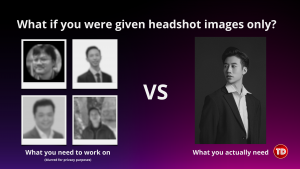
When Time, Quality, and Expectations Collide
Enter AI-Assisted Design with Nano Banana
transforming headshots into usable half-body images that look natural, professional, and consistent.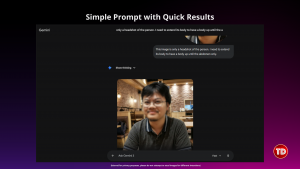
The Process: From Headshots to Cohesive Visuals

1. Image Expansion and Reconstruction
2. Style Consistency
3. Rapid Iteration
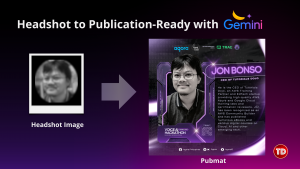
Why AI in Design Is Not “Cheating”–It’s Evolution
The Final Output: Professional, Polished, On Time
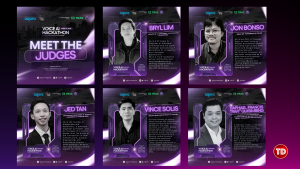
Why Nano Banana?
Key Takeaways for Designers and Event Organizers
1. AI Is a Force Multiplier
2. Asset Limitations Are No Longer Roadblocks
3. Speed Enables Creativity
The Future of Design Workflows
Final Thoughts
⚡$4.99 AWS Certified AI Practitioner AIF-C01 Video Course

Turn Your Team Into Cloud-Ready Professionals Today
Learn AWS with our PlayCloud Hands-On Labs

$2.99 AWS and Azure Exam Study Guide eBooks

Learn GCP By Doing! Try Our GCP PlayCloud

Learn Azure with our Azure PlayCloud

FREE AI and AWS Digital Courses

FREE AWS, Azure, GCP Practice Test Samplers


Subscribe to our YouTube Channel

Follow Us On Linkedin
Written by: Dearah Mae Barsolasco