
Last updated on June 10, 2026
Software development looks very different today than it did five years ago. Developers are no longer working with isolated tools and manual deployment pipelines. Instead, the modern software stack has grown into a connected ecosystem where artificial intelligence, cloud infrastructure, automated DevOps workflows, and collaborative development platforms all work together.
This matters whether you are an IT professional keeping pace with industry changes or a career-changer figuring out where to focus your learning. The tools shaping software engineering right now, from AI coding assistants to cloud-native deployment platforms, are the same ones that employers are increasingly expecting engineers to know.
A single developer can now generate production-ready APIs using Claude, deploy applications through GitHub Actions, containerize services using Docker, host globally through Vercel, and manage backend infrastructure with Supabase without maintaining traditional servers manually.
This shift is changing how startups launch products, how cloud engineers manage infrastructure, and how junior developers learn modern software engineering.
AI Is Becoming the First Layer of Modern Development
Artificial intelligence is no longer an optional productivity tool for developers. It is rapidly becoming the first layer of the modern software development workflow.
Developers today increasingly begin projects not by manually writing boilerplate code, but by prompting AI systems to generate foundational architecture, backend logic, deployment configurations, and infrastructure templates.
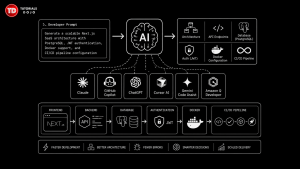
AI coding assistants such as Claude, GitHub Copilot, ChatGPT, Cursor AI, Gemini Code Assist, and Amazon Q Developer are transforming how software is written. These systems are capable of generating APIs, debugging infrastructure issues, writing SQL queries, optimizing Dockerfiles, and even explaining cloud architecture decisions in real time.
For example, a developer building a SaaS platform can now prompt Claude with:
Generate a scalable Next.js SaaS architecture with PostgreSQL, JWT authentication, Docker support, and CI/CD pipeline configuration
Within seconds, the AI assistant may generate backend routes, authentication middleware, Docker configurations, environment setup instructions, and GitHub workflow templates.
This dramatically reduces the amount of repetitive engineering work required during early-stage development.
More importantly, AI is changing how developers think. Instead of spending large amounts of time searching documentation for syntax and configurations, engineers are increasingly focusing on architecture design, feature iteration, and system integration.
The role of the developer is slowly evolving from pure implementation toward orchestration and engineering decision-making.
GitHub Is No Longer Just Version Control
GitHub has evolved far beyond source code hosting. In modern engineering environments, GitHub is increasingly functioning as the operational center of the entire software lifecycle.
Modern development workflows now revolve around GitHub repositories connected directly to deployment systems, cloud infrastructure, CI/CD automation, security scanning pipelines, and AI-assisted code review tools.
A developer can push a single commit to GitHub and automatically trigger:
- Unit testing
- Docker image builds
- Security vulnerability scanning
- Infrastructure deployment
- Production rollout
- Monitoring alerts
This automation dramatically changes deployment velocity.
For example, a GitHub Actions pipeline can automatically deploy applications to AWS after every successful commit:
name: Production Deployment
on:
push:
branches:
- main
This level of automation previously required dedicated DevOps teams. Today, solo developers and small engineering teams can build enterprise-grade deployment workflows directly inside GitHub repositories.
Combined with AI coding assistants, GitHub becomes more than version control. It becomes an intelligent software operations platform.
This is one reason why GitHub-native development is becoming central to cloud engineering and modern DevOps workflows.
Cloud Platforms Are Replacing Traditional Infrastructure Management
Cloud computing is now deeply embedded into modern software architecture. Developers no longer need to purchase physical servers or manually configure networking infrastructure to launch scalable applications globally.

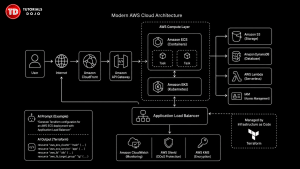
Platforms such as AWS, Google Cloud, and Microsoft Azure provide highly scalable infrastructure services that can be provisioned on demand.
Among these platforms, AWS continues dominating cloud-native development because of its mature ecosystem and extensive infrastructure services.
Modern engineering stacks commonly integrate:
- Amazon EC2
- AWS Lambda
- Amazon S3
- API Gateway
- ECS and EKS
- DynamoDB
- CloudFront
- IAM
The difference today is that AI assistants significantly lower the learning barrier for these cloud technologies.
A junior developer can now ask:
Generate Terraform configuration for an AWS ECS deployment with Application Load Balancer
AI systems can generate starter infrastructure templates immediately, helping developers move faster while learning cloud engineering concepts in real time. This AI-assisted cloud workflow is accelerating adoption of Infrastructure as Code, container orchestration, and serverless architectures worldwide.
Cloud platforms are no longer accessible only to enterprise engineers. Independent developers, startup founders, and students are now building globally distributed systems using modern cloud-native tooling.
Docker and Kubernetes Still Power Modern Infrastructure
Despite the rapid rise of AI development tools, containerization technologies remain foundational to modern software engineering.
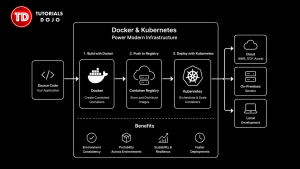
Docker continues to dominate modern application deployment workflows because it solves one of the biggest problems in software engineering: environment consistency.
Applications can now be packaged into portable containers that run consistently across local development environments, cloud infrastructure, and production systems.
Modern AI assistants can instantly generate Docker configurations:
FROM python:3.12
WORKDIR /app
COPY . .
RUN pip install -r requirements.txt
CMD ["python", "app.py"]
While AI simplifies setup, developers still need to understand container networking, image optimization, resource management, and deployment strategies.
Meanwhile, Kubernetes remains critical for large-scale orchestration.
AI tools can now generate Kubernetes manifests and explain deployment errors, but production environments still require strong understanding of:
- Scaling policies
- Cluster networking
- Secrets management
- Service discovery
- Observability
- Resource allocation
This highlights an important reality of modern engineering:
AI accelerates workflows, but engineering fundamentals still matter deeply.
Vercel and Supabase Are Simplifying Full-Stack Development
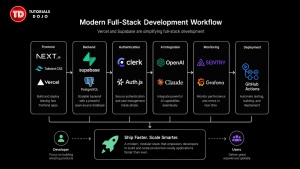
Another major shift in the stack is the rise of developer-first cloud platforms.
Tools such as Vercel, Supabase, Railway, Neon, PlanetScale, and Render are simplifying backend infrastructure and deployment workflows dramatically.
Developers no longer need to manually configure complex backend systems just to launch scalable applications.
For example, a modern full-stack workflow may now look like this:
Frontend:
- Next.js
- Tailwind CSS
- Vercel
Backend:
- Supabase
- PostgreSQL
Authentication:
- Clerk
- Auth.js
AI Integration:
- OpenAI API
- Claude API
Monitoring:
- Sentry
- Grafana
Deployment:
- GitHub Actions
This modular architecture enables extremely fast iteration cycles for startups and independent developers.
A single engineer can now build production-ready SaaS platforms capable of serving global users without maintaining traditional infrastructure manually.
This is one of the biggest reasons why modern startup development is moving faster than ever before.
AI-Augmented DevOps Is Becoming the New Standard
DevOps workflows are also rapidly evolving because of AI integration.

Modern cloud engineers increasingly use AI systems to analyze logs, troubleshoot infrastructure failures, optimize CI/CD pipelines, and diagnose deployment issues.
For example, developers can now ask AI systems:
Analyze this Kubernetes CrashLoopBackOff error and suggest possible fixes
AI assistants can identify possible causes such as:
- Failed liveness probes
- Missing environment variables
- Image pull failures
- Resource exhaustion
- Database connectivity issues
This significantly reduces troubleshooting time for engineering teams.
AI-assisted DevOps workflows are becoming especially valuable in environments involving microservices, distributed systems, and large-scale cloud infrastructure. However, experienced engineers still understand that AI-generated solutions require careful validation.
Production environments involve security risks, infrastructure costs, compliance concerns, and scalability tradeoffs that still require human engineering judgment.
The New Developer Is Becoming an AI-Orchestrated Engineer
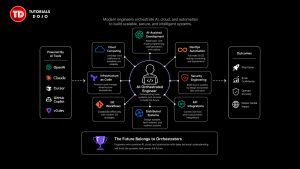
The modern software engineer is no longer defined solely by coding ability. Today’s developers increasingly act as orchestrators of AI systems, cloud infrastructure, APIs, automation pipelines, and distributed services.
The new software stack requires knowledge across multiple disciplines simultaneously:
- AI-assisted development
- Cloud computing
- DevOps automation
- Infrastructure as Code
- Security engineering
- Git workflows
- API integrations
- Distributed systems
This is fundamentally changing the definition of software engineering itself.
Developers who understand how to combine AI tools with cloud-native architectures and scalable deployment systems are becoming highly valuable in modern technology environments.
The future belongs to engineers who can build quickly while still understanding the deeper architectural and operational implications of their systems.
Why Strong Fundamentals Still Win
Despite the rise of AI-assisted development, strong engineering fundamentals remain essential.
AI can generate infrastructure templates, deployment pipelines, and backend services rapidly. However, developers still need deep understanding of networking, scalability, security, distributed systems, authentication, and performance optimization.
For example, AI may generate a cloud deployment architecture, but engineers still need to evaluate:
- Infrastructure costs
- Fault tolerance
- Security exposure
- Data privacy risks
- Scaling limitations
- Operational complexity
This is where experienced developers continue to stand out.
The best engineers are not simply the ones who generate the most code using AI.
They are the ones who understand why systems work, how architectures fail, and how to design reliable infrastructure under real-world conditions.
AI is becoming a productivity multiplier, not a replacement for engineering expertise.
Final Thoughts
The software stack of 2026 is evolving into a highly connected ecosystem built around AI-assisted development, GitHub-native workflows, cloud infrastructure, containerized deployment systems, and automated DevOps pipelines.
AI coding assistants are accelerating development speed. GitHub is becoming the center of software operations. Cloud-native infrastructure is simplifying scalability. Developer-first platforms are reducing operational overhead.
Together, these technologies are fundamentally changing how software is designed, deployed, and maintained.
However, despite these powerful advancements, the core principles of software engineering remain unchanged.
Strong technical fundamentals, system thinking, debugging ability, security awareness, and architectural understanding still separate exceptional engineers from average ones.
The future of software engineering will not belong solely to developers who use AI tools.
It will belong to developers who know how to combine AI, GitHub, cloud infrastructure, and engineering fundamentals into a powerful modern development workflow.
References
- GitHub Documentation
- AWS Documentation
- Docker Documentation
- Kubernetes Documentation
- Supabase Documentation
- Vercel Documentation
- OpenAI Platform Documentation
- Anthropic Claude Documentation
⚡$4.99 AWS Certified AI Practitioner AIF-C01 Video Course

Turn Your Team Into Cloud-Ready Professionals Today

Learn AWS with our PlayCloud Hands-On Labs

$2.99 AWS and Azure Exam Study Guide eBooks

Learn GCP By Doing! Try Our GCP PlayCloud
Learn Azure with our Azure PlayCloud
FREE AI and AWS Digital Courses

FREE AWS, Azure, GCP Practice Test Samplers

Subscribe to our YouTube Channel

Follow Us On Linkedin


Written by: Precious Grace Deborah Manucom