
AWS announces its new AWS Certified AI Business Strategist AIB-C01 certification, now open in beta and priced at $50 for a limited window. It is the AWS’s first credential built entirely around business judgment rather than technical skill, and the first to be listed in the “Business” category in the AWS Certification catalog.
The exam validates a professional’s ability to translate AI capabilities into business outcomes, establish responsible AI practices, and drive adoption at scale. It does not test the ability to build anything. There is no coding, no service configuration, and no prior AWS certification required to sit it.
What AWS is validating
The certification targets a decision-maker, not a builder. AWS describes the credential as covering four things a person needs to do to move AI from experiment to production:
- Evaluate where AI genuinely fits a business problem.
- Fund it by building a defensible business case.
- Govern it to manage risk and meet regulatory obligation.
- Scale it from a pilot into enterprise-wide deployment.
AWS’s stated positioning is that these skills travel. They apply regardless of which vendor’s tools an organization runs, and they follow the holder across companies and industries. For employers, the company frames the credential as a signal that someone is ready to own an AI outcome end to end.
Exam details
|
Item |
Detail |
|
Exam code |
AIB-C01 |
|
Category |
Business, foundational level |
|
Current status |
Beta |
|
Beta format |
85 questions, 170 minutes |
|
Standard duration |
130 minutes per the exam guide |
|
Question types |
Multiple choice, multiple response |
|
Beta price |
$50 USD |
|
Standard price |
$100 USD |
|
Delivery |
Pearson VUE test center or online proctored |
|
Languages |
English and Japanese |
|
Passing score |
700 on a 100–1,000 scale |
|
Prerequisites |
None |
The beta sitting runs longer than the eventual standard exam because betas include additional unscored questions used to validate item performance before those questions enter the live pool. Plan for close to three hours in the chair.
Multiple-response questions require every correct option to be selected before credit is awarded, with no partial marks. Blank answers score as incorrect, and there is no penalty for guessing, so nothing should be left unanswered.
Early Adopter badge: deadline February 15, 2027
AWS is attaching an incentive to the launch window. Anyone who earns the certification on or before February 15, 2027 receives an Early Adopter digital badge in addition to the standard certification badge.
Two conditions come with sitting during beta. Results take longer to arrive than a standard exam, and the official practice exam is not offered during the beta period. The official practice question set is available.
Who AWS built this for
The stated target candidate is a business professional who evaluates, champions, or scales AI initiatives inside their organization or on behalf of clients, and who works alongside technical teams without building solutions personally.
Roles AWS names directly:
- Product managers and program managers
- Sales and business development professionals
- Line-of-business managers and leaders
- Consultants and business analysts
- Marketing professionals

Recommended experience: basic familiarity with AI concepts, general awareness of what AWS AI and ML services offer at a strategic level, and roughly six months working with or alongside teams adopting AI. AWS expects candidates to recognize common categories of AI tooling and their business applications, including recommendation engines, natural language processing, computer vision, document extraction, and AI for customer operations, without needing to build or configure any of them.
The four content domains
Scored content splits almost evenly across four domains, with strategy carrying the largest single share.
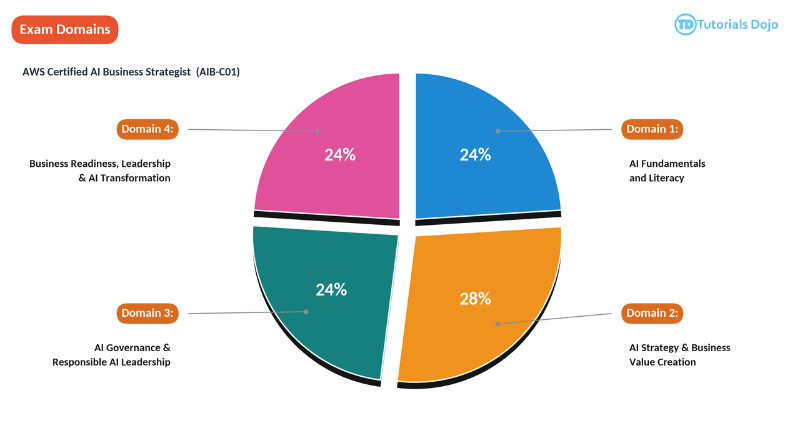
Domain 1: AI Fundamentals and Literacy (24%)
Establishes the vocabulary floor. Candidates need to explain core concepts in business terms, separate AI from machine learning from generative AI, distinguish structured from unstructured data, and articulate why data quality determines outcome quality. Global standards including ISO/IEC 23053 and ISO/IEC 42001 are named as part of a shared AI vocabulary.
The domain also covers solution selection, including the deliberately tested skill of choosing rule-based automation over AI when that is the better answer. AI agents appear as their own category, with autonomy, tool use, agent-to-agent communication, and orchestration strategies all in scope. Candidates should understand why deployed systems need ongoing monitoring for drift, and how transparent tool classification (approved, blocked, under evaluation) limits shadow AI risk.
Generative AI gets a dedicated task covering prompt engineering fundamentals, how token limits and context windows constrain performance, and how adaptation techniques, such as Retrieval-Augmented Generation and fine-tuning, contribute to a business use case.
Domain 2: AI Strategy and Business Value Creation (28%)
The largest domain. It covers identifying high-impact use cases across functions such as customer operations, sales and marketing, R&D, and software development, and then mapping capabilities to specific outcomes. Build-buy-partner evaluation weighs budget, timeline, capability, vendor proposals, and compliance requirements. Portfolio prioritization runs on value, feasibility, sustainability, and strategic alignment, including decisions to scale, pause, or terminate. Recognizing when AI is not the right solution is explicitly tested.
Measurement is the domain’s core. Candidates define KPIs spanning tangible benefits such as cost reduction and revenue growth, as well as intangible ones such as customer satisfaction and employee productivity. Baseline metrics must be established before deployment so that effects can be accurately attributed. ROI calculation uses comprehensive frameworks that cover time savings, cost reductions, revenue growth, and productivity gains. Leading indicators of project success and basic cost controls round out the task.
The final task addresses competitive positioning: assessing the landscape, spotting business-model transformation opportunities, understanding what makes an AI advantage durable, and calibrating investment level against industry maturity and competitive dynamics.
Domain 3: AI Governance and Responsible AI Leadership (24%)
Responsible AI treated as a business discipline. Candidates apply principles such as fairness, explainability, privacy, safety, transparency, and robustness to business scenarios, and navigate trade-offs when commercial objectives conflict with these principles. Governance by design is tested, meaning knowing when responsible AI practice has to enter project planning rather than arriving as a retrofit. Human oversight and safeguards, including hallucination detection, guardrails, and escalation criteria, are in scope.
On structure, the exam covers establishing governance with genuine cross-functional representation and clear accountability, identifying regulatory compliance exposures, applying appropriate access controls and data security measures, and using risk classification frameworks to prioritize decisions across the AI lifecycle.
Enterprise risk covers production controls and monitoring; recognition that bias can enter at multiple lifecycle stages and requires ongoing bias-drift monitoring; management of harmful content and intellectual property exposure; and mitigation of reliability risks, including hallucinations, degrading data quality, and model drift.
Domain 4: Business Readiness, Leadership, and AI Transformation (24%)
Readiness assessment spans leadership alignment, data quality, cultural preparedness, technical infrastructure, and governance frameworks. Maturity models locate an organization on its path from experimentation to enterprise-scale deployment. Candidates identify capability gaps across people, process, technology, and governance, then prioritize investment and build progression pathways.
Data and infrastructure foundations cover data readiness, accessibility, and the impact of silos, as well as the roles of data strategy, ownership, and sharing frameworks. Foundational infrastructure requirements are assessed at a business level.
Change leadership is heavily represented: securing executive sponsorship and empowering AI champions, building cross-functional teams spanning business, technical, legal, and compliance with clear accountability, communicating transparently about timelines and role impact, recognizing cultural barriers such as risk aversion and fear of failure, and selecting workforce development approaches including proof-of-concept programs, hackathons, and responsible AI training. Candidates also evaluate where human roles shift from manual execution toward oversight and collaboration, balancing human strengths in critical thinking, empathy, and creativity against AI capability.
Scaling closes the domain: iterative phases running envision, experiment, launch, and scale; methodologies that begin with short-term wins; AI centers of excellence and cross-functional collaboration mechanisms; continuous feedback and long-term value metrics; and the transition from experimental to production-grade with its governance and operational requirements.
AWS services in scope
The certification page states the exam does not assess AWS services knowledge. The exam guide qualifies that slightly: a short in-scope list exists, but every item is limited to strategic awareness or basic application.
- Amazon Bedrock — generative AI platform positioning, pricing tiers, Guardrails, Knowledge Bases
- Amazon SageMaker AI — custom ML, and the judgment call between managed and custom approaches
- Amazon Quick — AI-powered business assistants
- AWS Cloud Adoption Framework (CAF) — planning and scaling AI across an organization
- AWS shared responsibility model — applied to AI workloads, data security, and compliance
- AWS Well-Architected Framework, Responsible AI Lens — governance best practice
- Pricing and cost tooling — AI service pricing structures (consumption-based, instance-based, seat-based), cost optimization such as Savings Plans, AWS Pricing Calculator, AWS Cost Explorer, and AWS Marketplace for build-buy-partner evaluation
How it differs from AWS Certified AI Practitioner
|
AI Business Strategist |
AI Practitioner |
|
|
Validates |
Business judgment for AI decisions |
Foundational AI, ML, and GenAI knowledge |
|
AWS services |
Strategic awareness only |
Directly assessed |
|
Central question |
Should we invest, and how do we scale it? |
What is this, and what does AWS offer? |
|
Category |
Business |
Technical foundational |

AWS positions the two as complementary and notes that candidates can earn both to demonstrate technical AI knowledge alongside strategic business judgment.
For a path afterward, AWS suggests the AI Practitioner to deepen technology understanding, then the Machine Learning Engineer – Associate or the Generative AI Developer – Professional for advanced AI/ML skills. Cloud Practitioner is the alternative for a broader cloud foundation.
Scoring
Results are pass or fail and reported as a scaled score between 100 and 1,000, with a minimum passing score of 700. Scaled scoring keeps results comparable across exam forms of differing difficulty.
The exam uses a compensatory model, meaning candidates do not need to pass every section individually, only the exam overall. Score reports may include section-level performance classifications, which AWS advises interpreting with caution given uneven question counts across domains.
Preparing for the exam
AWS has published a four-step prep plan on Skill Builder:
- Get to know the exam — work through the prep plan, read the exam guide, and take the official practice question set
- Refresh knowledge and skills — enroll in digital courses covering identified gaps
- Review and practice — go domain by domain with exam-style questions, instructor walkthroughs of test-taking strategy, and the Meeting Simulator
- Assess readiness — take the official practice exam, unavailable during beta
The Meeting Simulator is scenario-based rather than a question bank, which suits an exam built around situational judgment. Candidates already working in AI adoption are most likely to find their gap in Domain 1’s formal terminology rather than in the strategy material, since practical familiarity with a concept does not always come with the vocabulary the exam uses.
Availability
The beta exam is now open for scheduling through Pearson VUE, with exam delivery beginning September 29, in a test center or online, proctored, in English or Japanese. The $50 beta price and the February 15, 2027 Early Adopter badge deadline both apply to this launch window.
References:
https://aws.amazon.com/certification/certified-ai-business-strategist/
https://skillbuilder.aws/category/exam-prep/ai-business-strategist-business-AIB-C01
📚 $2.99 USD Starting Price — Save 40% on All eBooks

Turn Your Team Into Cloud-Ready Professionals Today

Learn AWS with our PlayCloud Hands-On Labs

$2.99 AWS and Azure Exam Study Guide eBooks

Learn GCP By Doing! Try Our GCP PlayCloud
Learn Azure with our Azure PlayCloud

FREE AI and AWS Digital Courses

FREE AWS, Azure, GCP Practice Test Samplers


Subscribe to our YouTube Channel

Follow Us On Linkedin


Written by: Nikee Tomas