
The AWS Certified Solutions Architect – Professional certification validates advanced architectural judgment: choosing solutions that satisfy business requirements while balancing security, reliability, performance, operating effort, and cost. SAP-C03 extends that judgment to AI-integrated applications and modern enterprise environments.
Prepare by working through complete architectures. For each design, explain the requirements, the service choices, the alternatives you rejected, and how the workload behaves during failure. This study path follows the saved Tutorials Dojo section structure, with original explanations and exercises.
The AWS Certified Solutions – Professional Certification Exam Overview
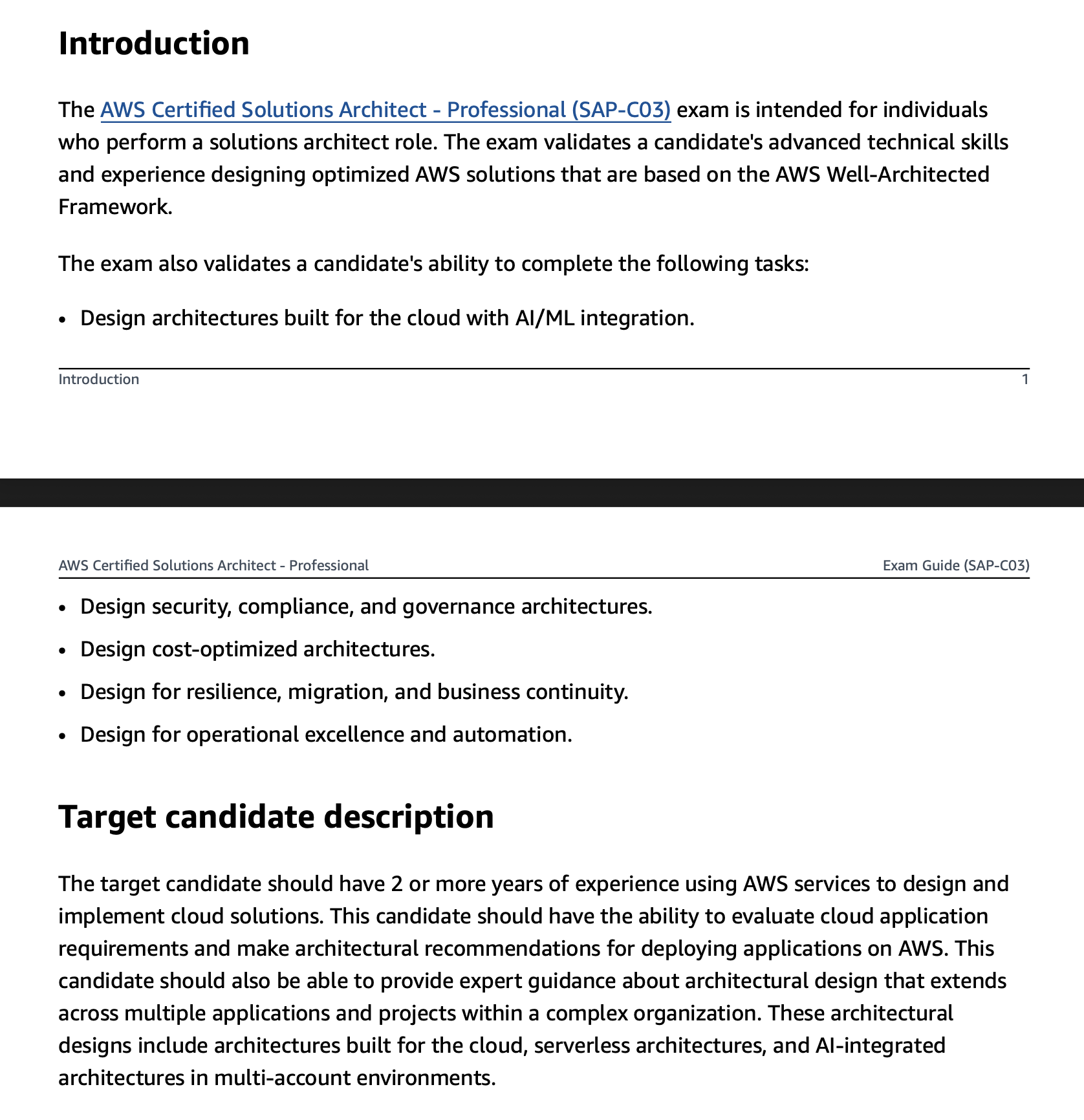
The target candidate has at least two years of experience designing and implementing AWS solutions and can advise across applications and projects in complex organizations. The scope includes serverless, multi-account, and AI-integrated architectures.
The official AWS Exam Guide, AWS Documentation, and AWS Whitepapers will be your primary study materials for this exam. Experience in building systems will also be helpful since the exam constitutes of multiple scenario-type questions. You can learn more details on your exam through the official AWS Certified Solutions Architect – Professional SAP-C03 Exam Guide here. Do a quick read on it to be aware of how to prepare and what to expect on the exam itself.
Difference between the SAP-C02 and SAP-C03 AWS Certified Solutions Architect Professional Exam Versions
SAP-C03 reorganizes four domains into five. The table below compares each version’s numbered domains; it does not imply a direct one-to-one transfer of their topics. AWS separately documents additions, deletions, and recategorizations.
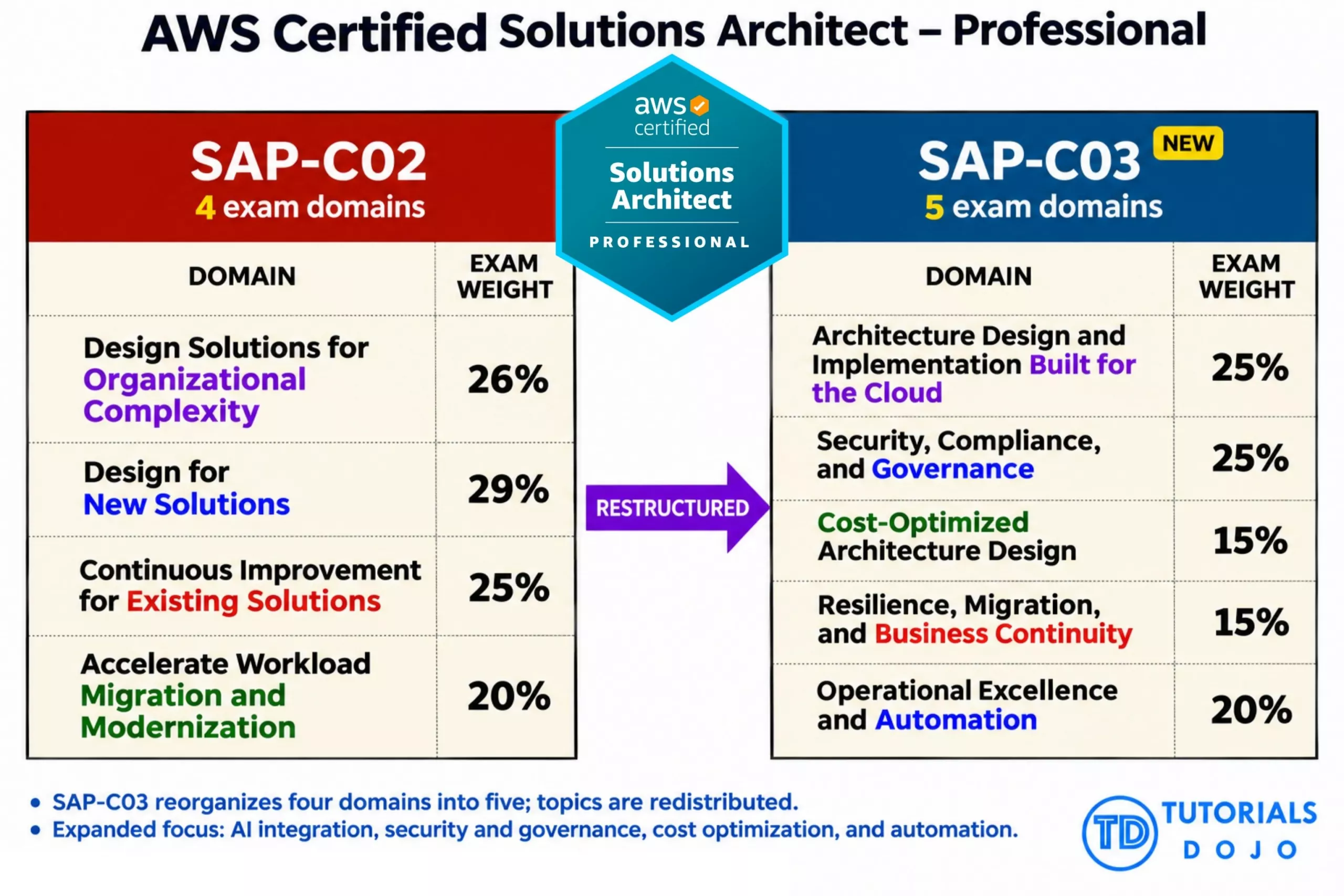
Notable additions include generative and agentic AI integration, RAG, responsible AI controls, post-quantum cryptography, modern cloud-native patterns, lakehouse architectures, and expanded DevSecOps and observability skills. Existing architecture experience remains useful, but SAP-C02 study materials alone are insufficient for SAP-C03 preparation unless they are supplemented with coverage of the new and expanded topics.”
The AWS Certified Solutions Architect Associate SAP-C03 Study Materials
As a starting point for your AWS Certified Solutions Architect – Professional SAP-C03 exam preparation, review the official SAP-C03 Exam Guide. Use its content domains and task statements to assess your knowledge and identify areas that need further study. Build your preparation around advanced architecture scenarios, hands-on practice, and SAP-C03-aligned training, supported by AWS documentation and the AWS Well-Architected Framework.
There are many posts on the Internet recommending the “best” course for the AWS Certified Solutions Architect – Professional exam. However, some resources may still focus on SAP-C02 and lack coverage of the updated SAP-C03 topics. Before choosing your study materials, check their exam version, update history, and coverage against the official SAP-C03 exam guide.
The best place to confirm exam information is the official AWS Certified Solutions Architect – Professional certification page. This page provides access to exam scheduling and official preparation resources. Review the SAP-C03 exam guide, then follow the preparation links to AWS Skill Builder for available official practice questions and exam preparation materials. Make sure the resources you select align with SAP-C03.
Let’s now explore the study materials for the AWS Certified Solutions Architect – Professional SAP-C03 exam. These include the official exam guide, official practice resources, AWS documentation, and supplementary free and paid training. Treat the official SAP-C03 exam guide as your primary reference for deciding which topics to study, and use other materials to deepen your understanding and practice architectural decision-making.
1. Official Exam Guide for the AWS Certified Solutions Architect Professional SAP-C03 Exam
2. AWS Certified Solutions Architect Professional SAP-C03 Video Course
3. AWS Certified Solutions Architect Professional SAP-C03 Practice Exams
Additional SAP-C03 Whitepapers
For whitepapers, focus on the following:
To support your AWS Certified Solutions Architect – Professional SAP-C03 preparation, focus on the following AWS whitepapers and architecture references. Use them alongside the official exam guide to understand architectural decisions, implementation tradeoffs, and operational best practices.
-
AWS Well-Architected Framework
Review the six pillars and use their design principles to evaluate security, reliability, performance, cost, operations, and sustainability across complex architectures. -
Security Pillar – AWS Well-Architected Framework
Focus on identity and access management, infrastructure protection, data protection, detection, and incident response to strengthen your security architecture knowledge. -
Cost Optimization Pillar – AWS Well-Architected Framework
Study expenditure management, resource selection, demand management, and ongoing optimization. Practice balancing cost savings with performance and availability requirements. -
Disaster Recovery of Workloads on AWS: Recovery in the Cloud
Understand recovery time objectives (RTOs), recovery point objectives (RPOs), and the tradeoffs between backup and restore, pilot light, warm standby, and multi-site recovery strategies. -
Operational Excellence Pillar – AWS Well-Architected Framework
Review observability, operational readiness, deployment practices, and continuous improvement to support your study of operational excellence and automation. -
An Overview of the AWS Cloud Adoption Framework
Explore how business, people, governance, platform, security, and operations perspectives support enterprise cloud adoption and transformation. -
Navigating the Security Landscape of Generative AI
Supplement your AI architecture preparation with guidance on generative AI security risks, protective controls, and responsible AI considerations.

Core AWS Services to Focus On for the SAP-C03 Exam
For SAP-C03, study how services work together to satisfy complex business requirements. Focus on architectural tradeoffs involving security, resilience, performance, operational effort, and cost. These study priorities align with the official exam guide; they do not indicate how frequently individual services appear on the exam.
Architecture, Compute, and Application Integration
-
Amazon EC2, Elastic Load Balancing, and Amazon EC2 Auto Scaling — Review workload placement, instance selection, purchasing options, health checks, scaling policies, and multi-Availability Zone designs. Understand how load balancer selection affects application traffic and availability.
-
AWS Lambda and Amazon API Gateway — Study serverless architectures, concurrency, throttling, authentication, retries, and failure handling. Understand synchronous and asynchronous integrations and how to build reliable, idempotent processing.
-
Amazon ECS, Amazon EKS, AWS Fargate, and Amazon ECR — Compare container deployment options, scaling, networking, workload identities, and operational responsibilities. Review image scanning, lifecycle policies, and service communication through Amazon VPC Lattice or Amazon ECS Service Connect.
-
Amazon SQS, Amazon SNS, Amazon EventBridge, and AWS Step Functions — Understand queuing, publish-subscribe messaging, event routing, and workflow orchestration. Review ordering, delivery guarantees, dead-letter queues, retries, and cross-account event patterns.
-
Amazon Bedrock and Amazon SageMaker AI — Study how applications integrate generative AI, agents, retrieval-augmented generation (RAG), and inference endpoints. Include retrieval permissions, vector stores, and multi-account deployment patterns.
Storage, Databases, and Analytics
-
Amazon S3 and S3 Glacier Storage Classes — Review storage class selection, lifecycle management, replication, versioning, encryption, access policies, and Object Lock. Compare retrieval requirements, retention needs, and costs.
-
Amazon EBS, Amazon EFS, and Amazon FSx — Select storage based on access protocols, shared access requirements, latency, throughput, and availability. Review encryption, backups, and recovery options.
-
Amazon RDS and Amazon Aurora — Compare database engines, Multi-AZ deployments, read replicas, connection management, backups, and recovery. Study Aurora Global Database and the tradeoffs between availability, read scaling, and regional recovery.
-
Amazon DynamoDB and Amazon ElastiCache — Review access patterns, capacity choices, partition design, global tables, caching, and consistency. Understand when DynamoDB Accelerator (DAX) or an application cache improves a design.
-
Amazon Kinesis Data Streams, Amazon MSK, AWS Glue, Amazon Athena, and Amazon Redshift — Compare streaming and batch processing architectures. Include data lakes, lakehouse patterns, AWS Lake Formation permissions, and cross-account data sharing.
Networking and Content Delivery
-
Amazon VPC, AWS PrivateLink, and AWS Transit Gateway — Study multi-account network connectivity, subnet design, routing, endpoints, IP address management, and IPv6. Review security groups, network ACLs, and centralized traffic inspection.
-
AWS Direct Connect, AWS VPN, and Amazon Route 53 Resolver — Design resilient hybrid connectivity and DNS resolution. Understand redundancy, failover, private hosted zones, and conditional forwarding.
-
Amazon Route 53, Amazon CloudFront, and AWS Global Accelerator — Compare DNS routing, content delivery, and global traffic acceleration. Review health checks, origin protection, caching, and multi-Region routing.
Security, Compliance, and Governance
-
AWS IAM, AWS IAM Identity Center, and Amazon Cognito — Study federation, temporary credentials, cross-account roles, workload identities, and application authentication. Understand permissions boundaries, attribute-based access control, and least-privilege design.
-
AWS Organizations, AWS Control Tower, and AWS RAM — Review account and OU structures, landing zones, automated account provisioning, and resource sharing. Understand how service control policies (SCPs) and resource control policies (RCPs) enforce organizational controls.
-
AWS KMS, AWS Certificate Manager, AWS CloudHSM, and AWS Secrets Manager — Study encryption, key policies, rotation, certificate management, and secret access. Include the post-quantum cryptography concepts identified in the SAP-C03 exam guide.
-
AWS CloudTrail, AWS Config, Amazon GuardDuty, AWS Security Hub, and Amazon Inspector — Compare audit logging, configuration compliance, threat detection, security posture management, and vulnerability assessment. Review centralized collection and automated responses across accounts.
-
AWS WAF, AWS Shield, and AWS Network Firewall — Understand application protection, DDoS mitigation, and network traffic filtering. Select controls according to the traffic path and protection requirements.
-
Amazon Bedrock Guardrails and Amazon Bedrock AgentCore Identity — Review content controls and access management for generative and agentic AI applications. Include human approval workflows and audit requirements for AI operations.
Migration, Resilience, and Business Continuity
-
AWS DMS, AWS Transform MGN, AWS DataSync, and AWS Storage Gateway — Compare database migration, server rehosting, data transfer, and ongoing hybrid storage access. Study dependency discovery, migration waves, cutover validation, and rollback planning.
-
AWS Backup, AWS Elastic Disaster Recovery, and Amazon Application Recovery Controller — Design recovery around recovery time objectives (RTOs), recovery point objectives (RPOs), and cost. Review centralized backups, replication, failover, and protection against accidental deletion.
-
AWS Resilience Hub and AWS Fault Injection Service — Study resilience assessments, recovery validation, and controlled failure experiments. Understand how to test whether an architecture meets business continuity requirements.
Operational Excellence, Automation, and Cost
-
AWS CloudFormation, AWS CDK, and CloudFormation StackSets — Review repeatable infrastructure deployment, policy validation, drift management, and multi-account and multi-Region provisioning.
-
AWS CodePipeline, AWS CodeBuild, and AWS CodeDeploy — Study deployment pipelines, security scanning, cross-account artifact promotion, and rollback. Compare blue/green, canary, and rolling deployment strategies.
-
Amazon CloudWatch, AWS X-Ray, AWS Distro for OpenTelemetry, and AWS Systems Manager — Review metrics, logs, traces, centralized observability, alerting, and automated runbooks. Include service-level objectives, user experience monitoring, and AI workload monitoring.
-
AWS Cost Explorer, AWS Budgets, AWS Cost and Usage Report, and AWS Compute Optimizer — Study cost allocation, usage analysis, rightsizing, and financial controls. Compare Savings Plans, Reserved Instances, Spot Instances, and On-Demand Instances, and account for network, storage, and AI inference costs.
Use the official SAP-C03 service scope as your broader checklist. AWS describes this list as non-exhaustive and subject to change.
Other SAP-C03 AWS Services that you should prepare for:
For the exam version ( SAP-C03 ), you should also know the following services:
-
AWS Directory Service — Review managed Microsoft Active Directory and integration with existing directory environments.
-
Amazon MQ — Understand managed message brokers and their role in modernizing applications that depend on established messaging protocols.
-
Amazon OpenSearch Service — Review search, log analytics, and vector search use cases.
-
Amazon MemoryDB — Understand when an application requires a durable in-memory database rather than a cache.
-
Amazon DocumentDB — Review document database use cases and compatibility considerations.
-
Amazon Neptune — Understand graph database use cases involving highly connected data.
-
Amazon Keyspaces — Review managed Apache Cassandra-compatible workloads and capacity considerations.
-
AWS Lake Formation — Study centralized data lake permissions and cross-account data access.
-
AWS Clean Rooms — Understand controlled collaboration and analysis across organizational datasets.
-
AWS Cloud WAN — Review centralized management of global networks connecting cloud and on-premises environments.
-
AWS Transfer Family — Understand managed file transfer and integration with AWS storage.
-
AWS Outposts and AWS Local Zones — Compare workload placement options for local processing, latency, and hybrid requirements.
-
Amazon Security Lake — Review centralized security data collection across accounts and sources.
-
AWS Verified Access — Understand identity- and context-based access to corporate applications.
-
Amazon Verified Permissions — Review fine-grained application authorization.
-
AWS Service Quotas — Include service limits in capacity planning, scaling, and recovery designs.
… plus a few more services and new SAP-C03 topics that we have recently added to our AWS Certified Solutions Architect Associate Practice Exams
For more information, check out the SAP-C03 official exam guide for the new SAP-C03 version here.
The AWS Documentation and FAQs will be your primary source of information. You can also visit Tutorials Dojo’s AWS Cheat Sheets to gain access to a repository of thorough content on the different AWS services mentioned above. Lastly, try out these services yourself by signing up on AWS and performing some lab exercises. Experiencing them on your own will help you greatly in remembering what each service is capable of.

Also check out this article: Top 5 FREE AWS Review Materials.
Common Exam Scenarios for the SAP-C03 exam
Domain 1: Architecture Design and Implementation Built for the Cloud
| Scenario | Approach to Evaluate |
|---|---|
| An application must process traffic spikes without overwhelming downstream services. | Decouple processing with Amazon SQS and independently scale consumers. Design for retries, duplicate processing, and dead-letter handling. |
| A company needs an internal AI assistant that answers questions using private documents. | Evaluate a RAG architecture using Amazon Bedrock Knowledge Bases and a supported vector store. Address document permissions, retrieval quality, and data freshness. |
| Several accounts need private access to an application without broad network connectivity. | Evaluate AWS PrivateLink for private service access and compare it with VPC peering or Transit Gateway connectivity. |
| A global application requires regional database reads and a recovery strategy for regional disruption. | Evaluate Aurora Global Database or DynamoDB global tables according to the data model, consistency requirements, write locations, and recovery objectives. |
| Multiple business units need governed access to a shared data lake. | Evaluate Amazon S3, AWS Glue Data Catalog, and AWS Lake Formation for cataloging, permissions, and cross-account sharing. |
Domain 2: Security, Compliance, and Governance
| Scenario | Approach to Evaluate |
|---|---|
| New AWS accounts must follow consistent security and governance requirements. | Use AWS Organizations and AWS Control Tower for account structure, landing zones, and provisioning. Apply appropriate SCPs, RCPs, and detective controls. |
| Employees need centrally managed access across multiple AWS accounts. | Evaluate IAM Identity Center with identity federation, permission sets, and temporary credentials. |
| A regulated workload requires centralized encryption management and restricted cross-account key access. | Design AWS KMS key policies, IAM permissions, grants, rotation, and audit logging around the required trust boundaries. |
| An AI agent can perform sensitive actions that require human authorization. | Combine scoped agent identities and tool permissions with an explicit approval workflow, such as AWS Step Functions. |
| Generative AI responses must follow content and compliance requirements. | Evaluate Amazon Bedrock Guardrails alongside application authorization, logging, evaluation, and human oversight. |
Domain 3: Cost-Optimized Architecture Design
| Scenario | Approach to Evaluate |
|---|---|
| A workload has a predictable baseline with occasional interruption-tolerant processing spikes. | Compare Savings Plans or Reserved Instances for eligible baseline usage with Spot capacity for suitable flexible workloads. |
| Private workloads generate significant NAT gateway charges when accessing Amazon S3. | Evaluate S3 gateway endpoints and review routing, access policies, and the actual traffic cost breakdown. |
| Storage contains frequently accessed, unpredictable, and archival datasets. | Compare S3 storage classes, Intelligent-Tiering, and lifecycle policies. Include retrieval charges, minimum storage durations, and recovery needs. |
| A shared platform must allocate costs to teams and detect unexpected spending. | Use cost allocation tags, Cost Categories, billing reports, Cost Explorer, AWS Budgets, and appropriate anomaly detection. |
| An AI application repeatedly sends large prompts and makes redundant inference requests. | Evaluate supported prompt caching, request batching, model selection, and application-level reuse while preserving quality, privacy, and latency requirements. |
Domain 4: Resilience, Migration, and Business Continuity
| Scenario | Approach to Evaluate |
|---|---|
| A database must migrate to AWS with limited downtime. | Evaluate AWS DMS replication, schema compatibility, validation, and a planned cutover. Define rollback and application dependency handling. |
| An organization must migrate interconnected applications in stages. | Discover dependencies, group migration waves, and select rehosting, replatforming, or refactoring approaches for each workload. |
| A critical application must recover from a regional outage. | Compare backup and restore, pilot light, warm standby, and active/active designs against RTO, RPO, cost, and operational complexity. |
| Backups must remain protected if a workload account is compromised. | Evaluate cross-account backup isolation, AWS Backup Vault Lock, restricted administration, and tested restoration procedures. |
| A team needs evidence that its architecture can withstand component failures. | Use AWS Resilience Hub assessments and controlled AWS Fault Injection Service experiments with defined safety limits and recovery measurements. |
Domain 5: Operational Excellence and Automation
| Scenario | Approach to Evaluate |
|---|---|
| Standard infrastructure must be deployed consistently across accounts and Regions. | Evaluate AWS CloudFormation StackSets, reusable templates, deployment permissions, and drift management. |
| A release must be validated before deployment across production accounts. | Design a pipeline with security scanning, controlled artifact promotion, approval gates, and an appropriate rollback strategy. |
| Operators need to trace failures across distributed services. | Correlate metrics, logs, and traces using Amazon CloudWatch, AWS X-Ray, and OpenTelemetry instrumentation. Define actionable alerts and service-level objectives. |
| A recurring operational problem should trigger automatic remediation. | Use EventBridge and Systems Manager Automation with scoped permissions, validation, retry limits, and escalation paths. |
| An AI application must maintain response quality and acceptable inference latency. | Include output evaluations, latency and error monitoring, agent performance tracking, and controlled release or rollback procedures. |
AWS Certified Solutions Architect Professional Video Course – SAA-C03
This is a concise Solutions Architect Professional video training course for the SAP-C03 exam. The goal of this video course is to equip you with the exam-specific knowledge that you need to understand in order to pass the SAP-C03 exam, presented in a highly visual form. Click here to enroll.
Validate Your SAP-C03 Knowledge
When you are feeling confident with your review, it is best to validate your knowledge through sample exams. You can take this practice exam from AWS for free as additional material but do not expect your real exam to be on the same level of difficulty as this practice exam on the AWS website. Tutorials Dojo offers a very useful and well-reviewed set of practice tests for AWS Solutions Architect Professional SAP-C03 takers here. The practice test has over 400 unique questions and each question comes with detailed explanations, reference links, and cheat sheets. You can also pair our practice exams with our video course and exam study guide eBook to further help in your exam preparations.
If you have scored well on the Tutorials Dojo AWS Certified Solutions Architect Associate SAP-C03 practice tests and you think you are ready, then go earn your certification! If you think you are lacking in certain areas, better review them again and take note of any hints in the questions that will help you select the correct answers.
Click here for more AWS Certified Solutions Architect Professional practice exam questions.
Check out our other AWS practice test courses here:

To increase your chances of passing the AWS Certified Solutions Architect Professional exam, we recommend using a combination of our video course, our practice tests, and our study guide eBook. You can view our triple bundles here.
Additional SAP-C03 Training Materials: High-Quality Video Courses for the AWS Certified Solutions Architect Professional Exam
There are a few top-rated AWS Certified Solutions Architect Professional SAP-C03 video courses that you can check out as well, which can help in your exam preparations. The list below is constantly updated based on feedback from our students on which course/s helped them the most during their exams.
Some Notes Regarding Your SAP-C03 Exam
SAP-C03 preparation requires evaluating complete architectures against business requirements. Before comparing answers, identify the primary objective and hard constraints, such as downtime, data residency, recovery objectives, operational effort, performance, and cost.
Read every option carefully. A service might fit the general use case while the proposed configuration fails a specific requirement. Check permissions, connectivity, replication behavior, scaling limits, and recovery procedures before selecting an answer.
For multiple-response questions, select the required number of answers. Eliminate options that violate the scenario’s requirements, then evaluate whether the remaining choices work together as a complete solution.
Be comfortable comparing services and architectural approaches, including:
-
SCPs vs. RCPs vs. IAM policies
-
Transit Gateway vs. PrivateLink vs. VPC peering
-
SQS vs. SNS vs. EventBridge vs. Amazon MQ
-
ECS vs. EKS vs. Lambda
-
RDS Multi-AZ vs. read replicas vs. Aurora Global Database
-
S3 vs. EBS vs. EFS vs. FSx
-
DataSync vs. Storage Gateway vs. DMS
-
Amazon Bedrock vs. Amazon SageMaker AI
-
CloudTrail vs. Config vs. CloudWatch
-
Backup and restore vs. pilot light vs. warm standby vs. active/active
-
Savings Plans vs. Reserved Instances vs. Spot vs. On-Demand
The Tutorials Dojo Comparison of AWS Services contains excellent cheat sheets comparing these seemingly similar services which are crucial to solving the tricky scenario-based questions in the actual exam. By knowing each service’s capabilities and use cases, you can consider these types of questions already half-solved.
Lastly, be on the lookout for “key terms” that will help you realize the answer faster. Words such as millisecond latency, serverless, managed, highly available, most cost-effective, fault-tolerant, mobile, streaming, object storage, archival, polling, push notifications, etc are commonly seen in the exam. Time management is very important when taking AWS certification exams, so be sure to monitor the time you consume for each question.
⏳ Get 30% OFF on Microsoft Azure and GitHub Reviewers this Black Friday Sale!

Turn Your Team Into Cloud-Ready Professionals Today

Learn AWS with our PlayCloud Hands-On Labs
$2.99 AWS and Azure Exam Study Guide eBooks

Learn GCP By Doing! Try Our GCP PlayCloud
Learn Azure with our Azure PlayCloud
FREE AI and AWS Digital Courses

FREE AWS, Azure, GCP Practice Test Samplers

Subscribe to our YouTube Channel

Follow Us On Linkedin


Written by: Ace Kenneth Batacandulo