
The AWS Certified Developer – Associate certification focuses on building, securing, testing, releasing, and troubleshooting applications on AWS. DVA-C03 includes using AI tools during development and integrating managed AI services.
Build your preparation around a small application you can improve throughout your review. Add authentication, persistence, asynchronous processing, deployment automation, and monitoring. Keep a record of failures and explain how you resolved each one.
The AWS Certified Developer – Associate Certification Exam Overview
AWS recommends at least one year of practical AWS application development experience. Familiarity with a programming language, SDKs, the AWS CLI, and application lifecycle practices provides a useful foundation.
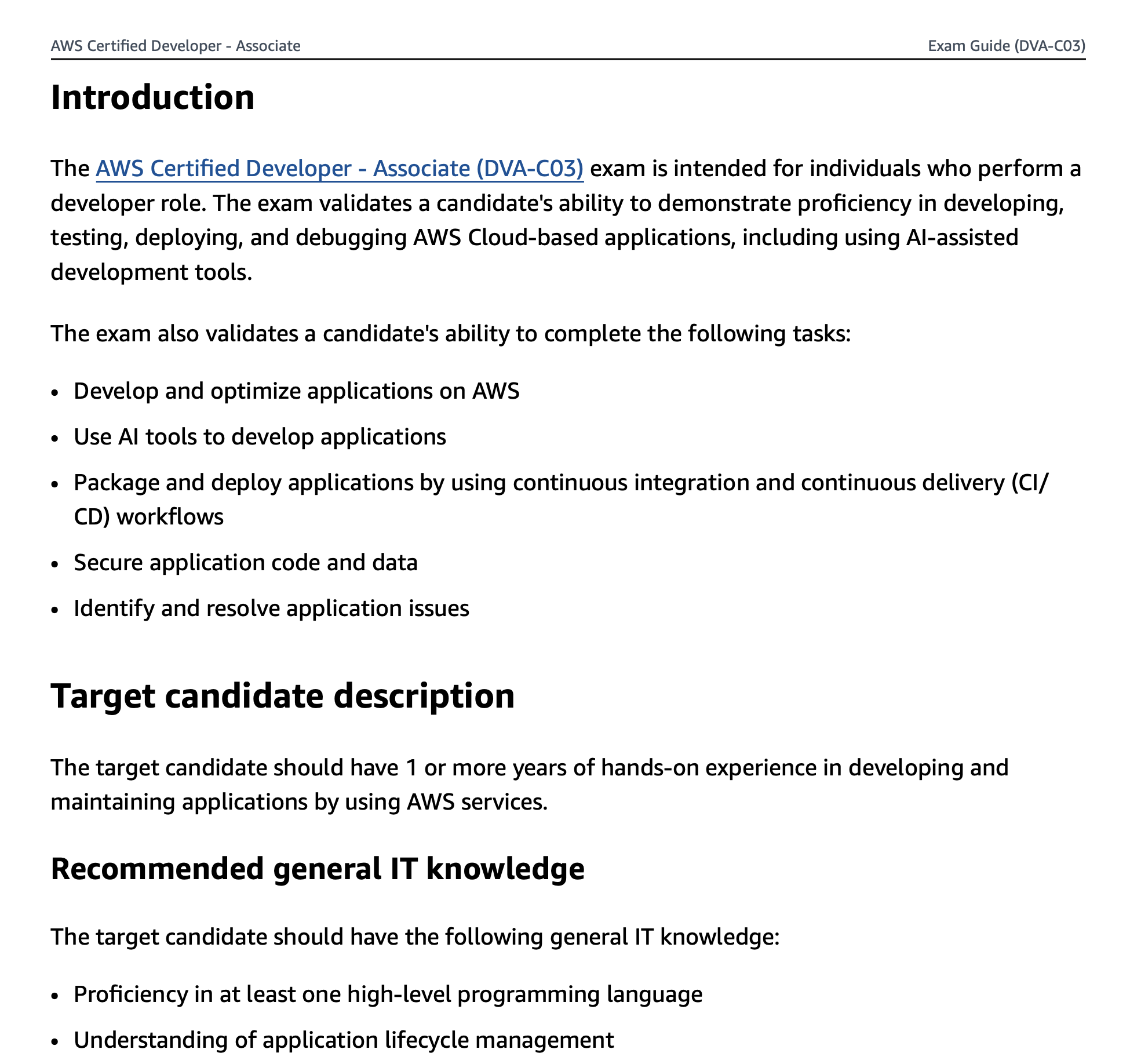
The official AWS Exam Guide, AWS Documentation, and AWS Whitepapers will be your primary study materials for this exam. Experience in building systems will also be helpful since the exam constitutes of multiple scenario-type questions. You can learn more details on your exam through the official AWS Certified Developer – Associate DVA-C03 Exam Guide here. Do a quick read on it to be aware of how to prepare and what to expect on the exam itself.
Difference between the DVA-C02 and DVA-C03 AWS Certified Developer Associate Exam Versions
The updated exam adds AI-assisted coding, test generation, troubleshooting, and optimization. It also expands container deployment coverage and introduces a dedicated AI security task covering privacy, input/output protection, agent permissions, and sensitive logs.
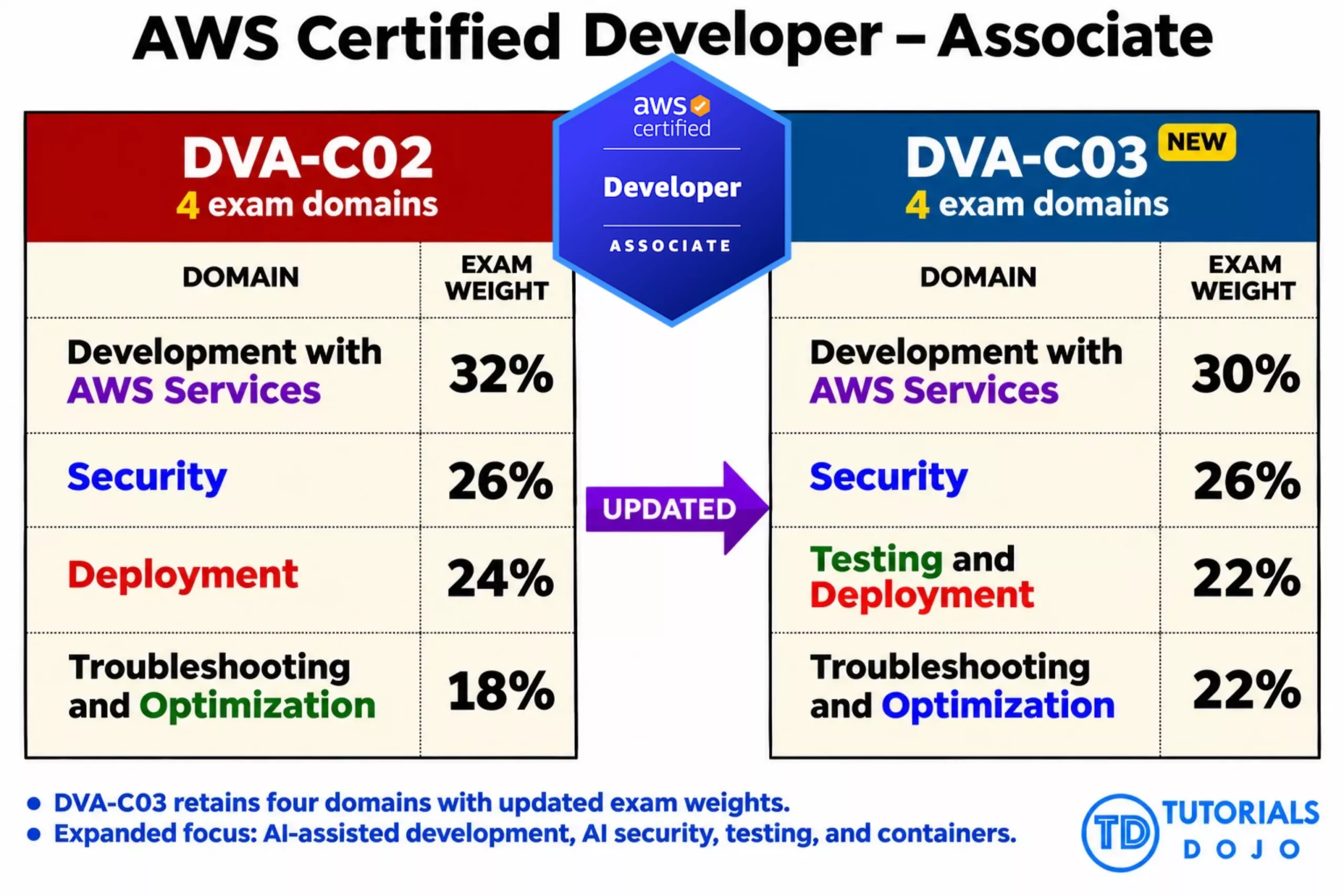
Some topics move between domains. Lambda performance tuning moves to Troubleshooting and Optimization, while SAM unit testing moves to Testing and Deployment. These changes reorganize existing skills as well as introducing new material.
The AWS Certified Developer Associate DVA-C03 Study Materials
As a starting point for your AWS Certified Developer – Associate DVA-C03 exam preparation, review the official DVA-C03 Exam Guide. Use its domains and task statements to identify your strengths and areas for improvement. Build your preparation around hands-on application development, security, testing, deployment, and troubleshooting, including the use of AI-assisted development tools.
There are many posts online recommending the “best” course for the AWS Certified Developer – Associate exam. However, some resources may still focus on DVA-C02. Before choosing your study materials, check their exam version, update history, and coverage against the official DVA-C03 exam guide.
The best place to confirm exam information is the official AWS Certified Developer – Associate certification page. Review the exam guide, then follow the preparation links to AWS Skill Builder for available practice questions, training, and exam preparation resources. Check that each resource supports your DVA-C03 preparation.
Let’s now explore the study materials for the AWS Certified Developer – Associate DVA-C03 exam. These include the official exam guide, practice resources, AWS documentation, and supplementary free and paid training. Use these materials to strengthen your understanding through coding exercises and practical application scenarios.
1. Official Exam Guide for the AWS Certified Developer Associate DVA-C03 Exam
2. AWS Certified Developer Associate DVA-C03 Video Course
3. AWS Certified Developer Associate DVA-C03 Practice Exams
Additional DVA-C03 Whitepapers
To support your AWS Certified Developer – Associate DVA-C03 preparation, use the following AWS whitepapers and documentation alongside the official exam guide. Focus on applying the guidance to the applications you build during your review.
-
AWS Well-Architected Framework
Use the six pillars as a checklist when reviewing your practice application’s security, reliability, performance, cost, operations, and sustainability. -
Serverless Applications Lens – AWS Well-Architected Framework
Explore guidance for building and operating serverless workloads. Connect the recommendations to your application’s event processing, integrations, monitoring, and failure handling. -
AWS Lambda Best Practices
Review function configuration, execution environment reuse, idempotent processing, and performance testing. Apply these practices to improve the reliability and efficiency of your Lambda code. -
Amazon DynamoDB Developer Guide
Review application data access, keys, indexes, consistency, and error handling. Pay particular attention to the differences between Query and Scan operations. -
Security Pillar – AWS Well-Architected Framework
Use this reference to reinforce your understanding of application permissions, temporary credentials, encryption, and sensitive data protection. -
Operational Excellence Pillar – AWS Well-Architected Framework
Review deployment readiness, observability, operational procedures, and continuous improvement. Practice investigating application issues using logs, metrics, and traces. -
DVA-C03 Security Domain: AI Service Security
Use the AI security task statements to guide your review of service access, data privacy, sensitive logs, model input and output protection, and secure agent interactions.

Core AWS Services to Focus On for the DVA-C03 Exam
For DVA-C03, focus on developing, securing, testing, deploying, troubleshooting, and optimizing applications on AWS. Practice using AWS SDKs, service APIs, and AI-assisted development tools. Use the official exam tasks to guide your review; the groupings below do not indicate how frequently a service appears on the exam.
Application Development and Integration
-
AWS Lambda — Review handlers, environment variables, memory, timeouts, concurrency, layers, and extensions. Practice event source mappings, error handling, destinations, and access to private VPC resources.
-
Amazon API Gateway — Study API integrations, request validation, request and response transformations, endpoints, and stages.
-
Amazon SQS, Amazon SNS, and Amazon EventBridge — Practice decoupling application components and implementing asynchronous and event-driven processing. Review retries and failure handling.
-
AWS SDKs and AWS CLI — Practice authenticated service calls, data serialization, error handling, and retries with backoff.
Storage, Databases, and Caching
-
Amazon DynamoDB — Review partition keys, indexes, read consistency, Query and Scan operations, and TTL.
-
Amazon S3 — Study application access, event notifications, and lifecycle policies.
-
Amazon RDS and Amazon ElastiCache — Review datastore selection based on application access patterns and appropriate caching approaches.
Application Security and Data Protection
-
AWS IAM and AWS STS — Study application permissions, role assumption, temporary credentials, and authenticated service requests.
-
Amazon Cognito — Review application authentication, identity federation, and access control.
-
AWS KMS and AWS Secrets Manager — Review encryption, key usage, secure secret retrieval, and protection of sensitive application data.
-
AWS Certificate Manager and AWS Private CA — Understand certificate management and encryption in transit.
-
Amazon S3 presigned URLs and Amazon CloudFront signed URLs — Review secure, time-limited access to application content.
AI-Assisted Development and AI Security
-
Amazon Bedrock — Review managed AI service integration, access permissions, privacy controls, and protection of sensitive inputs and outputs.
-
Amazon Bedrock AgentCore — Review secure agent interactions, including tool authorization, session isolation, and approval flows for sensitive actions.
-
Kiro — Practice AI-assisted code generation, review, refactoring, test generation, and troubleshooting. Validate generated suggestions before applying them.
Testing, Packaging, and Deployment
-
AWS SAM, AWS CDK, and AWS CloudFormation — Practice using infrastructure templates, validating changes, and testing applications.
-
AWS CodePipeline, AWS CodeBuild, and AWS CodeDeploy — Understand application build, test, deployment, and rollback workflows. Compare canary, rolling, and blue/green releases.
-
Amazon ECR, Amazon ECS, and Amazon EKS — Review container images, tags, lifecycle policies, task definitions, manifests, and deployment updates. Include AWS Fargate deployment options.
-
AWS AppConfig and Systems Manager Parameter Store — Review environment-specific configuration and distinguish configuration settings from secrets.
Troubleshooting, Observability, and Optimization
-
Amazon CloudWatch and CloudWatch Logs — Practice structured logging, log queries, custom metrics, alarms, and application health monitoring.
-
AWS X-Ray — Review distributed tracing and use traces alongside logs and metrics to investigate application failures.
-
Lambda concurrency and application resource settings — Evaluate memory, compute, connection pooling, and concurrency when investigating performance problems.
-
Amazon ElastiCache, DynamoDB Accelerator (DAX), and Amazon CloudFront — Review caching approaches for reducing application latency and downstream load.
Use the official DVA-C03 service scope as your broader checklist. AWS describes this list as non-exhaustive and subject to change.
Other DVA-C03 AWS Services that you should prepare for:
For the exam version ( DVA-C03 ), you should also know the following services:
-
AWS Step Functions — Review workflow orchestration, service integrations, retries, and error handling.
-
AWS Elastic Beanstalk — Understand application deployment, environment configuration, application versions, and deployment troubleshooting.
-
AWS Amplify — Review application hosting, branch-based environments, and deployment workflows.
-
AWS CodeArtifact — Understand package repositories, application dependencies, and authenticated package access.
-
AWS CloudShell — Become familiar with running AWS CLI commands and development utilities from a browser-based shell.
-
Amazon Kinesis — Review application interactions with streaming data, including producers, consumers, and processing failures.
-
Amazon Data Firehose — Understand managed delivery of streaming data to supported destinations.
-
Amazon Athena — Review SQL-based analysis of data stored in Amazon S3.
-
Amazon OpenSearch Service — Understand application search and log analytics use cases.
-
Amazon Aurora — Review relational database access, connection management, and application integration.
-
AWS CloudTrail — Understand how API activity records support investigation of application access and service interactions.
-
Amazon VPC and AWS PrivateLink — Review application connectivity to private resources and service endpoints.
-
Elastic Load Balancing and Amazon Route 53 — Understand application traffic distribution, health checks, and DNS resolution.
-
Amazon EBS and Amazon EFS — Review block and shared file storage options used by applications.
-
Amazon S3 Glacier Storage Classes — Understand archival storage, lifecycle transitions, and retrieval considerations.
-
AWS WAF — Review web request filtering and application protection.
-
Amazon Quick — Include this service in your review of the AI tools identified in the official DVA-C03 service list.
… plus a few more services and new DVA-C03 topics that we have recently added to our AWS Certified Developer Associate Practice Exams
For more information, check out the DVA-C03 official exam guide for the new DVA-C03 version here.
The AWS Documentation and FAQs will be your primary source of information. You can also visit Tutorials Dojo’s AWS Cheat Sheets to gain access to a repository of thorough content on the different AWS services mentioned above. Lastly, try out these services yourself by signing up on AWS and performing some lab exercises. Experiencing them on your own will help you greatly in remembering what each service is capable of.
Also check out this article: Top 5 FREE AWS Review Materials.
Common Exam Scenarios for the DVA-C03 Exam

Domain 1: Development with AWS Services
| Scenario | Approach to Evaluate |
|---|---|
| A Lambda function must process events from an SQS queue. | Configure an event source mapping and review retries, error handling, and failure processing. |
| An API must validate incoming requests before invoking its backend. | Configure API Gateway request validation and the required request or response transformations. |
| An application needs to retrieve DynamoDB items efficiently. | Review partition keys, indexes, Query versus Scan, and the required read consistency. |
| A function must access a private database. | Configure Lambda VPC access and verify connectivity and application permissions. |
| A developer uses AI to generate application code. | Review generated code, validate service integrations, and test correctness and security before use. |
Domain 2: Security
| Scenario | Approach to Evaluate |
|---|---|
| An application needs temporary access to resources in another account. | Use AWS STS role assumption. Check the role trust policy and the permissions required by the caller and assumed role. |
| Users need temporary access to a private S3 object. | Generate an S3 presigned URL with an appropriate expiration and narrowly scoped signing permissions. |
| Database credentials must not be embedded in source code. | Retrieve credentials through an appropriate secret management service and restrict application access. |
| An AI application sends sensitive information to a managed service. | Review service privacy controls, private connectivity, input and output filtering, and sensitive-data protection in logs. |
| An AI agent can execute sensitive actions. | Apply tool-use authorization, isolate sessions, and require human approval where appropriate. |
Domain 3: Testing and Deployment
| Scenario | Approach to Evaluate |
|---|---|
| A Lambda application requires different settings for test and production. | Review environment-specific configuration, Lambda aliases, and API Gateway stages. |
| A containerized application must be released to AWS. | Build and tag the image in ECR, then use the appropriate ECS task definition or EKS manifest for deployment. |
| A release must gradually receive production traffic. | Evaluate a canary deployment and configure validation and rollback for the target service. |
| An application needs repeatable deployment and test validation. | Use appropriate SAM, CDK, or CloudFormation templates and validate application behavior with test events and mocks. |
| AI-generated tests need to be included in a release workflow. | Review their assertions and coverage, run them through the testing workflow, and investigate failures before promotion. |
Domain 4: Troubleshooting and Optimization
| Scenario | Approach to Evaluate |
|---|---|
| An application begins failing after a deployment. | Inspect deployment output and correlate application logs, metrics, and traces to identify the cause. |
| A Lambda function is slow under increasing load. | Measure resource usage and bottlenecks, then evaluate memory, compute, concurrency, and downstream connections. |
| Support teams cannot trace a request across services. | Implement structured logging and tracing, and correlate diagnostic information across application components. |
| Repeated reads create application performance bottlenecks. | Evaluate an appropriate cache, such as ElastiCache, DAX, or CloudFront, based on the workload. |
| An AI tool suggests a fix for a production error. | Validate the suggestion against observed logs and metrics, test the change, and verify the resulting behavior. |
AWS Certified Developer Associate Video Course – DVA-C03
This is a concise Developer Associate video training course for the DVA-C03 exam. The goal of this video course is to equip you with the exam-specific knowledge that you need to understand in order to pass the DVA-C03 exam, presented in a highly visual form. Click here to enroll.
Validate Your DVA-C03 Knowledge
When you are feeling confident with your review, it is best to validate your knowledge through sample exams. You can take this practice exam from AWS for free as additional material but do not expect your real exam to be on the same level of difficulty as this practice exam on the AWS website. Tutorials Dojo offers a very useful and well-reviewed set of practice tests for AWS Certified Developer Associate DVA-C03 takers here. The practice test has over 400 unique questions and each question comes with detailed explanations, reference links, and cheat sheets. You can also pair our practice exams with our video course and exam study guide eBook to further help in your exam preparations.
If you have scored well on the Tutorials Dojo AWS Certified Developer Associate DVA-C03 practice tests and you think you are ready, then go earn your certification! If you think you are lacking in certain areas, better review them again and take note of any hints in the questions that will help you select the correct answers.
Click here for more AWS Certified Developer Associate practice exam questions.
Check out our other AWS practice test courses here:

To increase your chances of passing the AWS Certified Developer Associate exam, we recommend using a combination of our video course, our practice tests, and our study guide eBook. You can view our triple bundles here.
Additional DVA-C03 Training Materials: High-Quality Video Courses for the AWS Certified Developer Associate Exam
There are a few top-rated AWS Certified Developer Associate DVA-C03 video courses that you can check out as well, which can help in your exam preparations. The list below is constantly updated based on feedback from our students on which course/s helped them the most during their exams.

Some Notes Regarding Your DVA-C03 Exam
DVA-C03 preparation should focus on developing, securing, testing, deploying, and troubleshooting AWS applications, including using AI-assisted development tools. Understand how application code interacts with AWS services through APIs, SDKs, and event-driven workflows.
Before comparing answers, identify the application’s requirements, such as response time, message ordering, error handling, access permissions, deployment safety, and operational effort.
Read every option carefully. A service might suit the general use case while its proposed configuration fails a specific requirement. Pay attention to IAM permissions, SDK retry behavior, Lambda invocation types, DynamoDB access patterns, and application configuration.
For multiple-response questions, select the required number of answers. Eliminate choices that violate the requirements, then check whether the remaining options work together as a complete solution.
During your review, practice comparing services and features relevant to application development, including:
-
SQS vs. SNS vs. EventBridge — message queues, publish/subscribe messaging, and event routing.
-
SQS Standard vs. FIFO queues — ordering, duplicate handling, and throughput requirements.
-
Lambda synchronous vs. asynchronous invocations vs. event source mappings — response handling, retries, and failure processing.
-
Lambda versions vs. aliases — immutable code versions and deployment traffic management.
-
DynamoDB Query vs. Scan; GSIs vs. LSIs — efficient data access and index selection.
-
IAM roles vs. resource-based policies — application permissions and access to resources.
-
Amazon Cognito user pools vs. identity pools — user authentication and temporary AWS credentials.
-
Secrets Manager vs. Systems Manager Parameter Store vs. AppConfig — secrets, configuration values, and controlled configuration updates.
-
CodeBuild vs. CodeDeploy vs. CodePipeline — building and testing code, deploying applications, and coordinating delivery workflows.
-
CloudFormation vs. AWS SAM vs. AWS CDK — defining and deploying application infrastructure.
-
CloudWatch vs. X-Ray vs. CloudTrail — application monitoring, distributed tracing, and AWS API activity.
-
Canary vs. linear vs. all-at-once deployments — release speed, traffic shifting, and rollback considerations.
The Tutorials Dojo Comparison of AWS Services contains excellent cheat sheets comparing these seemingly similar services which are crucial to solving the tricky scenario-based questions in the actual exam. By knowing each service’s capabilities and use cases, you can consider these types of questions already half-solved.
Lastly, be on the lookout for “key terms” that will help you realize the answer faster. Words such as millisecond latency, serverless, managed, highly available, most cost-effective, fault-tolerant, mobile, streaming, object storage, archival, polling, push notifications, etc are commonly seen in the exam. Time management is very important when taking AWS certification exams, so be sure to monitor the time you consume for each question.
🌟 $2.99 AWS Associate eBooks and Up to 30% OFF All AWS Associate-Level Practice Exams & Video Courses

Turn Your Team Into Cloud-Ready Professionals Today

Learn AWS with our PlayCloud Hands-On Labs
$2.99 AWS and Azure Exam Study Guide eBooks

Learn GCP By Doing! Try Our GCP PlayCloud
Learn Azure with our Azure PlayCloud
FREE AI and AWS Digital Courses

FREE AWS, Azure, GCP Practice Test Samplers

Subscribe to our YouTube Channel

Follow Us On Linkedin


Written by: Ace Kenneth Batacandulo