
Last updated on February 10, 2026
In 2026, the creative landscape has reached a definitive tipping point. As predicted in the Artlist Creative Trend Report 2026, we have officially entered the “Age of Taste.” When anyone—from a Fortune 500 executive to a middle-schooler—can generate a 4K cinematic clip in seconds, the technical ability to “use the software” has lost its status as a competitive advantage. The industry’s “moat” has shifted from the hands to the head. The value is no longer in the execution, but in Creative Direction, Curation, and Intent. For decades, the multimedia industry was built on a foundation of technical gatekeeping. To be a professional, you had to survive the steep learning curves of Premiere Pro, After Effects, or Photoshop. These tools were the “how” that separated the amateurs from the masters. Today, AI has turned the “how” into a commodity. According to Artlist’s data, 87% of creative professionals now use AI tools, with 66% utilizing them weekly. This “Third Wave of Democratization” means that professional polish is no longer a differentiator—it is the baseline. As Artlist Co-CEO Itzik Elbaz puts it: “AI handles the how, freeing us to focus on the what.” The role of the creative professional has fundamentally pivoted. We have moved from being “makers” of manual assets to “directors” of intelligent systems. The Death of the Manual Task: Frame-by-frame rotoscoping and tedious color grading have become relics. Adobe’s 2026 AI-integrated Creative Cloud suite allows editors to describe a mood or mask an object with a single natural-language command. Prompting as the New Brushstroke: Multimedia artists are now “Prompt Engineers” or “Vision Architects.” They use language to sculpt light, define camera focal lengths ($50mm$ vs $24mm$), and dictate emotional subtext. The focus is no longer on clicking the mouse, but on the precision of the intent. Curation as the Final Filter: In a world where AI can provide 100 variations of a scene in minutes, the human’s most vital job is discernment. The ability to choose the one frame that resonates emotionally—to separate “AI slop” from art—is the highest-paid skill in the 2026 studio. Key Takeaway: Vision Over Velocity In 2026, we are experiencing “aesthetic inflation.” High-end production value is now free and instant. If everyone has a “magic button” that creates a perfect image, the only way to win is to have the best idea. Technical mastery is no longer the ceiling; it is the floor. To thrive in the Age of Taste, you must stop practicing how to build and start practicing how to see. Your competitive edge is no longer your software proficiency—it is your unique human perspective. References:
The End of Technical Gatekeeping

From “Maker” to “Director”
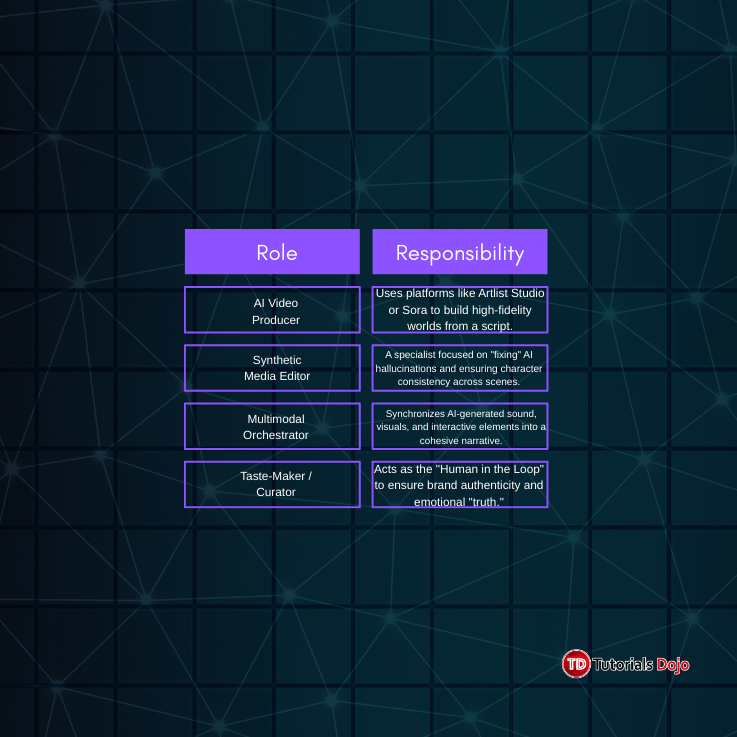
New Roles in the 2026 Studio
🌸 25% OFF All Reviewers on our International Women’s Month Sale! Save 10% OFF All Subscriptions Plans & 5% OFF Store Credits/Gift Cards!

Learn AWS with our PlayCloud Hands-On Labs

$2.99 AWS and Azure Exam Study Guide eBooks

New AWS Generative AI Developer Professional Course AIP-C01

Learn GCP By Doing! Try Our GCP PlayCloud

Learn Azure with our Azure PlayCloud

FREE AI and AWS Digital Courses

FREE AWS, Azure, GCP Practice Test Samplers


Subscribe to our YouTube Channel

Follow Us On Linkedin


Written by: Daniel Gerodias