
The AWS Certified AI Business Strategist (AIB-C01) certification is designed for business professionals who evaluate, champion, and scale AI initiatives within their organizations or for their clients. It validates the ability to apply foundational AI concepts, translate AI capabilities into business outcomes, develop AI strategies, establish responsible AI practices, and drive AI adoption and transformation at scale.
The exam assesses whether candidates can evaluate AI opportunities and solution types based on business requirements, develop and prioritize AI strategies, measure business value using KPIs and ROI, and identify opportunities for competitive advantage and business model transformation. Candidates should also be prepared to apply responsible AI principles, establish governance and compliance practices, identify and mitigate enterprise AI risks, assess organizational readiness and AI maturity, evaluate data and infrastructure foundations, lead organizational change, and scale AI initiatives from pilots to enterprise-wide deployments.
Candidates seeking more information about the AIB-C01 certification should review the official exam guide. The document describes the target candidate profile, exam format, weighted content domains, recommended AWS knowledge, detailed objectives, scoring method, and the AWS services and concepts that may appear on the exam. The exam focuses on strategic decision-making rather than technical implementation, and no coding or hands-on AWS implementation experience is required.
AIB-C01 Exam Domains
The exam domains for the AWS Certified AI Business Strategist (AIB-C01) certification represent the foundational business and strategic skills required to evaluate, champion, and scale AI initiatives. Candidates should be able to apply AI concepts in business contexts, identify appropriate AI solutions, develop AI strategies and business cases, measure business value, establish responsible AI governance, assess organizational readiness, lead AI-related change, and support the scaling of AI initiatives across the enterprise.
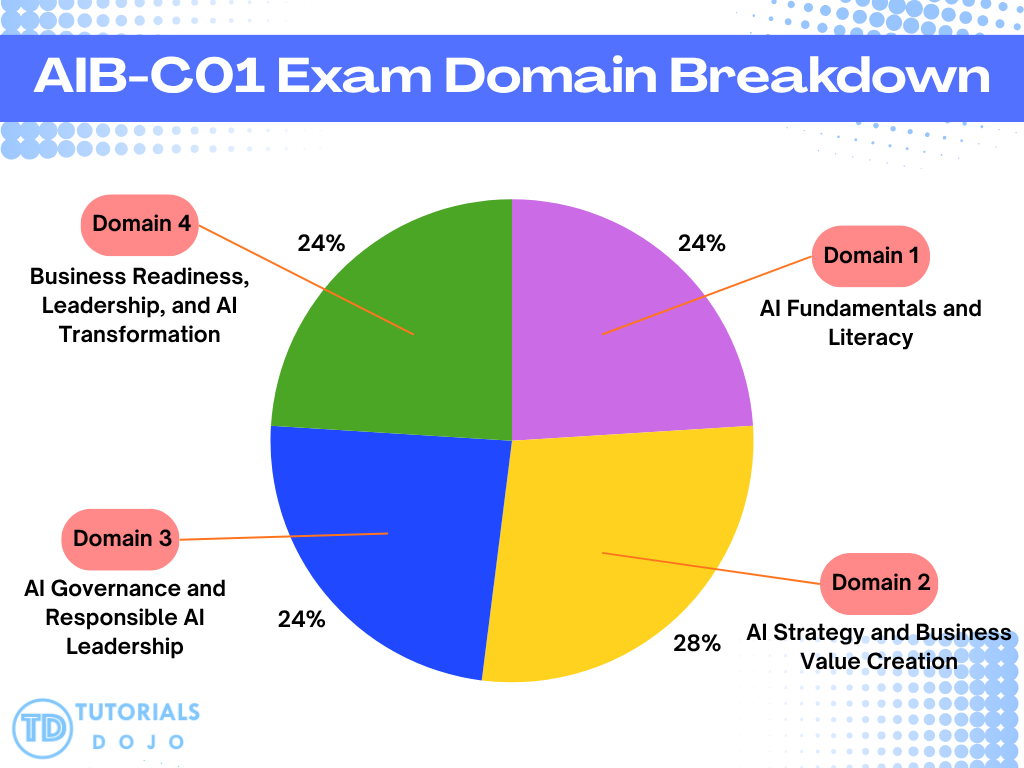
- AI Fundamentals and Literacy – 24%
- AI Strategy and Business Value Creation – 28%
- AI Governance and Responsible AI Leadership – 24%
- Business Readiness, Leadership, and AI Transformation – 24%
AIB-C01 Study Materials
Before taking the AWS Certified AI Business Strategist (AIB-C01) certification exam, candidates should review the resources listed below. These materials can help strengthen the strategic and business skills required to evaluate, develop, govern, and scale AI initiatives, including applying foundational AI concepts, identifying appropriate AI solution types, developing AI strategies and business cases, measuring business value, applying responsible AI principles, establishing governance, assessing organizational readiness, and leading AI transformation.
- Tutorials Dojo’s AWS Certified AI Business Strategist Practice Exams – content coming soon!
- AWS Certified AI Business Strategist Certification Page
- AWS Certified AI Business Strategist Study Guide
- AWS Certified AI Business Strategist SkillBuilder Exam Prep
- Official Practice Question Set: AWS Certified AI Business Strategist (AIB-C01 – English)
AWS Services and Features to Focus on for the AIB-C01 Exam
The AWS Certified AI Business Strategist (AIB-C01) is the first AWS certification focused specifically on AI business strategy where candidates are not expected to have hands-on experience implementing AWS services. The exam prioritizes strategic decision-making, business outcomes, governance, and AI adoption rather than technical implementation. However, candidates should still have a high-level familiarity with selected AWS AI and ML services, frameworks, pricing models, and business tools listed below.
Amazon Bedrock
- Understand Amazon Bedrock as a managed platform for building and using generative AI applications.
- Focus on its business-level capabilities, including foundation models, pricing options, Guardrails, and Knowledge Bases.
- Be prepared to identify when Amazon Bedrock is appropriate for business use cases without needing to configure or implement it.
Amazon SageMaker AI
- Understand Amazon SageMaker AI as a service for building and managing custom machine learning solutions.
- Know the business-level differences between using managed AI capabilities and developing custom ML solutions.
- Focus on when an organization may require custom ML capabilities rather than a fully managed generative AI service.
Amazon Q

- Understand Amazon Q as an AI-powered business assistant and the types of organizational use cases it supports.
- Focus on recognizing appropriate business applications rather than configuring or deploying the service.
AWS Cloud Adoption Framework (AWS CAF)
- Understand how AWS CAF can help organizations plan and scale AI initiatives across different organizational areas.
- Focus on organizational readiness, people, processes, governance, and technology considerations when adopting AI.
AWS Shared Responsibility Model
- Review how responsibilities are divided between AWS and the customer when using AWS services for AI workloads.
- Focus on the business and governance implications of data security, compliance, and responsible use of AI.
AWS Well-Architected Framework and Responsible AI Lens
- Understand how the AWS Well-Architected Framework can support responsible and scalable AI adoption.
- Review the Responsible AI Lens and its role in evaluating governance and responsible AI considerations.
AWS Pricing and Cost Optimization
- Become familiar with common AWS pricing structures, including consumption-based, instance-based, and seat-based pricing.
- Understand how pricing models can affect AI business cases, ROI calculations, and cost planning.
- Review cost optimization concepts such as Savings Plans.
AWS Pricing Calculator and AWS Cost Explorer
- Understand how AWS Pricing Calculator can be used for estimating and planning AWS costs.
- Know how AWS Cost Explorer can support cost analysis and monitoring.
- Focus on how these tools contribute to AI business case development and ROI analysis rather than their technical configuration.
AWS Marketplace
- Understand how AWS Marketplace can support build-versus-buy-versus-partner decisions.
- Focus on evaluating available solutions and considering business factors such as cost, capabilities, and organizational requirements.
Other general AWS AI and ML Services
- Be familiar with the business applications of AWS AI and ML services at a high level.
- Candidates should recognize common AI solution categories such as generative AI, recommendation engines, natural language processing, computer vision, document extraction, and AI-powered customer operations.
- The exam does not require candidates to configure, deploy, administer, or implement these services.
AIB-C01 Key Exam Topics by Domain
Domain 1: AI Fundamentals and Literacy
- AI foundations and terminology: Understand the differences between AI, machine learning, and generative AI, along with concepts such as models, training, inference, predictions, and data quality.
- AI solution selection: Determine when AI is appropriate compared with rule-based automation, and recognize different AI solution types and their business applications.
- AI agents: Understand what makes AI agents different from other AI solutions, including autonomy, tool use, orchestration, and agent-to-agent interaction.
- Generative AI fundamentals: Understand basic prompt engineering, token and context limitations, and how techniques such as RAG and fine-tuning can address specific business needs.
- AI monitoring and adoption: Recognize the need for ongoing monitoring, updates, and controls to manage changes in AI performance and unauthorized AI usage.
Domain 2: AI Strategy and Business Value Creation
- AI strategy development: Align AI initiatives with organizational objectives, business priorities, customer needs, and available resources.
- AI use case evaluation: Identify high-value opportunities across business functions and assess them based on expected outcomes, feasibility, risk, and strategic alignment.
- Build, buy, or partner decisions: Evaluate whether an organization should develop an AI capability internally, purchase an existing solution, or work with an external provider.
- Business value and ROI: Define KPIs, establish baselines, and evaluate costs and benefits to demonstrate the business impact of AI initiatives.
- Competitive advantage and transformation: Identify how AI can improve products, services, customer experiences, operations, decision-making, and business models.
Domain 3: AI Governance and Responsible AI Leadership
- Responsible AI principles: Apply concepts such as fairness, transparency, explainability, privacy, security, and robustness when evaluating AI initiatives.
- Governance and accountability: Establish appropriate governance structures, cross-functional responsibilities, and oversight throughout the AI lifecycle.
- Regulatory and compliance considerations: Recognize legal and regulatory requirements, including data protection, access control, and other compliance risks associated with AI.
- AI risk management: Identify risks such as bias, hallucinations, harmful content, intellectual property concerns, data quality issues, and model drift.
- Human oversight and safeguards: Determine when human review, escalation processes, monitoring, and guardrails are necessary for responsible AI use.
Domain 4: Business Readiness, Leadership, and AI Transformation
- AI readiness and maturity: Assess an organization’s preparedness across leadership, people, processes, technology, data, culture, and governance.
- Data and infrastructure foundations: Evaluate data quality, accessibility, ownership, data silos, and the foundational technology needed to support AI initiatives.
- Change management and workforce readiness: Build leadership support, address employee concerns, develop AI literacy, and establish cross-functional teams for AI adoption.
- Scaling AI initiatives: Understand how organizations can move from experimentation and pilots toward broader enterprise adoption using iterative approaches and measurable outcomes.
- Enterprise AI transformation: Establish mechanisms such as AI centers of excellence, continuous feedback, and success metrics to sustain and scale AI initiatives.
AIB-C01 Important Skills to Focus on
AI Fundamentals and Solution Evaluation
- Understand core AI, machine learning, and generative AI concepts and how they apply to business scenarios.
- Evaluate AI solution types based on business requirements, data, constraints, expected outcomes, and the level of customization required.
- Recognize generative AI concepts such as prompt engineering, RAG, model adaptation, agents, tokens, and context limitations.
AI Strategy and Business Value
- Translate organizational goals and customer needs into practical AI opportunities and prioritize them based on value, feasibility, alignment, cost, and risk.
- Develop AI business cases using KPIs, baseline measurements, expected benefits, costs, and ROI.
- Evaluate build, buy, and partner approaches and identify opportunities for AI to improve products, services, operations, customer experiences, and business models.
Responsible AI and Governance
- Apply responsible AI principles involving fairness, transparency, explainability, privacy, security, safety, and accountability.
- Establish appropriate governance structures, policies, responsibilities, and oversight for AI initiatives.
- Identify and manage risks involving data, privacy, security, bias, intellectual property, regulatory requirements, and AI model behavior.
AI Readiness and Transformation
- Assess organizational readiness across people, processes, technology, data, culture, and governance before expanding AI initiatives.
- Identify gaps in data foundations, infrastructure, skills, and organizational capabilities that may affect AI adoption.
- Move AI initiatives from experimentation and pilots toward broader adoption through measurable outcomes, continuous improvement, and appropriate organizational frameworks.
AI Leadership and Change Management
- Build stakeholder support for AI initiatives and communicate their expected value, risks, and impact across different parts of the organization.
- Address workforce concerns, develop AI literacy, and establish the skills and teams needed to support AI adoption.
- Lead organizational change by encouraging collaboration, managing resistance, and aligning AI initiatives with broader business transformation.

Validate Your AIB-C01 Exam Readiness
After reviewing the recommended materials, candidates can test their knowledge with Tutorials Dojo’s AWS Certified AI Business Strategist AIB-C01 Practice Exams. The practice exams include a 10-question diagnostic set to help candidates quickly assess their current knowledge and identify areas that need more review. The succeeding practice exam sets are designed to closely simulate the actual AIB-C01 exam, with 85 questions consisting of multiple-choice and multiple-response questions and an exam duration of 170 minutes.
These practice tests cover major exam topics such as AI fundamentals, AI solution evaluation, AI strategy, business value and ROI, responsible AI, governance, organizational readiness, change management, and AI transformation. Each question includes detailed explanations and reference links to help candidates understand the reasoning behind the correct answer.
Using the official exam guide together with Tutorials Dojo’s practice exams can help candidates identify knowledge gaps, strengthen weaker areas, become familiar with the exam format and pacing, and build the strategic decision-making skills needed to prepare for the AIB-C01 exam.
AIB-C01 Sample Practice Test Questions:
Question 1
A multinational consulting firm finds that employees are accessing public AI tools that have not undergone security, privacy, or compliance review. The governance team already maintains an internal registry that records the approval status of each tool, but monitoring reports show that employees continue using unapproved services, increasing the risk of shadow AI.
The company wants to prevent employees from accessing unapproved AI services while establishing a controlled process for evaluating additional tools that employees may need for legitimate business purposes.
Which actions should the company take to meet these requirements? (Select TWO.)
- Block all unapproved AI tools at the network level so employees can access only services that have completed the organization’s review process.
- Allow employees to use unapproved AI tools temporarily as long as no confidential information is submitted.
- Require employees to submit a formal request before any new AI tool can be evaluated and approved for business use.
- Monitor usage of unapproved AI tools and send periodic reminders encouraging employees to select approved alternatives.
- Permit department managers to independently approve new AI tools without completing the organization-wide security and compliance review.
Correct Answer: 1,3
Shadow AI occurs when employees use AI applications or services outside an organization’s approved governance processes. AWS guidance explains that unmanaged generative AI usage can introduce uncontrolled data and security risks. Organizations should provide sanctioned AI tools and maintain visibility into AI usage so employees have approved alternatives while security teams can identify unauthorized activity.
Effective AI governance also requires more than maintaining a list of approved tools. AWS Prescriptive Guidance recommends centralized registries, defined approval processes, and access management policies. It specifically highlights responsive approval processes as an important way to reduce shadow AI while still allowing employees to obtain legitimate AI capabilities when needed. AWS also recommends enforcing restrictions on identified shadow tools after approved alternatives are available, rather than relying entirely on passive monitoring.
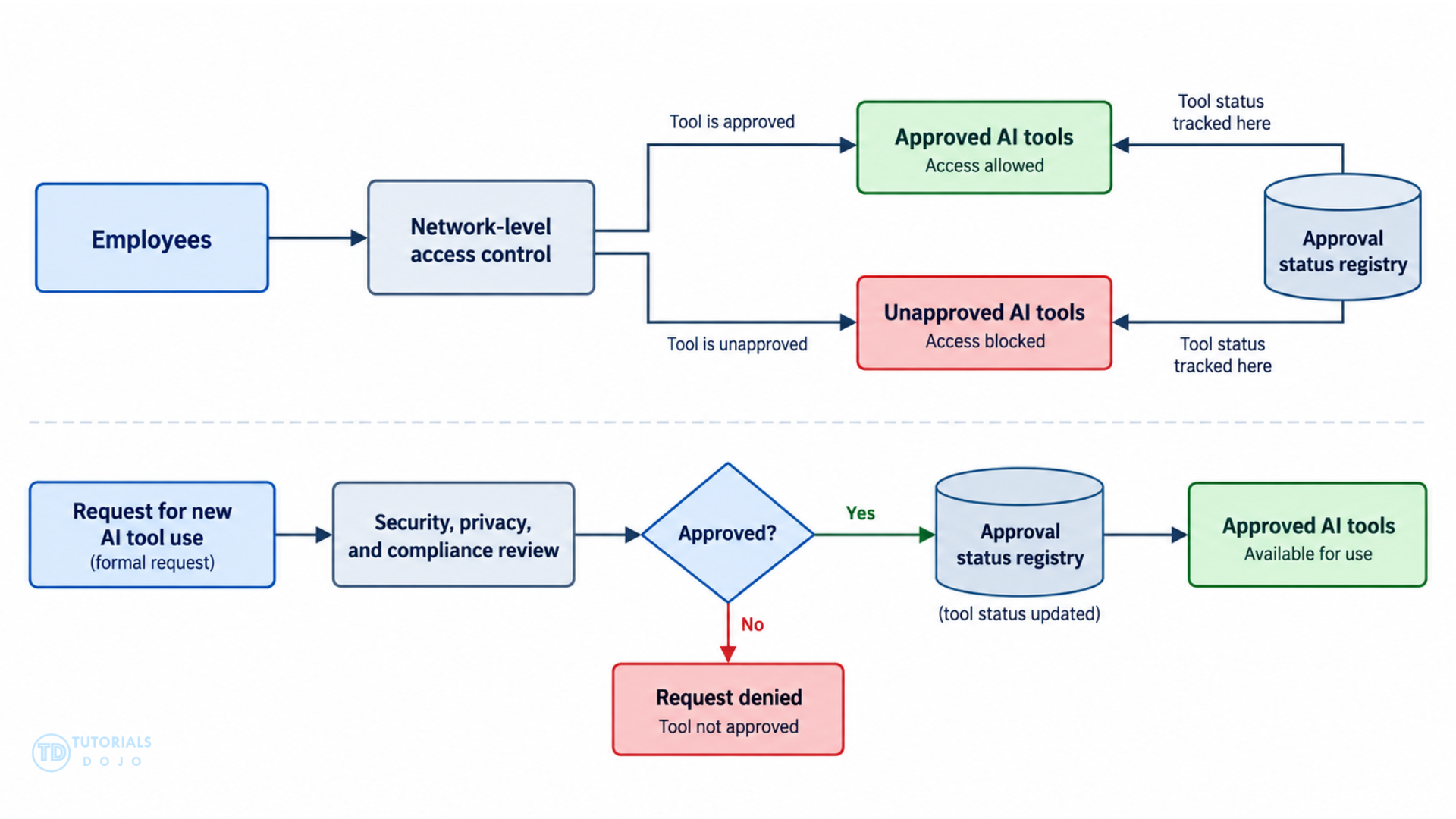
In this scenario, the company already maintains a registry containing the approval status of its AI tools, but employees continue accessing unapproved services. Therefore, the registry alone is insufficient. Blocking unapproved AI tools at the network level provides the preventive control required to stop unauthorized access. At the same time, requiring a formal request for new AI tools establishes a controlled path for security, privacy, and compliance evaluation before additional tools are approved. This approach reduces shadow AI without preventing legitimate business requirements from being considered.
Hence, the correct answers are:
– Block all unapproved AI tools at the network level so employees can access only services that have completed the organization’s review process.
– Require employees to submit a formal request before any new AI tool can be evaluated and approved for business use.
The option that says: Allow employees to use unapproved AI tools temporarily as long as no confidential information is submitted is incorrect because this simply relies on employee behavior rather than enforcing the organization’s approval process. The tool could still introduce security, privacy, or compliance risks even when employees believe that sensitive information is not being shared.
The option that says: Monitor usage of unapproved AI tools and send periodic reminders encouraging employees to select approved alternatives is incorrect because monitoring only provides visibility into unauthorized usage. It does not satisfy the requirement to prevent employees from accessing unapproved AI services.
The option that says: Permit department managers to independently approve new AI tools without completing the organization-wide security and compliance review/strong> is incorrect because department managers would typically not replace the organization-wide security, privacy, and compliance evaluation process. Allowing separate departments to approve tools independently could create inconsistent governance standards and increase shadow AI risk.
References:
Check out this AWS Data and AI Journey: Data Governance and Security Cheat Sheet:
https://tutorialsdojo.com/aws-data-and-ai-journey-data-governance-and-security/
Question 2
A retail company uses an AI assistant to support damaged order requests. The current solution can answer policy questions and summarize order information. The company now wants the system to review each request and choose the appropriate next step. Depending on the case, it may need to check order status, process a replacement, issue a refund, or escalate the request based on the result of a previous action.
Which solution BEST meets these requirements?
- A conversational AI chatbot grounded in order information and customer service documentation.
- A rules-based workflow configured for damaged-order processing across customer service systems.
- A retrieval-augmented generative AI assistant connected to order records and customer service policies.
- An AI agent integrated with order management, replacement, refund, and escalation tools.
Correct Answer: 4
Agentic AI systems are designed to handle goals that may require several decisions and actions rather than producing a single response. An orchestration layer can interpret a request, determine which tool is appropriate, pass the tool result back into the process, maintain context, and continue until the task reaches an appropriate outcome. AWS documentation describes this orchestration as a loop involving model interaction, tool selection, result processing, context management, and failure handling. Tools can also connect these systems to APIs, business applications, and other resources so that generated decisions can lead to actions in external systems.
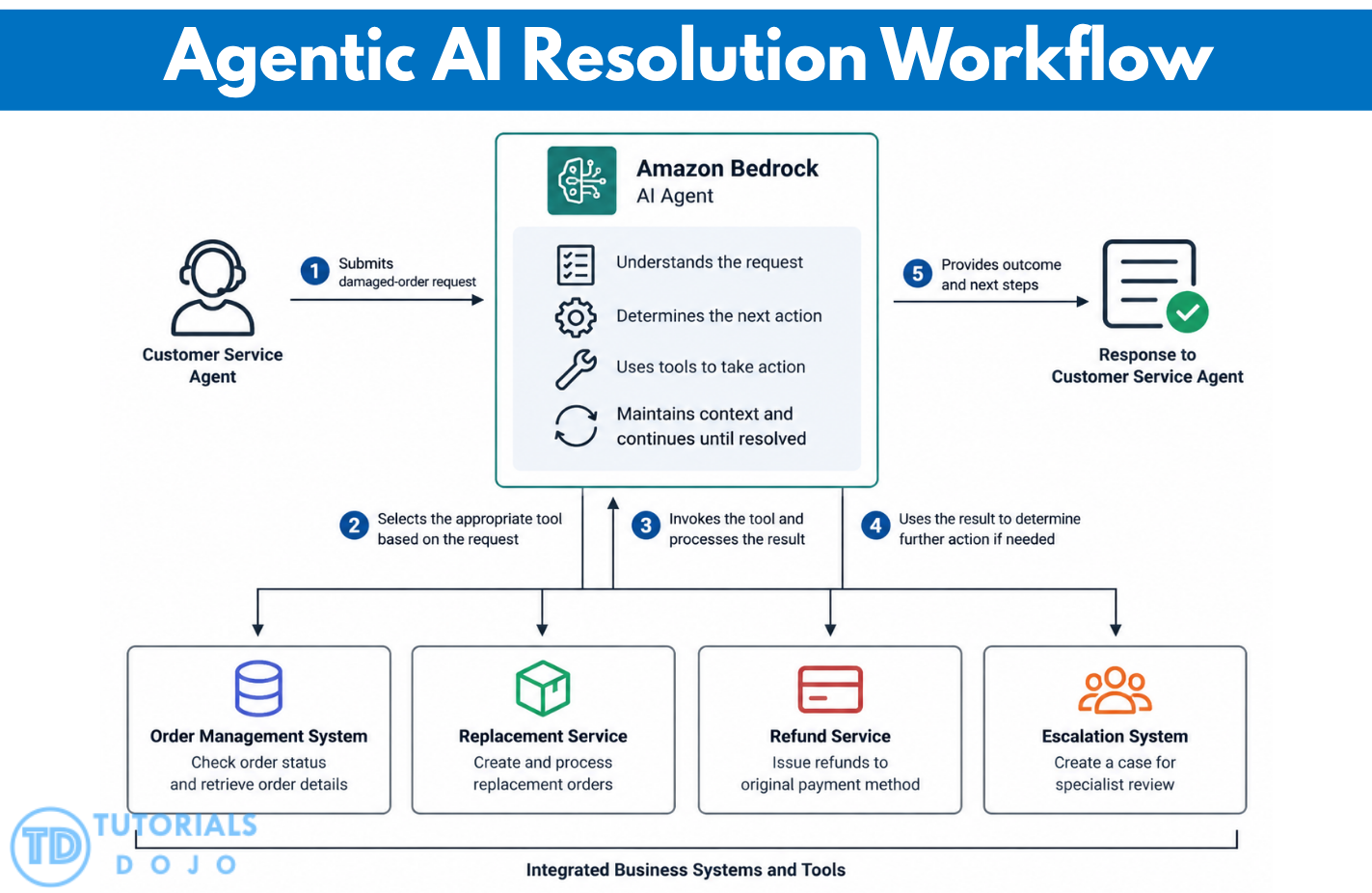
This approach is useful when the appropriate next action depends on information discovered during earlier steps. Instead of requiring every possible sequence to be defined in advance, the system can evaluate the current context and select from available capabilities as the task develops. AWS also supports communication between agents and tools through protocols such as Model Context Protocol (MCP) and Agent-to-Agent (A2A), which can extend this approach to specialized components working together. For business processes involving different outcomes, such capabilities allow the system to retrieve information, perform an appropriate operation, evaluate the result, and continue toward the intended business objective.
Hence, the correct answer is: An AI agent integrated with order management, replacement, refund, and escalation tools.
The option that says: A conversational AI chatbot grounded in order information and customer service documentation is incorrect because it is primarily suited to providing contextual responses based on available information. Amazon Bedrock Knowledge Bases can retrieve relevant information from enterprise data and use that context to improve generated responses, but grounding a chatbot does not by itself provide the action groups or tool invocation needed to carry out operational tasks. The scenario requires the system to move beyond answering questions and perform actions such as processing a replacement, issuing a refund, or escalating a case based on earlier results.
The option that says: A rules-based workflow configured for damaged-order processing across customer service systems is incorrect because a rules-based workflow typically follows transitions and decision branches that are defined in advance. AWS Step Functions, for example, represents business processes as state machines in which states, Choice rules, and transitions determine how execution proceeds. Although this works well for predictable processes, the scenario requires the system to interpret each request and determine which available action should occur as the situation develops rather than depend on a fully predefined decision path.
The option that says: A retrieval-augmented generative AI assistant connected to order records and customer service policies is incorrect because RAG simply focuses on retrieving relevant information from connected data sources and adding that information to the model’s context to improve response relevance and accuracy. Amazon Bedrock Knowledge Bases supports retrieval and retrieval-and-generation operations, but these capabilities alone do not provide the operational action execution required to modify orders, initiate refunds, or create escalation cases. Those types of actions require callable tools or APIs that can perform work in external systems.
References:
https://docs.aws.amazon.com/bedrock-agentcore/latest/devguide/harness.html/
https://docs.aws.amazon.com/bedrock-agentcore/latest/devguide/harness-tools.html/
https://docs.aws.amazon.com/bedrock-agentcore/latest/devguide/agents-tools-runtime.html/
Check out this Amazon Bedrock AgentCore Cheat Sheet:
Check out our other practice exam offerings for AWS, Azure, and Google Cloud, featuring detailed explanations, by visiting the Tutorials Dojo Portal:


Final Remarks
Preparing for the AIB-C01 exam is about understanding how AI can be evaluated, adopted, and used to create meaningful business outcomes. Take time to understand the reasoning behind each concept, practice applying it to different business scenarios, and use practice exams to identify areas that need further review. With consistent preparation and a clear understanding of the role of an AI Business Strategist, you can approach the exam with greater confidence. Good luck with your preparation!
🔔 20% OFF All Reviewers + 10% OFF PlayCloud’s First Billing Use Code: TDPLAYCLOUD-101326

Turn Your Team Into Cloud-Ready Professionals Today

Learn AWS with our PlayCloud Hands-On Labs

$2.99 AWS and Azure Exam Study Guide eBooks

Learn GCP By Doing! Try Our GCP PlayCloud
Learn Azure with our Azure PlayCloud
FREE AI and AWS Digital Courses

FREE AWS, Azure, GCP Practice Test Samplers


Subscribe to our YouTube Channel

Follow Us On Linkedin


Written by: Lois Angelo Dar Juan