
Amazon Managed Blockchain (AMB) Cheat Sheet
- A fully managed service designed to help you build resilient Web3 applications on both public and private blockchains
- Reduces the overhead required to create and manage blockchain networks and access blockchain data
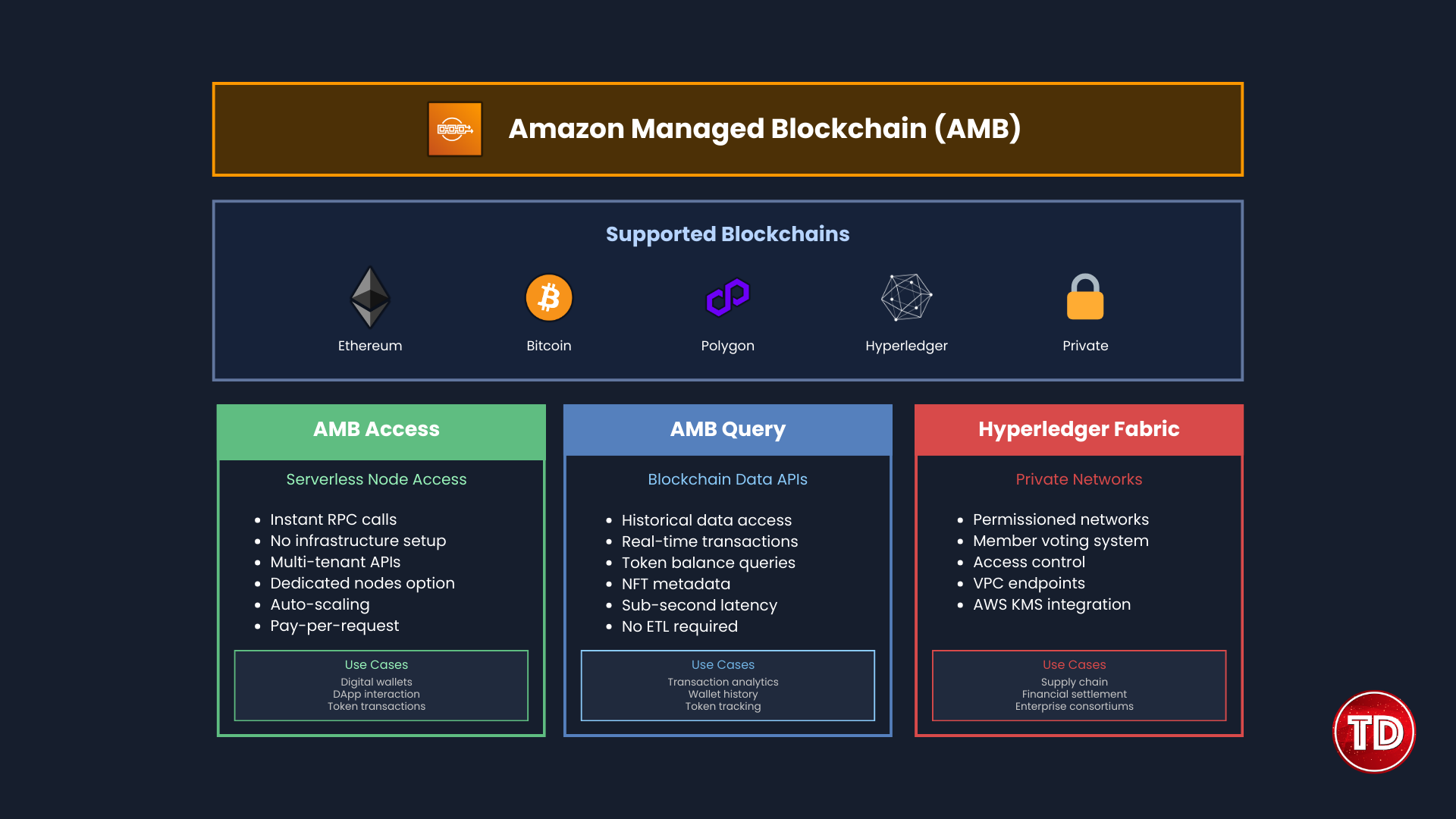
- Currently supports Ethereum, Polygon, Bitcoin, and Hyperledger Fabric blockchains
- Enables multiple parties to securely transact and share data on a distributed and immutable ledger without a trusted central authority
Key Terms and Concepts
Blockchain Basics
- Blockchain – A distributed, immutable digital ledger that logs transactions across a peer-to-peer network without requiring a trusted central authority
- Node – A computer that maintains a copy of the blockchain and helps validate and relay transactions
- Peer Node – In AMB, a compute resource that processes transactions, maintains a copy of the ledger, and runs chaincode/smart contracts
- Consensus Mechanism – The method by which all participants agree on the current state of the ledger (e.g., proof-of-work, proof-of-stake)
Transaction and Smart Contract Terms
- Transaction – A record of data exchange or value transfer between parties on the blockchain
- Smart Contract – Self-executing code stored on the blockchain that automatically enforces agreement terms when conditions are met
Network and Identity Terms
- Public Blockchain – An open network anyone can join, read, and write to (e.g., Bitcoin, Ethereum, Polygon)
- Private/Permissioned Blockchain – A restricted network where participants must be invited and authenticated (e.g., Hyperledger Fabric)
- Member – An organization or entity that participates in a Hyperledger Fabric network on AMB
- Membership – Your identity and authentication within an AMB Hyperledger Fabric network
- Channel – A private communication pathway between specific members in a Hyperledger Fabric network
Wallet and Token Terms
- Wallet – Software that stores private keys and enables users to send/receive cryptocurrency and interact with blockchains
- Token – A digital asset created on a blockchain; can represent currency, ownership, or access rights (fungible tokens are interchangeable; non-fungible tokens are unique)
- Non-Fungible Token (NFT) – Unique tokens representing ownership of distinct items (e.g., digital art, collectibles)
API and Technical Terms

- JSON-RPC – A remote procedure call protocol using JSON format; the standard way to interact with blockchain nodes
- API – A set of protocols that allows different software applications to communicate
- Mainnet – The primary, production blockchain network where real transactions with actual value occur
- Testnet – A separate blockchain network for testing purposes where tokens have no real value
Amazon Managed Blockchain Key Components
AMB Access
- Provides instant and serverless access to multiple blockchains
- Two types of blockchain infrastructure services:
- Multi-tenant (Serverless) – Shared blockchain node infrastructure behind an API layer (Bitcoin, Polygon)
- Dedicated (Single-tenant) – Create your own public Ethereum blockchain nodes or private Hyperledger Fabric networks for exclusive use
- Build Web3-ready applications without deploying or managing specialized blockchain infrastructure
AMB Query
- Serverless access to standardized, multi-blockchain datasets with developer-friendly APIs
- Access real-time and historical data from multiple blockchains
- No specialized blockchain infrastructure or ETL (extract, transform, and load) needed
- Supports use cases like:
- Populating wallet transaction history
- Retrieving token balances (fungible and non-fungible tokens)
- Reviewing historical blockchain data
- Getting contextual information about transactions
Amazon Managed Blockchain Supported Blockchains
Public Blockchains
Ethereum
- Deploy dedicated Ethereum full nodes using go-ethereum (Geth) execution client and Lighthouse consensus client
- Supports Mainnet and select testnets (e.g., Sepolia)
- Use JSON-RPC APIs for Execution and Consensus layers
- Build and test smart contracts, perform NFT transactions, and query blockchain data
Bitcoin
- Serverless JSON-RPC API access to Bitcoin Mainnet and Testnet
- Fleet of Bitcoin Core full nodes (non-mining) managed by AWS
- Supports common JSON-RPC operations for reading data and submitting transactions
- Wallet functionality disabled – you manage your own Bitcoin addresses
Polygon
- Serverless access to the Polygon blockchain (EVM-based scaling solution)
- Supports Polygon Mainnet and Mumbai Testnet
- High transaction throughput with low transaction fees
- Proof-of-stake consensus mechanism
- Commonly used for NFTs, Web3 games, and tokenization
Private Blockchains
Hyperledger Fabric
- Deploy private, permissioned blockchain networks in minutes
- Create multi-party networks across multiple AWS accounts
- Members can vote on network governance (adding/removing members)
Amazon Managed Blockchain Key Features
Network Creation and Management
- Launch blockchain networks in minutes using AWS Management Console
- Configure network membership and peer nodes easily
- Invite other AWS accounts to join your blockchain network
- Create additional members in your account for testing (simulated multi-party network)
Voting API (Hyperledger Fabric)
- Members can vote on proposals for adding or removing network members
- Democratic governance without custom development
Scalability
- Add peer nodes to process transactions more quickly
- APIs available to create new nodes based on application demand
- Peer node instance families: bc.t3, bc.m5, and bc.c5 with varying CPU and memory combinations
Managed Infrastructure
- Secure networking and reliable syncs to blockchain networks
- Durable elastic storage for ledger data
- Encryption at rest and in transit
- Secure access to open-source APIs
Hyperledger Fabric Network Editions
|
Attribute |
Starter Edition |
Standard Edition |
|
Maximum members per network |
5 |
14 |
|
Maximum peer nodes per member |
2 |
3 |
|
Available peer node types |
bc.t3.small, bc.t3.medium |
bc.t3, bc.m5, bc.c5 families |
|
Maximum channels per network |
8 |
8 |
|
Ordering service |
Lower throughput and availability |
Higher throughput and availability |
Amazon Managed Blockchain Security
Encryption
- All data encrypted at rest and in transit
- TLS 1.2 required (TLS 1.3 recommended)
- AWS KMS technology secures Hyperledger Fabric’s certificate authority
Access Control
- IAM permissions policies – Control who can access AMB resources and actions
- VPC endpoint services (AWS PrivateLink) – Private connectivity to AMB resources
- EC2 Security Groups – Virtual firewalls for inbound/outbound traffic control
- Signature Version 4 (SigV4) – Authentication for Ethereum and Bitcoin JSON-RPC calls
Network Isolation
- Interface VPC Endpoints for private access to Hyperledger Fabric components
- Members can interact with each other’s peer nodes through VPC endpoints
Additional Best Practices
- Use multi-factor authentication (MFA) for each account
- Set up API and user activity logging with AWS CloudTrail
- Use AWS encryption solutions and default security controls
Amazon Managed Blockchain Pricing
AMB Access Ethereum (Dedicated)
- Peer nodes – Per-second billing (1-minute minimum)
- Peer node storage – GB-month increments
- Requests – Per API call (accrued in 32 KB or 500 ms increments)
- Data transfer – Standard AWS data transfer charges

AMB Access Serverless (Bitcoin, Polygon)
- API requests – Pay per request, grouped by API complexity tiers (Extra Small, Small, Medium, Large)
- No hourly charges or minimum number of API requests
- Polygon preview is currently free of charge
AMB Query
- API requests – Pay per request, tiered by compute and data requirements (Small, Medium)
- No subscriptions, minimum quotas, or overage charges
AMB Access Hyperledger Fabric
- Membership – Hourly rate (billed per second) includes CA and shared network costs
- Peer nodes – Per-second billing (1-minute minimum)
- Peer node storage – GB-month increments
- Data written – Per payload size of transactions
- Data transfer – Standard AWS data transfer charges
Amazon Managed Blockchain Use Cases
Digital Asset Wallets
- Build multichain cryptocurrency wallets
- Populate transaction history with AMB Query APIs
- Broadcast transactions with AMB Access nodes
NFT Applications
- Create token-gated experiences
- Verify event ticket NFTs using historical token balance APIs
- Build NFT marketplaces
Cryptocurrency Exchanges
- Facilitate Bitcoin/Ethereum transactions
- Track asset balances
- Perform data analytics across multiple blockchains
Supply Chain Tracking
- Use private Hyperledger Fabric networks for consortium members
- Track provenance information on an immutable ledger
- Multi-party transaction verification
Digital Asset Custody
- Secure Bitcoin management on behalf of users
- Verify deposits and read historical transaction information
- Reduce infrastructure footprint
DeFi Applications
- Wrap Bitcoin for use on other blockchains
- Build lending and borrowing protocols
- Cross-chain asset management
Amazon Managed Blockchain Integrations
- AWS KMS – Key management for certificate authority
- Amazon VPC – Private endpoint connectivity
- AWS CloudTrail – Logging and auditing API calls
- AWS IAM – Authentication and authorization
- Amazon EC2 – Run Hyperledger Fabric client applications
AMB vs Amazon QLDB
Important Notice: Amazon QLDB reached end of support on July 31, 2025 and is no longer available. AWS recommended migrating to Amazon Aurora PostgreSQL as an alternative for audit and ledger use cases. For blockchain and decentralized transaction needs, use Amazon Managed Blockchain.
|
Feature |
Amazon Managed Blockchain |
Amazon QLDB |
|
Purpose |
Decentralized multi-party transactions |
Centralized ledger owned by single entity |
|
Control |
Distributed among network members |
Single owner/authority |
|
Trust model |
No trusted central authority needed |
Trusted central authority (owner) |
|
Network type |
Public and private blockchains |
Not a blockchain |
|
Use case |
Multi-party transaction sharing |
Complete verifiable data change history |
Amazon Managed Blockchain Regional Availability
- AMB Access (Ethereum, Hyperledger Fabric) – US East (N. Virginia), Asia Pacific (Seoul, Singapore, Tokyo), Europe (Ireland, London)
- AMB Query – US East (N. Virginia)
- AMB Access (Bitcoin, Polygon) – US East (N. Virginia)
References
- https://aws.amazon.com/managed-blockchain/
- https://docs.aws.amazon.com/managed-blockchain/
- https://docs.aws.amazon.com/managed-blockchain/latest/hyperledger-fabric-dev/
- https://docs.aws.amazon.com/managed-blockchain/latest/ethereum-dev/
- https://docs.aws.amazon.com/managed-blockchain/latest/ambbtc-dg/
- https://docs.aws.amazon.com/managed-blockchain/latest/ambq-dg/
🌸 25% OFF All Reviewers on our International Women’s Month Sale! Save 10% OFF All Subscriptions Plans & 5% OFF Store Credits/Gift Cards!

Learn AWS with our PlayCloud Hands-On Labs
$2.99 AWS and Azure Exam Study Guide eBooks

New AWS Generative AI Developer Professional Course AIP-C01

Learn GCP By Doing! Try Our GCP PlayCloud
Learn Azure with our Azure PlayCloud
FREE AI and AWS Digital Courses

FREE AWS, Azure, GCP Practice Test Samplers

Subscribe to our YouTube Channel

Follow Us On Linkedin

Written by: Ostline Casao