
Last updated on February 3, 2026
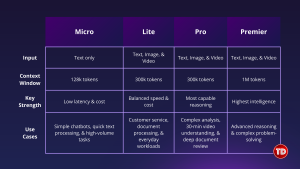
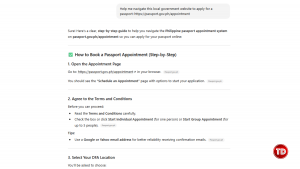
The generative AI (GenAI) revolution has fundamentally changed how organizations extract value from data. Large language models (LLMs) excel at understanding and generating human-like text, but their true enterprise value emerges only when they can access proprietary data and take real-world action. While vector databases and retrieval-augmented generation (RAG) gave LLMs memory, Amazon Nova provides execution and specialization. In this article, we break down the Amazon Nova model family, with a deep focus on Nova Act and Nova Forge, and explain how they enable a shift from passive chatbots to autonomous, enterprise-grade AI agents. Amazon Nova is not a single model, but a tiered family of foundation models designed to balance intelligence, latency, and cost. *Note: Model pricing may differ based on region Instead of choosing between large, expensive models and smaller, underpowered ones, Nova provides a structured hierarchy: While these models form the foundation, the real engineering innovation lies in how AWS enables them to act and specialize through Nova Act and Nova Forge. Most LLMs operate in a text-in, text-out loop. Ask them to “help me navigate this local government website to apply for a passport,” and they can explain the steps, but they cannot execute them. Amazon Nova Act changes this paradigm. Nova Act is an agentic workflow service that allows Nova models to interact directly with web-based systems using a secure, AWS-managed headless browser environment. Unlike brittle automation tools such as Selenium, which often break when a website’s structure changes. Nova Act relies on visual and semantic understanding, not static selectors. The workflow follows four stages: This capability unlocks Actionable AI. These are AI systems that don’t just retrieve information but execute real workflows, including: In effect, Nova Act turns AI into a digital worker, not just a conversational interface. To have a hands-on-experience on how Nova Act works, you can try their playgrounds to get a grasp on how you will set up agents. Foundation models are powerful, but they are generalists. In enterprise environments, generic intelligence is rarely enough. Amazon Nova Forge is a fine-tuning and distillation environment designed to create smaller, faster, and highly specialized models trained on your proprietary data. A general-purpose LLM may understand poetry, trivia, and casual conversation, but enterprise systems often require models that deeply understand: Nova Forge introduces two critical techniques: A high-capability teacher model (Nova Premier) generates high-quality responses, often using synthetic data, which are then used to train a smaller student model (Nova Lite or Nova Micro). Result: During training, proprietary enterprise data is blended with Amazon’s curated general-reasoning datasets. Result: Just as vector databases became the memory layer for modern AI systems, Amazon Nova is positioning itself as the action layer. By combining: AWS enables developers to build AI systems that do more than generate text–they execute, adapt, and scale. You can explore Amazon Nova models and agent capabilities with or without Amazon Bedrock. Here are some of the resources you could explore:
What Is the Amazon Nova Model Family?
Amazon Nova Act: Enabling Autonomous AI Agents

How Nova Act Works
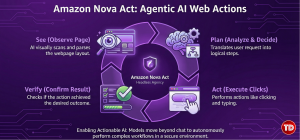
The model captures both the Document Object Model (DOM) and the rendered visual state of the page.
A natural-language instruction (for example, “Find the January invoice”) is translated into a structured sequence of steps.
The agent performs actions such as clicking, scrolling, and typing within a secure browser container.
The system confirms whether the expected state change occurred (for example, verifying that a file download has started).Why Nova Act Matters
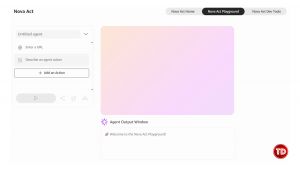
Nova Act Playground
Amazon Nova Forge: Building Custom, Domain-Specific Intelligence
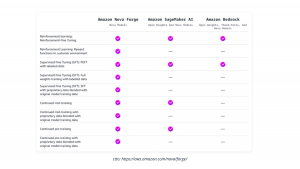
The Limitations of Generic LLMs
The Solution: Distillation and Data Blending
You retain much of the teacher model’s intelligence while achieving significantly lower latency and cost.
This prevents catastrophic forgetting, ensuring the model remains fluent, coherent, and capable of logical reasoning, even after specialization.Choosing the Right Nova Component: A Practical Comparison
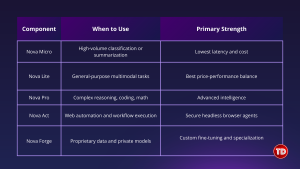
Conclusion
Getting Started with Amazon Nova
🌸 25% OFF All Reviewers on our International Women’s Month Sale! Save 10% OFF All Subscriptions Plans & 5% OFF Store Credits/Gift Cards!

Learn AWS with our PlayCloud Hands-On Labs

$2.99 AWS and Azure Exam Study Guide eBooks

New AWS Generative AI Developer Professional Course AIP-C01

Learn GCP By Doing! Try Our GCP PlayCloud
Learn Azure with our Azure PlayCloud
FREE AI and AWS Digital Courses

FREE AWS, Azure, GCP Practice Test Samplers


Subscribe to our YouTube Channel

Follow Us On Linkedin


Written by: Dearah Mae Barsolasco