
Amazon Timestream Cheat Sheet
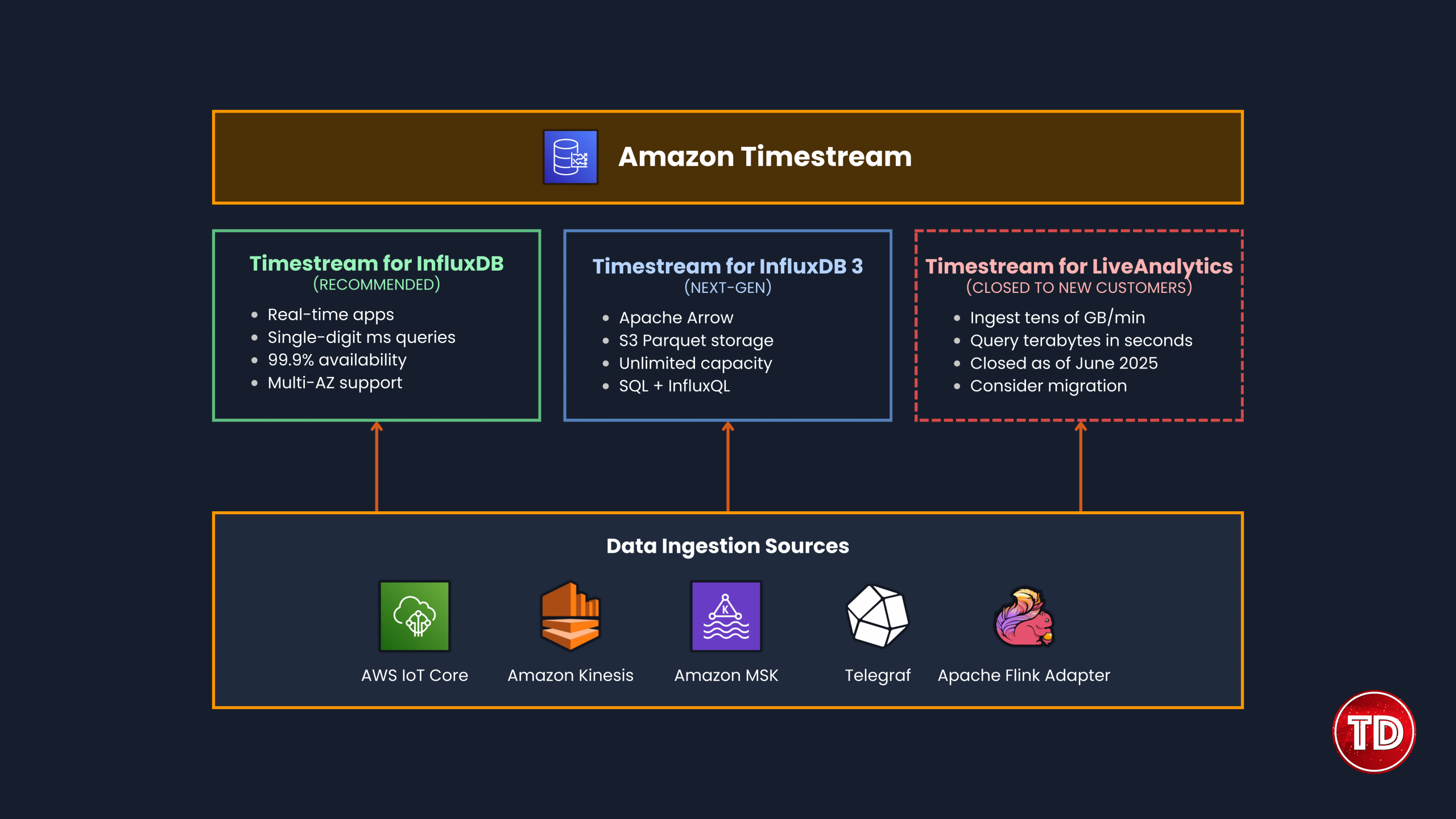
- A fully managed, purpose-built time series database service for storing and analyzing trillions of time series data points per day
- Offers multiple database engines: Timestream for InfluxDB (Recommended) – Managed InfluxDB databases for real-time time series applications with single-digit millisecond query response times and up to 99.9% availability
- Timestream for InfluxDB 3 – Next-generation managed InfluxDB 3 databases leveraging Apache Arrow, Apache Data Fusion, and columnar Parquet storage on Amazon S3
- Timestream for LiveAnalytics – Serverless, for large-scale data ingestion and SQL queries (No longer accepting new customers as of June 20, 2025 – existing customers can continue using the service)
Amazon Timestream for InfluxDB
- AWS’s recommended time series database for new customers
- Managed InfluxDB 2.x databases on AWS
- Compatible with open-source InfluxDB APIs, tools, and Telegraf plugins
- DB Instance: Basic building block
- Supports multiple organizations and buckets
- Up to 40 instances per account
- Instance Classes: db.influx.medium to db.influx.24xlarge
- vCPU range: 1 to 96
- Memory range: 8 GiB to 768 GiB
- Storage: Influx IOPS Included with three tiers (3K, 12K, 16K IOPS)
- Deployments: Single-AZ
- Multi-AZ (primary + standby in different AZ)
- Read Replica Cluster (licensed add-on via AWS Marketplace)
- Authentication: Master user account, InfluxDB API tokens, AWS Secrets Manager integration

Amazon Timestream for InfluxDB 3
- Next-generation InfluxDB engine with a completely new architecture
- Built on Apache Arrow (in-memory processing), Apache Data Fusion (query execution), and Parquet columnar storage on Amazon S3
- Deployment Options: Core – Single-node, no compaction, best for near real-time workloads on recent data
- Enterprise – Multi-node clusters, compaction support, horizontal scaling, suitable for long-term analytics
- Storage: S3-based object storage, shared across all nodes, virtually unlimited capacity
- Query APIs: SQL, InfluxQL, HTTP, Flight+gRPC, v1 compatibility API
- Features: Last Value Cache (LVC) for sub-10ms response times
Amazon Timestream for LiveAnalytics
- Effective June 20, 2025: Amazon Timestream for LiveAnalytics is closed to new customers
- Existing customers: Can continue using the service typically; AWS continues investing in security, availability, and performance improvements.
- Recommendation: AWS recommends evaluating Amazon Timestream for InfluxDB as an alternative for new workloads
- Migration: AWS provides migration guides for transitioning from LiveAnalytics to InfluxDB
- Serverless, fully managed time series database that automatically scales up or down to adjust capacity and performance
- Ingest tens of gigabytes of time-series data per minute and run SQL queries on terabytes of data in seconds.
Amazon Timestream Integrations
- Data Ingestion: AWS IoT Core (rule actions)
- Amazon Kinesis
- Amazon MSK (Managed Streaming for Apache Kafka)
- Open-source Telegraf
- Apache Flink adapter
- Visualization:
- Amazon QuickSight
- Grafana (Timestream plugin)
- Business intelligence tools via JDBC driver
- Machine Learning:
- Backup:
- AWS Backup integration for LiveAnalytics (immutable backups, cross-account/Region copies)
Amazon Timestream Security
- Encryption: All data is encrypted at rest and in transit by default
- Uses AWS KMS for key management
- Memory store: Timestream service key
- Magnetic store: Customer-managed KMS key (CMK) option
- AES-256 encryption algorithm
- Access Control: AWS IAM integration for authentication and authorization
- Identity-based policies for fine-grained access control
- Resource-based tags for access control
- Network: VPC endpoints support
- TLS 1.2 or later recommended
- Perfect forward secrecy (PFS) cipher suites are required
- Compliance: Data replicated across 3 AZs for durability
Amazon Timestream Pricing
InfluxDB 2.x (Recommended)
- Compute – Per DB instance-hour (billed per second, 10-minute minimum)
- Storage – Per GB-month based on storage type and allocated volume
InfluxDB 3
- Compute – Per node instance-hour
- Storage – Per GB-month (S3-based object storage)
LiveAnalytics (Existing Customers Only)
- Writes – Per million writes of 1 KiB
- Memory Store – Per GB-hour
- Magnetic Store – Per GB-month (minimum 100 GB per account per Region)
- Queries – Per TCU-hour
Amazon Timestream Use Cases
- DevOps monitoring (infrastructure performance metrics)
- IoT sensor data storage and analysis
- Industrial telemetry for equipment management and maintenance
- Real-time application monitoring and alerting
- User behavior analytics and clickstream data
- Fraud detection in payment processing
- Fleet management and logistics optimization
Amazon Timestream Best Practices
- Data Modeling: Use multi-measure records for cost efficiency
- Choose appropriate dimensions for time series identification.
- Set retention policies based on query patterns and cost requirements.
- Writes: Batch writes (5000 lines per request for InfluxDB, 100 records for LiveAnalytics)
- Sort tags by key lexicographically
- Use the coarsest time precision possible.
- Enable gzip compression
- Queries: Use scheduled queries for frequently accessed aggregates
- Include time ranges, measure names, and dimension names in predicates for efficient pruning.
- Monitor QueryTCU metric to optimize costs.
- Storage: Set memory store retention based on late-arriving data requirements
- Consider magnetic store for long-term analytical queries.
- Enable magnetic store writes for late-arriving data.
Amazon Timestream References:
- https://docs.aws.amazon.com/timestream/latest/developerguide/
- https://docs.aws.amazon.com/timestream/latest/developerguide/AmazonTimestreamForLiveAnalytics-availability-change.html
- https://aws.amazon.com/timestream/
- https://aws.amazon.com/timestream/pricing/
- https://aws.amazon.com/timestream/features/
- https://aws.amazon.com/products/lifecycle/
🌸 25% OFF All Reviewers on our International Women’s Month Sale! Save 10% OFF All Subscriptions Plans & 5% OFF Store Credits/Gift Cards!

Learn AWS with our PlayCloud Hands-On Labs
$2.99 AWS and Azure Exam Study Guide eBooks

New AWS Generative AI Developer Professional Course AIP-C01

Learn GCP By Doing! Try Our GCP PlayCloud
Learn Azure with our Azure PlayCloud
FREE AI and AWS Digital Courses

FREE AWS, Azure, GCP Practice Test Samplers


Subscribe to our YouTube Channel

Follow Us On Linkedin


Written by: Ostline Casao

Ostline is a Computer Science undergraduate at Cavite State University. She is an AWS Certified Cloud Practitioner with experience in web development and Web3 technologies. She actively contributes to tech communities and edutech platforms that promote accessible education.