Last updated on September 18, 2026
The AWS Certified Machine Learning Engineer – Associate (MLA-C02) exam validates a candidate’s ability to build, operationalize, deploy, and maintain AI and ML solutions and pipelines using the AWS Cloud. This certification confirms expertise in both traditional machine learning (ML) models and foundation models (FMs), ensuring that engineers can design production-ready systems with proper automation, governance, and cost optimization.
Ideal candidates must possess a foundational understanding of both the theoretical and practical aspects of machine learning within a cloud environment.

General IT Knowledge
- ML Algorithms: Understanding common supervised and unsupervised ML algorithms and their specific use cases.
- Foundation Models: Comprehensive knowledge of FM capabilities, limitations, and common GenAI use cases.
- Data Engineering Fundamentals: Proficiency in common data formats, ingestion methods, and transformation techniques required for ML data pipelines.
- Software Engineering Best Practices: Mastery of modular, reusable code development, deployment strategies, and debugging.
- Cloud Resource Management: Familiarity with provisioning and monitoring cloud-based and on-premises ML resources.
- DevOps and IaC: Experience with Continuous Integration/Continuous Delivery (CI/CD) pipelines and Infrastructure as Code (IaC) principles.
General AWS Knowledge
- SageMaker AI: Knowledge of Amazon SageMaker AI capabilities and algorithms for traditional ML and GenAI models.
- Amazon Bedrock: Understanding features, model offerings, and capabilities for building GenAI applications.
- Data Storage and Processing: Expertise in AWS services (e.g., S3, AWS Glue, Amazon EFS, Amazon FSx) used to prepare data for modeling.
- Deployment and Monitoring: Familiarity with deploying applications on AWS and using monitoring tools (e.g., Amazon CloudWatch, AWS X-Ray) for troubleshooting.
- Automation: Knowledge of AWS services for orchestration (e.g., AWS Step Functions, Amazon EventBridge) and CI/CD (e.g., AWS CodePipeline).
- Security Best Practices: Understanding the AWS Shared Responsibility Model, Identity and Access Management (IAM), encryption, and data protection.
What’s New in MLA-C02
The MLA-C02 exam reflects the broadened scope of the machine learning engineer role, incorporating significant advancements in Artificial Intelligence. The updated exam includes:
- Generative AI Implementation: Leveraging Amazon Bedrock and designing Retrieval-Augmented Generation (RAG) architectures using vector databases such as OpenSearch Serverless and pgvector.
- Agentic AI: Orchestrating autonomous AI agents and managing complex, agentic workflows to optimize efficiency.
- Foundation Models (FMs) and LLMs: Expertise in model selection, fine-tuning, and the operationalization of Large Language Models (LLMs).
- Responsible AI Practices: Implementing guardrails, mitigating hallucinations, and managing drift across traditional ML and Generative AI (GenAI) solutions.
- Expanded Technical Scope: Increased focus on SageMaker AI pipelines, specialized data preparation for AI, and advanced model evaluation techniques.
For a more detailed and in-depth look at what’s new in the MLA-C02 exam, you can refer to our article here.
Exam Overview and Question Formats
The MLA-C02 exam consists of 85 questions to be completed within 170 minutes. The exam includes 65 scored questions and 20 unscored questions used for statistical evaluation. Results are reported as a scaled score from 100 to 1,000, with a minimum passing score of 720.
| Type | Description |
| Multiple Choice | One correct response and three incorrect responses (distractors). |
| Multiple Response | Two or more correct responses out of five or more options. |
| Ordering | Arranging steps or processes in the correct functional sequence. |
| Matching | Pairing related items or concepts across two columns. |
| Case Studies | A single scenario followed by multiple related questions to assess deep analysis. |
AWS Certified Machine Learning Engineer Associate MLA-C02 Exam Domains
The official exam guide for the AWS Certified Machine Learning Engineer Associate MLA-C02 provides a comprehensive list of exam domains, relevant topics, and services that require your focus. The certification exam comprises of four (4) exam domains and their respective weightings, as shown below:
| MLA-C02 Exam Domains: | Percentage of Exam (%) |
| Domain 1: Data Preparation for ML and AI | 28% |
| Domain 2: ML Model and Foundation Model (FM) Development | 24% |
| Domain 3: Deployment and Orchestration of ML Workflows | 24% |
| Domain 4: Operating, Monitoring, and Securing ML and AI Solutions | 24% |
| Total: | 100% |
Since the first domain which is “Data Preparation for ML and AI” holds the highest exam coverage of 28%, you should give importance to the topics included in this section. However, it’s equally important to devote sufficient attention to the other domains, as they also contribute significantly to your overall understanding and performance on the exam. Each domain plays a crucial role in your preparation, and neglecting them could leave gaps in your knowledge. Listed below are the exam domains and their respective skills and knowledge that you should posses.
Domain 1: Data Preparation for ML and AI (28%)
This domain focuses on the ingestion, storage, and transformation of data required for high-quality modeling.
- Task 1.1: Collect and store data
- Extract data from data sources: Extract data from Amazon S3, Amazon EBS, Amazon EFS, Amazon RDS, Amazon DynamoDB, and Amazon OpenSearch Service.
- Storage decision-making: Configure storage services based on cost, performance, data structure, and compliance rules.
- Debugging ingestion & storage: Troubleshoot and debug data ingestion and storage capacity and scalability issues.
- Streaming data ingestion: Use streaming data sources like Amazon Kinesis, Apache Flink, and Apache Kafka.
- Optimized formats: Write and ingest data using Apache Parquet, JSON, CSV, and ORC based on access patterns.
- Data merging: Merge data from multiple sources using code, AWS Glue, and Apache Spark.
- Vector databases for AI: Configure scalable vector databases for RAG and GenAI applications (OpenSearch Service, Amazon RDS with pgvector, Amazon S3).
- Multimodal data types: Ingest and store diverse data types including text, images, and audio.
- Feature Store ingestion: Ingest streaming and batch data into SageMaker Feature Store.
- Task 1.2: Perform data transformation, feature engineering, and pre-processing
- Data transformation tools: Transform data using AWS Glue, AWS Glue DataBrew, Spark on Amazon EMR, and SageMaker Data Wrangler.
- Feature management: Create and manage online and offline features using SageMaker Feature Store.
- Streaming data transformations: Transform streaming data via AWS Lambda and Spark.
- Feature engineering techniques: Perform scaling, standardization, feature splitting, binning, log transformation, and normalization.
- Embeddings for AI: Configure and use embedding models to convert text and image assets into numerical vector representations.
- Text pre-processing: Apply advanced text pre-processing techniques (tokenization, domain-specific data augmentation).
- Document preparation for RAG: Prepare documents for Retrieval Augmented Generation applications using chunking strategies and metadata extraction.
- Data privacy & masking: Mask, redact, and anonymize sensitive PII/PHI data.
- Data prep for FMs: Prepare datasets for FM fine-tuning, continuous pre-training, and model distillation.
- Task 1.3: Validate data quality and manage bias
- Data quality validation: Validate data quality using AWS Glue Data Quality and DataBrew.
- Data labeling: Label and annotate datasets using human workflows (Amazon SageMaker Ground Truth).
- Bias identification & mitigation: Identify and mitigate dataset bias using splitting, shuffling, and data augmentation techniques.
- Multimodal bias metrics: Optimize multimodal data distributions by applying bias metrics across numeric, text, and image assets.
- Class imbalance resolution: Resolve class imbalance across numeric, text, and image datasets.
- AI training data integrity: Validate prompt-response pair integrity and perform content safety screening.
- Data cleaning: Clean data by detecting outliers, imputing missing values, and removing duplicates.
Domain 2: ML Model and Foundation Model (FM) Development (24%)
This domain covers the selection, training, and analysis of both traditional and foundation models.
- Task 2.1: Choose appropriate modeling approaches for ML and AI solutions
- Bedrock FM selection: Evaluate and select appropriate FMs from Amazon Bedrock based on task requirements and performance criteria.
- Fine-tuning strategy selection: Identify fine-tuning strategies for pre-trained FMs to satisfy business needs.
- Model & algorithm comparison: Compare and select traditional ML algorithms, GenAI models, and solution templates based on interpretability, performance, and latency.
- Architectural tradeoffs: Evaluate tradeoffs between custom models, managed services, pre-trained models, and FMs.
- RAG architecture patterns: Select Retrieval Augmented Generation (RAG) architecture patterns based on use case requirements.
- Cost vs. performance tradeoffs: Assess tradeoffs between ML model accuracy/performance, training time, and cost.
- Latency vs. cost tradeoffs: Assess tradeoffs between AI model performance, latency, and operational cost.
- AWS AI services: Apply turnkey AWS AI services (Amazon Textract, Amazon Rekognition, Amazon Comprehend, Amazon Transcribe) for domain problems.
- Task 2.2: Train, fine-tune, and customize models for ML and AI solutions
- Built-in algorithms & frameworks: Apply SageMaker AI built-in algorithms and standard ML libraries.
- SageMaker Script Mode: Configure SageMaker AI script mode with supported frameworks (PyTorch, TensorFlow).
- Hyperparameter optimization: Implement automatic model tuning (AMT) and hyperparameter search pipelines.
- Training acceleration: Implement early stopping and distributed training strategies to reduce training duration.
- Overfitting & catastrophic forgetting: Prevent overfitting, underfitting, and catastrophic forgetting during tuning.
- Model ensembling: Combine multiple ML models to improve performance or reduce inference cost.
- Hyperparameter tuning: Adjust fundamental hyperparameters including epoch, step count, and batch size.
- Customization & prompt engineering: Apply AI customization techniques including task-specific prompt engineering and fine-tuning.
- Retrieval & embedding optimization: Optimize retrieval components and embedding models for RAG architectures.
- Task 2.3: Analyze and evaluate the performance of ML and AI systems
- Experiment tracking: Perform reproducible experiments using MLflow on SageMaker AI, Amazon Bedrock evaluations, and Bedrock Prompt Management.
- Baselines & drift detection: Establish model performance baselines and implement drift detection.
- Production variant testing: Compare performance of shadow variants against active production variants.
- Explainability: Explain model outputs and detect post-training bias (using SageMaker Clarify).
- Convergence debugging: Debug model convergence issues during training.
- Evaluation techniques: Apply comprehensive evaluation techniques for both traditional ML models and GenAI models.
- Human evaluation frameworks: Implement human-in-the-loop (HITL) workflows and text generation quality assessment.
- NLP evaluation metrics: Apply NLP metrics including BLEU, ROUGE, BERTScore, and semantic similarity.
- GenAI & LLM evaluation: Evaluate AI outputs using content quality validation, bias detection, and LLM-as-a-judge frameworks.
- RAG system monitoring: Configure RAG system monitoring, including retrieval accuracy assessment.
Domain 3: Deployment and Orchestration of ML and AI Workflows (24%)
This domain focuses on moving models into production and automating the lifecycle.
- Task 3.1: Manage deployment infrastructure for ML and AI model types
- Compute & target selection: Select compute environments and target platforms (real-time, batch, asynchronous, serverless).
- Multi-model strategies: Select deployment orchestrators and multi-model/multi-container endpoint strategies.
- Inference pattern selection: Choose model inference strategies based on real-time vs. batch latency constraints.
- FM deployment selection: Evaluate and select appropriate foundation model (FM) hosting options.
- External model import: Deploy third-party or custom models built outside of AWS into SageMaker AI and Bedrock Custom Model Import.
- Agent deployment & protocols: Deploy and configure AI agents for specific tasks, service integrations, and communication protocols.
- FM resource allocation: Configure FM deployment, model hosting, and GPU/CPU resource allocation.
- RAG system configuration: Apply RAG system configurations including retrieval strategies and reranking models.
- Task 3.2: Provision and configure resources for ML and AI workloads based on existing architecture and requirements
- Provisioning optimization: Balance on-demand vs. provisioned resources for cost efficiency and speed.
- Automated stack provisioning: Automate infrastructure provisioning with integrated stack communications.
- Container management: Build and maintain OCI-compliant container images for ML and AI workloads.
- VPC network isolation: Configure SageMaker AI endpoints securely inside VPC private subnets.
- Programmatic deployment: Deploy and host models programmatically using the SageMaker Python SDK, AWS CLI, and Boto3.
- Auto scaling configuration: Select specific performance metrics for endpoint Auto Scaling.
- Bedrock Knowledge Bases: Create and manage Bedrock knowledge bases with vector database configurations, document indexing, and retrieval optimization.
- Retrieval pipeline implementation: Implement custom retrieval pipelines to satisfy business SLA requirements.
- Agent state management: Implement state management systems for complex agentic workflows.
- GPU resource scaling: Implement AI-specific resource scaling tailored to GPU workloads.
- Agentic workflow infrastructure: Deploy and maintain infrastructure for agentic workflows.
- Task 3.3: Implement automated orchestration and continuous integration and continuous delivery (CI/CD) pipelines for MLOps and AI workloads
- Deployment strategies: Implement automated deployment strategies (Blue/Green, Canary) and automated rollback actions.
- AWS Developer Tools: Configure and troubleshoot AWS CodeBuild, AWS CodeCommit, AWS CodeDeploy, AWS CodePipeline, and AWS CodeConnections.
- Job orchestration: Configure automated training, processing, and inference jobs.
- Automated testing in CI/CD: Configure automated unit and integration testing strategies within MLOps pipelines.
- Automated retraining: Build and integrate automated triggers to re-train models based on data/performance thresholds.
- Model Versioning & Registry: Manage model versions for auditability using SageMaker Model Registry and MLflow on SageMaker AI.
- Prompt Management: Manage versioning and testing of prompts using Amazon Bedrock Prompt Management.
- Agent deployment pipelines: Implement automated agent deployment pipelines and agent version management.
- AI testing frameworks: Implement AI model testing frameworks, including prompt testing.
- FM deployment automation: Configure FM deployment automation with fine-tuned model versioning.
- Knowledge Base refresh pipelines: Configure AI-specific pipeline orchestration for RAG system updates and knowledge base refresh cycles.
Domain 4: Operating, Monitoring, and Securing ML and AI Solutions (24%)
The final domain ensures the long-term health, cost-efficiency, and security of ML systems.
- Task 4.1: Monitor ML and AI model inference and performance
- Production observability: Monitor model performance in production using Amazon CloudWatch generative AI observability, Amazon Bedrock Model Evaluation, and drift detection pipelines.
- Anomaly & error detection: Monitor inference workflows to detect data drift, concept drift, or pipeline errors.
- Data distribution shifts: Detect changes in input data distribution that impact accuracy.
- A/B testing: Monitor live model performance in production using A/B testing and traffic splitting.
- Agent coordination monitoring: Monitor and automate management of agent coordination (detecting coordination failures, truncated streaming, or tool call errors).
- FM performance evaluation: Configure AI-specific performance monitoring for foundation models using Amazon Bedrock evaluations.
- Task 4.2: Optimize and manage ML and AI infrastructure costs and performance
- Instance selection: Select optimal inference instance families (CPU, GPU, Inferentia, Graviton) for cost and throughput.
- Observability & troubleshooting: Use CloudWatch, Amazon Bedrock AgentCore Observability, and AWS X-Ray to diagnose bottlenecks.
- Monitoring dashboards: Set up CloudWatch and QuickSight dashboards to track operational metrics.
- Capacity optimization: Optimize instance capacity for reliability, latency, and cost.
- Cost controls & quotas: Set up cost quotas and manage spend using AWS Cost Explorer and Budgets.
- Purchasing options: Reduce compute costs using Savings Plans, Reserved Instances, and Spot Instances.
- FM inference cost analysis: Evaluate cost implications of deploying FMs for inference in production.
- Agent resource patterns: Track agent resource consumption patterns and execution efficiency.
- FM usage optimization: Manage FM inference costs via usage optimization and prompt tokens management.
- AI-specific cost tracking: Monitor token usage, embedding computation costs, and vector database storage expenses.
- Task 4.3: Secure ML and AI workloads and model endpoints
- Pipeline vulnerability scanning: Secure CI/CD pipelines by scanning for code and container image vulnerabilities (Amazon CodeGuru, Amazon Inspector).
- Least privilege access: Configure fine-grained least privilege access to ML artifacts, models, and datasets.
- IAM configuration: Configure IAM policies, execution roles, and resource controls for users and services.
- Auditability & compliance: Configure CloudTrail, AWS Config, and AWS Trusted Advisor for auditing and compliance.
- Security troubleshooting: Troubleshoot and debug IAM, network, or policy security issues.
- Network isolation: Create VPCs, private subnets, security groups, and VPC endpoints for isolated network security.
- Vulnerability mitigation: Identify and mitigate security risks and prompt injection vulnerabilities in AI systems.
- Credential management: Select appropriate authentication mechanisms for FMs (Bedrock API keys, IAM credentials, Secrets Manager).
- Guardrails & responsible AI: Implement safeguards and sensitive data protection (PII masking, toxicity filtering, hallucination guardrails) using Amazon Bedrock Guardrails.
What AWS services are included in the MLA-C02 Exam?
The AWS Certified Machine Learning Engineer Associate – MLA-C02 Exam Guide provides a breakdown of the exam domains and a comprehensive list of important tools, technologies, and concepts covered in the exam. Below is a non-exhaustive list of AWS services and features that should be studied for the exam based on the information provided in the official exam guide and their corresponding cheat sheets that can serve as your reference guides, providing you information that you need to know about these services. It’s important to remember that this list is subject to change, but it can still be useful in identifying the AWS services that require more attention.
In-scope AWS services and features
Exam Prep Materials for the MLA-C02 Exam
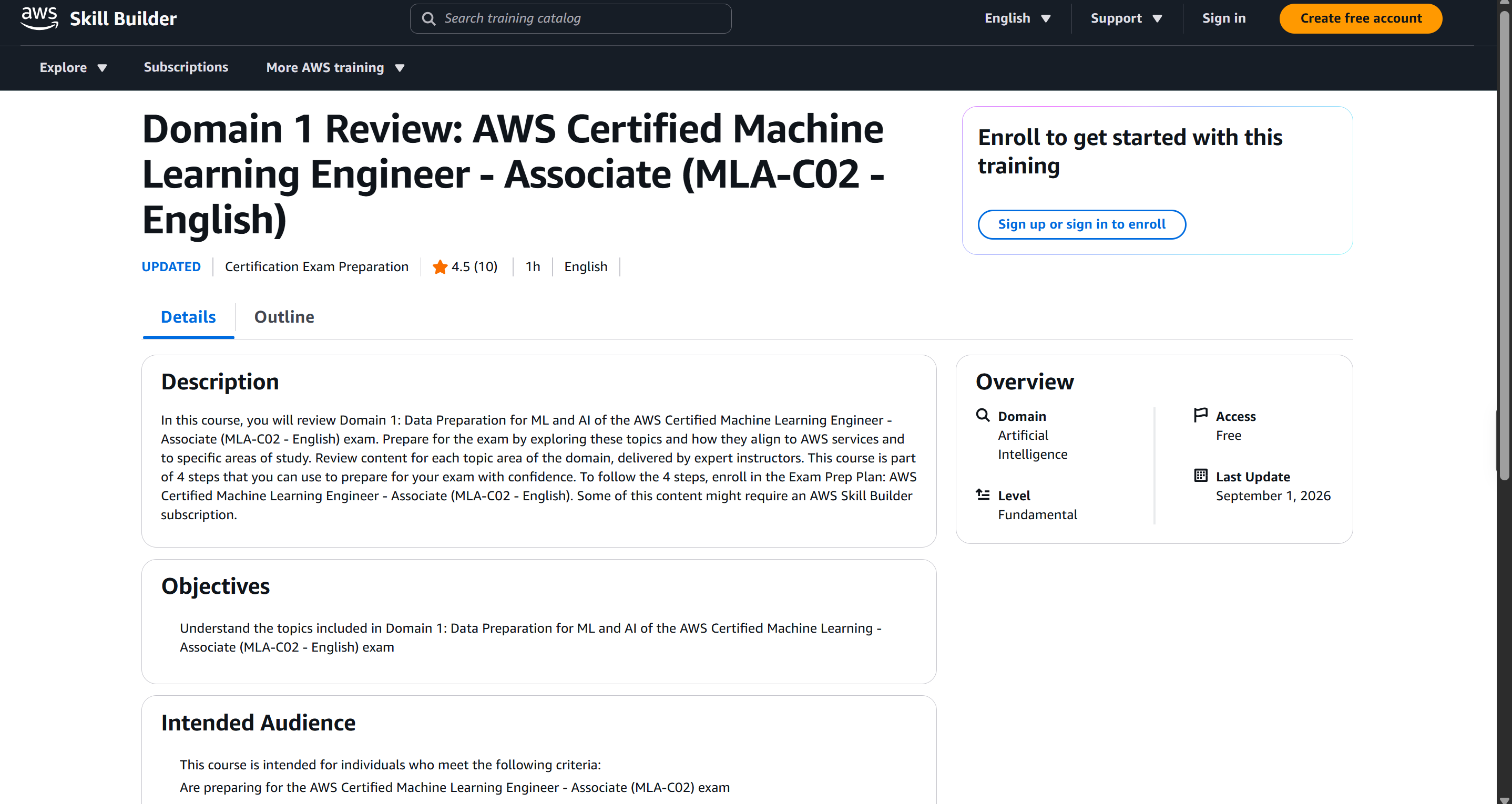
You are in luck, as there are a lot of free resources that you can use to prepare for this exam. Interested IT professionals can enroll in various free and premium digital courses to fill gaps in their knowledge and skills. Our team has compiled a list of recommended courses that you can check out, which we will update regularly.
Free AWS ML Digital Courses
- Digital courses for Machine Learning available in the Tutorials Dojo portal (in collaboration with AWS):
- Courses from the AWS Skill Builder site:
- MLA-C02 Standard Exam Prep Plan – Includes only free resources
Additionally, visit the official AWS Certification page for the AWS Certified Machine Learning Engineer Associate MLA-C02 beta exam. This page provides the most up-to-date information, including the link to schedule your MLA-C02 exam, as well as access to the official Exam Guide.
Validate your knowledge for the MLA-C02 AWS Certified Machine Learning Engineer – Associate Exam
After reviewing AI/ML concepts and gaining hands-on experience with AWS tools and technologies, you should be prepared to take practice exams to assess your understanding and readiness for the actual exam. AWS doesn’t have a sample practice test for free, so you can check out our official MLA-C02 sampler. You can also opt to buy the longer AWS sample practice test at aws.training and use the discount coupon you received from any previously taken certification exams.
But of course, these sample practice tests do not mimic the difficulty of the real Machine Learning Engineer Associate exam. That is why we highly encourage using other mock exams such as our very own and newly released AWS Certified Machine Learning Engineer Associate Practice Exam course which contains high-quality questions with complete explanations on correct and incorrect answers, visual images and diagrams, YouTube videos as needed, and also contains reference links to official AWS documentation as well as our cheat sheets and study guides. Stay tuned, as the AWS Certified Machine Learning Engineer Associate Exam Study Guide eBook will be coming soon!
Sample Practice Exam Question for MLA-C02:
Question 1:
A healthcare company seeks to enhance patient outcome predictions using generative AI applications. The company requires a solution that allows selection from various predictive models, guarantees the confidentiality of private data during model fine-tuning, and eliminates the need for managing the underlying ML infrastructure.
Which AWS service best meets the requirements?
- Amazon Bedrock
- Amazon Rekognition
- Amazon SageMaker Studio
- Amazon Comprehend Medical
Correct Answer: 1
Amazon Bedrock is a fully managed service that offers leading foundation models (FMs) and a set of capabilities to quickly build and scale generative artificial intelligence (generative AI) applications.
Amazon Bedrock provides a serverless environment, simplifying the deployment and management of machine learning models without the need to handle the underlying infrastructure. Bedrock supports customizations of these models, ensuring privacy and security for user data, making it suitable for various applications, including those requiring handling of sensitive information.
Hence, the correct answer is Amazon Bedrock.
The option that says: Amazon SageMaker Studio is incorrect. While this service offers comprehensive tools for machine learning, it’s primarily designed for broad ML tasks rather than focusing specifically on generative AI and foundation models. It requires more hands-on management of the machine learning lifecycle compared to Bedrock.
The option that says: Amazon Comprehend Medical is incorrect because this service is tailored only for extracting medical information from unstructured text using natural language processing. It does not support the creation or management of generative AI models, as it’s focused solely on NLP tasks in the medical field.
The option that says: Amazon Rekognition is incorrect because Amazon Rekognition is simply used for tasks like facial analysis, object detection, and activity recognition. It does not facilitate the building or scaling of foundation models for generative AI applications, making it unsuitable for predictive analytics in healthcare beyond visual data.
References:
https://docs.aws.amazon.com/bedrock/latest/userguide/what-is-bedrock.html

https://aws.amazon.com/bedrock/
Check out this Amazon Bedrock Cheat Sheet:
Question 2:
A Machine Learning Specialist uses Amazon SageMaker Data Wrangler to prepare the training data for a model. The specialist aims to analyze the dataset to understand feature relationships and detect issues. The goal is to visualize correlations and assess their strength to identify patterns and outliers.
Which visualization technique should be used?
- Histogram
- Multicollinearity
- Scatter Plot
- Bias Report
Correct Answer: 3
Amazon SageMaker Data Wrangler offers a visual interface for preparing data for machine learning. It allows users to perform various data analysis tasks, including data visualization. Visualizing relationships between variables and evaluating the strength of these relationships is essential for understanding the dataset and spotting patterns and outliers. A scatter plot is a useful tool for showing the relationship between two continuous variables. By graphing each observation as a point, the scatter plot helps in identifying correlations, trends, and potential outliers in the data. It provides a clear visual representation of how one variable changes in relation to another, making it easier to detect linear and non-linear relationships, as well as clusters and deviations.
In SageMaker Data Wrangler, scatter plots help understand feature relationships for feature engineering and model selection. Strong correlations may indicate redundant variables, while weak correlations may signal the need for additional features or data transformations. Additionally, scatter plots can identify outliers for effective dataset cleaning before model training, leading to more accurate predictive models.
Hence, the correct answer is: Scatter Plot.
The option that says: Histogram is incorrect. This option is only used to visualize the distribution of a single variable rather than relationships between two variables. While histograms are helpful for understanding the distribution and frequency of data points, they do not provide insight into how two variables interact or correlate with each other.
The option that says: Bias Reportis incorrect. As the name suggests, this technique is primarily used to detect bias in machine learning models, not to visualize relationships between variables in the dataset. Bias reports are crucial for ensuring fairness and accuracy in models but do not serve the purpose of visualizing feature correlations.
The option that says: Multicollinearity is incorrect because it’s just a statistical phenomenon in which several independent variables in a model are highly correlated. It is not a visualization technique but rather an issue that needs to be detected and addressed through statistical analysis, often using techniques like variance inflation factor (VIF) or correlation matrices.
References:
Tutorials Dojo’s AWS Machine Learning Cheat Sheets:
https://tutorialsdojo.com/aws-cheat-sheets-aws-machine-learning-and-ai/
Click here for more AWS Certified Machine Learning Engineer Associate MLA-C02 practice exam questions.
Check out our other AWS practice test courses here:

How Will the AWS Certified Machine Learning Engineer Associate MLA-C02 Help My Career?
Based on the recent World Economic Forum Future of Jobs Report in 2023:
- The demand for AI and Machine Learning Specialists is likely to grow by 40% in the next couple of years.
- 70% of IT leaders in North America have expressed difficulty filling AI/ML specialist roles in their respective organizations.
In a related November 2023 research conducted by AWS, companies are willing to pay:
- 43% more for ML-skilled workers in areas of sales and marketing
- 42% more for those in the finance/banking industry
- 41% more for business enterprise operations
- 47% more for the general IT professional salary range
The MLA-C02 certification can really position you for in-demand machine learning jobs, especially for opportunities that require extensive experience in the AWS Cloud.
What other AWS Certifications Should I Earn Next?
- Cloud Careers: AWS Certified Solutions Architect – Associate SAA-C03.
- Data, AI, and ML Careers:
- AWS Certified Data Engineer – Associate DEA-C01
Achieve greater heights for your career with an AWS Certified Machine Learning Engineer Associate MLA-C02 certification!
⚡10% OFF Practice Exam and eBook Bundles
Turn Your Team Into Cloud-Ready Professionals Today

Learn AWS with our PlayCloud Hands-On Labs

$2.99 AWS and Azure Exam Study Guide eBooks
Learn GCP By Doing! Try Our GCP PlayCloud
Learn Azure with our Azure PlayCloud
FREE AI and AWS Digital Courses
FREE AWS, Azure, GCP Practice Test Samplers
Subscribe to our YouTube Channel
Follow Us On Linkedin