
Last updated on June 7, 2026
One of the biggest surprises I encountered while learning AWS was realizing that understanding individual services and understanding cloud architecture are not the same thing. Like many beginners, I started by learning services one at a time. EC2 was a virtual server. S3 was object storage. RDS was a managed database. Load Balancers distributed traffic. Each service had its own purpose, features, and use cases. At first, this approach made sense. Understanding individual services is an important part of building cloud knowledge. In fact, every cloud architecture is built upon these individual components. However, as I continued working through cloud labs and hands-on exercises, I began to realize that knowing what a service does is only one part of the learning process. The next step is understanding how those services work together. This shift in perspective helped me see cloud computing differently. Instead of viewing AWS services as isolated tools, I started seeing them as connected components within larger systems designed to solve real-world problems. Many cloud learners begin by studying AWS services individually. This is completely understandable. AWS itself is organized into hundreds of services, each with its own documentation, features, and learning resources. As beginners, we often focus on questions such as: While these questions are important, focusing only on them can sometimes make it difficult to see how services fit into larger solutions. It is possible to understand the definition of a service without fully understanding how it fits into a complete application. For example, knowing that Amazon EC2 provides virtual servers does not automatically explain how a website handles user traffic, stores files, or manages application data. Learning services individually helps build a strong foundation, and it remains an essential part of cloud learning. However, real-world cloud solutions rarely rely on a single service operating alone. At some point, learners must begin connecting those pieces together to understand how complete systems are designed. Cloud architecture refers to the way different cloud services are organized and connected to deliver a complete solution. In many ways, cloud architecture is less about individual services and more about how those services work together to meet business and technical requirements. While individual services remain important, cloud architecture focuses on how those services interact through relationships, communication, and overall system design. In simple terms, architecture answers questions such as: These questions go beyond individual service definitions. They focus on how services work together to solve a problem. Understanding architecture helps transform cloud knowledge from a collection of concepts into a complete system. This does not reduce the importance of learning individual services. Instead, architecture builds upon that knowledge by showing how each component contributes to a larger solution. One realization that helped me understand cloud architecture was seeing how multiple AWS services combine to support a single application. Consider a simple web application. A user visits a website by entering a domain name. Behind the scenes, several AWS services may work together: Individually, each service has a specific role. Together, they create a complete system capable of serving users, storing data, and handling requests efficiently. Looking at each service individually only tells part of the story. The diagram below illustrates how these services can work together as a complete solution. A simplified example showing how multiple AWS services work together to support a web application. An Application Load Balancer distributes traffic across EC2 instances managed by an Auto Scaling Group, while Amazon RDS provides database storage and Amazon S3 stores files and images used by the application. This is where architecture begins to make sense. The focus shifts from individual services to the flow of information throughout the application. Understanding architecture provides context. Without architecture, cloud services can feel like separate pieces of information that are difficult to connect. With architecture, each service becomes part of a larger picture. Architecture does not replace service-level knowledge. Rather, it provides context. It helps explain not only what a service does, but also why it exists within a solution and how it interacts with other services. This becomes especially important when considering real-world challenges such as: These are not simply service-level decisions. They are architectural decisions. A cloud architect is not only concerned with what a service does. They are also concerned with how services interact, how systems behave under load, and how applications continue operating when problems occur. One of the biggest lessons I learned is that cloud solutions rarely depend on a single service. Most applications combine multiple services to meet different requirements. A static website might use: A traditional web application might use: A serverless application might use: Although these architectures differ, they share one common idea: services work together. Understanding those relationships adds another layer of understanding beyond service definitions. Knowing what a service does remains important but understanding how services work together helps connect those concepts into practical solutions. As I spent more time working with AWS, I noticed that the most useful learning moments came from understanding how services connected rather than simply learning new service names. Labs became easier to follow. Architectures started making more sense. For example, I initially viewed Amazon EC2, Amazon RDS, and Amazon S3 as completely separate services. It was only after working through hands-on exercises that I began seeing them as components of a single application rather than unrelated tools. Services no longer felt random. Instead of asking: “What does this service do?” I started asking: “Why is this service included in the architecture?” That small shift changed how I approached cloud learning. A simplified learning progression showing how many cloud learners move from understanding individual services to designing complete solutions. Each stage builds upon the previous one, gradually expanding technical knowledge into architectural thinking. It encouraged me to think about systems, workflows, and solutions rather than individual tools. This does not mean that learning individual services became less important. Instead, understanding architecture gave those services more meaning by helping me see how they contributed to a complete solution. For beginners starting their cloud journey, understanding architecture does not require mastering every AWS service. In fact, it can be helpful to focus on common architectural patterns before diving into advanced services. Some examples include: Drawing simple diagrams can also be valuable. Even basic diagrams help visualize how users, applications, databases, and storage services interact with one another. Another helpful approach is asking a simple question whenever learning a new service: “What problem does this service solve within a larger system?” This encourages architectural thinking rather than memorization. At the same time, continue building your understanding of individual services. The stronger your foundation is, the easier it becomes to understand more complex architectures later on. Learning individual AWS services is an important first step in cloud computing. While services such as EC2, S3, and RDS are powerful on their own, their true value becomes clearer when viewed as parts of a complete solution. For many cloud learners, the journey begins by learning service names, features, and use cases. That foundation remains important because cloud architecture is ultimately built from individual services. Over time, however, that foundation expands into understanding how those services work together to solve real-world problems. The shift from learning services to understanding architecture is not about replacing one with the other. Rather, it is about building upon existing knowledge and seeing the bigger picture. Together, both perspectives help transform cloud learners from memorizing services to understanding how complete solutions are built. In many ways, that shift may be one of the most valuable milestones in any cloud learning journey. What is Cloud Computing? – Cloud Computing Services, Benefits, and Types – AWS Reference Architecture Examples and Best Practices AWS Well-Architected Framework – AWS Well-Architected Framework Overview of Amazon Web Services – Overview of Amazon Web Services AWS Architecture Explained: Components, Diagrams, and Best Practices
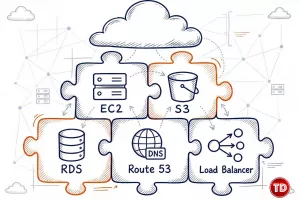
The Foundation: Learning Individual AWS Services
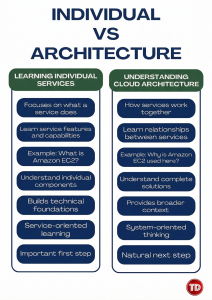
What Is Cloud Architecture?

From Individual Services to a Complete System
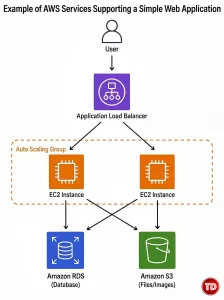
Why Architecture Matters
Real-World Applications Rarely Use One Service
The Shift in Mindset

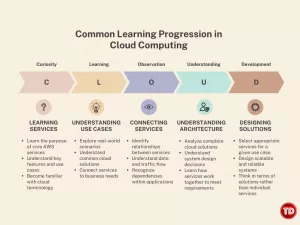
How Beginners Can Learn Architecture Earlier
Seeing the Bigger Picture
References
🤖 $3.74 ONLY for Claude eBooks and Get 25% OFF All Claude Reviewers

Turn Your Team Into Cloud-Ready Professionals Today

Learn AWS with our PlayCloud Hands-On Labs

$2.99 AWS and Azure Exam Study Guide eBooks

Learn GCP By Doing! Try Our GCP PlayCloud

Learn Azure with our Azure PlayCloud

FREE AI and AWS Digital Courses

FREE AWS, Azure, GCP Practice Test Samplers


Subscribe to our YouTube Channel

Follow Us On Linkedin


Written by: Rhome Louie Saringayat