
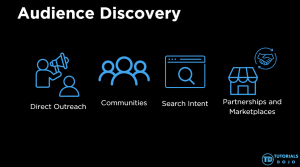
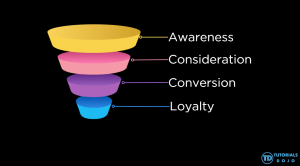
App marketing begins once your product is live and people can try it. This guide is for solo developers, startup teams, and career-changers who have launched an app but need a practical way to find the right users, measure what they do, and turn feedback into steady growth. Shipping proves that your release is available in production. But it does not prove that people know about it, understand its value, or trust it enough to use your new creation. Those are distribution problems, and they require the same deliberate work as product design and development. Distribution is the process of helping a specific audience you discover, evaluate, and adopt your solution. Oftentimes, this begins with identifying your audience, knowing them well enough that you can easily connect with them. A small initial audience is useful when it represents the market and the use case your product wants to serve. Friends can test whether buttons work, but they may not face the problem it was built to solve. Ten people who experience that problem every week can teach you more than hundreds of casual visitors. Marketing may feel uncomfortable if your background is technical, this is especially true to single founders who envisioned, builds and deployed their applications but it does not require a new personality. The goal is to become useful and credible in one place where potential users already spend time. Before diving head first on marketing let’s define some terms first. Because depending on what you pivot into, your marketing strategy shall be different. Remember that Business-to-business, or B2B, products are sold to organizations, while business-to-consumer, or B2C, products are sold to individuals. A B2B user may need approval from a manager, security team, or procurement officer. A B2C user usually decides alone, but may leave quickly when the benefit is unclear. Choose one narrow group before planning content or advertising. Hopefully you figured this out while planning your app first. Then, start with one channel that fits how that audience looks for solutions. Run you can run each of these for quite sometime, it can be as short as 2 weeks up to a month. Then compare the effort with qualified visits, conversations, activations, and paying users. If it bumped the numbers, continue with that channel signals improve. Otherwise, change the message or channel. Since there’s no one size fits all approach in marketing, continuous experiment and a bit of luck can go a long way. A marketing funnel is the sequence from first contact to continued use. Essentially, it’s a journey that should be engineered in multiple steps in order to gain and build sustainable flow of audience and revenue. A simple version can include stages dedicated to building awareness, visit, signup, activation, and retention. Activation is the first moment a user receives the intended value. For a budgeting app, it may be creating the first budget and categorizing a transaction. For a team tool, it may be inviting a colleague and completing a shared task. Remember that a signup is not activation because an account can exist without the user utilizing it to solve the problem. You can use Google Analytics 4, or GA4, to record events that are meaningful interaction, such as completing onboarding or creating a project. This allows you to have transparent view on where the user gets stuck and what part of the journey works for them. Tutorials Dojo’s guide to migrating to Google Analytics 4 explains its event model and reporting features, while Google’s recommended events documentation lists common actions you can measure. (Tutorials Dojo) Track a small set of numbers that support decisions. I recommend four starting metrics: Use your first month as a baseline, analytics can also create a privacy risk when it captures data that is not needed. For example, adding a user’s email address to an event may expose personal information to anyone with analytics access; the Open Worldwide Application Security Project (OWASP) advises apps to explain what data they collect and why. Collect the minimum data required, restrict access, and document what is sent. (OWASP Mobile Application Security) Post-launch work should not split into “building” and “marketing” as if they are unrelated. Marketing reveals objections, missing use cases, and unclear language; product work turns that evidence into a better experience. Use a sustainable cadence. Review the funnel at the start of the week, schedule a few user conversations, choose one marketing experiment, and ship one improvement tied to what you learned. A small team that repeats this cycle can build evidence without exhausting itself. New channels and tools will keep appearing, but novelty is not a strategy. Before adopting one, ask whether the target audience uses it, which measurable outcome it could improve, and what current work must stop to make room. Fast execution matters only when the team is moving toward a defined user problem. The first month should produce evidence, not instant scale. Use it to find one audience, one message, and one repeatable path from discovery to value. At the end of 30 days, write down what changed your mind. That record prevents the team from repeating failed experiments and makes future decisions easier to explain. It also turns marketing from a vague obligation into a learning process that can be improved. Do not aim to reach everyone next. Aim to make the service indispensable to a small, well-defined group, then expand from evidence rather than hope. Growth becomes more reliable when each new channel builds on a message, onboarding path, and user outcome that already work.
Treat launch as the start of distribution
Choose one audience and one channel first

Build a funnel you can measure
Keep product and marketing in one weekly rhythm
Your first 30 days after launch

References
🤖 $3.74 ONLY for Claude eBooks and Get 25% OFF All Claude Reviewers
Turn Your Team Into Cloud-Ready Professionals Today

Learn AWS with our PlayCloud Hands-On Labs
$2.99 AWS and Azure Exam Study Guide eBooks

Learn GCP By Doing! Try Our GCP PlayCloud
Learn Azure with our Azure PlayCloud
FREE AI and AWS Digital Courses

FREE AWS, Azure, GCP Practice Test Samplers

Subscribe to our YouTube Channel

Follow Us On Linkedin
Written by: Vince Austria