
If you have ever opened a machine learning tutorial and felt like you were reading a math and statistics textbook, you are not alone. I spent months telling myself I would “get into AI eventually”, until I finally arrived at my breakthrough. This is not a textbook breakdown of deep learning theory, but rather a practical journey. This is the honest account of a computer science student learning Machine Learning with PyTorch for the first time and trying to make sense of it all.
What Is Machine Learning?
Before writing a single line of code, I had to understand what I was actually trying to do. Machine learning, at its core, is teaching a computer to learn from examples rather than following a set of explicitly written rules. Consider how you learned to recognize a dog. Nobody formally taught you every characteristic that makes a dog a dog. Instead, you saw enough dogs and enough things that were not dogs, such as cats, computers, or food, that your brain gradually learned to recognize the pattern. Machine learning models work in much the same way. Feed them enough data, and they learn to identify patterns on their own as you dive into Machine Learning with PyTorch.
Why PyTorch?
There are several frameworks available for building advanced data architectures. PyTorch is among the most widely used, particularly in research and by developers who want to understand what is actually happening inside their models, not just get results. What makes it approachable is that PyTorch feels like writing ordinary Python code. There is no heavy abstraction hiding what is going on beneath the surface. You build things step by step, and the logic behind each part becomes clear as you go.
The Four Core Components
Almost everything in machine learning comes down to four ideas. Once these made sense, the rest of the field became much easier to follow:
- Tensors
-
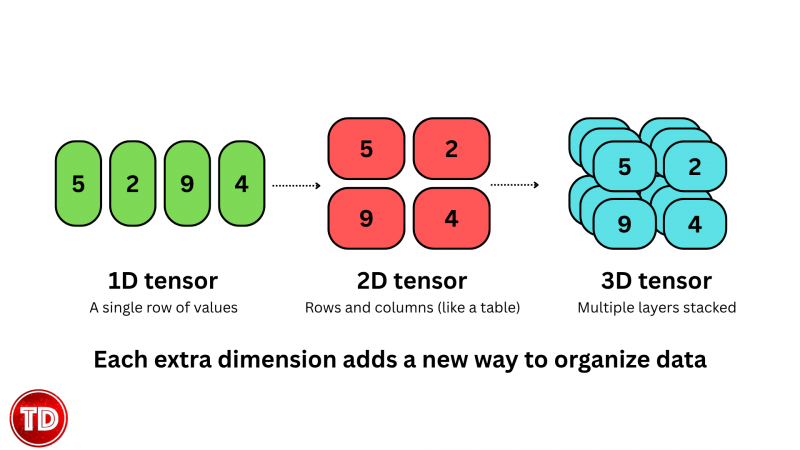
- The fundamental unit of data in PyTorch.
- Think of them as multi-dimensional containers for numbers, like a spreadsheet, but with more dimensions.
- Every piece of data your model touches, such as images, text, and sensor readings, gets turned into a tensor first.
- Models

-
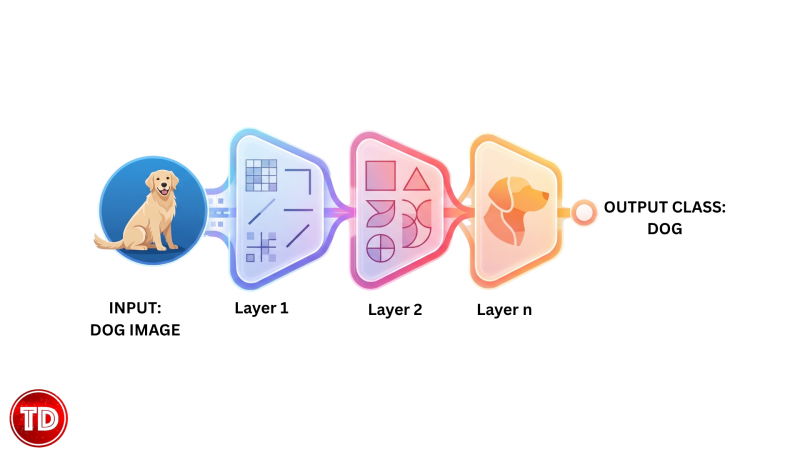
- A model is the structure that learns.
- It takes in data, processes it through a series of layers, and produces an output.
- You define the architecture. The model learns the weights through training.
- Loss
-
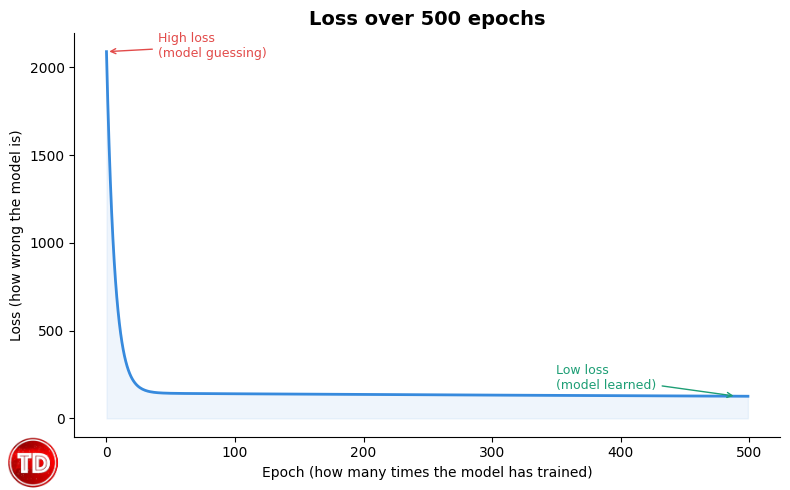
- Loss measures how wrong the model is at any given point.
- It compares the model’s prediction against the correct answer.
- The lower the loss, the better the model is performing.
- Training Loop
-
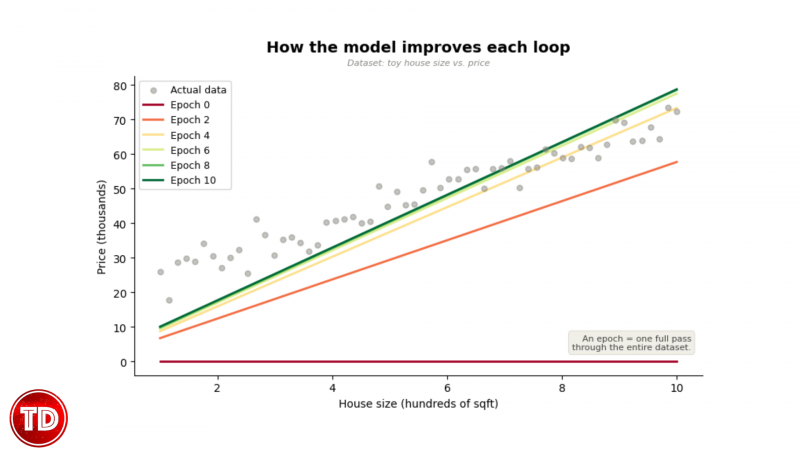
- The training loop is the core cycle of machine learning.
- The model sees data, makes a prediction, measures its error, adjusts, and repeats.
- This cycle runs thousands of times until the model improves to an acceptable level.
What Intrigued Me Along the Way
- It Is More Experimental Than Traditional Programming
- Unlike regular software, where there is a single correct solution, machine learning is about iterating and testing.
- You adjust parameters, compare results, and refine your approach. Constantly.
- The mindset shift from “write the right code” to “find what works” took some getting used to.
- Embracing this trial-and-error methodology is essential for anyone learning Machine Learning with PyTorch.
- Visualization Is Not Optional
- Plotting your data and charting your loss curves reveals problems that numbers alone would hide.
- Seeing what your model actually outputs at each stage builds intuition faster than reading ever could.
- It is one of the most underrated habits a beginner can develop early.
- You Do Not Need a Powerful Machine to Start
- Google Colab provides free cloud-based computing resources accessible from any browser.
- No expensive GPU required. You can run real PyTorch experiments from a basic laptop.
- This removes what I assumed was the biggest barrier to getting started.
So, Why Start Now?
Machine learning is not a skill reserved for researchers or specialists anymore. As AI becomes embedded into more products, pipelines, and platforms, developers who understand how models actually work, and not just how to call an API, will have an advantage. These tools helped me develop an intuitive understanding of how machines learn, making it easier to grasp and apply new AI concepts as I encounter them.
If you have been putting this off the same way I did, the best time to start is now. Confusion is part of the process, not a sign you are doing it wrong. Every expert developer started exactly where you are sitting today, so check out the starter courses on the Tutorials Dojo Homepage, pick a simple guide, type out the code yourself, and take that very first step!
References
🤖 $3.74 ONLY for Claude eBooks and Get 25% OFF All Claude Reviewers

Turn Your Team Into Cloud-Ready Professionals Today

Learn AWS with our PlayCloud Hands-On Labs

$2.99 AWS and Azure Exam Study Guide eBooks

Learn GCP By Doing! Try Our GCP PlayCloud
Learn Azure with our Azure PlayCloud
FREE AI and AWS Digital Courses

FREE AWS, Azure, GCP Practice Test Samplers


Subscribe to our YouTube Channel

Follow Us On Linkedin


Written by: Roljohn Frilles