
Last updated on February 10, 2026
The “Blue Link” era is officially fading. In 2026, the digital landscape has reached a tipping point: Gartner predicts a 25% drop in traditional search volume as users migrate to AI-driven “answer engines.” For modern brands, ranking #1 on a search results page is no longer the finish line. The new goal? To be the cited source inside the AI’s answer. This shift has birthed a new discipline: Generative Engine Optimization (GEO). Traditional SEO was built on the logic of crawlers, keywords, and the pursuit of clicks. GEO, however, is built on the logic of Large Language Models (LLMs), entity authority, and citation frequency. To ensure your brand’s insights are the ones AI models recommend, you must move away from “writing for humans” or “writing for bots” and start writing for synthesis. Here are the three pillars of the 2026 GEO playbook: AI engines like Perplexity, SearchGPT, and Gemini search for “passage-level” relevance. They don’t digest your entire 2,000-word blog post; they scan for the most concise, accurate 50-word answer to a specific user query. The Strategy: Implement “TL;DR” summaries at the top of every major section. The Format: Use H2 and H3 headers phrased as specific questions (e.g., “How does AI impact video editing costs?”), followed immediately by a direct, factual answer. LLMs are increasingly trained to ignore “fluff.” Generic marketing speak—like “our high-quality service”—is treated as noise. AI models prioritize content rich in specific data and verifiable facts. The Strategy: Integrate original research, survey data, and proprietary case study metrics into every piece of content. The Format: Use tables and bulleted lists. Structured data is significantly easier for AI models to parse, summarize, and cite than long paragraphs of prose. In 2026, AI models are “misinformation-shy.” To avoid hallucinations, they prioritize content from verified entities with a proven track record of experience, expertise, authoritativeness, and trustworthiness. The Strategy: Update the “About Us” and author bio pages with clear credentials, certifications, and links to third-party mentions. The Format: Use Schema Markup (JSON-LD) to explicitly define for the AI who the author is, what their specific expertise is, and how your brand is connected to the topic. If users are getting their answers directly from an AI interface without clicking through to your site, traditional metrics like “Organic Sessions” lose their shine. In 2026, marketers must shift their KPIs to: Citation Share: What percentage of time is your brand mentioned in AI summaries compared to your competitors? Sentiment Score: How does the AI describe your brand? Is it labeled as the “most affordable option” or the “industry leader”? Referral Traffic from AI: Tracking visitors who arrive via “Source Cards” or “Read More” citations within tools like Perplexity or Gemini. GEO isn’t about gaming a new system; it’s about being the most helpful, factual, and authoritative source on the internet. By restructuring your content to be “machine readable” and “human trustable,” you ensure your brand remains visible in the age of conversational search. The future of search isn’t a list of results—it’s a conversation. Make sure your brand is invited to the table.
SEO vs. GEO: Understanding the Paradigm Shift
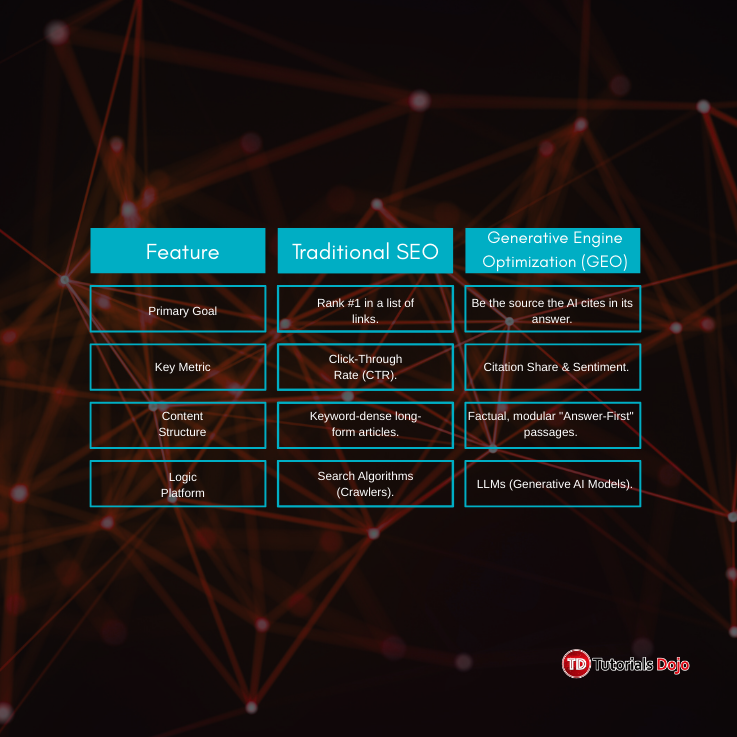
The 3 Pillars of a Successful GEO Strategy
1. The “Answer-First” Content Architecture

2. Boosting Your “Fact Density”
3. Entity-Based E-E-A-T
How to Measure Success in a “Zero-Click” World
Conclusion: Getting Your Brand in the “AI Brain”
References
🌸 25% OFF All Reviewers on our International Women’s Month Sale! Save 10% OFF All Subscriptions Plans & 5% OFF Store Credits/Gift Cards!

Learn AWS with our PlayCloud Hands-On Labs

$2.99 AWS and Azure Exam Study Guide eBooks

New AWS Generative AI Developer Professional Course AIP-C01

Learn GCP By Doing! Try Our GCP PlayCloud
Learn Azure with our Azure PlayCloud

FREE AI and AWS Digital Courses

FREE AWS, Azure, GCP Practice Test Samplers


Subscribe to our YouTube Channel

Follow Us On Linkedin


Written by: Daniel Gerodias