
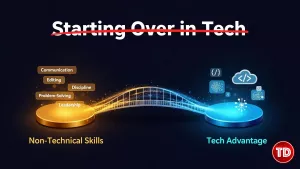
When people talk about entering the tech field, one idea often comes up: that starting over in tech means you have to start from zero. For many students and beginners, this belief can feel intimidating. It creates the impression that only those with a strong technical background can succeed, while others must completely reset and rebuild from scratch. But in reality, that’s not entirely true. Entering tech is not about starting over. It’s about reframing and applying what you already know in a different context. The idea of starting over in tech can feel overwhelming at first, especially when it seems like everything has to be learned from scratch. The idea of starting from zero suggests that previous experiences—whether in writing, content creation, leadership, or other fields—have little to no relevance in technology. However, technology is not just about writing code. It is a field built on: These are skills that are rarely developed in isolation and often come from experiences outside of tech. One of the most common assumptions when entering tech is the belief that everything must be learned from scratch. Many beginners feel that without prior coding experience or a strong technical background, they are already at a disadvantage. This often leads to unnecessary pressure and self-doubt early in the learning process. However, this mindset overlooks an important reality: many foundational skills used in technology are not exclusive to tech itself. They are developed through various experiences and can be adapted over time. Recognizing this early can make the transition into tech less intimidating and more manageable. But starting over in tech doesn’t mean you’re starting without experience. Many skills that seem unrelated at first glance actually have strong applications in technical environments. At this point, it becomes clear that starting over in tech is not about abandoning your past skills, but about applying them differently. In fields like writing or research, individuals learn how to filter large amounts of information and present only what is relevant. In tech, this translates to: The ability to determine what matters—and what doesn’t—is critical in both areas. Editing involves identifying inconsistencies, improving clarity, and refining content. Similarly, debugging requires: Both processes rely on attention to detail and structured thinking. Clear communication is often underestimated in technical roles. Yet in real-world environments, it is essential for: The ability to translate complex ideas into understandable language is a valuable advantage. Whether developed through academics, sports, or other structured environments, discipline plays a crucial role in tech. Learning new technologies such as cloud platforms, programming languages, or data tools requires: Progress in tech is rarely instant; it is built through repeated effort. Technology is often seen as purely logical, but creative thinking is equally important. It enables: Creativity allows individuals to go beyond standard solutions and build more effective ones. A common concern among beginners is the feeling of being “behind” compared to others with prior technical experience. However, this perspective overlooks an important point: Different backgrounds create different, often overlooked strengths. Individuals coming from non-technical fields often bring: These differences can become advantages in a field as diverse as technology. The transition into tech is not only about learning new tools—it is also about changing how previous experiences are viewed. Instead of thinking: “My background is not relevant to tech.” A more accurate perspective is: “My background provides a foundation that I can build on.” This shift reduces the pressure of “starting over” and allows learning to become more natural and sustainable. Technology does not require you to abandon your past experiences. Instead, it allows you to integrate them into new applications. Whether your background is in: the skills you developed remain relevant, they simply take on new forms. As more learners begin exploring areas such as cloud computing, data, and software development, this perspective becomes even more relevant. These fields may introduce new tools and concepts, but the underlying skills—analysis, communication, and problem-solving—persist. Entering the tech field is often seen as a complete reset. But in practice, it is more accurate to view it as an extension of what you already know. You are not starting from zero. You are starting from experience. In the end, starting over in tech is less about beginning from zero and more about building on what you already have. The goal isn’t to erase your past—it’s to build on top of it and move forward with everything you’ve already developed. Transferable Skills: 10 Skills That Work Across Industries | Indeed.com What Having a “Growth Mindset” Actually Means Workplace Communication: What Is It & Why Is It Important? | Coursera
The Misconception of “Starting from Zero”
Why Starting Over in Tech Isn’t Really Starting From Zero
Transitioning into Tech: Using Your Existing Skills
Information Filtering → System Design

Editing and Refinement → Debugging and Optimization
Communication → Documentation and Collaboration
Discipline → Consistency in Learning
Creativity → Problem Solving
Starting Over in Tech Doesn’t Mean You’re Behind
The Real Shift Is in Perspective
Building on What You Already Have
Final Thoughts
References:
🐰 25% OFF Easter Sale! Use code TDPLAYCLOUD-04022026 for 10% OFF ALL PlayClouds Subscription & 5% OFF gift cards!

Learn AWS with our PlayCloud Hands-On Labs

$2.99 AWS and Azure Exam Study Guide eBooks

New AWS Generative AI Developer Professional Course AIP-C01

Learn GCP By Doing! Try Our GCP PlayCloud

Learn Azure with our Azure PlayCloud

FREE AI and AWS Digital Courses

FREE AWS, Azure, GCP Practice Test Samplers


Subscribe to our YouTube Channel

Follow Us On Linkedin


Written by: Rhome Louie Saringayat