
Claude Skills Cheat Sheet
Claude Skills package reusable instructions and optional resources or scripts for a task. Use a skill to teach Claude a repeatable workflow, such as turning weekly updates into a report with a consistent structure.
What Are Claude Skills?
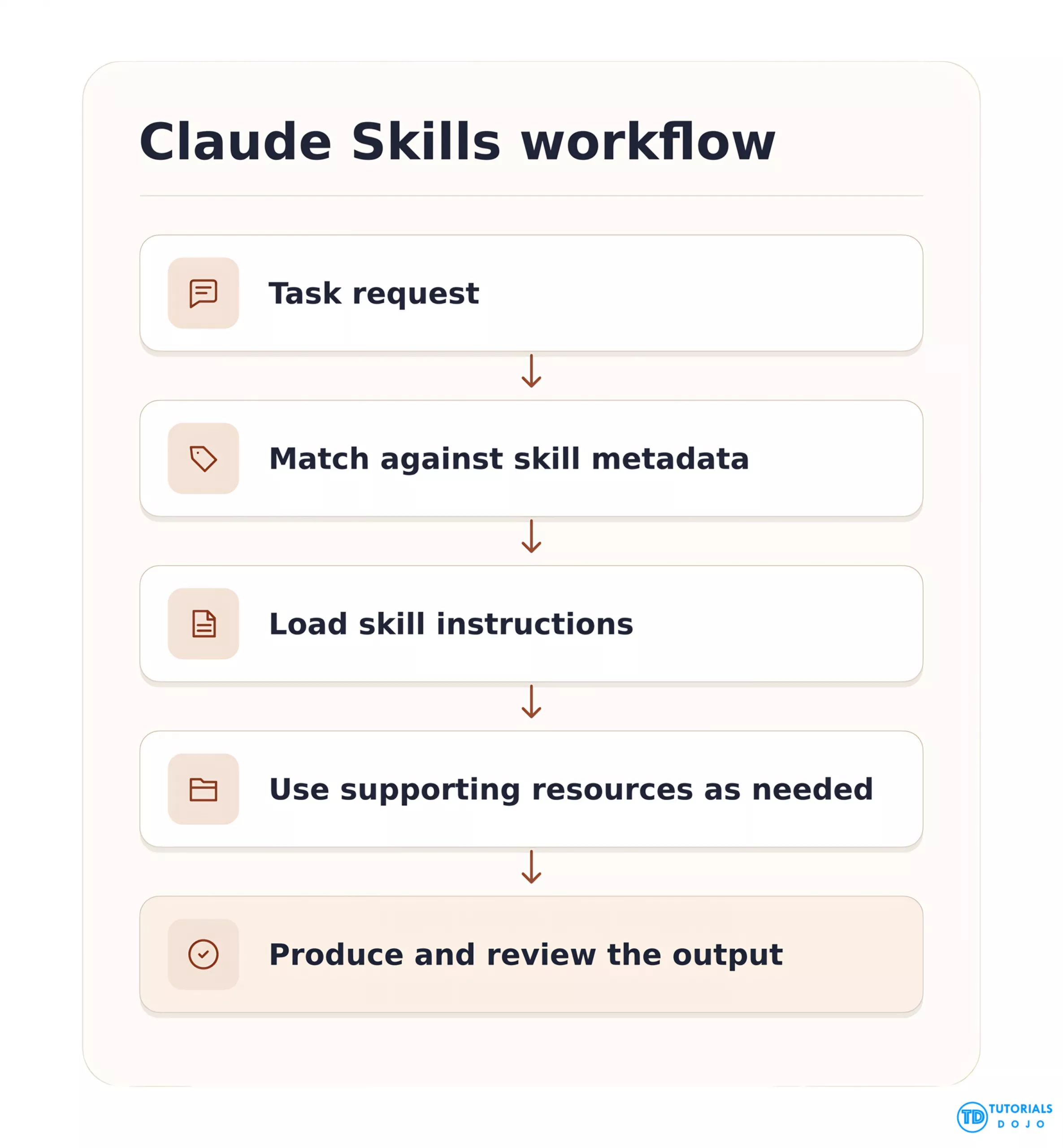
Claude uses progressive disclosure. It considers a skill’s metadata when deciding whether the skill applies, then loads the instructions and supporting resources as needed. Anthropic documents skills in Claude with code execution enabled, in Claude Code, and in the API in beta with its code execution tool. Setup varies by surface.
The Core Concept
-
You provide the task rules, examples, templates, and output checks.
-
Claude uses the relevant skill to guide the task.
-
You review whether Claude followed the workflow and produced the expected result.
Architecture Overview
Key Components & Features
| Component | What it does |
|---|---|
| Skill folder | Packages the instructions and supporting files as one unit. |
SKILL.md |
Defines the skill’s name, description, and workflow. The description tells Claude when to use it. |
| Resources | Provide templates, examples, or reference material the instructions can point to. |
| Scripts | Optionally perform deterministic steps such as checking an output’s structure, when execution is available. |
| Directory and custom upload | Discover existing skills in Claude’s directory or upload a custom skill ZIP where supported. |
Primary Use Cases
-
Standardize headings, source attribution, and how missing figures are shown.
-
Use an approved voice guide and examples for draft announcements.
-
Apply a repeatable review checklist before handing off an artifact.

Key Benefits & Value Proposition
-
Keep rules and examples in one reusable package.
-
Define stable instructions once and supply changing inputs with each request.
-
Update the template or instructions when the workflow changes.
Deployment Process & Timeline
| Phase | Activities | Estimated duration |
|---|---|---|
| Define | Pick one recurring task and describe its inputs and expected output. | Depends on workflow scope. |
| Package | Create the skill folder and instruction file. Add only the resources it needs. | Depends on existing templates. |
| Install | For custom upload in Claude, ZIP the skill folder as the archive’s top-level folder and enable the skill in Customize → Skills. Follow the separate instructions for Claude Code or API use. | Depends on access and workspace settings. |
| Validate | Test relevant and unrelated prompts. Correct instructions or metadata if it activates at the wrong time or misses expected checks. | Depends on the test cases. |
Ideal Customer Profile
Teams with recurring deliverables, existing templates, or quality standards they want Claude to apply consistently.
Key Considerations & Planning Factors
-
Access
-
Confirm that your Claude surface supports skills and that required features, including code execution where applicable, are enabled.
-
-
Permissions
-
A skill can specify which sources to use. Access to those sources comes from the user, the environment, or a configured connector.
-
-
Trust
-
Review third-party instructions and scripts before enabling them. Keep credentials out of skill files.
-
-
Maintenance
-
Assign an owner and retest after changes to templates, data sources, or output requirements.
-
Claude Skills vs. Adjacent Features
| Factor | Skill | Connector | Plugin |
|---|---|---|---|
| Main purpose | Teach a reusable workflow. | Provide access to an external tool or data source. | Package extensions for a supported Claude surface. |
| Weekly report example | Defines sections and how to cite sources. | Retrieves project updates from an authorized service. | Can bundle related capabilities for distribution. |
Conclusion
Use a skill when the same procedure or quality criteria should apply across tasks. A connected service can supply the changing inputs while the skill defines how to use them.
Claude Skills Cheat Sheet References:
https://support.claude.com/en/articles/12512176-what-are-skills
https://support.claude.com/en/articles/12512198-how-to-create-custom-skills
🛍️ $0.99 eBooks Are Here and Save Up to 75% on All Practice Exams & Video Courses

Turn Your Team Into Cloud-Ready Professionals Today

Learn AWS with our PlayCloud Hands-On Labs
50% OFF ON OUR YEARLY PLAN

Learn GCP By Doing! Try Our GCP PlayCloud

Learn Azure with our Azure PlayCloud
FREE AI and AWS Digital Courses

FREE AWS, Azure, GCP Practice Test Samplers

Subscribe to our YouTube Channel

Follow Us On Linkedin

Written by: Ace Kenneth Batacandulo